2 Best Open-Source Alternatives to Forgejo in 2026
By Noahlast updated pricing verified
Compared: open-source alternatives to Forgejo
| Alternative | Best for | Standout | Biggest weakness | Learning curve | Price |
|---|---|---|---|---|---|
| Forgejoreference | developers and organizations that want a GitHub-style forge on self-hosted infrastructure, governed by a community rather than a company | Runs with dramatically lower CPU and memory requirements than GitLab, making it practical to self-host on a small VPS or single-board computer while still offering pull requests, issues, and GitHub Actions-compatible CI. | Self-hosting is entirely on the user: there is no official managed cloud offering, so teams must handle their own updates, backups, and scaling, and the project deliberately has no official GitHub mirror, which can surprise developers used to finding a project's canonical repo there. | Moderate | Free |
| Gitea | teams that want to self-host Git repository hosting, CI/CD, and package management with unlimited free users, upgrading to Enterprise only for SSO and compliance features | The open-source edition is genuinely free with unlimited users and repositories and no artificial seat caps, unlike many self-hosted Git platforms that gate user limits behind a paid tier. | Gitea Enterprise requires a mandatory 1-year commitment paid online rather than flexible monthly billing, and Gitea Cloud's actual subscription price is not published anywhere on the pricing page, requiring signup just to see a number. | Moderate | Free tier · paid from $9.50/mo |
| GitLab | engineering teams that want source control, CI/CD, and security scanning in one application instead of assembling separate tools for each function | Security and compliance scanning (SAST, DAST, dependency and container scanning) is built into the Ultimate tier as a native part of the CI/CD pipeline, rather than a bolt-on third-party integration. | The jump from Premium to Ultimate is steep (roughly $29 to $99/user/month), pricing the deepest security features out of reach for many teams, and GitLab's dense, feature-heavy interface has a real learning curve compared to GitHub's simpler workflow. | Steep | Free tier · paid from $29/mo |
 Forgejo
 Gitea
Gitea GitLab
1.Gitea — best Forgejo alternative for teams that want to self-host Git repository hosting, CI/CD, and package management with unlimited free users, upgrading to Enterprise only for SSO and compliance features
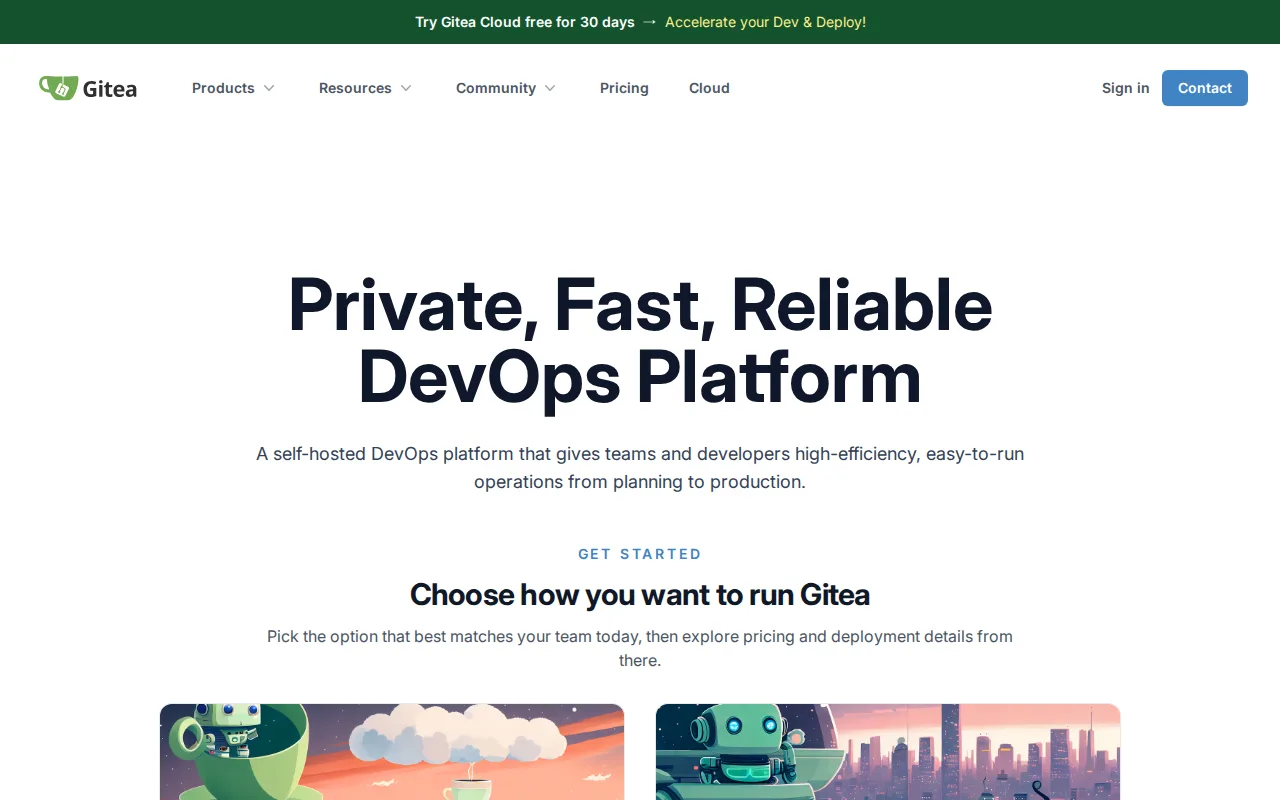
Gitea is the best Forgejo alternative for teams that want essentially the same self-hosted, lightweight Git forge experience but with the option to upgrade to a paid Enterprise tier or fully managed cloud hosting later. Gitea holds a 5/5 rating from 9 Product Hunt reviews, external validation Forgejo's own listing doesn't have at all. Like Forgejo, Gitea's open-source core is free with unlimited users and repositories and runs as a lightweight Go binary practical on small VPS instances, since both projects share Gitea as their common ancestor. Where Gitea diverges is Gitea Enterprise, a self-hosted paid tier at $9.50-$19/user/month that adds SAML SSO, audit logs, and Kubernetes autoscaling runners, none of which Forgejo's free-only project offers, plus Gitea Cloud, a fully managed hosted option with a 30-day free trial that Forgejo doesn't sell at all. Gitea also supports more than 20 package registry formats (npm, PyPI, Maven, Cargo) built in. Forgejo remains the better choice for buyers who specifically want community governance guaranteed against being acquired or relicensed: Forgejo was forked from Gitea in 2022 over exactly this governance disagreement, and Gitea Enterprise's required 1-year online-payment commitment is a corporate-style constraint Forgejo's fully free, no-tier model doesn't impose.
Compared to Forgejo: 5/5 rating from 9 Product Hunt reviews vs Forgejo's none on file, optional Gitea Enterprise ($9.50-$19/user/month) with SSO and audit logs vs Forgejo's free-only single tier, Gitea Cloud managed hosting vs no managed offering from Forgejo
Wins:5/5 rating from 9 Product Hunt reviews, evidence Forgejo has none of on file · Gitea Enterprise ($9.50-$19/user/month) adds SAML SSO, audit logs, and Kubernetes autoscaling runners that Forgejo's free-only project doesn't offer · Gitea Cloud gives a fully managed hosted option with a 30-day free trial, while Forgejo has no official managed hosting at all
Loses:Was forked away from by Forgejo in 2022 specifically because Forgejo's community wanted governance guarantees Gitea's corporate structure didn't provide · Gitea Enterprise requires a mandatory 1-year commitment with online payment rather than Forgejo's fully free, no-commitment model · Gitea Cloud's actual subscription price is not published anywhere on the pricing page, unlike Forgejo's fully transparent $0 self-hosted cost
Pros
- Open-source core is free with unlimited users and repositories, no artificial caps.
- Lightweight Go binary runs comfortably on small servers, unlike heavier self-hosted alternatives.
- Gitea Actions is compatible with existing GitHub Actions workflow syntax, easing migration.
- Supports 20+ package registry formats (npm, PyPI, Maven, Cargo, and more) built in.
Cons
- Gitea Enterprise requires a 1-year commitment with online payment rather than flexible monthly billing.
- Gitea Cloud pricing is not published on the site; the number is only revealed after starting the signup flow.
- Smaller third-party integration and marketplace ecosystem than GitHub or GitLab.
- Self-hosted deployments still require the team to manage updates, backups, and uptime themselves on the free tier.
Pricing: Free tier · paid from $9.50/mo — Gitea's open-source core is free like Forgejo, but Gitea Enterprise adds a paid $9.50-$19/user/month self-hosted tier and unpriced Gitea Cloud option that Forgejo doesn't sell at all (verified undefined NaN, NaN)
2.GitLab — best Forgejo alternative for engineering teams that want source control, CI/CD, and security scanning in one application instead of assembling separate tools for each function

GitLab is the best Forgejo alternative for engineering teams that want source control, CI/CD, and security scanning bundled into one application rather than assembling separate tools around a lighter forge. GitLab holds a 4.6/5 rating from 1,224 Capterra reviews plus a 5/5 rating from 13 Product Hunt reviews, external validation Forgejo's own listing doesn't have at all. Like Forgejo, GitLab Community Edition is open source (MIT-licensed) and free to self-host with no user cap, so teams that specifically value Forgejo's open-source self-hostability can get the same property from GitLab CE. Where GitLab goes further is its Ultimate tier at $99/user/month, which layers static and dynamic security scanning, dependency and container scanning, and compliance tooling natively into the CI/CD pipeline, capabilities entirely outside Forgejo's own feature set. Forgejo remains the better choice for teams that specifically want to run on far less CPU and memory: Forgejo is built to be lightweight enough for a small VPS or Raspberry Pi, while GitLab's self-managed instances can be resource-intensive to run and upgrade, and the jump from GitLab's Premium tier ($29/user/month) to Ultimate ($99/user/month) is a steep price increase that a purely self-hosted, free Forgejo instance avoids entirely.
Compared to Forgejo: 4.6/5 rating from 1,224 Capterra reviews vs Forgejo's none on file, Ultimate-tier security scanning ($99/user/month) vs no equivalent in Forgejo's feature set, MIT-licensed free-to-self-host Community Edition matching Forgejo's own open-source model
Wins:4.6/5 rating from 1,224 Capterra reviews and 5/5 from 13 Product Hunt reviews, evidence Forgejo has none of on file · Ultimate tier ($99/user/month) bundles native SAST, DAST, dependency, and container security scanning that Forgejo's feature set doesn't include at all · CI/CD, issue tracking, and code review are all native to one application, versus Forgejo's leaner, more minimal built-in tooling
Loses:Self-managed instances can be resource-intensive to run and upgrade, unlike Forgejo's deliberately lightweight footprint practical on a small VPS or Raspberry Pi · Premium ($29/user/month) to Ultimate ($99/user/month) is a steep price jump that a fully free Forgejo instance avoids entirely · Denser, feature-heavy interface creates a steeper learning curve than Forgejo's simpler, GitHub-style workflow
Pros
- CI/CD, issue tracking, and code review are native to the platform rather than third-party add-ons.
- Community Edition is genuinely open source (MIT) and free to self-host with no artificial user cap.
- Ultimate tier includes built-in security scanning (SAST, DAST, dependency scanning) as part of the pipeline.
- Self-managed and SaaS deployment options give teams a real choice on data residency and control.
Cons
- Ultimate tier costs roughly $99/user/month, a steep jump from Premium's $29/user/month, pricing advanced security scanning out of reach for smaller teams.
- Interface density and the sheer number of features create a steeper learning curve than GitHub for new users.
- Self-managed instances can be resource-intensive to run and upgrade, especially at Ultimate-tier feature scope.
- Third-party integration marketplace is smaller than GitHub's, since GitLab favors native built-in features over an app ecosystem.
Pricing: Free tier · paid from $29/mo — GitLab Premium runs $29/user/month and Ultimate $99/user/month, both costs Forgejo avoids entirely since its self-hosted software carries no per-user licensing fee at all