5 Best Alternatives to Enpass for Windows in 2026
By Noahlast updated pricing verified
Compared: Enpass alternatives that run on Windows
| Alternative | Best for | Standout | Biggest weakness | Learning curve | Price |
|---|---|---|---|---|---|
| Enpassreference | privacy-conscious users who want their password vault synced through their own cloud storage (iCloud, Dropbox, Google Drive) instead of a vendor's servers | Vaults sync through a cloud provider you already use rather than Enpass's own servers, so Enpass never holds a copy of your encrypted vault. | Advertised Individual and Family prices are introductory rates for the first 12 months only; the exact renewal price after year one is not disclosed on the pricing page, and there is no web-based vault for accessing passwords from a browser without installing an app. | Moderate | Free tier · paid from $1.99/mo |
| 1Password | individuals, families, and engineering teams who want a password manager with built-in developer secrets tooling (CLI, SSH agent, CI/CD integration), not just browser autofill | Watchtower's continuous audit of every vault for weak, reused, and breached passwords, paired with a CLI and SSH agent that inject secrets into developer workflows and CI/CD pipelines. | No permanently free tier: every plan is a 14-day trial that converts to a paid subscription, and Individual/Family customers get email and community support only, with no phone or live chat. | Low | From $3.99/mo |
| Bitwarden | individuals and teams who want an open-source, independently audited password manager they can self-host, at roughly half the price of 1Password or Dashlane | Fully open-source client and server code (GPL-3.0), independently audited, with an official self-hosting option and a community-maintained lightweight server (Vaultwarden) for running your own vault infrastructure. | The official self-hosted server carries a mixed license (GPL-3.0 core plus a Bitwarden-specific license for some enterprise features), and the interface is generally considered less polished than 1Password's, with fewer built-in extras like a bundled VPN. | Low | Free tier · paid from $1.65/mo |
| Dashlane | individuals and families who want a password manager with a built-in VPN and dark web monitoring bundled into one subscription rather than purchased separately | AI-powered Scam Protection combined with a bundled VPN in the Individual Premium plan, so Wi-Fi protection and phishing-link detection ship alongside password storage instead of requiring separate subscriptions. | Dashlane discontinued its free plan in September 2025, so there is no way to use it long-term without paying, and Business pricing is hidden behind a sales quote rather than published on the pricing page. | Low | From $4.99/mo |
| LastPass | individuals and small businesses that want a widely compatible password manager with mature browser and OS support, and who are not deterred by LastPass's 2022 breach history | Broad platform coverage across every major browser, Windows, macOS, Linux, iOS, and Android, with a mature enterprise feature set (SSO, SaaS Monitoring) at the Business Max tier. | LastPass disclosed two connected 2022 security incidents in which attackers accessed encrypted customer vault backups, and Trustpilot reviewers report ongoing billing, cancellation, and support-access problems; the free tier also restricts sync to a single device type (computers or mobile, not both). | Low | Free tier · paid from $3/mo |
| KeePassXC | privacy-conscious individuals and technical teams who want a fully offline password vault they control, rather than a cloud-synced subscription service | The entire vault is a single locally encrypted file with no vendor cloud account required, and browser integration prompts for per-site access confirmation rather than auto-filling silently. | There is no built-in cross-device sync, so keeping the vault current across a phone and multiple computers requires manually configuring a third-party sync tool (Dropbox, Nextcloud, Syncthing), and the mobile experience relies on separate community apps rather than a first-party KeePassXC app for iOS or Android. | Moderate | Free |
 Enpass
 1Password
 Bitwarden
 Dashlane
 LastPass
 KeePassXC
1.1Password — best Enpass alternative for individuals, families, and engineering teams who want a password manager with built-in developer secrets tooling (CLI, SSH agent, CI/CD integration), not just browser autofill
1Password is the best Enpass alternative for individuals and engineering teams who want developer secrets tooling and continuous security auditing built into their password manager. 1Password holds a combined 3,780 reviews across G2 (4.6/5, 1,605 reviews), Capterra (4.7/5, 2,130 reviews), and Product Hunt (4.8/5, 45 reviews), far more review volume than Enpass carries in our listing data. Watchtower continuously audits every vault for weak, reused, and breached passwords, and the 1Password CLI and SSH agent let developers inject secrets into terminal sessions and CI/CD pipelines, capabilities Enpass's local-first, cloud-agnostic sync model doesn't offer. Enpass is still the better choice for anyone who wants their vault stored only on their own devices or their own chosen cloud provider rather than a vendor's servers: 1Password syncs through its own infrastructure, while Enpass never holds a copy of the encrypted vault at all, and Enpass's Individual plan costs $1.99/month for the first 12 months, cheaper than 1Password's $3.99/month Individual plan. Enpass's one-time 3-Year Plan ($49.99) also avoids a recurring subscription entirely, an option 1Password doesn't offer.
Compared to Enpass: combined 3,780 reviews across G2, Capterra, and Product Hunt vs no external ratings, Watchtower continuously audits every vault for weak or breached passwords, a CLI and SSH agent inject secrets into CI/CD pipelines
Wins:Combined 3,780 reviews across G2 (4.6/5), Capterra (4.7/5), and Product Hunt (4.8/5), versus no external ratings for Enpass in our listing data · Watchtower continuously audits every vault for weak, reused, and breached passwords · CLI and SSH agent inject secrets into terminal sessions and CI/CD pipelines, a developer-focused feature Enpass doesn't offer
Loses:Vault syncs through 1Password's own infrastructure, unlike Enpass's local-first model that never stores a copy of the vault on the vendor's servers · Individual plan costs $3.99/month, more than Enpass's $1.99/month introductory Individual price · No one-time-payment option, unlike Enpass's $49.99 3-Year Plan that avoids a recurring subscription entirely
Pros
- Watchtower flags weak, reused, and breached passwords across every vault automatically.
- Native apps and browser extensions for macOS, Windows, Linux, iOS, and Android, unlocked with Touch ID, Face ID, or Windows Hello.
- 1Password CLI and SSH agent let developers inject secrets into terminal sessions and CI/CD pipelines instead of hardcoding them.
- Travel Mode temporarily removes selected vaults from a device before crossing a border.
Cons
- No permanently free plan; every tier starts as a 14-day trial before billing begins.
- Individual and Family plans include only email and community support, no phone or live chat.
- No built-in password inheritance workflow for a deceased or incapacitated user's vault.
- Subscription pricing runs higher than Bitwarden or NordPass at the same seat count.
Pricing: From $3.99/mo — $3.99/month Individual (billed annually) vs Enpass's $1.99/month introductory Individual price (first 12 months) (verified undefined NaN, NaN)
2.Bitwarden — best Enpass alternative for individuals and teams who want an open-source, independently audited password manager they can self-host, at roughly half the price of 1Password or Dashlane
Bitwarden is the best Enpass alternative for anyone who wants an independently audited, open-source password manager with a genuinely free tier. Bitwarden's Free plan covers unlimited passwords and devices with no time limit, something Enpass doesn't offer since its cheapest published plan is $1.99/month, and Bitwarden's Premium tier costs $1.65/month billed annually, even cheaper than Enpass's own introductory Individual price. Bitwarden holds a 4.7/5 rating from 216 Capterra reviews and 4.8/5 from 16 Product Hunt reviews, and its client and server code is published on GitHub under GPL-3.0 and independently audited, letting security researchers verify the encryption Enpass's closed-source app only asks users to trust. Enpass is still the better choice for anyone who specifically wants their vault to never touch a vendor's servers at all: Bitwarden's official self-hosted server carries a mixed license (GPL-3.0 core plus a Bitwarden-specific license for some enterprise components), and its default sync still runs through Bitwarden's own cloud unless a user deliberately self-hosts, while Enpass's local-first architecture routes sync through a cloud provider the user already trusts (iCloud, Dropbox, Google Drive) by default, never holding a copy itself.
Compared to Enpass: a genuinely free tier with unlimited passwords and devices, cheaper Premium plan ($1.65/mo vs Enpass's $1.99/mo introductory price), open-source and independently audited client and server code
Wins:Free tier includes unlimited passwords and devices with no time limit, unlike Enpass's cheapest published plan at $1.99/month · Premium plan costs $1.65/month, cheaper than Enpass's $1.99/month introductory Individual price · Open-source and independently audited client and server code (GPL-3.0) that anyone can inspect on GitHub
Loses:Default sync runs through Bitwarden's own cloud unless a user deliberately self-hosts, while Enpass routes sync through a user-chosen cloud provider by default and never holds a copy of the vault itself · Official self-hosted server carries a mixed license (GPL-3.0 core plus a Bitwarden-specific license for some enterprise components) · No one-time-payment option like Enpass's $49.99 3-Year Plan; every tier is a recurring subscription
Pros
- Open-source, independently audited client and server code that anyone can inspect on GitHub.
- Free tier includes unlimited passwords and devices with no artificial time limit.
- Roughly half the price of 1Password or Dashlane at every comparable tier.
- Official self-hosting option, plus a community Vaultwarden server for lighter-weight self-hosting.
Cons
- Free tier excludes the integrated authenticator and file attachments, which require upgrading to Premium.
- Server code isn't purely open source; some enterprise components ship under a separate Bitwarden license alongside the GPL-3.0 core.
- Interface and browser extension are generally considered less polished than 1Password's.
- No bundled VPN or dark-web monitoring the way some competitors include at similar price points.
Pricing: Free tier · paid from $1.65/mo — $1.65/month Premium (billed annually) vs Enpass's $1.99/month introductory Individual price (first 12 months) (verified undefined NaN, NaN)
3.Dashlane — best Enpass alternative for individuals and families who want a password manager with a built-in VPN and dark web monitoring bundled into one subscription rather than purchased separately
Dashlane is the best Enpass alternative for individuals who want a bundled VPN and continuous dark web monitoring inside the same subscription instead of buying those tools separately. Dashlane's Individual Premium plan costs $4.99/month billed annually and includes a VPN for Wi-Fi protection, dark web monitoring, and AI-powered Scam Protection that flags phishing links before a user enters credentials, none of which Enpass's local-first vault syncing offers. Dashlane holds a 4.5/5 rating from 276 Capterra reviews, and its Friends & Family plan covers up to 10 people from $7.49/month, more people than most family password-manager plans cover. Enpass is still the better choice for anyone who wants a lower-cost or one-time-payment option: Dashlane discontinued its free plan in September 2025, so every personal tier now starts as a 14-day trial before billing begins, at $4.99/month versus Enpass's $1.99/month introductory Individual price, and Enpass's $49.99 3-Year Plan avoids a recurring subscription entirely, an option Dashlane doesn't offer. Dashlane also has no native Linux desktop app, while Enpass supports Windows, macOS, Linux, iOS, and Android.
Compared to Enpass: bundled VPN and dark web monitoring in one subscription, AI-powered Scam Protection for phishing links, Friends & Family covers up to 10 people from $7.49/month
Wins:Bundles a VPN for Wi-Fi protection and dark web monitoring that Enpass's local-first syncing model doesn't include · AI-powered Scam Protection flags phishing links before credentials are entered · Friends & Family plan covers up to 10 people from $7.49/month
Loses:Discontinued its permanently-free option in September 2025, so every plan now starts as a paid trial, at $4.99/month versus Enpass's $1.99/month introductory price · No one-time-payment option, unlike Enpass's $49.99 3-Year Plan that avoids a recurring subscription entirely · No native Linux desktop app, while Enpass supports Windows, macOS, Linux, iOS, and Android
Pros
- Bundled VPN included in Individual Premium at no extra cost.
- Continuous dark web monitoring alerts users when a linked email appears in a breach.
- AI-powered Scam Protection flags phishing links before credentials are entered.
- Friends & Family plan covers up to 10 people from $7.49/month.
Cons
- No permanently free tier since September 2025; every plan starts as a 14-day trial before billing.
- Business pricing (Omnix Password Management and Credential Protection) is not published and requires contacting sales.
- No native Linux desktop app, unlike 1Password or Bitwarden.
- Friends & Family members other than the plan manager lose access to the bundled VPN.
Pricing: From $4.99/mo — $4.99/month Individual Premium vs Enpass's $1.99/month introductory Individual price (first 12 months)
4.LastPass — best Enpass alternative for individuals and small businesses that want a widely compatible password manager with mature browser and OS support, and who are not deterred by LastPass's 2022 breach history
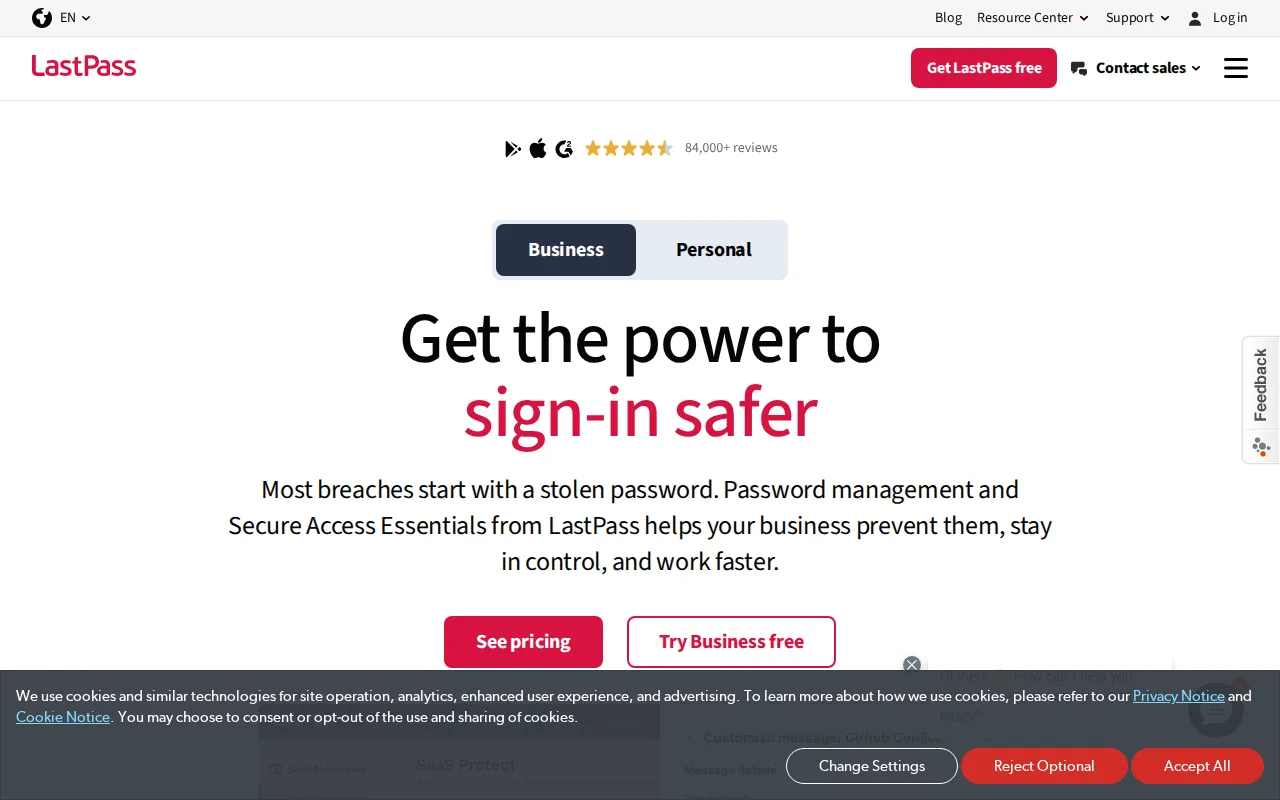
LastPass is the best Enpass alternative for anyone who wants a genuinely free tier and support across every major browser and OS. LastPass holds a 4.6/5 rating from 2,786 Capterra reviews, the largest single review count among Enpass's listed alternatives, and its Free plan stores unlimited passwords with dark web monitoring at no cost, something Enpass doesn't offer since its cheapest published plan is $1.99/month. LastPass Premium runs about $3/month billed annually, comparable to Enpass's $1.99/month introductory price before Enpass's undisclosed renewal rate applies after year one. Enpass is still the better choice for anyone weighing security incident history: LastPass disclosed two connected 2022 security incidents in which attackers accessed encrypted customer vault backups, a breach history Enpass's listing carries no equivalent of, and LastPass's free tier restricts syncing to a single device type (computers or mobile, not both), a limitation Enpass's cross-device local-first sync doesn't share. LastPass's renewal pricing also has a documented history of jumping above its promotional first-year rate, a pricing-transparency concern similar to Enpass's own undisclosed post-promotional renewal price.
Compared to Enpass: a genuinely free tier with unlimited password storage, broadest platform support across every major browser plus Windows, macOS, Linux, iOS, and Android, 4.6/5 rating from 2,786 Capterra reviews vs no external ratings
Wins:Free tier stores unlimited passwords with dark web monitoring at no cost, unlike Enpass's cheapest published plan at $1.99/month · 4.6/5 rating from 2,786 Capterra reviews, the largest single review count among Enpass's listed alternatives · Broad platform support across every major browser plus Windows, macOS, Linux, iOS, and Android
Loses:Disclosed two connected 2022 security breaches that exposed encrypted customer vault backups, a history Enpass's listing carries no equivalent of · Free tier restricts syncing to a single device type (computers or mobile), not both, unlike Enpass's cross-device local-first sync · Renewal pricing has a documented history of jumping above the promotional first-year rate
Pros
- Broad platform support across every major browser, Windows, macOS, Linux, iOS, and Android.
- Dark web monitoring alerts when a stored email or password appears in a known breach.
- Business Max tier adds SaaS Monitoring and SaaS Protect for tracking unsanctioned app usage org-wide.
- Family plan covers up to 6 individual Premium accounts under a single admin-managed bill.
Cons
- Disclosed two connected security breaches in 2022 that exposed encrypted customer vault data, a lasting trust issue competitors still use in switching campaigns.
- Free tier restricts syncing to a single device type (computers or mobile), not both at once.
- Trustpilot reviewers report recurring billing, cancellation, and support-access complaints, a sharp contrast to its higher Capterra rating.
- Renewal pricing has a documented history of jumping above the promotional first-year rate.
Pricing: Free tier · paid from $3/mo — About $3/month Premium (billed annually) vs Enpass's $1.99/month introductory Individual price (first 12 months)
5.KeePassXC — best Enpass alternative for privacy-conscious individuals and technical teams who want a fully offline password vault they control, rather than a cloud-synced subscription service
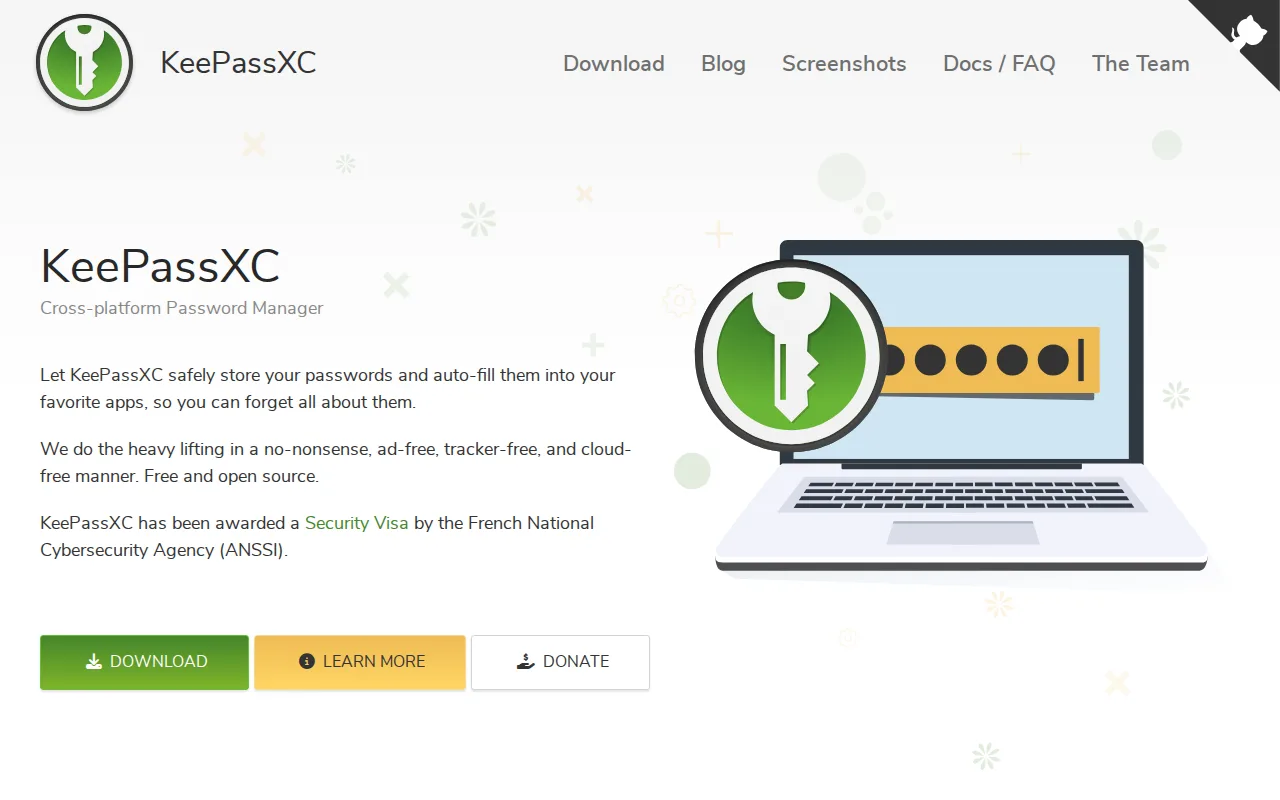
KeePassXC is the best Enpass alternative for anyone who wants a fully free, offline password vault with zero subscription cost, ever. KeePassXC has no pricing tiers, account, or subscription requirement of any kind — development is funded entirely through donations — while Enpass charges $1.99/month for Individual access even at its introductory rate. Both tools share the same local-first philosophy of keeping the encrypted vault off a vendor's servers, but KeePassXC goes further: it's fully open source under GPL-2.0/3.0 with 28,500+ GitHub stars and received an ANSSI security certification for version 2.7.9, letting anyone independently verify its encryption, unlike Enpass's closed-source app. Enpass is still the better choice for anyone who wants integrated sync and a mobile app without manual setup: Enpass has official iOS and Android apps and built-in sync support for iCloud, Dropbox, Google Drive, OneDrive, or WebDAV, while KeePassXC has no first-party sync service at all, so cross-device use requires manually pairing the vault file with a third-party tool like Dropbox, Nextcloud, or Syncthing, and there is no official KeePassXC mobile app, so iOS and Android users must rely on separate, third-party KeePass-compatible apps.
Compared to Enpass: fully free with no pricing tiers or subscription ever, fully open source (GPL-2.0/3.0) with 28,500+ GitHub stars and an ANSSI security certification, no vendor account or cloud storage required at all
Wins:Fully free with no pricing tiers, account, or subscription requirement of any kind, versus Enpass's $1.99/month introductory Individual price · Fully open source (GPL-2.0/3.0) with 28,500+ GitHub stars and an ANSSI security certification for version 2.7.9 · No vendor account or cloud storage dependency at all; the vault is a single locally encrypted file
Loses:No official mobile app; iOS and Android users rely on separate, third-party KeePass-compatible apps, unlike Enpass's native iOS and Android apps · No first-party sync service; cross-device use requires manually pairing with Dropbox, Nextcloud, or Syncthing, versus Enpass's built-in iCloud/Dropbox/Google Drive/OneDrive/WebDAV support · More utilitarian, less polished interface than commercial competitors like Enpass
Pros
- Vault is a single locally encrypted file with no vendor cloud account or subscription required.
- Fully open source (GPL-2.0/GPL-3.0) with 28,500+ GitHub stars and an ANSSI security certification for version 2.7.9.
- Browser integration asks for per-site confirmation instead of silent autofill, reducing phishing risk.
- Built-in TOTP generator removes the need for a separate authenticator app for many accounts.
Cons
- No first-party sync service; cross-device use requires manually pairing with Dropbox, Nextcloud, or Syncthing.
- No official KeePassXC mobile app; iOS and Android users rely on separate, third-party KeePass-compatible apps.
- Interface is more utilitarian and less polished than commercial competitors like 1Password or Bitwarden.
- Family or team sharing requires manual vault-file sharing rather than a built-in sharing feature.
Pricing: Free — Free forever, no paid tier, vs Enpass's $1.99/month introductory Individual price (first 12 months) (verified undefined NaN, NaN)