Bitwarden — An open-source password manager with GPL-licensed client code, a genuinely free tier, and paid plans starting at $1.65/month for individuals.

By Noahlast updated pricing verified
Bitwarden screenshots & video
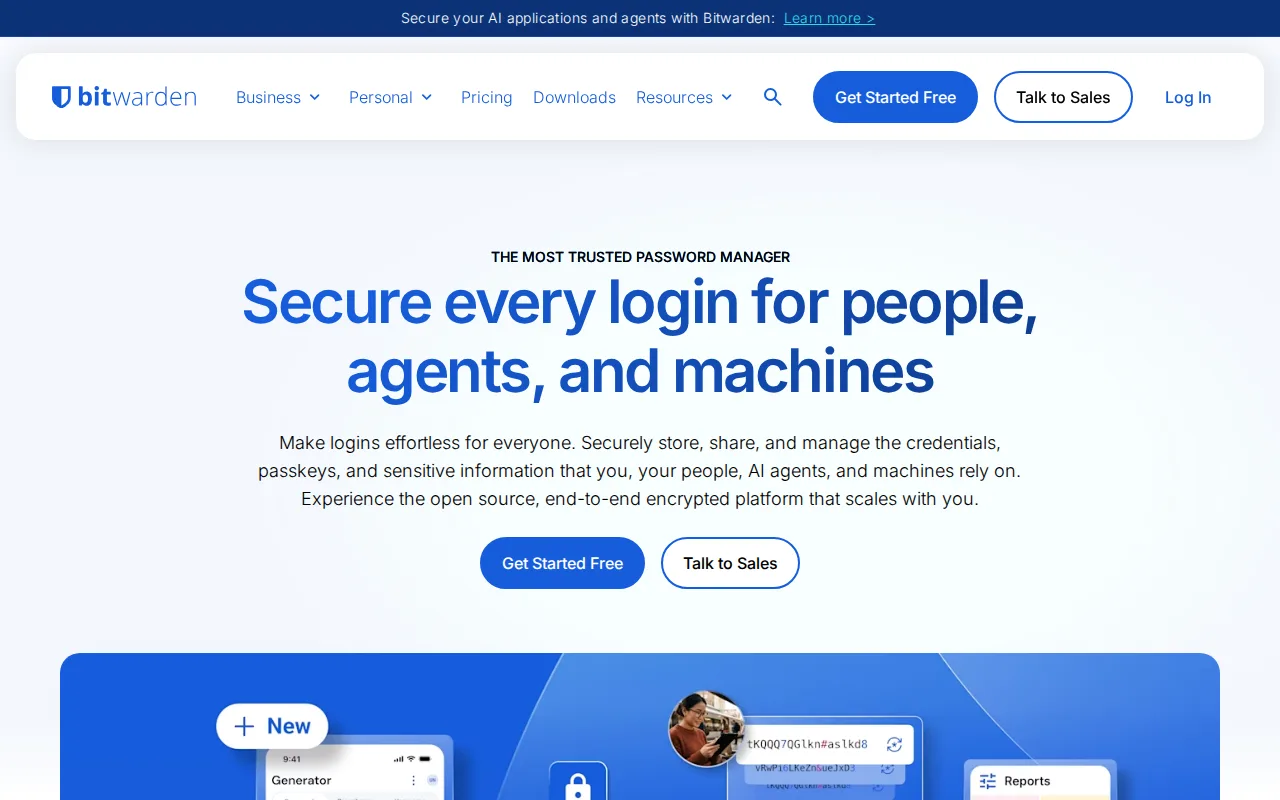
Bitwarden in 20 seconds
Best for: individuals and teams who want an open-source, independently audited password manager at roughly half the price of 1Password or Dashlane
Pricing: Free tier with no time limit; Premium $1.65/month billed annually; Families $3.99/month for 6 users; Teams $4/user/month; Enterprise $6/user/month.
- Bitwarden Premium costs $1.65/month billed annually ($19.80/year), and the Free plan has no time limit or device cap.
- Bitwarden Teams costs $4/user/month and Enterprise costs $6/user/month, both billed annually.
- Bitwarden holds a 4.7/5 rating from 216 reviews on Capterra and 4.8/5 from 16 reviews on Product Hunt.
- Bitwarden's client code is open source under GPL-3.0 and independently security-audited, with self-hosting available.
- Bitwarden supports web, Windows, macOS, Linux, iOS, and Android, plus a CLI.
Limitations: Free tier lacks the integrated authenticator and file attachments available on Premium.; Server code is open-core, not purely open source; some enterprise components carry a separate license.; Interface is generally considered less polished than 1Password's, with fewer bundled extras like a VPN.
Top alternatives: 1Password, Dashlane, LastPass, Keeper Security, NordPass — full list
What is Bitwarden?
Bitwarden is a password and passkey manager: it generates, stores, and autofills logins, secure notes, and payment cards inside end-to-end encrypted vaults synced across browsers, desktop, and mobile. Unlike most competitors, Bitwarden's client applications are open source under GPL-3.0, published on GitHub, and independently security-audited, which lets anyone inspect how encryption is implemented rather than trusting a closed-source vendor. The official server code carries a mixed license (core GPL-3.0 plus a Bitwarden-specific license for some enterprise components), making Bitwarden an open-core product overall — individuals and small teams can also self-host the community-maintained Vaultwarden server as a lightweight alternative to Bitwarden's own cloud. Plans range from a genuinely free individual tier through paid Premium, Families, Teams, and Enterprise tiers.
Bitwarden is an open-source password manager that stores logins, passkeys, and secure notes in end-to-end encrypted vaults, with client code published on GitHub under GPL-3.0 and independently audited. The Free tier covers unlimited passwords and devices with no time limit; Premium adds a built-in authenticator, 5GB of encrypted file attachments, and emergency access for $1.65/month billed annually ($19.80/year). Families covers up to six people for $3.99/month, and business plans run $4/user/month (Teams) or $6/user/month (Enterprise), both billed annually. Bitwarden's core differentiator is that its clients (web, browser extensions, desktop, mobile, CLI) are fully open source and self-hostable, so security researchers can audit the code and organizations can run their own server instead of trusting Bitwarden's cloud. Bitwarden holds a 4.7/5 rating from 216 reviews on Capterra and 4.8/5 from 16 reviews on Product Hunt, with reviewers citing strong value against 1Password and Dashlane as the recurring theme.
Standout feature: Fully open-source client and server code (GPL-3.0), independently audited, with an official self-hosting option and a community-maintained lightweight server (Vaultwarden) for running your own vault infrastructure.
Biggest weakness: The official self-hosted server carries a mixed license (GPL-3.0 core plus a Bitwarden-specific license for some enterprise features), and the interface is generally considered less polished than 1Password's, with fewer built-in extras like a bundled VPN.
Pros
- Open-source, independently audited client and server code that anyone can inspect on GitHub.
- Free tier includes unlimited passwords and devices with no artificial time limit.
- Roughly half the price of 1Password or Dashlane at every comparable tier.
- Official self-hosting option, plus a community Vaultwarden server for lighter-weight self-hosting.
Cons
- Free tier excludes the integrated authenticator and file attachments, which require upgrading to Premium.
- Server code isn't purely open source; some enterprise components ship under a separate Bitwarden license alongside the GPL-3.0 core.
- Interface and browser extension are generally considered less polished than 1Password's.
- No bundled VPN or dark-web monitoring the way some competitors include at similar price points.
Bitwarden pricing
Free tier · paid from $1.65/mo · verified from the vendor's pricing page
| Plan | Price | Notes |
|---|---|---|
| Free | Free | Unlimited passwords and devices, zero-knowledge encryption, two-step login; no time limit. |
| Premium | $1.65/mo | Billed annually ($19.80/year); adds integrated authenticator, 5GB encrypted file attachments, emergency access, and security reports. |
| Families | $3.99/mo | Billed annually ($47.88/year); covers up to 6 users with unlimited sharing and shared collections. |
| Teams | $4/mo | Per user, billed annually; adds centralized management, secure credential sharing, audit logs, and directory sync. |
| Enterprise | $6/mo | Per user, billed annually; adds passwordless SSO, granular access control, self-hosting flexibility, and account recovery. |
What reviewers say
Scores belong to their platforms; we display them with attribution and never fold them into our own ratings.