3 Best Open-Source Alternatives to Codeberg in 2026
By Noahlast updated pricing verified
Compared: open-source alternatives to Codeberg
| Alternative | Best for | Standout | Biggest weakness | Learning curve | Price |
|---|---|---|---|---|---|
| Codebergreference | open-source maintainers and FOSS projects that want ad-free, non-commercial Git hosting without a corporate owner behind it | Run entirely as a non-profit association (Codeberg e.V.) rather than a company, with no ads, no third-party tracking, and terms of use that explicitly restrict LLM-generated content and cryptocurrency projects. | There is no enterprise plan, SLA, or paid support contract to buy — Codeberg runs on volunteer effort and donations, so organizations that need guaranteed uptime commitments or a support escalation path have no paid tier to purchase. | Low | Free |
| GitLab | engineering teams that want source control, CI/CD, and security scanning in one application instead of assembling separate tools for each function | Security and compliance scanning (SAST, DAST, dependency and container scanning) is built into the Ultimate tier as a native part of the CI/CD pipeline, rather than a bolt-on third-party integration. | The jump from Premium to Ultimate is steep (roughly $29 to $99/user/month), pricing the deepest security features out of reach for many teams, and GitLab's dense, feature-heavy interface has a real learning curve compared to GitHub's simpler workflow. | Steep | Free tier · paid from $29/mo |
| SourceHut | developers and open-source maintainers who want a JavaScript-free, self-hostable forge with email-based patch review instead of a pull-request UI | Every service (git hosting, CI, mailing lists, tickets, chat) works without JavaScript and without an account for contributors, and the entire platform is open source and self-hostable. | The email-based patch review workflow (rather than a pull-request UI) and text-first, JavaScript-free interface are a steep departure from GitHub/GitLab conventions that many developers new to the platform find unfamiliar and slower to adopt; the platform also remains in public alpha with fewer polished collaboration features than mainstream forges. | Steep | Free tier · paid from $4/mo |
| Gitea | teams that want to self-host Git repository hosting, CI/CD, and package management with unlimited free users, upgrading to Enterprise only for SSO and compliance features | The open-source edition is genuinely free with unlimited users and repositories and no artificial seat caps, unlike many self-hosted Git platforms that gate user limits behind a paid tier. | Gitea Enterprise requires a mandatory 1-year commitment paid online rather than flexible monthly billing, and Gitea Cloud's actual subscription price is not published anywhere on the pricing page, requiring signup just to see a number. | Moderate | Free tier · paid from $9.50/mo |
 Codeberg
 GitLab
 SourceHut
 Gitea
Gitea1.GitLab — best Codeberg alternative for engineering teams that want source control, CI/CD, and security scanning in one application instead of assembling separate tools for each function

GitLab is the best Codeberg alternative for engineering teams that want source control, CI/CD, and security scanning built into one application rather than assembled from Codeberg's separate Woodpecker CI/CD and Weblate translation tools. GitLab's Free tier costs $0/user/month with core Git hosting and CI/CD on GitLab.com SaaS, matching Codeberg's no-cost entry point, while Premium at roughly $29/user/month adds merge approval rules and portfolio management, and Ultimate at $99/user/month layers in SAST, DAST, and dependency scanning as a native part of the CI/CD pipeline. GitLab Community Edition is MIT-licensed and free to self-host with no user limit, giving it the same self-hostable, source-available model Codeberg's Forgejo backend offers. GitLab holds a 4.6/5 rating from 1,224 Capterra reviews. Codeberg is still the better choice for FOSS maintainers who specifically want a non-profit, ad-free, non-commercial host: GitLab is a company selling proprietary Premium and Ultimate tiers on top of its open core, its interface has a real learning curve reviewers describe as steeper than GitHub's, and the jump from Premium to Ultimate pricing (roughly $29 to $99/user/month) prices advanced security features out of reach for many teams Codeberg serves for free.
Compared to Codeberg: built-in CI/CD, merge approvals, and security scanning (SAST/DAST) in one application, MIT-licensed Community Edition free to self-host, 4.6/5 rating from 1,224 Capterra reviews vs Codeberg's no ratings on file
Wins:Native CI/CD, merge request review, and SAST/DAST security scanning in one application, beyond Codeberg's Woodpecker CI/CD scope · Community Edition is MIT-licensed and free to self-host with no user limit, similar to Codeberg's own self-hostable Forgejo base · 4.6/5 rating from 1,224 Capterra reviews and 5/5 from 13 Product Hunt reviews, with no comparable rating volume on file for Codeberg
Loses:A for-profit, open-core company selling proprietary Premium ($29/user/month) and Ultimate ($99/user/month) tiers, unlike Codeberg's non-profit, fully free model · Dense, feature-heavy interface has a steeper learning curve than GitHub's or Codeberg's simpler Forgejo-based interface, per reviewers · Ultimate tier's security scanning costs roughly $99/user/month, pricing it out of reach for teams that get equivalent hosting free on Codeberg
Pros
- CI/CD, issue tracking, and code review are native to the platform rather than third-party add-ons.
- Community Edition is genuinely open source (MIT) and free to self-host with no artificial user cap.
- Ultimate tier includes built-in security scanning (SAST, DAST, dependency scanning) as part of the pipeline.
- Self-managed and SaaS deployment options give teams a real choice on data residency and control.
Cons
- Ultimate tier costs roughly $99/user/month, a steep jump from Premium's $29/user/month, pricing advanced security scanning out of reach for smaller teams.
- Interface density and the sheer number of features create a steeper learning curve than GitHub for new users.
- Self-managed instances can be resource-intensive to run and upgrade, especially at Ultimate-tier feature scope.
- Third-party integration marketplace is smaller than GitHub's, since GitLab favors native built-in features over an app ecosystem.
Pricing: Free tier · paid from $29/mo — $0 (GitLab Free) vs $0 (Codeberg, always free); GitLab Premium runs about $29/user/month for advanced CI/CD controls
2.SourceHut — best Codeberg alternative for developers and open-source maintainers who want a JavaScript-free, self-hostable forge with email-based patch review instead of a pull-request UI
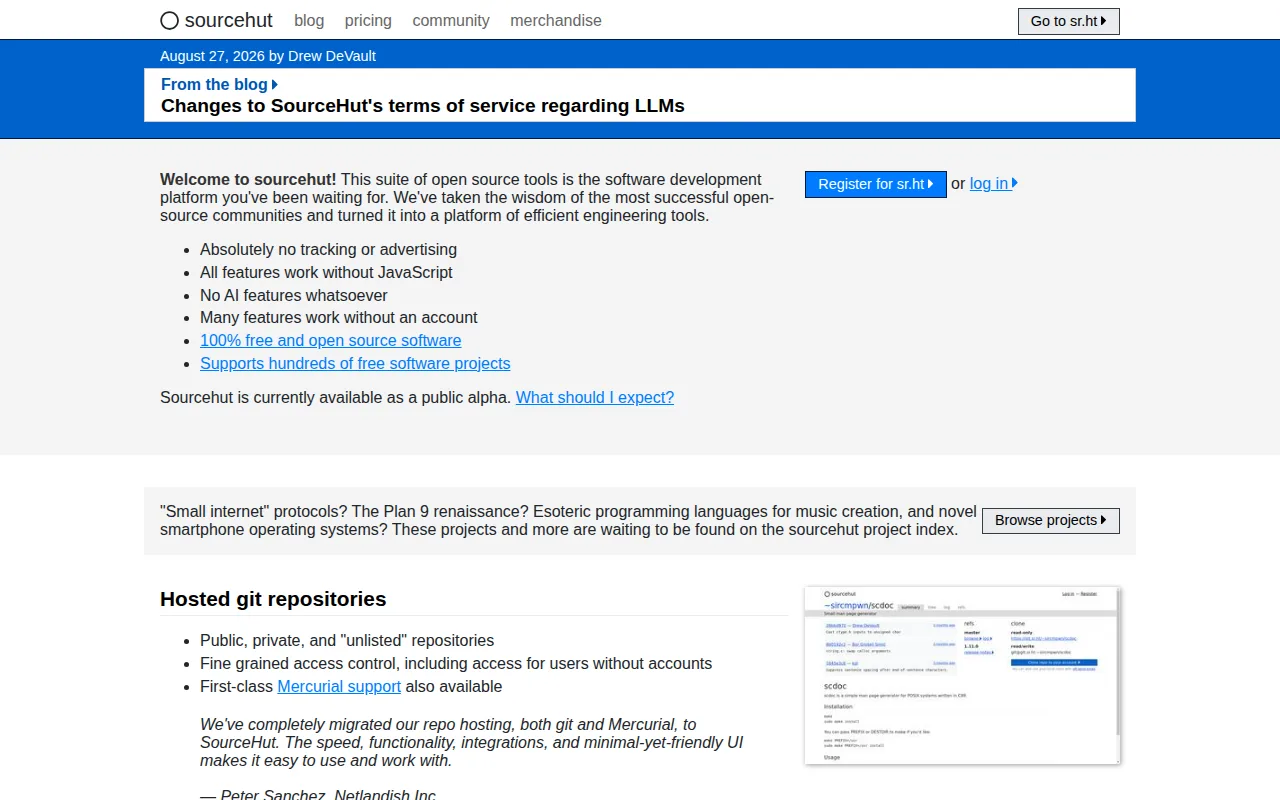
SourceHut is the best Codeberg alternative for developers who want an even more minimal, JavaScript-free forge, since both projects share a non-commercial, open-source ethos rather than a venture-backed business model. SourceHut runs entirely without JavaScript, ads, or tracking, and, like Codeberg's Forgejo backend, is itself 100% free and open-source software (licensed primarily under AGPL and BSD) that can be self-hosted from source. Pricing is pay-what-you-can across three self-selected tiers ($4, $8, or $12/month), all unlocking identical access to every service, and contributors interacting with hosted projects never need an account or payment at all — a lower bar than Codeberg's free-but-still-account-based model for anyone submitting a patch. SourceHut bundles git and Mercurial hosting, virtualized CI (builds.sr.ht), and mailing-list-based patch review (lists.sr.ht) in one platform, going beyond Codeberg's Git-plus-Woodpecker-CI-plus-Pages scope on the Mercurial and mailing-list front specifically. Codeberg is still the better choice for developers who want a free account with no payment at all and a pull-request-based workflow: SourceHut's builds.sr.ht CI and chat.sr.ht require a paid subscription with no free tier, and its email-based patch review is a steep departure from the PR-and-issue-tracker model Codeberg (like GitHub and GitLab) uses.
Compared to Codeberg: contributors can submit patches with no account or payment at all, bundles Mercurial hosting and mailing-list-based patch review, works entirely without JavaScript
Wins:Contributors can submit patches and interact with hosted projects without ever creating an account, a lower bar than Codeberg's account-based model · Bundles git and Mercurial hosting plus mailing-list-based patch review (lists.sr.ht), beyond Codeberg's Git-and-Woodpecker-CI scope · Every service works without JavaScript, ads, or tracking, matching Codeberg's own no-tracking stance but going further on the no-JavaScript front
Loses:builds.sr.ht (CI) and chat.sr.ht require a paid subscription ($4-$12/month); Codeberg's Woodpecker CI/CD is free for everyone · Email-based patch review instead of a pull-request UI is unfamiliar to developers coming from Codeberg, GitHub, or GitLab · Remains in public alpha with a smaller, more minimal feature set than Codeberg's Forgejo-based interface
Pros
- Fully open source and self-hostable under AGPL/BSD licenses, avoiding vendor lock-in.
- No ads, tracking, or AI features; every service works without JavaScript.
- Contributors can submit patches and interact with projects without creating an account.
- Flat pay-what-you-can pricing tiers unlock identical full access to every service.
Cons
- Email-based patch review instead of a pull-request UI is unfamiliar to developers coming from GitHub or GitLab.
- Remains in public alpha, with a smaller, more minimal feature set than mainstream forges.
- No free tier for the CI (builds.sr.ht) or chat (chat.sr.ht) services; these require a paid subscription.
- Smaller ecosystem of third-party integrations and marketplace apps compared to GitHub.
Pricing: Free tier · paid from $4/mo — $4-$12/month self-selected tiers (SourceHut, all identical access) vs $0 (Codeberg, always free) (verified undefined NaN, NaN)
3.Gitea — best Codeberg alternative for teams that want to self-host Git repository hosting, CI/CD, and package management with unlimited free users, upgrading to Enterprise only for SSO and compliance features
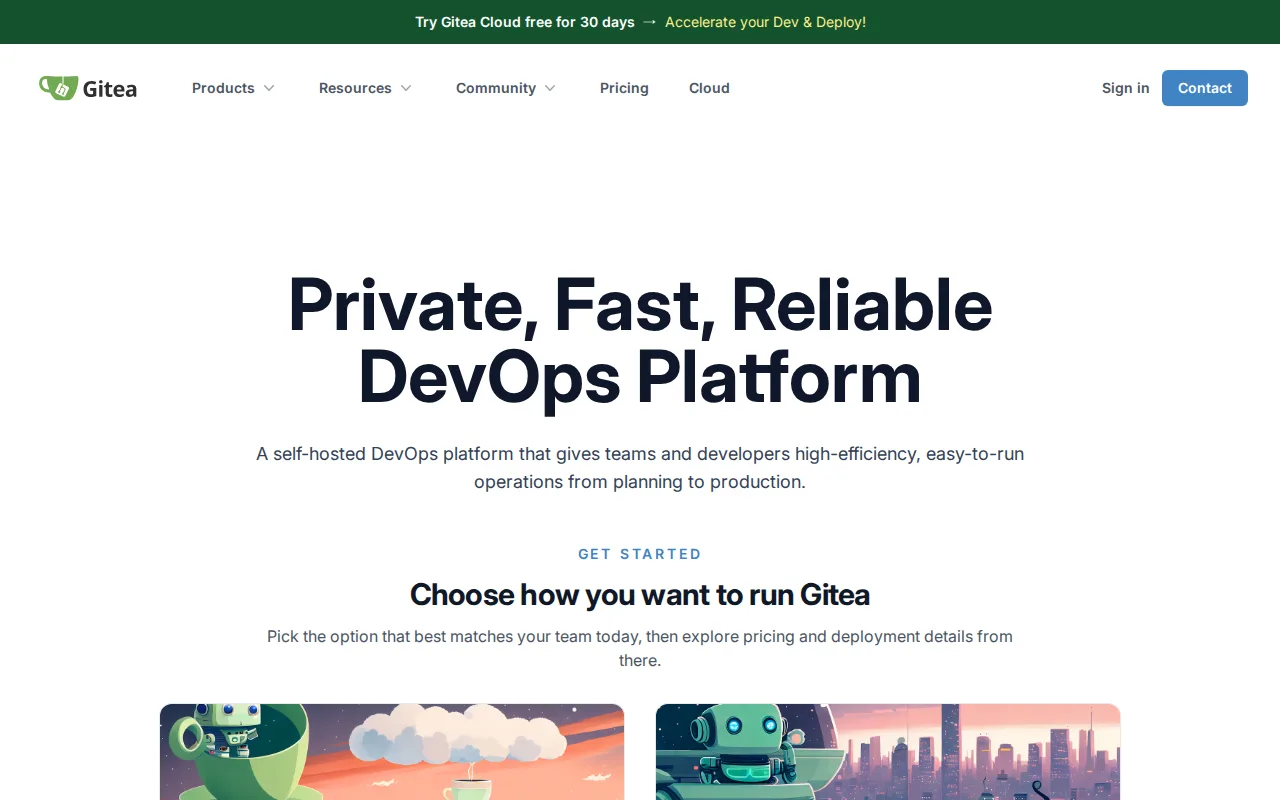
Gitea is the best Codeberg alternative for teams and individuals who want to run the same kind of lightweight, self-hosted Git service Codeberg itself is built on (Codeberg runs on Forgejo, a fork of Gitea), but on their own infrastructure instead of Codeberg's shared instance. The open-source Gitea edition is free under the MIT license with unlimited users and repositories, matching Codeberg's zero-cost model, and its lightweight Go binary runs comfortably on small servers, similar in spirit to Forgejo's own resource profile. Gitea Actions is compatible with existing GitHub Actions workflow syntax, easing migration for teams moving off GitHub, something Codeberg's Woodpecker CI/CD doesn't offer. For organizations that want a support contract rather than volunteer-run infrastructure, Gitea Enterprise costs $9.50-$19/user/month with SAML SSO, audit logs, and an SLA — options Codeberg has no equivalent of at any price, since Codeberg runs entirely on member donations with no paid support tier. Codeberg is still the better choice for FOSS maintainers who want to publish on a shared, already-running non-profit instance rather than operate their own server: self-hosting Gitea means the team is responsible for its own updates, backups, and uptime, work Codeberg's e.V. members handle collectively.
Compared to Codeberg: Gitea Actions compatible with GitHub Actions workflow syntax, optional paid Enterprise tier with SSO and an SLA, run on your own infrastructure instead of a shared instance
Wins:Gitea Actions is compatible with existing GitHub Actions workflow syntax, easing CI migration in a way Codeberg's Woodpecker CI/CD doesn't match · Gitea Enterprise offers a paid SLA, SAML SSO, and audit logs ($9.50-$19/user/month) for organizations that need a support contract, which Codeberg has no equivalent of · Runs on a team's own infrastructure rather than a shared instance, giving full control over uptime and configuration
Loses:Self-hosting shifts updates, backups, and uptime onto the team, work Codeberg's e.V. members handle on the shared instance · Gitea Enterprise requires a 1-year commitment paid online rather than Codeberg's simple donation model · Smaller third-party integration ecosystem than GitHub, similar to Codeberg's own smaller ecosystem
Pros
- Open-source core is free with unlimited users and repositories, no artificial caps.
- Lightweight Go binary runs comfortably on small servers, unlike heavier self-hosted alternatives.
- Gitea Actions is compatible with existing GitHub Actions workflow syntax, easing migration.
- Supports 20+ package registry formats (npm, PyPI, Maven, Cargo, and more) built in.
Cons
- Gitea Enterprise requires a 1-year commitment with online payment rather than flexible monthly billing.
- Gitea Cloud pricing is not published on the site; the number is only revealed after starting the signup flow.
- Smaller third-party integration and marketplace ecosystem than GitHub or GitLab.
- Self-hosted deployments still require the team to manage updates, backups, and uptime themselves on the free tier.
Pricing: Free tier · paid from $9.50/mo — $0 (Gitea open source, self-hosted) vs $0 (Codeberg, always free); Gitea Enterprise starts at $9.50/user/month for SSO and an SLA (verified undefined NaN, NaN)