3 Best Alternatives to Coda in 2026
By Noahlast updated

From our data: 2 of the 3 Coda alternatives listed here have a free tier, matching Coda's own free plan; Google Workspace is the exception, with no free tier at any price. All 3 publish per-seat prices as static text — $7 per user/month (Google Workspace Business Starter, billed annually), $10 per member/month (Notion Plus), and $20 per user/month (Airtable Team) — a median of $10, while Coda publishes no plan number at all and bills by doc maker instead. Only 1 of the 3 carries an external review-platform rating: Google Workspace at 4.7/5 from 17,667 Capterra reviews.
 Notion
 Airtable
 Google Workspace
How we picked
- Pricing transparency was checked first, because Coda's own listing names it as a weakness: the coda.io pricing page is JavaScript-rendered and exposes no plan numbers without running the app. All three alternatives publish per-seat prices as static text — Notion at $10 and $20 per member/month, Airtable at $20 and $45 per user/month, and Google Workspace at $7, $14, and $22 per user/month billed annually.
- Coda's doc-maker billing was compared against straight per-seat billing at a 20-person team. Coda charges only the people who build docs, which is cheaper when most of a team just reads; Notion, Airtable, and Google Workspace all bill every member, so the same 20 people cost $200/month on Notion Plus, $400 on Airtable Team, $900 on Airtable Business, and $140 on Google Workspace Business Starter.
- Structural fit was weighed against what Coda actually does — live tables inside a document that can drive a calendar view, a kanban board, and an AI column from one dataset. Notion is the closest match, with databases as blocks inside pages; Airtable separates the base from the documentation around it; Google Workspace splits the job across Docs and Sheets.
- External review evidence exists for only one tool on this page: Google Workspace at 4.7/5 from 17,667 Capterra reviews. Coda, Notion, and Airtable have no external review-platform rating on record here, so scores could not rank the full list.
- Free access was checked rather than assumed. Coda, Notion, and Airtable all have free tiers; Google Workspace has none at any price. Notion's and Airtable's prices were verified on their own pricing pages on 2026-09-15, while Google Workspace's and Coda's carry no pricing-verification timestamp in this data.
Paid placement never alters editorial rank — read the full methodology.
Coda alternatives at a glance
| Alternative | Best for | Standout | Biggest weakness | Learning curve | Price |
|---|---|---|---|---|---|
| Codareference | Teams that want to replace a mix of wiki, spreadsheet, and lightweight internal-tool software with one doc-based workspace, e.g. a product team building a roadmap, OKR tracker, and meeting hub in the same file. | Tables embedded directly inside a document behave like a database: the same table can power a calendar view, a kanban board, and an AI-generated summary column, all synced from one dataset, inside what still reads as a normal doc. | Coda bills by 'doc maker' rather than by simple per-seat pricing, which is cheaper for teams with many read-only viewers but makes it hard to predict costs as more people need edit rights; the pricing page itself is JavaScript-rendered with no plan numbers visible without running the app, and the ongoing rebrand to 'Superhuman Docs' adds uncertainty about whether current plans, limits, and support channels will carry over unchanged. | Steep | Pricing not verified |
| Notion | Teams that want to consolidate scattered docs, wikis, and lightweight project trackers into one linked workspace, and are willing to spend time designing their own database structure. | Custom Agents and Notion Agent, which can complete multi-step tasks using context pulled from Notion pages, connected apps (Slack, GitHub, Google Drive), and the web, billed at $10 per 1,000 Notion credits after a free trial. | Free and Plus plans only give trial access to Notion AI features (chat, meeting notes, research mode); full AI usage requires the Business plan at $20/member/month or separate Notion credits for Custom Agents and Workers, which adds an unpredictable usage-based cost on top of the seat price. | Steep | Free tier · paid from $10/mo |
| Airtable | Small-to-midsize teams that need a relational database with a spreadsheet UI to run project trackers, content calendars, or lightweight CRMs without writing code. | Bases behave like a real relational database (linked records across tables) while looking and feeling like a spreadsheet, so non-technical users can model structured data without SQL. | Costs scale per editor seat, so a 20-person team on the Business plan pays $45/user/month billed annually ($900/month) just to give everyone edit rights, and the Free plan's record and attachment caps push active teams into a paid tier quickly. | Moderate | Free tier · paid from $20/mo |
| Google Workspace | businesses, schools, and startups standardizing on browser-based email and real-time collaborative documents instead of desktop Office software | Real-time multi-user editing across Docs, Sheets, and Slides with automatic saving, paired with Gemini AI writing and summarization built into every paid tier at increasing depth. | No official native Linux desktop client and more limited offline-editing depth than Microsoft 365's desktop apps; Meet participant caps and storage are hard-capped per tier, forcing upgrades for larger or heavier-usage teams. | Low | From $7/mo |
 Coda
Coda1.Notion — best Coda alternative for teams that want to consolidate scattered docs, wikis, and lightweight project trackers into one linked workspace, and are willing to spend time designing their own database structure.
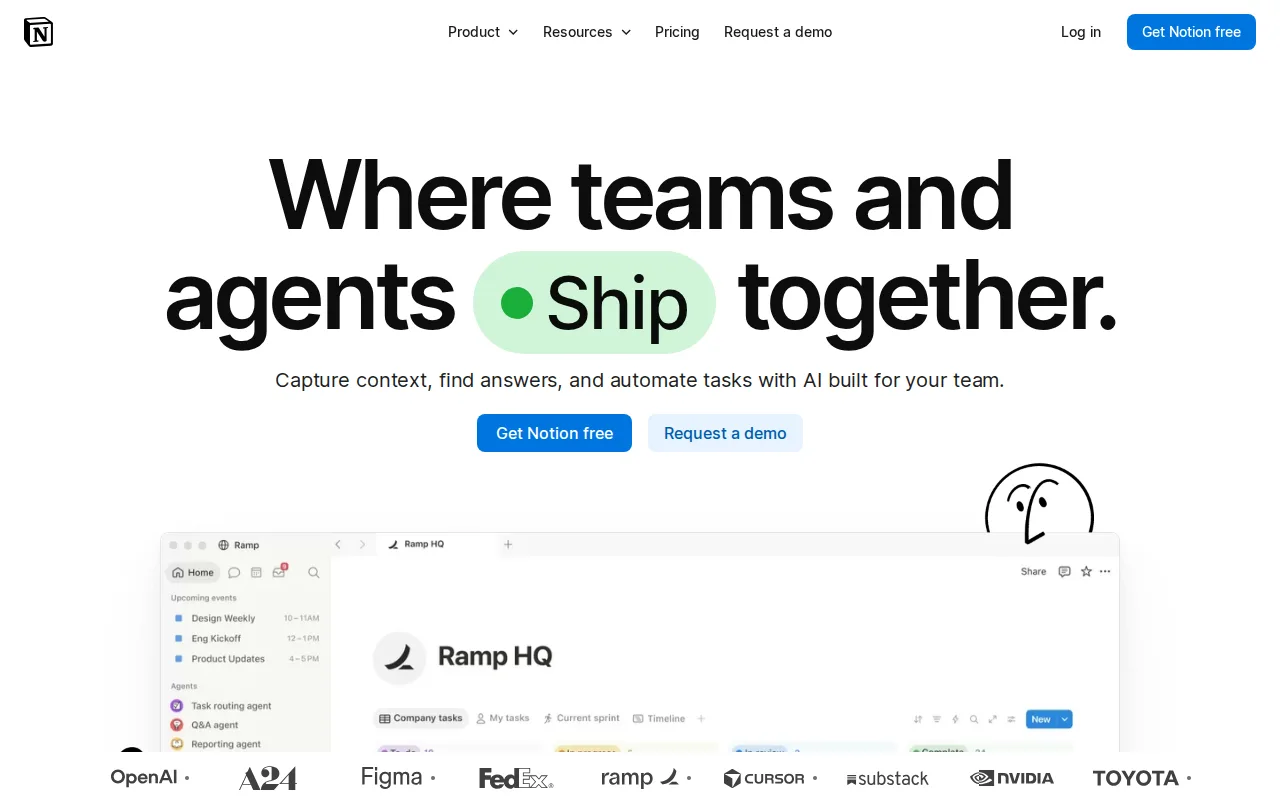
Notion is the best Coda alternative for teams that want the same docs-plus-databases canvas with a price they can budget before signing up. Notion publishes per-member pricing as static text — Free, Plus at $10 per member/month, Business at $20, and custom Enterprise — while Coda's pricing page is JavaScript-rendered and exposes no plan numbers without running the app, which Coda's own listing names as a weakness. Both products put structured data inside pages: Notion's databases are blocks with grid, board, calendar, and gallery views, layered with Notion Agent, AI Meeting Notes, and Enterprise Search. Notion also ships a native Linux desktop client alongside web, Windows, macOS, iOS, and Android, where Coda covers every platform except Linux, and Notion is not mid-rebrand — Coda is transitioning to Superhuman Docs under Superhuman, which is owned by Grammarly. Coda is still the better choice for teams with many read-only viewers. Coda bills by doc maker rather than per seat, so a 20-person team with three builders pays for three, while 20 Notion members on Plus cost $200/month. Notion's meaningful AI also requires the $20/member/month Business plan, and Custom Agents bill separately at $10 per 1,000 Notion credits.
Compared to Coda: published per-member prices of $10 and $20 where Coda's pricing page shows no plan numbers, a native Linux desktop client Coda doesn't ship, and a stable product name while Coda rebrands to Superhuman Docs
Wins:Publishes per-member pricing as static text — Free, $10 Plus, $20 Business — where Coda's pricing page exposes no plan numbers without running its app · Native Linux desktop client on top of web, Windows, macOS, iOS, and Android; Coda covers every platform except Linux · Not mid-rebrand, where Coda is transitioning to Superhuman Docs under Superhuman (owned by Grammarly) with plan and support continuity unresolved
Loses:Bills every member at $10-$20 per month, where Coda charges only doc makers, so a 20-person team with three builders pays far less on Coda than $200/month on Notion Plus · Meaningful AI (Notion Agent, AI Meeting Notes, Enterprise Search) requires the $20/member/month Business plan, and Custom Agents bill on top at $10 per 1,000 credits · No equivalent to Coda's 600+ Packs pulling Slack, Jira, Google Calendar, and Figma into a doc — Notion connects through its public API, webhooks, and one-way syncs — and offline reaches only recently viewed or favorited pages
Pros
- Single tool covers docs, wikis, databases, and basic project tracking, reducing tool-switching
- Free plan supports unlimited pages and blocks for solo use, with only multi-member workspaces hitting block limits
- Deep customization through nested pages, linked databases, and templates
- Public API, webhooks, and 1-way database syncs (Jira, GitHub, Asana) for connecting external tools
Cons
- Per-member pricing on paid tiers ($10-$20/month) gets expensive fast for larger teams compared to flat-fee tools
- Offline support is limited to recently viewed or favorited pages on paid plans rather than full offline access
- Flexible block-and-database model has a steep learning curve for teams used to fixed-structure apps
- Meaningful AI features (Notion Agent, Enterprise Search, AI Meeting Notes) require the $20/month Business plan or higher
Pricing: Free tier · paid from $10/mo — Notion Plus at $10 per member/month and Business at $20, both published as static text, vs Coda, which publishes no plan price without a JavaScript-rendered session and bills by doc maker instead (verified undefined NaN, NaN)
2.Airtable — best Coda alternative for small-to-midsize teams that need a relational database with a spreadsheet UI to run project trackers, content calendars, or lightweight CRMs without writing code.
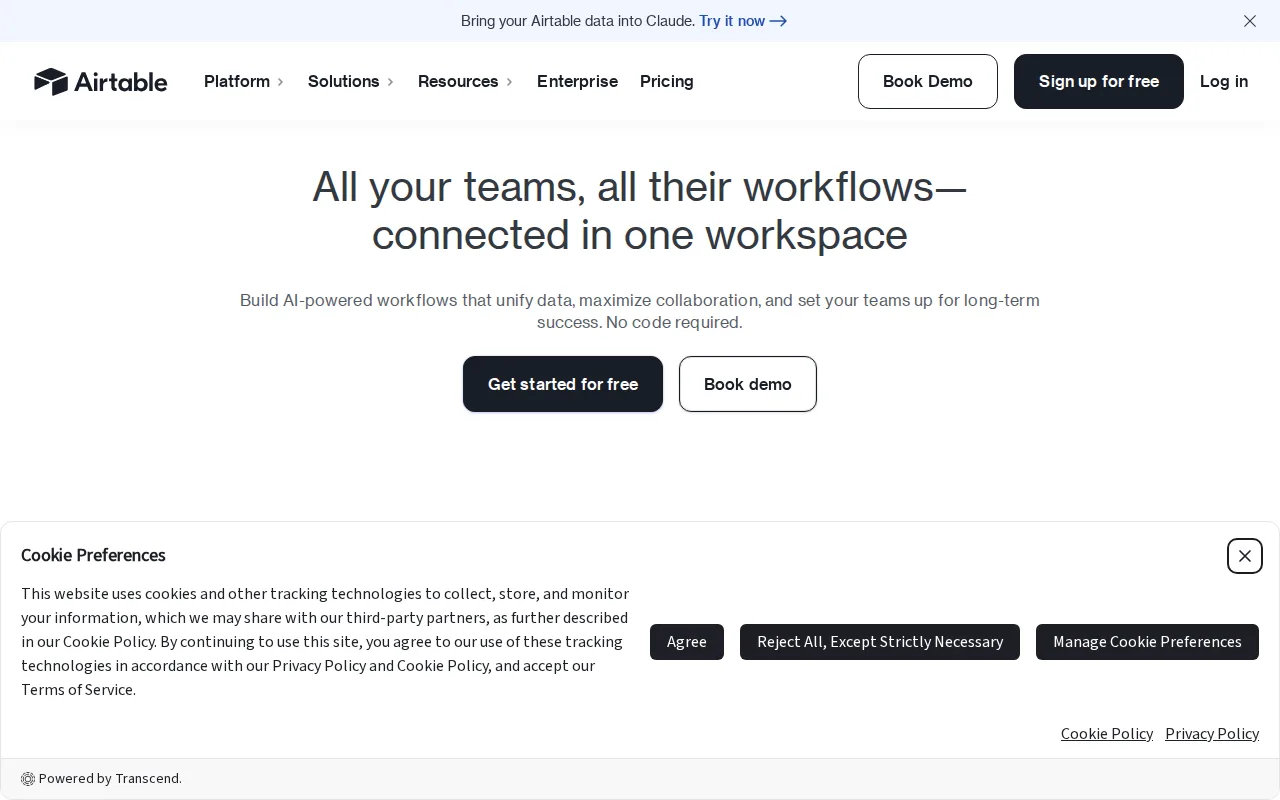
Airtable is the best Coda alternative for teams whose data has outgrown tables inside a document. Airtable bases behave like a real relational database — linked records across tables plus grid, kanban, calendar, gallery, and Gantt views over the same records — while still reading as a spreadsheet, and Airtable reports more than 500,000 organizations on the product, with HyperDB on Enterprise Scale handling record counts in the hundreds of millions. Coda's tables live inside a doc, which is the whole point of Coda but also its ceiling. Airtable publishes its prices openly: Free, Team at $20 per user/month, and Business at $45, both billed annually, where Coda's pricing page shows no plan numbers without a JavaScript-rendered session. Airtable's learning curve is rated moderate against Coda's steep. Coda is still the better choice for teams that want writing and data in the same file, and for teams with many viewers. Airtable charges per editor seat, so 20 editors on Business cost $900/month while Coda bills only doc makers. Airtable's free tier also caps records and attachments per base, and the base sits apart from whatever document explains it — exactly the split Coda exists to remove.
Compared to Coda: linked records across relational tables rather than tables inside a doc, published prices of $20 and $45 per user/month where Coda shows none, but per-editor billing at $900/month for 20 Business seats where Coda charges only doc makers
Wins:Bases are a real relational database with linked records across tables, scaling to record counts in the hundreds of millions on the HyperDB Enterprise Scale tier · Publishes Team at $20 and Business at $45 per user/month billed annually as static text, where Coda's pricing page shows no plan numbers without running its app · Learning curve is rated moderate against Coda's steep, and Airtable reports more than 500,000 organizations using the product
Loses:Charges per editor seat: 20 editors on Business cost $900/month, while Coda bills only the people who actually build docs · The base sits apart from whatever document explains it, removing the text-and-data-in-one-file arrangement Coda is built around · Free and Team tiers cap records and attachments per base, and SSO, advanced RBAC, and unlimited workspaces require custom-quoted Enterprise Scale
Pros
- Relational linking between tables goes well beyond what a flat spreadsheet like Google Sheets can do
- Built-in automations, interfaces, and reporting reduce the need for separate tools for simple internal apps
- Free plan is usable for individuals and very small teams before any payment is required
- Native integrations with Slack, Google Drive, Salesforce, Jira, and Zendesk plus a documented REST API for custom work
Cons
- Per-editor seat pricing gets expensive fast once a team grows past a handful of active editors
- Free and Team tiers cap records and attachments per base, forcing upgrades as data volume grows
- Enterprise-grade features (SSO, advanced RBAC, unlimited workspaces) are locked behind custom-quoted Enterprise Scale pricing
- Complex bases with many linked tables and automations can become hard to navigate for new users
Pricing: Free tier · paid from $20/mo — Airtable Team at $20 per user/month and Business at $45, both billed annually and published openly, vs Coda, which publishes no plan price and bills by doc maker (verified undefined NaN, NaN)
3.Google Workspace — best Coda alternative for businesses, schools, and startups standardizing on browser-based email and real-time collaborative documents instead of desktop Office software
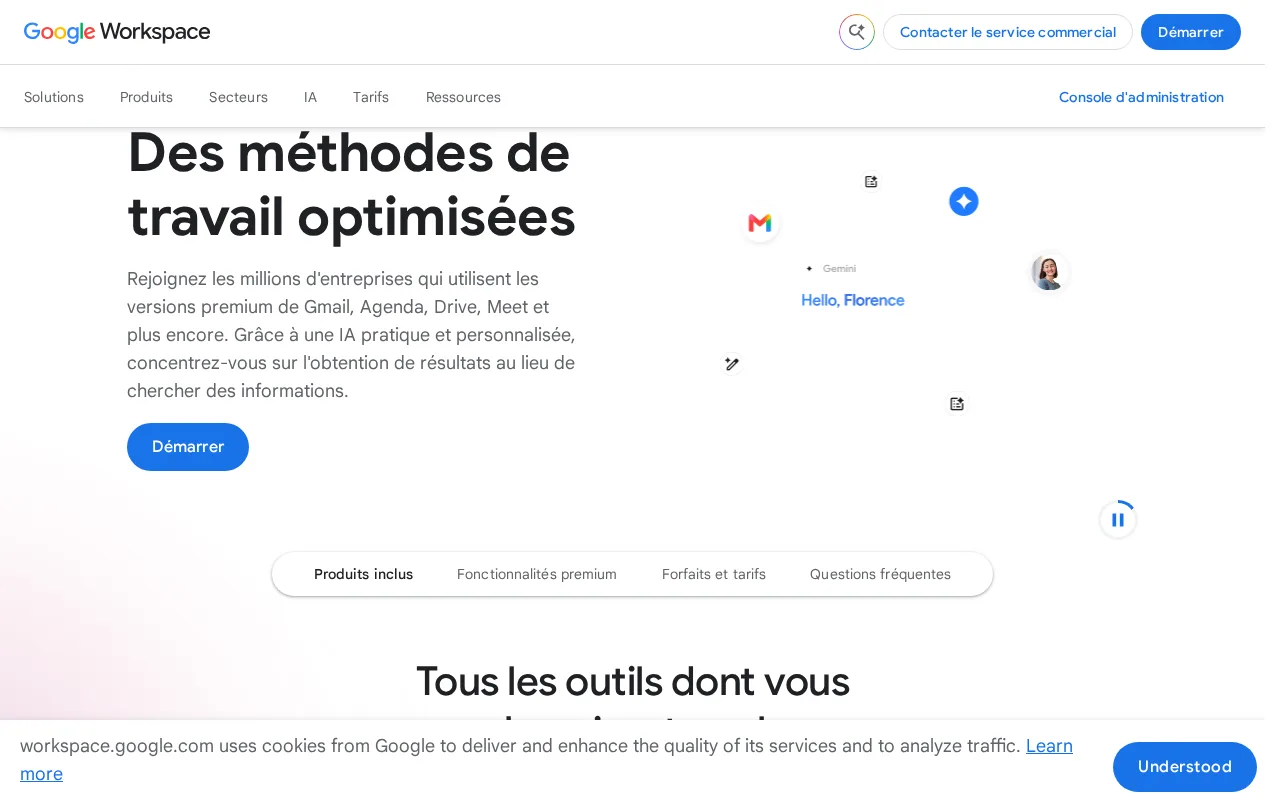
Google Workspace is the best Coda alternative for teams that need business email and storage alongside collaborative documents, at the lowest published seat price on this page. Business Starter is $7 per user/month billed annually ($8.40 billed flexibly), under Notion Plus at $10 and Airtable Team at $20, and it bundles Gmail on a custom domain, 30GB of pooled storage per user, Drive, Docs, Sheets, Slides, Meet for up to 100 participants, and Calendar under one admin console. Gemini AI is included in every paid tier rather than sold as an add-on. Google Workspace is also the only tool on this page with independent review evidence: 4.7/5 from 17,667 Capterra reviews, where Coda has none on record, and its learning curve is rated low against Coda's steep. Coda is still the better choice for teams that want one file holding text, live tables, and automations together. Google Workspace splits that work across Docs and Sheets with no buttons or mini-app layer, and it has no free tier at any price while Coda does. Google Workspace also ships no official native Linux desktop client, and Meet participant caps and storage are hard-capped per tier.
Compared to Coda: $7 per user/month billed annually with business email, Drive, and Meet bundled in, 4.7/5 from 17,667 Capterra reviews against no external rating, but no free tier where Coda has one
Wins:Business Starter is $7 per user/month billed annually ($8.40 billed flexibly), under Notion Plus at $10 and Airtable Team at $20, while Coda publishes no price at all · Bundles business email on a custom domain, 30GB pooled storage per user, Drive, Docs, Sheets, Slides, Meet, and Calendar under one admin console, with Gemini AI on every paid tier · 4.7/5 from 17,667 Capterra reviews and a learning curve rated low against Coda's steep; Coda has no external review-platform rating on record
Loses:No free tier at any price, while Coda, Notion, and Airtable all have one · Documents and spreadsheets are separate apps, so no single file holds text, live tables, buttons, and automations the way a Coda doc does · No official native Linux desktop client for Drive sync, Meet participant and storage limits are hard-capped per tier, and the advertised prices require annual billing — flexible monthly costs about 20% more
Pros
- Real-time collaborative editing across Docs, Sheets, and Slides with automatic saving.
- Gemini AI features are bundled into every paid tier rather than sold as a separate add-on.
- Tight integration across Gmail, Drive, Calendar, and Meet under one admin console.
- Transparent, published per-user pricing with no mandatory onboarding fee.
Cons
- Offline and power-user editing features lag behind Microsoft 365's desktop Excel and Word.
- No official native Linux desktop client for Drive sync.
- Google Meet participant caps and storage limits are hard-capped per tier, forcing plan upgrades.
- Lowest advertised per-user price requires annual billing; flexible monthly billing costs about 20% more.
Pricing: From $7/mo — Google Workspace Business Starter at $7 per user/month billed annually ($8.40 billed flexibly), rising to $14 Standard and $22 Plus, vs Coda, which publishes no plan price and bills by doc maker
Which one is right for you?
- You want the same docs-plus-databases workspace but need a price you can budget before signing upNotion
- Your data has real relations across many tables and has outgrown tables inside a documentAirtable
- You need business email on your own domain alongside collaborative documentsGoogle Workspace
- Your team runs Linux desktops and needs a native client, not just a browser tabNotion
- You want the lowest per-seat cost for a whole team and every person needs an accountGoogle Workspace
- You're building an internal tool with kanban, calendar, and gallery views over the same recordsAirtable
- You want collaborative editing that non-technical staff pick up in a day rather than a build-it-yourself canvasGoogle Workspace
Frequently asked questions
Is there a free alternative to Coda?
- Yes — Notion and Airtable both have free tiers, the same as Coda. Notion's free plan supports unlimited pages and blocks for solo use, and Airtable's free plan covers individuals and very small teams with capped records and attachments. Google Workspace has no free tier at any price.
What is the closest alternative to Coda?
- Notion is the closest match: both put documents and databases on one canvas, both are freemium across web, Windows, macOS, iOS, and Android, and both are rated steep on learning curve. The split is billing and transparency — Notion publishes $10 and $20 per-member prices as static text, while Coda bills by doc maker and shows no plan numbers without running its app.
Can Notion replace Coda?
- Yes for most teams building team hubs, project trackers, and wikis, with pricing you can budget in advance at $10 per member/month on Plus. Stay on Coda if most of your people only read, because Coda charges by doc maker rather than by seat, so a 20-person team with three builders pays far less than 20 Notion members at $10 each.
Which Coda alternative is cheapest?
- Google Workspace Business Starter at $7 per user/month billed annually is the cheapest published seat price, ahead of Notion Plus at $10 and Airtable Team at $20. Flexible monthly billing raises Google Workspace to $8.40 per user/month, about 20% more.
How much does Coda cost compared to these alternatives?
- Coda publishes no plan prices as static text — its pricing page is JavaScript-rendered and shows nothing without running the app — so a direct dollar comparison is not possible. What is comparable is the billing model: Coda charges by doc maker, while Notion ($10-$20 per member/month), Airtable ($20-$45 per user/month), and Google Workspace ($7-$22 per user/month) all bill every seat.
Is Coda being renamed to Superhuman Docs?
- Yes — Coda is being rebranded as Superhuman Docs under Superhuman, which is owned by Grammarly, while the coda.io domain, sign-in, and existing docs continue to operate under the Coda name during the transition. Coda's own listing flags near-term uncertainty about whether current plans, limits, and support channels carry over unchanged, which is why some teams are evaluating Notion, Airtable, or Google Workspace now.
Which Coda alternative is best for relational data?
- Airtable, whose bases behave like a real relational database with linked records across tables while still reading as a spreadsheet, scaling to record counts in the hundreds of millions on the HyperDB Enterprise Scale tier. The cost is per editor seat at $20 per user/month on Team and $45 on Business, or $900 a month for 20 Business editors.