4 Best Alternatives to Azure DevOps in 2026
By Noahlast updated pricing verified

From our data: Jira's 15,456 Capterra reviews are the largest sample among the four alternatives compared to Azure DevOps, more than 104 times Azure DevOps's own 148 reviews and more than 12 times GitLab's 1,224, the next-smallest sample; on entry pricing, Bitbucket's Standard tier at $3.65/user/month is the cheapest paid option, undercutting Azure DevOps's own $6/user/month Basic tier.
 GitHub
 GitLab
 Bitbucket
 Jira
JiraHow we picked
- Pricing was independently verified on-site for three of the four alternatives — GitHub, Bitbucket, and, indirectly, Azure DevOps's own listing (fetched 2026-08-21) — while GitLab's Free/Premium/Ultimate tiers and Jira's Free/Standard/Premium tiers carry no verification timestamp in our listing data.
- All four alternatives and Azure DevOps itself offer a free entry point, but the free-tier shape differs sharply: Azure DevOps gives its first 5 users free per organization, GitHub and GitLab offer unlimited users on their free tier, Bitbucket caps free at 5 users, and Jira caps free at 10 users.
- Review volume spans a wide range: Jira's 15,456 Capterra reviews are the largest sample, more than 12 times GitLab's 1,224 and nearly 12 times Bitbucket's 1,347, while GitHub's 6,198 reviews sit between; Azure DevOps's own listing carries just 148 Capterra reviews at 4.4/5.
- Licensing model is a real point of differentiation: GitLab's Community Edition is fully open source (MIT) and self-hostable, matching neither Azure DevOps's proprietary model nor GitHub's, Bitbucket's, or Jira's freemium-but-closed licensing, a distinction reflected directly in the differences below.
Paid placement never alters editorial rank — read the full methodology.
Azure DevOps alternatives at a glance
| Alternative | Best for | Standout | Biggest weakness | Learning curve | Price |
|---|---|---|---|---|---|
| Azure DevOpsreference | organizations already standardized on Microsoft Azure infrastructure that want an integrated, single-vendor Boards + Repos + Pipelines + Test Plans suite rather than assembling best-of-breed tools | One integrated suite covering work tracking, Git hosting, CI/CD, manual testing, and package management, with pipeline agents that build for Linux, macOS, and Windows regardless of deployment target. | Real cost is fragmented across multiple add-ons: Test Plans triples the per-user price to $52/month, GitHub Advanced Security costs $19-30/committer/month extra, and additional pipeline parallelism or Artifacts storage are billed separately, making total cost harder to predict than a single flat per-seat price. | Steep | Free tier · paid from $6/mo |
| GitHub | development teams that want Git hosting combined with integrated CI/CD, project tracking, and code review in a single platform, from individual open-source maintainers up to large enterprises requiring SSO and compliance | The largest network effect of any Git host: most open-source projects, package registries, and third-party dev tools integrate with GitHub first, making it the default home for public collaboration. | Team and Enterprise pricing shown ($4 and $21 per user/month) are promotional first-year rates, so costs increase after the first 12 months, and reviewers note that GitHub Actions configuration and navigating large repositories with many branches, workflows, and pull requests has a steeper learning curve than plain Git usage. | Moderate | Free tier · paid from $4/mo |
| GitLab | engineering teams that want source control, CI/CD, and security scanning in one application instead of assembling separate tools for each function | Security and compliance scanning (SAST, DAST, dependency and container scanning) is built into the Ultimate tier as a native part of the CI/CD pipeline, rather than a bolt-on third-party integration. | The jump from Premium to Ultimate is steep (roughly $29 to $99/user/month), pricing the deepest security features out of reach for many teams, and GitLab's dense, feature-heavy interface has a real learning curve compared to GitHub's simpler workflow. | Steep | Free tier · paid from $29/mo |
| Bitbucket | teams already standardized on Jira and Confluence who want Git hosting and CI/CD that links natively to issue tracking without a separate integration | Native, bidirectional linking between commits/branches and Jira issues, including smart commits that transition issue status from a commit message, plus built-in Pipelines CI/CD without a third-party runner. | No self-hosted option since Atlassian retired Bitbucket Server/Data Center in 2024, and its third-party app and integration marketplace is far smaller than GitHub's, so teams outside the Atlassian ecosystem get less added value per dollar. | Low | Free tier · paid from $3.65/mo |
| Jira | software development teams that need deeply configurable issue workflows and tight integration with Bitbucket/GitHub, and are willing to invest in a dedicated Jira admin to manage the configuration | Fully customizable workflows and permission schemes per project, combined with native integration into Bitbucket, GitHub, and CI/CD pipelines that link commits and pull requests directly to issues. | Steep learning curve for workflow and permission-scheme configuration; teams scaling past a few projects commonly need a dedicated Jira administrator, and per-seat pricing on Standard/Premium slides with team size in a way that makes budgeting harder to predict. | Steep | Free tier · paid from $7.91/mo |
 Azure DevOps
1.GitHub — best Azure DevOps alternative for development teams that want Git hosting combined with integrated CI/CD, project tracking, and code review in a single platform, from individual open-source maintainers up to large enterprises requiring SSO and compliance

GitHub is the best Azure DevOps alternative for development teams that want Git hosting combined with CI/CD, project tracking, and code review in one platform with a much larger community than Azure DevOps's own ecosystem. GitHub's Free plan includes unlimited public and private repositories with 2,000 CI/CD minutes/month, comparable to Azure DevOps giving the first 5 users free per organization, but GitHub's free tier has no user-count cap at all. GitHub holds a 4.8/5 rating from 6,198 Capterra reviews, more than 41 times Azure DevOps's own 148 reviews. GitHub Copilot integrates directly into pull requests and code review, and GitHub is the default home for most public open-source projects, a network effect Azure DevOps's more enterprise-focused audience doesn't carry. Azure DevOps remains the better choice for organizations that specifically want one integrated suite spanning Boards, Repos, Pipelines, Test Plans, and Artifacts under a single Microsoft billing relationship: GitHub's Team and Enterprise pricing ($4 and $21 per user/month) are promotional first-year rates that increase afterward, and GitHub's own Advanced Security and manual test-planning tools are less centralized than Azure DevOps's bundled Test Plans add-on.
Compared to Azure DevOps: unlimited users on the free tier vs Azure DevOps's first-5-users-free model, 4.8/5 from 6,198 Capterra reviews vs Azure DevOps's 148, GitHub Copilot integrated directly into pull requests
Wins:Free tier includes unlimited public and private repositories with no user-count restriction, unlike Azure DevOps's first-5-users-free model · 4.8/5 rating from 6,198 Capterra reviews, more than 41 times Azure DevOps's own 148 reviews · The largest ecosystem of open-source projects, integrations, and third-party tooling of any Git host, a network effect Azure DevOps's enterprise-focused audience doesn't carry
Loses:Team and Enterprise pricing ($4 and $21 per user/month) are promotional first-year rates that increase afterward, unlike Azure DevOps's flat $6/user/month Basic pricing · No single bundled suite spanning work tracking, repos, CI/CD, manual test planning, and package management the way Azure DevOps combines Boards, Repos, Pipelines, Test Plans, and Artifacts · GitHub Actions configuration and navigating very large repositories with many branches and workflows has a real learning curve
Pros
- Free tier includes unlimited public and private repositories with no user-count restriction.
- The largest ecosystem of open-source projects, integrations, and third-party tooling of any Git host.
- GitHub Actions and Codespaces provide integrated CI/CD and cloud dev environments without separate tools.
- Frequent, well-communicated platform updates and a large community that resolves issues quickly.
Cons
- Team and Enterprise pricing ($4 and $21 per user/month) are introductory rates for the first 12 months, increasing afterward.
- GitHub Actions and repository security settings have a steeper learning curve for teams new to CI/CD configuration.
- Navigating and discovering content in very large repositories with many branches and workflows can be difficult.
- Advanced Security features (secret scanning, code scanning at scale) are largely gated behind Enterprise pricing.
Pricing: Free tier · paid from $4/mo — Free (unlimited users) or $4/user/month (Team, first-year promotional rate) vs Azure DevOps's first-5-users-free then $6/user/month Basic (verified undefined NaN, NaN)
2.GitLab — best Azure DevOps alternative for engineering teams that want source control, CI/CD, and security scanning in one application instead of assembling separate tools for each function
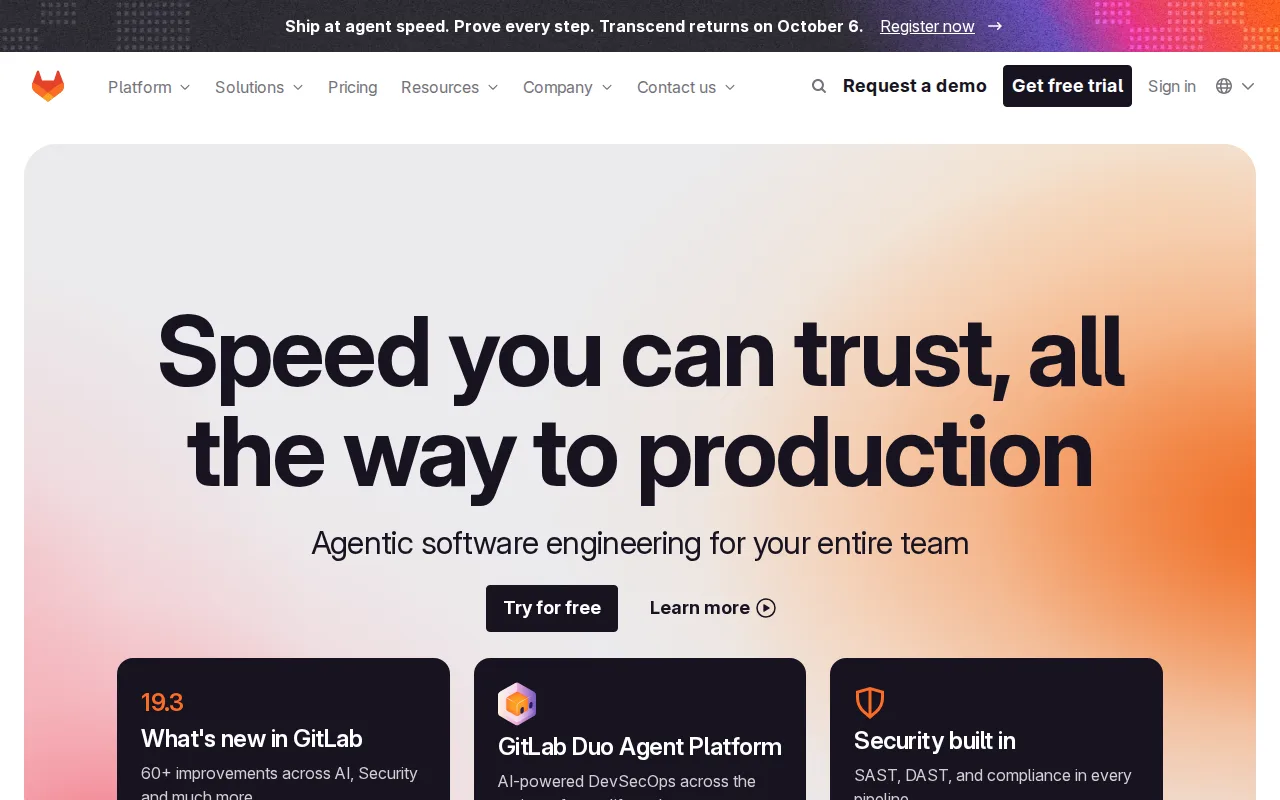
GitLab is the best Azure DevOps alternative for engineering teams that want source control, CI/CD, and security scanning built into one application rather than assembled from separate services. GitLab's Ultimate tier bundles static and dynamic security scanning (SAST, DAST, dependency and container scanning) natively into the CI/CD pipeline, a depth of built-in compliance tooling that goes beyond Azure DevOps's own add-on model, where GitHub Advanced Security-equivalent features cost $19-30/committer/month extra. GitLab holds a 4.6/5 rating from 1,224 Capterra reviews plus a 5.0/5 from 13 Product Hunt reviews, well above Azure DevOps's own 4.4/5 from 148 reviews. GitLab's Community Edition is MIT-licensed and free to self-host with no user limit on core Git features, a genuinely open-source option Azure DevOps doesn't offer. Azure DevOps remains the better choice for organizations already standardized on Microsoft Azure infrastructure and Boards-style configurable work tracking: GitLab's jump from Premium to Ultimate is steep (roughly $29 to $99/user/month), pricing its deepest security features out of reach for smaller teams, and its dense, feature-heavy interface has a real learning curve compared to Azure DevOps's more familiar Microsoft ecosystem tooling.
Compared to Azure DevOps: native security scanning (SAST, DAST) built into CI/CD at the Ultimate tier vs Azure DevOps's separate $19-30/committer/month Advanced Security add-on, 4.6/5 from 1,224 Capterra reviews vs Azure DevOps's 4.4/5 from 148, MIT-licensed self-hostable Community Edition Azure DevOps doesn't offer
Wins:Security and compliance scanning (SAST, DAST, dependency and container scanning) is native to the Ultimate tier's CI/CD pipeline, rather than a separate $19-30/committer/month add-on like Azure DevOps's GitHub Advanced Security · 4.6/5 rating from 1,224 Capterra reviews plus a 5.0/5 from 13 Product Hunt reviews, both above Azure DevOps's 4.4/5 from 148 reviews · Community Edition is genuinely open source (MIT) and free to self-host with no artificial user cap, unlike Azure DevOps's proprietary model
Loses:Ultimate tier costs roughly $99/user/month, a steep jump from Premium's $29/user/month, pricing advanced security scanning out of reach for smaller teams · Dense, feature-heavy interface creates a steeper learning curve than a team already familiar with Microsoft's ecosystem tooling · Smaller third-party integration marketplace than Azure DevOps's ties into the broader Microsoft and Visual Studio ecosystem
Pros
- CI/CD, issue tracking, and code review are native to the platform rather than third-party add-ons.
- Community Edition is genuinely open source (MIT) and free to self-host with no artificial user cap.
- Ultimate tier includes built-in security scanning (SAST, DAST, dependency scanning) as part of the pipeline.
- Self-managed and SaaS deployment options give teams a real choice on data residency and control.
Cons
- Ultimate tier costs roughly $99/user/month, a steep jump from Premium's $29/user/month, pricing advanced security scanning out of reach for smaller teams.
- Interface density and the sheer number of features create a steeper learning curve than GitHub for new users.
- Self-managed instances can be resource-intensive to run and upgrade, especially at Ultimate-tier feature scope.
- Third-party integration marketplace is smaller than GitHub's, since GitLab favors native built-in features over an app ecosystem.
Pricing: Free tier · paid from $29/mo — $0 (Free) to $29/user/month (Premium) to $99/user/month (Ultimate) vs Azure DevOps's first-5-free then $6/user/month Basic, $52/user/month with Test Plans
3.Bitbucket — best Azure DevOps alternative for teams already standardized on Jira and Confluence who want Git hosting and CI/CD that links natively to issue tracking without a separate integration
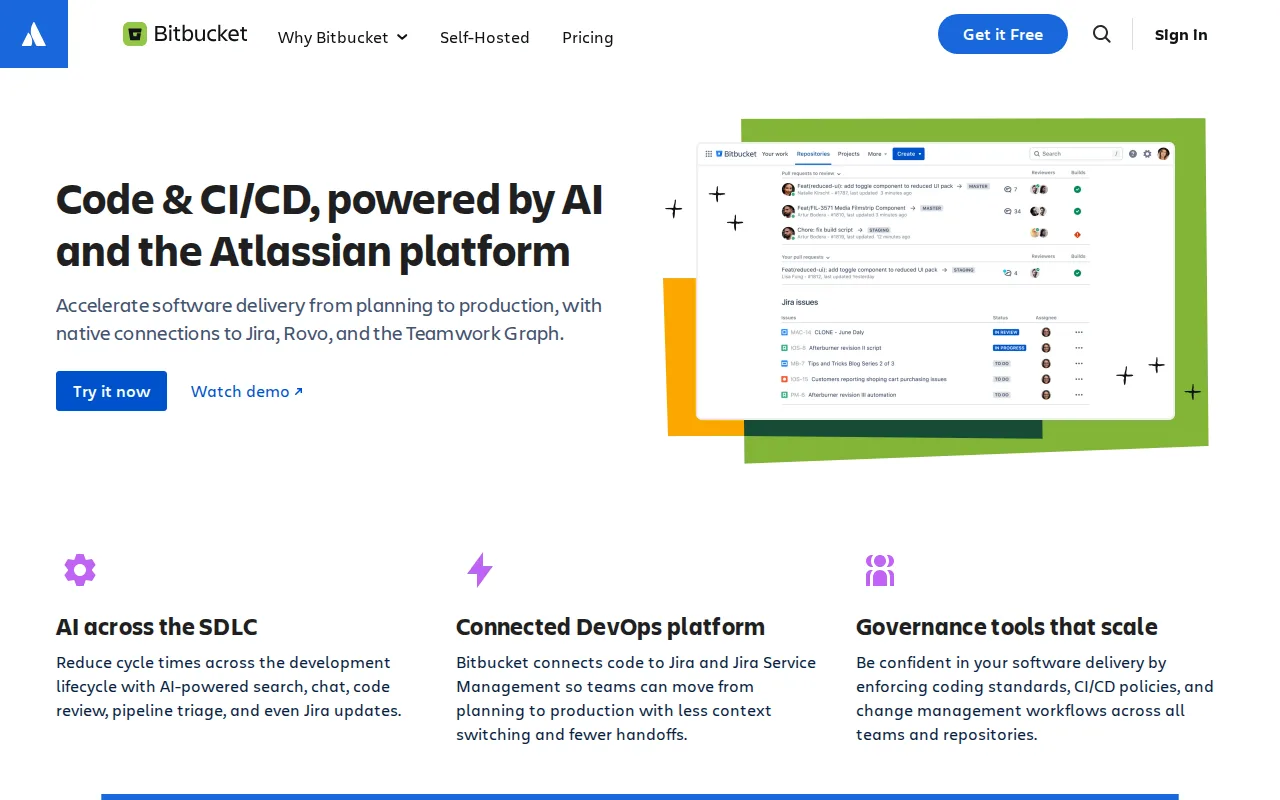
Bitbucket is the best Azure DevOps alternative for teams already standardized on Jira and Confluence who want Git hosting and CI/CD that link natively to issue tracking without a separate integration. Bitbucket's Pipelines, Atlassian's built-in CI/CD runner, ships without needing a separate tool, similar in spirit to Azure Pipelines but tied directly into Jira's workflow states through smart commits that can transition issue status from a commit message. Bitbucket holds a 4.6/5 rating from 1,347 Capterra reviews, more than 9 times Azure DevOps's own 148 reviews. Its Standard tier costs $3.65/user/month, well under Azure DevOps's $6/user/month Basic tier, and Premium at $7.25/user/month still undercuts Azure DevOps's Basic + Test Plans tier at $52/user/month. Azure DevOps remains the better choice for organizations that want a single integrated suite (Boards, Repos, Pipelines, Test Plans, Artifacts) rather than depending on the rest of the Atlassian ecosystem: Bitbucket has no self-hosted option since Atlassian retired Bitbucket Server/Data Center in 2024, and its third-party app marketplace is far smaller than the tooling available around Azure DevOps and the broader Microsoft ecosystem.
Compared to Azure DevOps: native Jira/Confluence integration with smart commits vs Azure DevOps's own Boards, 4.6/5 from 1,347 Capterra reviews vs Azure DevOps's 4.4/5 from 148, Standard tier at $3.65/user/month vs Azure DevOps's $6/user/month Basic
Wins:Native, bidirectional linking between commits/branches and Jira issues, including smart commits that transition issue status from a commit message · 4.6/5 rating from 1,347 Capterra reviews, more than 9 times Azure DevOps's own 148 reviews · Standard tier at $3.65/user/month and Premium at $7.25/user/month both undercut Azure DevOps's $6/user/month Basic and $52/user/month Basic + Test Plans tiers
Loses:No self-hosted option since Bitbucket Server/Data Center was discontinued in 2024, unlike Azure DevOps which offers on-premises deployment options · Free tier caps out at 5 users, smaller than Azure DevOps's first-5-users-free-per-organization allowance combined with its broader Boards/Pipelines/Artifacts bundle · Third-party integration marketplace is much smaller than the tooling available around Azure DevOps and the wider Microsoft ecosystem
Pros
- Native Jira and Confluence integration links commits and branches directly to issues without extra configuration.
- Built-in Pipelines CI/CD runs without needing a separate tool like CircleCI or GitHub Actions.
- Free plan covers up to 5 users with unlimited private repositories, useful for small teams.
- Community and academic organizations get free plans with expanded storage and build minutes.
Cons
- No self-hosted edition since Bitbucket Server/Data Center was discontinued in 2024; every plan is cloud-only.
- Free tier caps out at 5 users, smaller than GitHub's free-tier user allowance.
- Third-party integration marketplace is much smaller than GitHub's, reducing value for teams outside the Atlassian suite.
- Extra Pipelines build minutes or LFS storage cost $10/month per add-on block rather than being bundled into higher tiers.
Pricing: Free tier · paid from $3.65/mo — $3.65/user/month (Standard) or $7.25/user/month (Premium) vs Azure DevOps's $6/user/month Basic or $52/user/month with Test Plans (verified undefined NaN, NaN)
4.Jira — best Azure DevOps alternative for software development teams that need deeply configurable issue workflows and tight integration with Bitbucket/GitHub, and are willing to invest in a dedicated Jira admin to manage the configuration
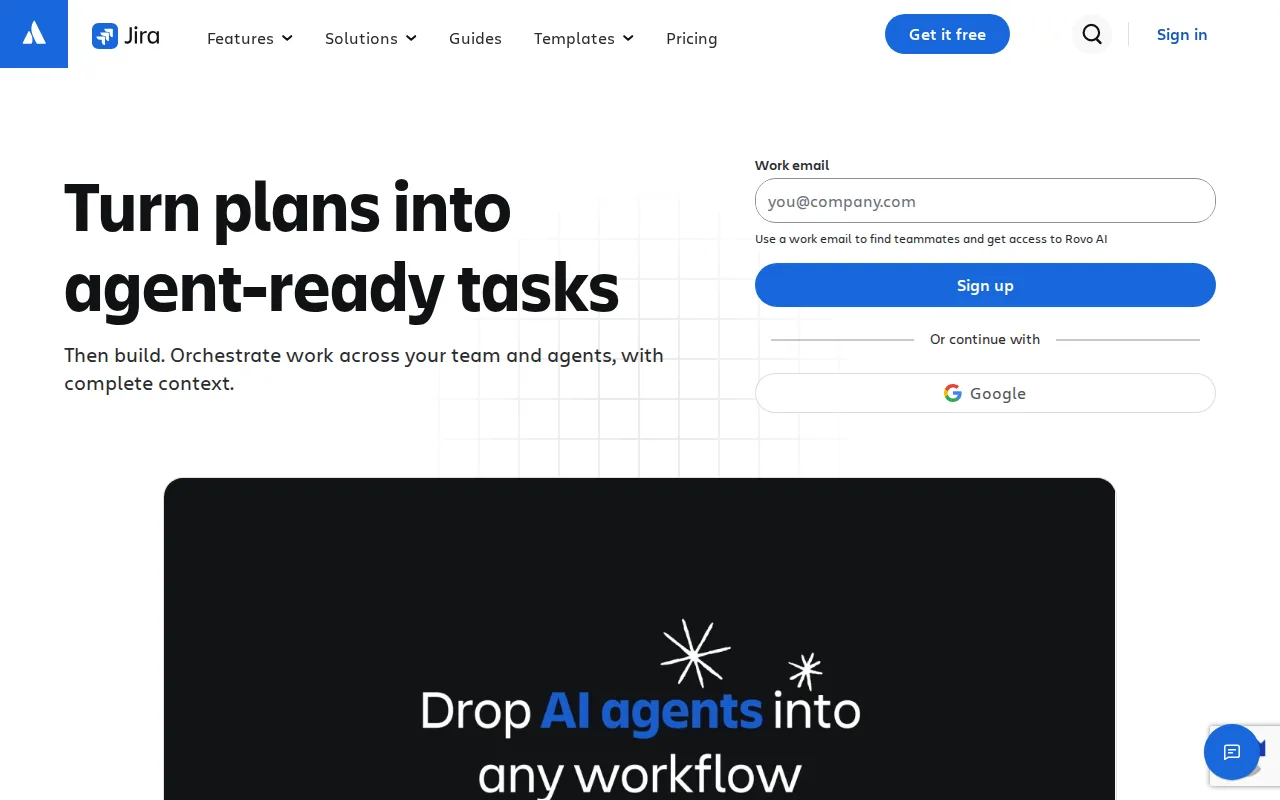
Jira is the best Azure DevOps alternative for software teams that need deeply configurable issue workflows and boards, the closest match to Azure Boards' own configurable Kanban and work-item tracking. Jira is free for up to 10 users, twice Azure DevOps's first-5-users-free-per-organization allowance, and its Standard tier starts around $7.91/user/month on monthly billing. Jira holds a 4.4/5 rating from 15,456 Capterra reviews, more than 104 times Azure DevOps's own 148 reviews and the largest review base among all four alternatives compared here. Jira's native integration with Bitbucket, GitHub, and GitLab links commits and pull requests directly to issues, giving teams choice of Git host rather than Azure DevOps's own bundled Repos. Azure DevOps remains the better choice for organizations that want work tracking bundled with Git hosting, CI/CD, manual testing, and package management under one login and one Microsoft billing relationship: Jira has no official native desktop app, access is web and mobile only, and Jira's own workflow and permission-scheme configuration commonly requires a dedicated Jira administrator to keep large instances from sprawling.
Compared to Azure DevOps: free for up to 10 users vs Azure DevOps's 5-user-free allowance, 4.4/5 from 15,456 Capterra reviews vs Azure DevOps's 4.4/5 from 148, native integration with any of GitHub/GitLab/Bitbucket rather than one bundled Repos product
Wins:Free for up to 10 users, twice Azure DevOps's first-5-users-free-per-organization allowance · 4.4/5 rating from 15,456 Capterra reviews, the largest review base among all four alternatives compared here and more than 104 times Azure DevOps's own 148 · Native integration with Bitbucket, GitHub, or GitLab lets teams keep their own Git host choice rather than being tied to one bundled Repos product
Loses:No official native desktop app; access is web and mobile only, unlike Azure DevOps's broader tooling options · No bundled CI/CD, manual test planning, or package management the way Azure DevOps combines Pipelines, Test Plans, and Artifacts alongside Boards · Workflow and permission-scheme configuration often requires a dedicated Jira administrator as instances scale past a few projects
Pros
- Free for up to 10 users with core Scrum/Kanban boards and backlog management.
- Deep workflow, field, and permission-scheme customization per project.
- Native integration with Bitbucket, GitHub, GitLab, and CI/CD pipelines links code directly to issues.
- Scales into the broader Atlassian suite (Confluence, Jira Product Discovery) without leaving the ecosystem.
Cons
- Steep learning curve; workflow and permission-scheme setup often requires a dedicated Jira administrator.
- Per-seat pricing slides with team size, making exact cost harder to predict than a flat per-seat rate.
- No official native desktop app; access is web and mobile only.
- Default configuration can feel heavy for small teams that just need a simple task list.
Pricing: Free tier · paid from $7.91/mo — Free for up to 10 users, then $7.91/user/month (Standard) vs Azure DevOps's first-5-users-free then $6/user/month Basic
Which one is right for you?
- You want Git hosting with the largest open-source community and Copilot built into code review.GitHub
- You want security and compliance scanning (SAST, DAST) built natively into your CI/CD pipeline.GitLab
- You're already standardized on Jira and Confluence and want Git hosting that links to issues natively.Bitbucket
- You need deeply configurable issue workflows and boards, free for up to 10 users.Jira
- You want the lowest per-seat starting price among the compared alternatives for a small team.Bitbucket
Frequently asked questions
What is the best alternative to Azure DevOps?
- GitHub is the best-reviewed alternative to Azure DevOps, holding a 4.8/5 rating from 6,198 Capterra reviews and an unlimited-user free tier versus Azure DevOps's first-5-users-free model. GitLab is the better fit for teams that want security scanning built natively into CI/CD.
Is there a free alternative to Azure DevOps?
- Yes — GitHub and GitLab both offer unlimited users on their free tier, more generous than Azure DevOps's first-5-users-free-per-organization allowance. Bitbucket caps free at 5 users and Jira caps free at 10 users.
Can GitHub replace Azure DevOps?
- GitHub can replace Azure DevOps for Git hosting, CI/CD, and project tracking, since GitHub Actions and Projects cover similar ground to Azure Pipelines and Boards. GitHub doesn't bundle a dedicated manual-testing product the way Azure DevOps's Test Plans add-on does, at $52/user/month.
What is the closest alternative to Azure DevOps for teams using Jira?
- Bitbucket is the closest alternative for teams already using Jira and Confluence, since it links commits and branches directly to Jira issues through smart commits. Bitbucket's Standard tier costs $3.65/user/month, undercutting Azure DevOps's $6/user/month Basic tier.
How does Azure DevOps pricing compare to its alternatives?
- Azure DevOps gives the first 5 users free per organization then charges $6/user/month Basic, or $52/user/month with Test Plans. Bitbucket's Standard tier at $3.65/user/month and Jira's free-for-10-users model both undercut that, while GitLab's Ultimate tier at $99/user/month is the most expensive option compared here.