1 Best Open-Source Alternatives to Airtable in 2026
By Noahlast updated pricing verified
Compared: open-source alternatives to Airtable
| Alternative | Best for | Standout | Biggest weakness | Learning curve | Price |
|---|---|---|---|---|---|
| Airtablereference | Small-to-midsize teams that need a relational database with a spreadsheet UI to run project trackers, content calendars, or lightweight CRMs without writing code. | Bases behave like a real relational database (linked records across tables) while looking and feeling like a spreadsheet, so non-technical users can model structured data without SQL. | Costs scale per editor seat, so a 20-person team on the Business plan pays $45/user/month billed annually ($900/month) just to give everyone edit rights, and the Free plan's record and attachment caps push active teams into a paid tier quickly. | Moderate | Free tier · paid from $20/mo |
| Baserow | teams that want an Airtable-like no-code database with the option to self-host for free under MIT, avoiding per-user fees at scale | MIT-licensed core can be self-hosted at no cost with no per-user pricing, avoiding Airtable's escalating per-seat cost as a team's row and collaborator count grows. | Self-hosted deployments lose premium and enterprise features (advanced permissions, audit logs, AI-assisted database building) unless paired with a commercial license, so the "fully free" self-hosted version is meaningfully less capable than the paid cloud tiers. | Moderate | Free tier · paid from $10/mo |
 Airtable
 Baserow
1.Baserow — best Airtable alternative for teams that want an Airtable-like no-code database with the option to self-host for free under MIT, avoiding per-user fees at scale
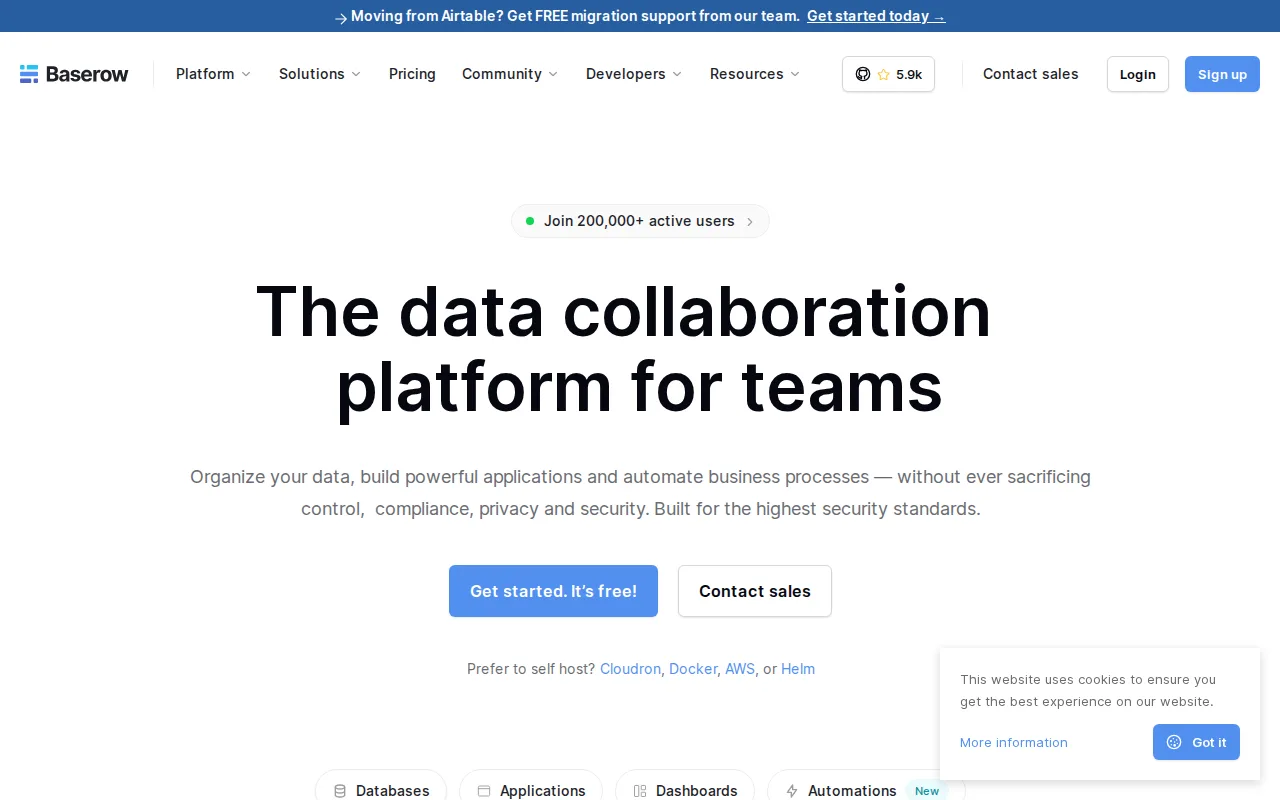
Baserow is the best Airtable alternative for teams that want the same no-code relational database under an open-source license they can host themselves. Baserow's core is MIT-licensed and runs free on Docker, Cloudron, AWS, or Helm with no per-user fees at all, which answers Airtable's own stated weakness directly: per-editor seat pricing at $20 per user/month on Team and $45 per user/month on Business, or $900/month for a 20-person team. On Baserow's managed cloud, Premium is $10 per user/month billed yearly ($12 billed monthly) with 50,000 rows per workspace and 20GB of storage, half Airtable Team's price; Advanced is $18 per user/month billed yearly ($22 monthly) with 250,000 rows, role-based permissions, and audit logs, still well under Airtable Business at $45. Baserow covers Grid, Kanban, Calendar, Timeline, Form, Gallery, and Survey views and holds 4.7/5 from 69 Capterra reviews plus 5.0/5 from 6 Product Hunt reviews. Airtable is still the better choice for reach and ecosystem. Baserow runs in the browser only, with no Windows, macOS, iOS, or Android apps, all four of which Airtable ships, and its integration and template ecosystem is far smaller. Self-hosting also costs capability: the free self-hosted edition withholds the Kuma AI assistant, advanced permissions, and audit logs without a commercial license.
Compared to Airtable: an MIT-licensed core that self-hosts with no per-user fees, cloud Premium at $10 per user/month billed yearly against Airtable Team's $20, but browser-only with no desktop or mobile apps
Wins:MIT-licensed core self-hosts free on Docker, Cloudron, AWS, or Helm with no per-user fees, against the $900/month Airtable Business costs for 20 editors · Cloud Premium is $10 per user/month billed yearly ($12 monthly) for 50,000 rows and 20GB of storage, half Airtable Team's $20 per user/month · 4.7/5 from 69 Capterra reviews and 5.0/5 from 6 Product Hunt reviews, where Airtable has no external review-platform rating on record
Loses:Browser-only: no Windows, macOS, iOS, or Android apps, all of which Airtable ships · The free self-hosted edition withholds the Kuma AI assistant, advanced permissions, and audit logs without a commercial license · Smaller integration and template ecosystem than Airtable's, and free cloud workspaces cap at 3,000 rows and 2GB of storage
Pros
- MIT-licensed core is genuinely free to self-host with no per-user fees.
- Multiple view types (Grid, Kanban, Calendar, Timeline, Form, Gallery, Survey) cover most no-code database use cases.
- Automations and an app builder are included alongside the core database, reducing the need for separate tools.
- GDPR, HIPAA, and SOC 2 compliance available on the managed cloud offering.
Cons
- Premium features like the Kuma AI assistant, advanced permissions, and audit logs are withheld from the free self-hosted edition.
- Row and storage limits on the Free and Premium cloud tiers (3,000 and 50,000 rows respectively) can be restrictive for larger datasets.
- Enterprise pricing is not published and requires a sales conversation.
- Smaller third-party integration and template ecosystem than Airtable's much larger, longer-established marketplace.
Pricing: Free tier · paid from $10/mo — Self-hosted free under MIT, or cloud Premium at $10 per user/month billed yearly ($12 monthly) vs Airtable Team at $20 per user/month billed annually (verified undefined NaN, NaN)