Baserow — An open-source, no-code database and app builder positioned as an Airtable alternative, free self-hosted under MIT or from $10/user/month on cloud.

By Noahlast updated pricing verified
Baserow screenshots & video
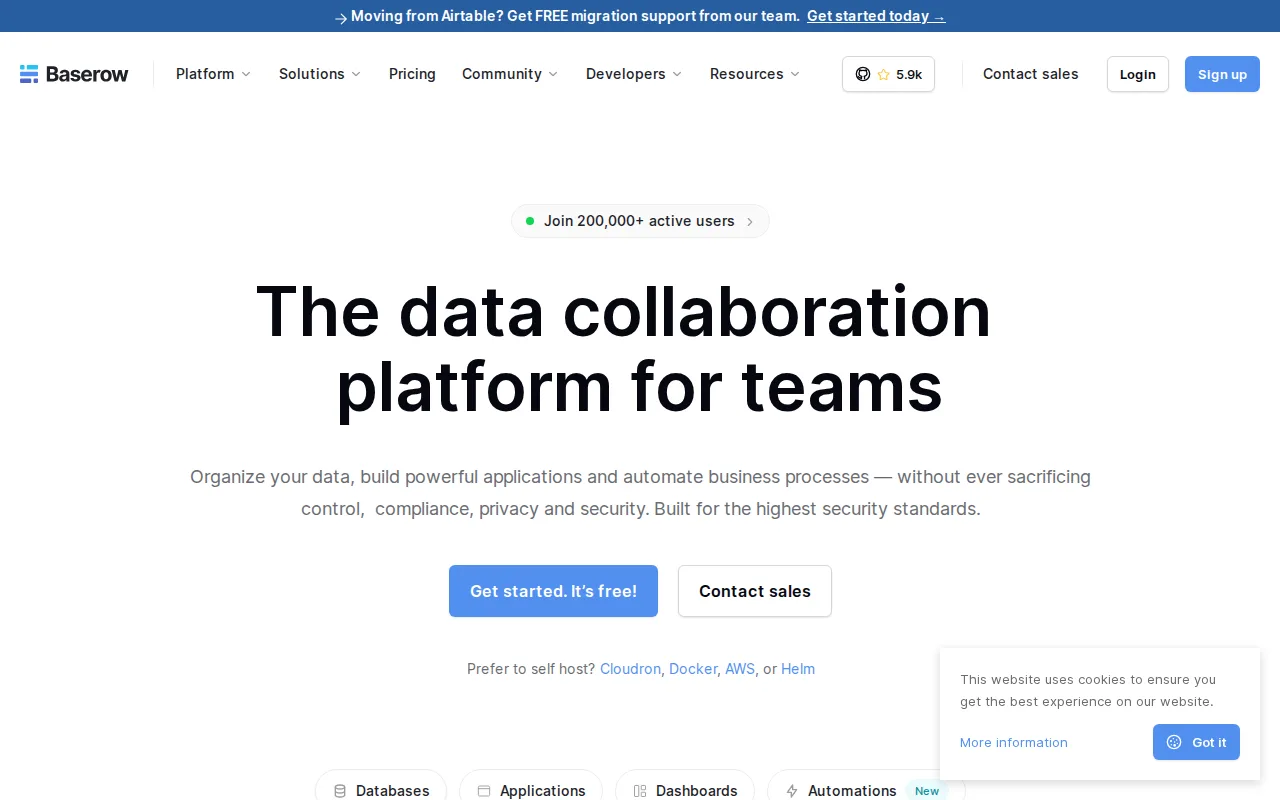
Baserow in 20 seconds
Best for: teams wanting an Airtable-like no-code database with the option to self-host for free under MIT
Pricing: Free cloud tier (3,000 rows); Premium $10/user/month billed yearly, Advanced $18/user/month billed yearly, Enterprise custom.
- Baserow's core is MIT-licensed and free to self-host with no per-user fees.
- Baserow's cloud Premium tier costs $10/user/month billed yearly ($12/month billed monthly) for 50,000 rows/workspace.
- Baserow's Advanced tier costs $18/user/month billed yearly ($22/month billed monthly) for role-based permissions and audit logs.
- The GitHub repository has 5.6k stars.
- Baserow holds a 4.7/5 rating from 69 reviews on Capterra and 5.0/5 from 6 reviews on Product Hunt.
Limitations: Self-hosted free edition lacks premium features like the Kuma AI assistant and audit logs.; Free and Premium cloud tiers cap rows at 3,000 and 50,000 respectively.; Enterprise pricing is not published and requires contacting sales.
Top alternatives: Airtable, NocoDB, Grist, Notion, Smartsheet — full list
What is Baserow?
Baserow is an open-source spreadsheet-database hybrid, positioned explicitly as a no-code, self-hostable alternative to Airtable. Data is organized into tables that can be viewed as a spreadsheet grid, a Kanban board, a calendar, a timeline, or a form for external submissions, and Baserow layers visual automation workflows (triggers, conditions, loops) and an app builder for lightweight internal tools on top of the underlying database. The project is open-core: the MIT-licensed core and non-premium features can be self-hosted for free with no per-user fees, which Baserow markets as a key differentiator against Airtable's per-seat pricing at scale. Premium features, including its Kuma AI assistant that builds databases from natural-language descriptions, higher row/storage limits, role-based permissions, and audit logging, require either a paid cloud subscription or a commercial license for self-hosted enterprise deployments. Baserow targets teams across HR, marketing, finance, sales, operations, and IT who want database-backed internal tools without engineering resources, and lists customers including Royal Bank of Canada and Capgemini, with GDPR, HIPAA, and SOC 2 compliance available on its managed cloud offering.
Baserow is an open-source, no-code database and application builder that lets teams organize data into Grid, Kanban, Calendar, Timeline, Form, Gallery, and Survey views, then layer automations and simple apps on top without writing code. It is MIT-licensed and open-core: the base platform and non-premium/non-enterprise features are free to self-host via Docker, Cloudron, AWS, or Helm, while premium features (unlimited rows beyond the free tier, AI-assisted database building via its Kuma assistant, advanced permissions, audit logs) require a paid plan. Baserow's cloud offering starts free (3,000 rows/workspace, 2GB storage), moves to Premium at $10/user/month billed yearly ($12 monthly) for 50,000 rows and AI features, Advanced at $18/user/month billed yearly ($22 monthly) for role-based permissions and audit logs, and Enterprise at custom pricing. The GitHub repository has 5.6k stars, and Baserow holds a 4.7/5 rating from 69 reviews on Capterra and a 5.0/5 rating from 6 reviews on Product Hunt.
Standout feature: MIT-licensed core can be self-hosted at no cost with no per-user pricing, avoiding Airtable's escalating per-seat cost as a team's row and collaborator count grows.
Biggest weakness: Self-hosted deployments lose premium and enterprise features (advanced permissions, audit logs, AI-assisted database building) unless paired with a commercial license, so the "fully free" self-hosted version is meaningfully less capable than the paid cloud tiers.
Pros
- MIT-licensed core is genuinely free to self-host with no per-user fees.
- Multiple view types (Grid, Kanban, Calendar, Timeline, Form, Gallery, Survey) cover most no-code database use cases.
- Automations and an app builder are included alongside the core database, reducing the need for separate tools.
- GDPR, HIPAA, and SOC 2 compliance available on the managed cloud offering.
Cons
- Premium features like the Kuma AI assistant, advanced permissions, and audit logs are withheld from the free self-hosted edition.
- Row and storage limits on the Free and Premium cloud tiers (3,000 and 50,000 rows respectively) can be restrictive for larger datasets.
- Enterprise pricing is not published and requires a sales conversation.
- Smaller third-party integration and template ecosystem than Airtable's much larger, longer-established marketplace.
Baserow pricing
Free tier · paid from $10/mo · verified from the vendor's pricing page
| Plan | Price | Notes |
|---|---|---|
| Free | Free | 3,000 rows/workspace, 2GB storage, 2,000 automation credits; Grid, Form, and Gallery views; access to 65+ templates. |
| Premium | $10/mo | Per user, billed yearly ($12/month billed monthly); 50,000 rows/workspace, 20GB storage, 100,000 automation credits, all view types, AI features. |
| Advanced | $18/mo | Per user, billed yearly ($22/month billed monthly); 250,000 rows/workspace, 100GB storage, 500,000 automation credits, role-based permissions, audit logs. |
| Enterprise | Custom | Custom pricing; 1,000,000 rows/workspace, 1,000GB storage, unlimited external app users, implementation support. |
What reviewers say
Scores belong to their platforms; we display them with attribution and never fold them into our own ratings.