Zulip — Open-source, topic-threaded team chat with a free self-hosted tier and Zulip Cloud plans from $6.67/user/month billed annually.

By Noahlast updated pricing verified
Zulip screenshots & video
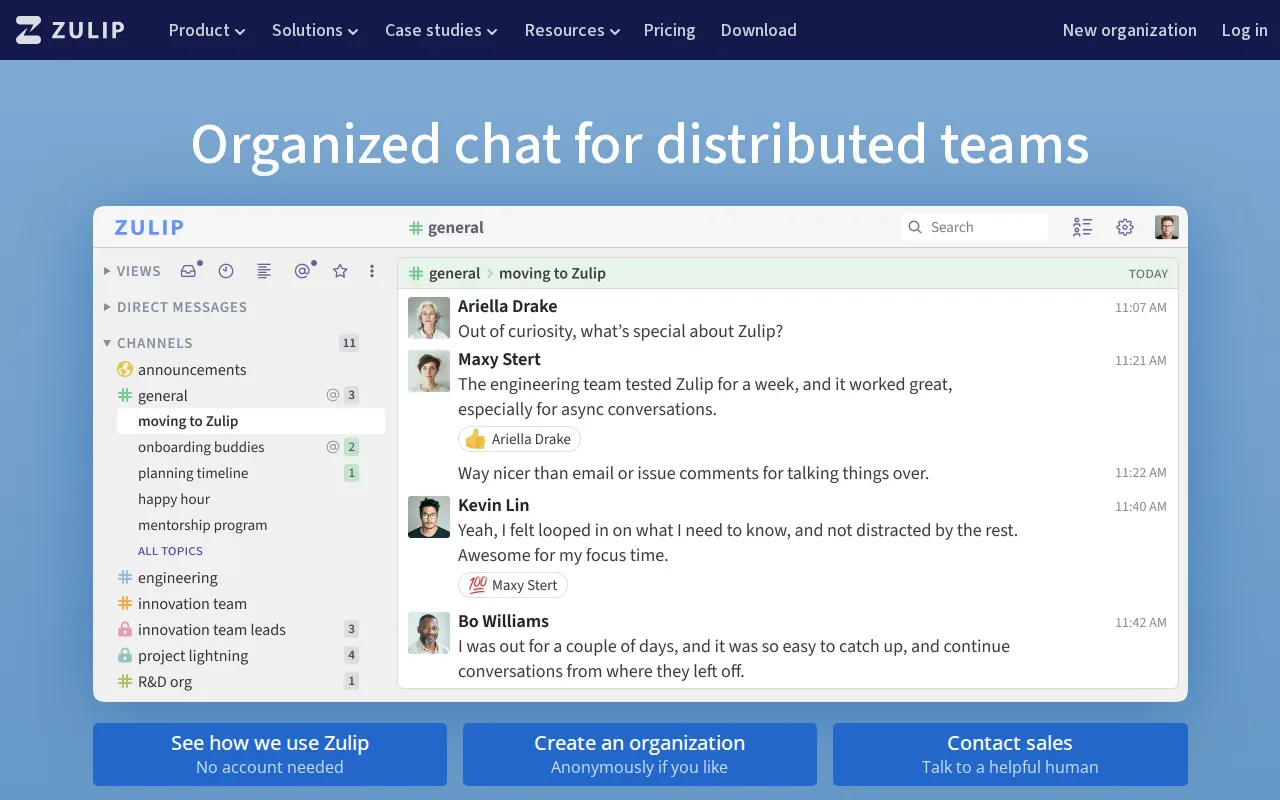
Zulip in 20 seconds
Best for: distributed and remote teams who need many parallel conversations to stay organized without a flat chat feed
Pricing: Free self-hosted edition with full features; Zulip Cloud from $6.67/user/month billed annually; paid self-hosted support tiers from $3.50/user/month.
- Zulip's self-hosted edition is free, open source (Apache 2.0), and includes the complete feature set with no per-user cap.
- Zulip Cloud Standard costs $6.67/user/month billed annually ($8/month billed monthly).
- Zulip holds a 4.9/5 rating from 196 reviews on Capterra.
- Zulip organizes conversations by channel and topic, not a single flat message stream.
- Zulip's source code is public on GitHub (zulip/zulip) with over 25,700 stars.
Limitations: Topic-based threading is a different mental model from flat-stream chat and takes adjustment.; Cloud Free caps search history at 10,000 messages.; Self-hosting requires ongoing server maintenance to match Zulip Cloud's reliability.
Top alternatives: Slack, Microsoft Teams, Discord, Mattermost, Rocket.Chat — full list
What is Zulip?
Zulip is a team chat application that organizes conversations by channel and topic, rather than the single merged message stream most chat apps use, so that a single channel can hold many parallel, clearly labeled conversations at once. Each message belongs to a channel (e.g. "engineering") and a topic within it (e.g. "deploy failure - Aug 20"), which lets people jump into or catch up on one topic without reading unrelated messages in the same channel — a model Zulip positions as better suited to asynchronous, distributed teams than flat-stream chat apps. The core Zulip server and web/desktop/mobile apps are open source under the Apache 2.0 license, published on GitHub (zulip/zulip, 25,700+ stars), and are genuinely self-hostable with the full feature set available for free with no per-user cap. Zulip Cloud is the managed hosting option, with free and paid ($6.67-10/user/month) plans; the self-hosted edition also has optional paid tiers ($3.50-8/user/month) that add unlimited mobile push notifications and support without gating core chat features. Apps are available for web, Windows, macOS, Linux, iOS, and Android.
Zulip is an open-source team chat app built around topic-based threading, organizing every conversation into a channel-plus-topic pair so distributed teams can follow specific discussions without scrolling through one merged feed. Zulip Cloud's free plan includes 10,000 messages of search history and 5GB of file storage; Standard costs $6.67/user/month billed annually ($8/month billed monthly) for unlimited history and priority support; Plus costs $10/user/month billed annually ($12/month billed monthly, 10-user minimum) and adds SAML SSO and SCIM sync. The self-hosted edition is free with the complete feature set and no user cap; paid self-hosted Basic ($3.50/user/month) and Business ($6.67-8/user/month, 25-user minimum) tiers add unlimited mobile push notifications and support. Zulip's code is public on GitHub (zulip/zulip) under Apache 2.0, making it a common pick for teams that want Slack-style chat with a genuine self-hosted, open-source option.
Standout feature: Topic-based threading splits every channel into named sub-conversations by default, so a team can hold dozens of parallel discussions in one channel without losing track of any of them, and the full self-hosted edition is genuinely free with no per-user cap on core features.
Biggest weakness: Topic-based threading is a real behavior change from flat-stream chat apps like Slack or Microsoft Teams, so teams migrating over often need a deliberate adjustment period, and self-hosting requires the same ongoing server maintenance any self-hosted Basic/Business/Enterprise pricing.
Pros
- Self-hosted edition is fully open source (Apache 2.0) and free with the complete feature set and no user cap.
- Topic-based threading keeps many parallel conversations organized within a single channel.
- Cloud Free plan includes hundreds of integrations and guest accounts, not just a stripped demo.
- Apps available on web, Windows, macOS, Linux, iOS, and Android.
Cons
- Topic-based threading is a different mental model from flat-stream chat and requires teams to adjust their habits.
- Cloud Free caps search history at 10,000 messages, which active teams can hit quickly.
- Cloud Plus and Self-Hosted Business both carry 10- and 25-user minimums, respectively, so small teams pay a per-seat floor.
- Self-hosting requires ongoing server maintenance to get the same reliability as the managed Zulip Cloud.
Zulip pricing
Free tier · paid from $3.50/mo · verified from the vendor's pricing page
| Plan | Price | Notes |
|---|---|---|
| Cloud Free | Free | 10,000 messages of search history, 5GB total file storage, roles/permissions, guest accounts, hundreds of integrations. |
| Cloud Standard | $6.67/mo | Per user, billed annually ($8/month billed monthly); unlimited search history, 5GB per-user file storage, custom groups, message retention policies, priority support. |
| Cloud Plus | $10/mo | Per user, billed annually ($12/month billed monthly), 10-user minimum; adds 25GB per-user file storage, SAML SSO, SCIM sync, custom domain. |
| Self-Hosted Free | Free | Complete self-hosted feature set with no per-user cap; mobile push notifications capped at 10 users for communities not eligible for Zulip's free unlimited-notification program. |
| Self-Hosted Basic | $3.50/mo | Per user, billed monthly; unlimited mobile push notifications; $20/month discount in the first year. |
| Self-Hosted Business | $6.67/mo | Per user, billed annually ($8/month billed monthly), 25-user minimum; adds email/chat support for SSO, AD/LDAP, guests, and exports. |
| Self-Hosted Enterprise | Custom | Custom pricing; OpenID Connect, advanced group sync, SCIM, implementation consulting, and phone support. |
What reviewers say
Scores belong to their platforms; we display them with attribution and never fold them into our own ratings.