1 Best Open-Source Alternatives to Zcal in 2026
By Noahlast updated
Compared: open-source alternatives to Zcal
| Alternative | Best for | Standout | Biggest weakness | Learning curve | Price |
|---|---|---|---|---|---|
| Zcalreference | individual sales, coaching, and client-facing professionals who want a fast, highly customizable free scheduling page as a Calendly alternative | Unlimited invite links and calendar connections are included in the free plan, covering what Zcal describes as 99% of its features, more generous than free tiers on most competing scheduling tools. | The paid Team plan's price is not published on Zcal's pricing page, and with only about a dozen reviews on Capterra and Product Hunt, Zcal has a much shorter, thinner track record than established competitors like Calendly. | Low | Free |
| Cal.com | individuals and technical teams who want an open-source, self-hostable Calendly alternative with API-level control over booking flows | The scheduling engine is genuinely self-hostable via Docker, with a fully open community fork (cal.diy, MIT-licensed) that strips out enterprise/commercial code entirely, giving teams a real self-hosted path rather than an open-source demo that funnels users to the paid cloud. | Self-hosting requires ongoing infrastructure maintenance and doesn't include Cal.com's managed support, while advanced features like SSO and fine-grained access control are gated behind the pricier Organizations and Enterprise tiers on the hosted product. | Moderate | Free tier · paid from $12/mo |
 Zcal
Zcal Cal.com
1.Cal.com — best Zcal alternative for individuals and technical teams who want an open-source, self-hostable Calendly alternative with API-level control over booking flows
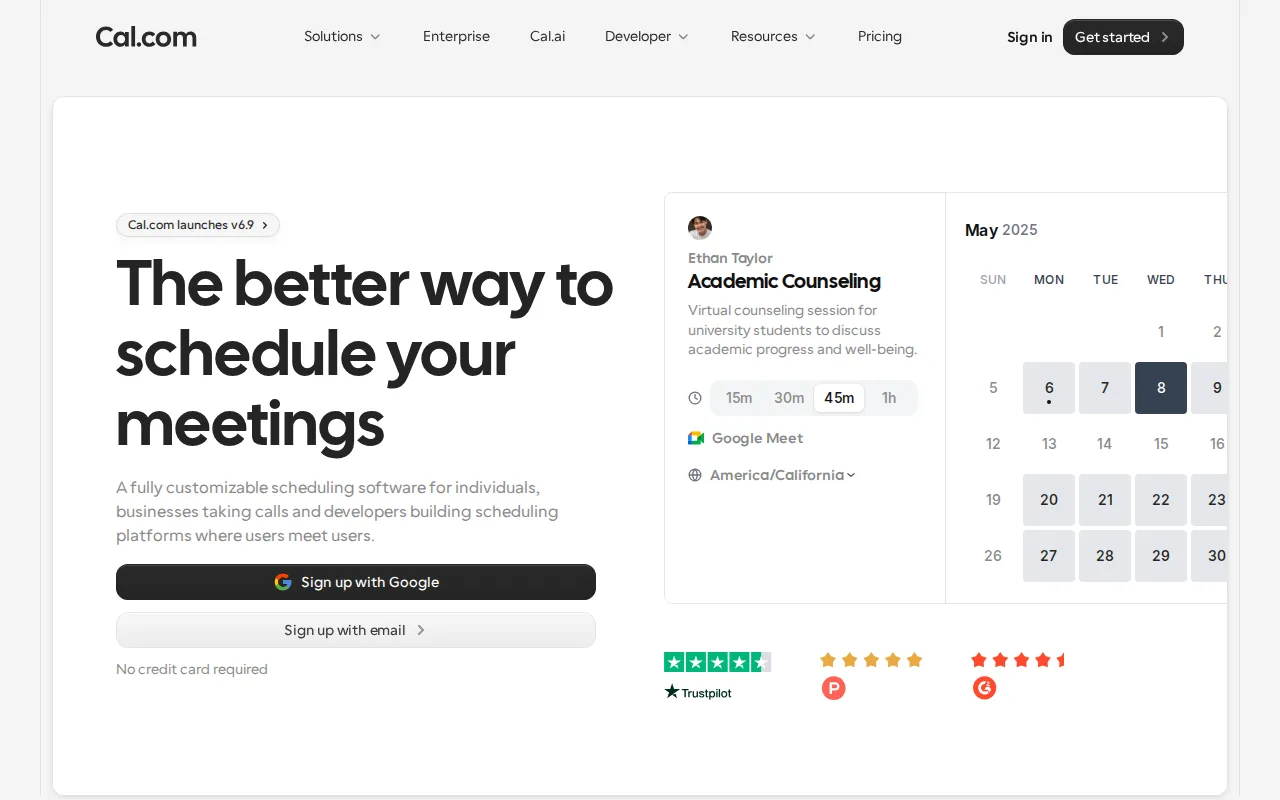
Cal.com is the best Zcal alternative for individuals and technical teams who want an open-source, self-hostable scheduling engine: its community codebase, maintained as the MIT-licensed cal.diy fork, lets organizations run their own booking infrastructure, an option Zcal's listing doesn't offer. Cal.com publishes its Teams pricing directly at $12/user/month, while Zcal's paid Team plan shows no dollar figure on its pricing page, and Cal.com's 85 Product Hunt reviews (4.8/5) is a larger sample than Zcal's own 14 Product Hunt reviews (4.4/5). Zcal is still the better choice for buyers who want more functionality free without adopting open-source infrastructure: Zcal describes 99% of its features, including unlimited invite links and calendar connections, as available on its Free plan for a single user, while Cal.com's Free plan, though also generous with unlimited event types and calendars, requires managing a separate self-hosted deployment to get equivalent infrastructure control.
Compared to Zcal: genuinely self-hostable via Docker with a fully open MIT-licensed community fork, publishes real starting price ($12/user/month Teams) instead of an unpriced Team plan, larger Product Hunt review base (85 reviews at 4.8/5 vs 14 at 4.4/5)
Wins:Genuinely self-hostable via Docker, with a fully open MIT-licensed community fork (cal.diy) available · Publishes real self-serve pricing ($12/user/month Teams) instead of Zcal's unpriced Team plan · 85 Product Hunt reviews (4.8/5), a larger sample than Zcal's own 14 Product Hunt reviews (4.4/5)
Loses:Self-hosting requires ongoing infrastructure maintenance, unlike Zcal's fully managed free plan · No Capterra rating in our listing data to compare directly against Zcal's 4.9/5 from 12 reviews · SSO and advanced access control are gated to the pricier Organizations and Enterprise tiers
Pros
- Free tier includes unlimited event types and calendars for a single user, with no artificial feature caps.
- Genuinely self-hostable via Docker, with a fully open MIT-licensed community fork (cal.diy) available.
- 100+ integrations and two-way Salesforce/HubSpot sync are available even on the free plan.
- Built-in Stripe and PayPal payment collection at time of booking without a separate add-on.
Cons
- Self-hosting requires ongoing infrastructure maintenance and forgoes Cal.com's managed support and updates.
- SSO and advanced access control are gated to the pricier Organizations and Enterprise tiers.
- Team-oriented features require per-user billing ($12-28/user/month), which adds up faster than Calendly's flat team pricing at small seat counts.
- Self-hosted deployments can lag behind the hosted cloud product on the latest feature releases.
Pricing: Free tier · paid from $12/mo — $12/user/month Teams vs Zcal's unpriced paid Team plan (verified undefined NaN, NaN)