1 Best Open-Source Alternatives to Weebly in 2026
By Noahlast updated pricing verified
Compared: open-source alternatives to Weebly
| Alternative | Best for | Standout | Biggest weakness | Learning curve | Price |
|---|---|---|---|---|---|
| Weeblyreference | small businesses and solo entrepreneurs who want a simple website with built-in Square-powered online selling, without a separate e-commerce platform | Unlimited e-commerce items, a shopping cart, and Square Gift Cards are included even on the entry-level $13/month Personal plan, unlike builders that reserve online selling for a dedicated commerce tier. | Templates and layout flexibility lag newer builders like Squarespace and Webflow — sections stack in a fixed grid with no freeform canvas, and reviewers describe the design options as dated. | Low | Free tier · paid from $13/mo |
| WordPress | site owners and developers who want full control over hosting, plugins, and code, and are comfortable managing their own server, security updates, and backups in exchange for no software licensing cost | A plugin ecosystem with tens of thousands of free and premium plugins (WooCommerce for e-commerce, Yoast for SEO, and more) that lets a self-hosted install take on nearly any site type without custom development. | Because it is self-hosted, the site owner is fully responsible for hosting performance, security patching, and backups; a poorly chosen host or an unmaintained plugin is a common source of slow sites, hacked installs, and update conflicts that hosted builders like Squarespace and Wix eliminate entirely. | Moderate | Free |
 Weebly
 WordPress
1.WordPress — best Weebly alternative for site owners and developers who want full control over hosting, plugins, and code, and are comfortable managing their own server, security updates, and backups in exchange for no software licensing cost
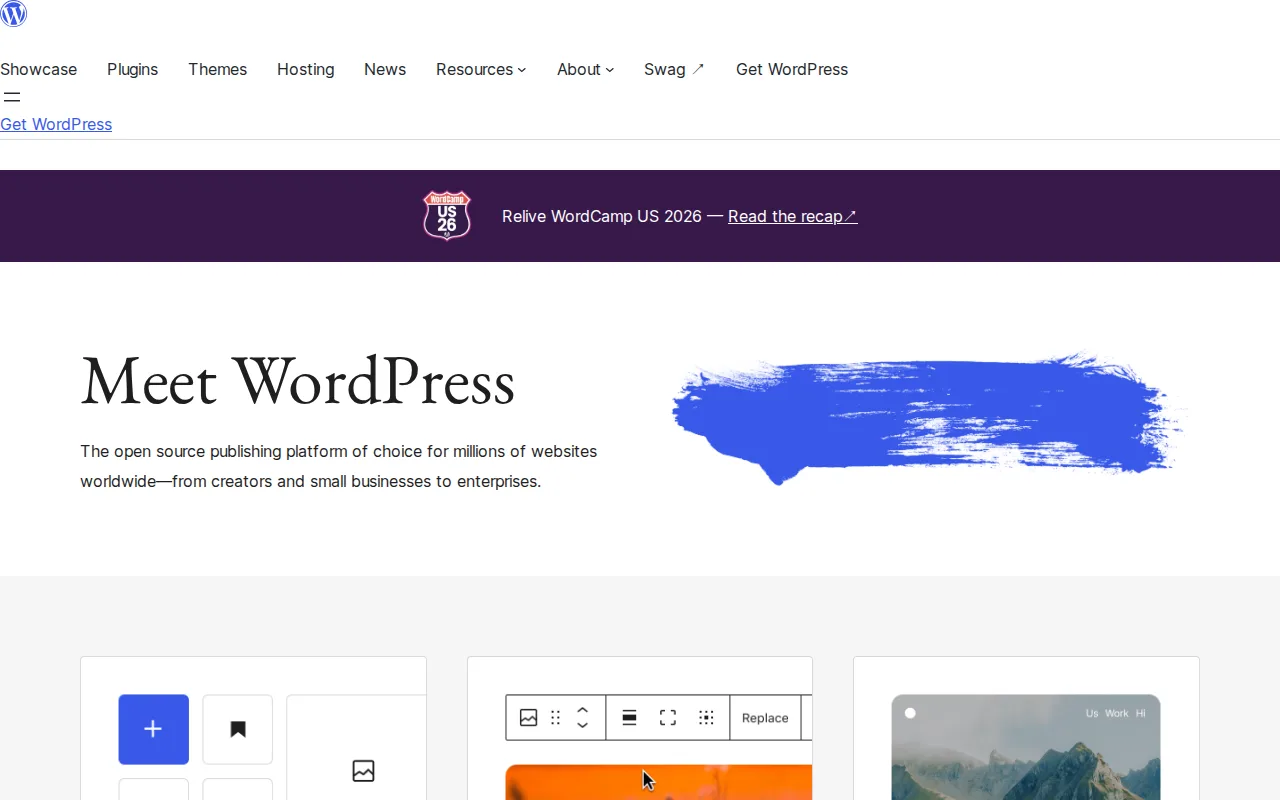
WordPress is the best Weebly alternative for site owners who want full ownership and no software licensing cost, going further than Weebly's hosted, subscription-based model: WordPress is free to download and self-host under the GPLv2 (or later) license with no vendor-imposed pricing tiers at all, unlike Weebly, where a custom domain requires the paid Personal tier. WordPress's plugin ecosystem, including WooCommerce for e-commerce and Yoast for SEO, lets a base install take on nearly any site type without custom development, a far broader extensibility model than Weebly's more limited built-in feature set. Weebly is still the better choice for small businesses that want a fully hosted, no-maintenance experience with e-commerce built in from day one: WordPress requires the site owner to manage their own hosting performance, security patching, and backups, with no built-in vendor safety net, while Weebly's every paid tier includes unlimited e-commerce items and Square Gift Cards with hosting, SSL, and support all handled by Weebly itself. WordPress's total cost is also unpredictable compared to Weebly's fixed-tier pricing, since hosting, premium themes, and premium plugins are all separate purchases.
Compared to Weebly: free, self-hosted core with no licensing cost vs Weebly's subscription pricing, self-managed hosting/security/backups vs Weebly's fully hosted model, unpredictable total cost vs Weebly's fixed-tier pricing
Wins:Free software under GPLv2 with no licensing fee regardless of site size or traffic, unlike Weebly's tiered subscription pricing · Plugin ecosystem (WooCommerce, Yoast, and thousands more) lets a base install take on nearly any site type without custom development · Full ownership and portability: a self-hosted WordPress site can move to any host without vendor lock-in, unlike Weebly's closed platform
Loses:Site owner is fully responsible for hosting performance, security patching, and backups, with no built-in vendor safety net the way Weebly provides · Total cost is unpredictable compared to Weebly's fixed-tier pricing, since hosting, premium themes, and plugins are separate purchases · Learning curve for a properly configured, secure, fast site is steeper than Weebly's simple drag-and-drop editor
Pros
- Free software under GPLv2, no licensing fee regardless of site size or traffic.
- Plugin ecosystem covers e-commerce, SEO, forms, and page-building without custom code for most common needs.
- Full ownership and portability: a self-hosted WordPress site can move to any host without vendor lock-in.
- Massive community documentation, forums, and third-party tutorials for nearly any configuration question.
Cons
- Self-hosting means the site owner is responsible for security updates, backups, and server performance, with no built-in vendor safety net.
- Plugin quality varies widely; poorly maintained plugins are a common source of security vulnerabilities and site breakage after core updates.
- Total cost is unpredictable compared to fixed-tier builders, since hosting, premium themes, and premium plugins are all separate purchases.
- The learning curve for a properly configured, secure, fast site is steeper than fully hosted builders like Squarespace or Wix.
Pricing: Free — Free software (self-hosted; hosting and add-ons priced separately) vs Weebly's $13/month Personal (billed annually) (verified undefined NaN, NaN)