Webflow — A visual, no-code website builder and CMS with built-in hosting, used by designers and marketers to ship production sites; paid site plans start around $18/month.

By Noahlast updated
Webflow screenshots & video
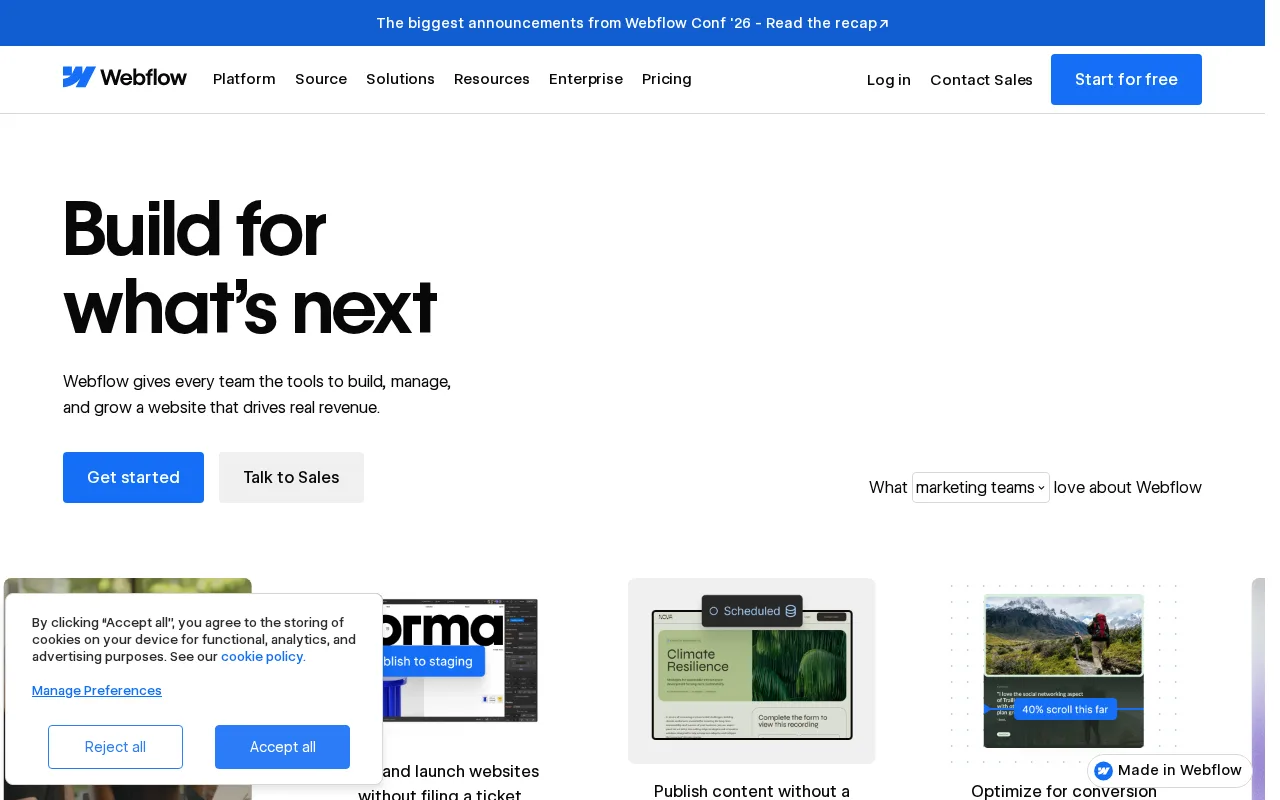
Webflow in 20 seconds
Best for: designers and marketing teams who want a fully custom, responsive website without hand-coding CSS
Pricing: Free starter tier; paid site plans run about $18-49/month depending on tier (monthly billing).
- Webflow generates production HTML, CSS, and JavaScript from a browser-based visual design canvas.
- Founded in 2013 by Vlad Magdalin, Sergie Magdalin, and Bryant Chou through Y Combinator.
- Site plans range from a free webflow.io subdomain tier through Basic, CMS, and Business paid tiers.
- Webflow reports powering roughly 1.2% of the top 10 million websites.
Limitations: No portable export to self-host elsewhere; leaving Webflow means rebuilding the site.; CMS collection-item and bandwidth limits force upgrades as content-heavy sites grow.
Top alternatives: WordPress.com, Squarespace, Wix — full list
What is Webflow?
Webflow is a visual website builder that generates production HTML, CSS, and JavaScript from a browser-based design canvas, aimed at designers and marketers who want pixel-level control without hand-coding, and at developers who want clean exportable output. Founded in 2013 by Vlad Magdalin, Sergie Magdalin, and Bryant Chou through Y Combinator, Webflow bundles four things most competitors sell separately: a visual design tool with full CSS access, a headless-capable CMS for dynamic content, built-in hosting with a claimed 99.99% uptime, and AI features for generating starter sites, writing copy, and running automated A/B tests. Site plans range from a free webflow.io-subdomain tier through Basic, CMS, and Business plans that add custom domains, more CMS collection items, and higher traffic/bandwidth allowances; Ecommerce and multi-seat Workspace plans are priced on separate schedules from the core site plans. Webflow markets itself to four audiences on one platform — marketers who edit content visually, designers who manage design systems, developers who use the API/webhooks and Figma import, and agencies who hand off CMS-driven sites to non-technical clients — and has grown through acquisitions including animation library GreenSock (2024) and Vidoso.ai (2026).
Webflow is a visual website builder that lets designers and marketers build responsive sites with full CSS control in the browser, then publish to Webflow's own hosting without hand-writing HTML or CSS, while still exporting clean code for developers who want it. Site plans start on a free tier limited to a webflow.io subdomain, with paid plans beginning around $18/month (Basic, billed monthly) for a custom domain and rising through CMS (~$29/month) and Business (~$49/month) tiers for content-heavy or high-traffic sites; ecommerce and multi-seat workspace plans are priced separately. The platform bundles a visual CMS, native analytics, AI-assisted site generation and A/B testing, and SEO tooling aimed at marketer-led content sites and agency client work. Webflow reports powering roughly 1.2% of the top 10 million websites and has expanded through acquisitions including animation library GreenSock and Vidoso.ai.
Standout feature: Full CSS-level design control in the browser combined with a visual CMS and built-in hosting, so designers can ship production sites without a separate developer handoff for styling.
Biggest weakness: Sites are locked into Webflow's own hosting and CMS data model — there's no simple one-click export to run the same site on another host, so switching away later means rebuilding rather than migrating, and CMS collection-item limits force upgrades as content-heavy sites grow.
Pros
- Full CSS-level visual control produces genuinely custom designs, not template-locked layouts.
- Visual CMS lets marketers manage dynamic content (blog posts, products, team bios) without touching code.
- Hosting, CDN, and SSL are bundled in every paid plan instead of requiring a separate hosting purchase.
- Figma import and clean code export give developers a path in and out of the visual editor.
Cons
- No portable export to self-host elsewhere; leaving Webflow means rebuilding the site on another platform, not migrating a file.
- CMS collection-item and bandwidth limits mean content-heavy or high-traffic sites are pushed toward the pricier Business tier.
- Ecommerce and multi-seat Workspace plans are priced separately from site plans, making total cost harder to estimate upfront.
Webflow pricing
Free tier · paid from $18/mo
| Plan | Price | Notes |
|---|---|---|
| Starter | Free | Free tier limited to a webflow.io subdomain; suitable for prototypes and personal projects, not custom domains. |
| Basic | $18/mo | Monthly billing rate (discounted under annual billing); custom domain support, no CMS collections. |
| CMS | $29/mo | Monthly billing rate; adds the visual CMS with a set number of collection items and blog-style content management. |
| Business | $49/mo | Monthly billing rate; higher CMS item limits, more form submissions and bandwidth, and priority support for higher-traffic sites. |
What reviewers say
Scores belong to their platforms; we display them with attribution and never fold them into our own ratings.