3 Best Free Alternatives to VSCodium in 2026
By Noahlast updated pricing verified
Compared: free alternatives to VSCodium
| Alternative | Best for | Standout | Biggest weakness | Learning curve | Price |
|---|---|---|---|---|---|
| VSCodiumreference | developers who want VS Code's editing experience and MIT-licensed source without Microsoft's telemetry, proprietary marketplace terms, or branding | Ships the exact same MIT-licensed source as VS Code, compiled without Microsoft's proprietary product.json customizations, so telemetry is disabled by default. | Can't use Microsoft's official Visual Studio Marketplace due to its licensing terms, so extension installation depends on the smaller Open VSX Registry, which doesn't mirror every extension available to VS Code users. | Low | Free |
| Visual Studio Code | developers across nearly any language or stack who want a fast, free, extensible editor with strong Git integration and a large extension ecosystem, rather than a full paid IDE | An extension marketplace of over 80,000 extensions that turns a lightweight base editor into a full language- or framework-specific IDE, combined with first-class Git and remote-development support. | The official Microsoft-branded build is not fully open source in practice (telemetry and the curated marketplace ship under a separate license from the MIT-licensed core), and heavy extension use can noticeably slow startup time and memory usage compared to lighter editors like Sublime Text. | Low | Free |
| Cursor | software teams that want autonomous AI agents handling multi-file changes and PR reviews directly inside their editor and CI pipeline | Cloud agents that keep working on long-running tasks (hours or days) independent of the local machine, combined with a Slack and GitHub-integrated review workflow. | Usage-based pricing on top of the subscription (extra Agent requests, Bugbot) can make monthly costs unpredictable for heavy users, and the jump from Pro ($20/month) to Ultra ($200/month) is steep for teams that outgrow Pro's Agent limits. | Moderate | Free tier · paid from $20/mo |
| Zed | developers who want a genuinely fast, native (non-Electron) editor with built-in agentic AI support, and who are comfortable using their own API keys or a lean paid AI subscription instead of a bundled enterprise IDE | Native Rust performance (no Electron/Chromium runtime) combined with built-in multiplayer collaboration and support for bringing an external coding agent like Claude Code directly into the editor. | Extension ecosystem and IDE-style workflows (debugging integrations, language-specific tooling) are noticeably thinner than VS Code's, since Zed is a much younger project without VS Code's decade-plus head start on plugins; teams standardized on VS Code extensions will find some tooling missing. | Moderate | Free tier · paid from $10/mo |
 VSCodium
 Visual Studio Code
 Cursor
 Zed
Zed1.Visual Studio Code — best VSCodium alternative for developers across nearly any language or stack who want a fast, free, extensible editor with strong Git integration and a large extension ecosystem, rather than a full paid IDE
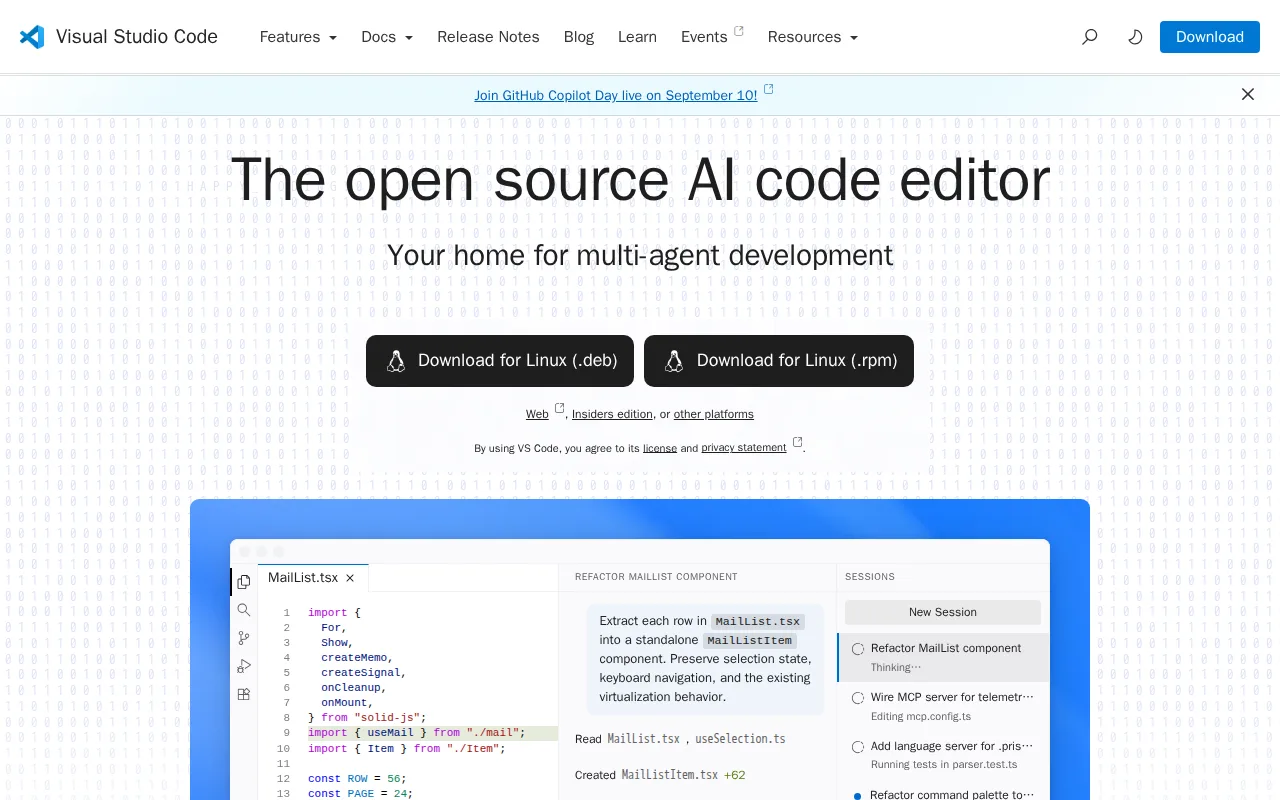
Visual Studio Code is the best VSCodium alternative for developers who want the official Microsoft-supported build and access to Microsoft's full Visual Studio Marketplace, rather than VSCodium's community-maintained build that's restricted to the smaller Open VSX Registry. Visual Studio Code's marketplace covers more than 80,000 extensions, and because VSCodium can't connect to that marketplace due to Microsoft's licensing terms, some extensions that check specifically for Microsoft's product.json fields won't install or function correctly in VSCodium at all. Visual Studio Code holds a 4.8/5 rating from 1,694 Capterra reviews, while VSCodium has no external ratings on record. Both editors are free with no paid tier and run on Windows, macOS, and Linux, and Visual Studio Code adds a web build at vscode.dev that VSCodium doesn't offer. Microsoft has also built AI-assisted coding directly into Visual Studio Code, including inline completions and GitHub Copilot integration, features not present in VSCodium's stripped-down build. VSCodium remains the better choice for anyone who specifically wants telemetry removed and no Microsoft data collection: Visual Studio Code's official build ships with Microsoft's proprietary telemetry enabled by default, the exact customization VSCodium's maintainers strip out at compile time, and VSCodium requires no account, license key, or Microsoft branding at all.
Compared to VSCodium: access to Microsoft's 80,000+ extension Marketplace vs VSCodium's smaller Open VSX Registry, 4.8/5 from 1,694 Capterra reviews vs no ratings on file for VSCodium, ships with Microsoft's telemetry enabled by default vs VSCodium's telemetry-stripped build
Wins:Connects to Microsoft's official Visual Studio Marketplace with 80,000+ extensions, versus VSCodium's smaller, community-run Open VSX Registry · 4.8/5 rating from 1,694 Capterra reviews, evidence VSCodium's own listing has no external ratings to compare against · Runs on web (vscode.dev) in addition to Windows, macOS, and Linux, one more platform than VSCodium's coverage
Loses:Ships with Microsoft's proprietary telemetry enabled by default, the exact data collection VSCodium's build strips out at compile time · The official build's telemetry and marketplace terms sit under a separate Microsoft license, distinct from the plain MIT license VSCodium ships under · Carries Microsoft branding and product.json customizations throughout, while VSCodium requires no account, license key, or Microsoft branding at all
Pros
- Free for individual and commercial use with no paid tier gating core editor functionality.
- Extension marketplace covers virtually every language, framework, and workflow, from linting to remote containers.
- Built-in Git integration and an integrated terminal remove the need for separate tools for basic version control.
- Runs identically across Windows, macOS, Linux, and the browser via vscode.dev.
Cons
- Performance degrades with many extensions installed, especially on large codebases or lower-end hardware.
- The official build's telemetry and marketplace terms sit under a separate Microsoft license, distinct from the MIT-licensed open-source core.
- Advanced refactoring and language-specific tooling generally lag behind dedicated JetBrains IDEs for languages like Java or C#.
- AI features increasingly nudge users toward GitHub Copilot, which is a separate paid subscription for full functionality.
Pricing: Free — Both free with no paid tier for the editor itself (verified undefined NaN, NaN)
2.Cursor — best VSCodium alternative for software teams that want autonomous AI agents handling multi-file changes and PR reviews directly inside their editor and CI pipeline
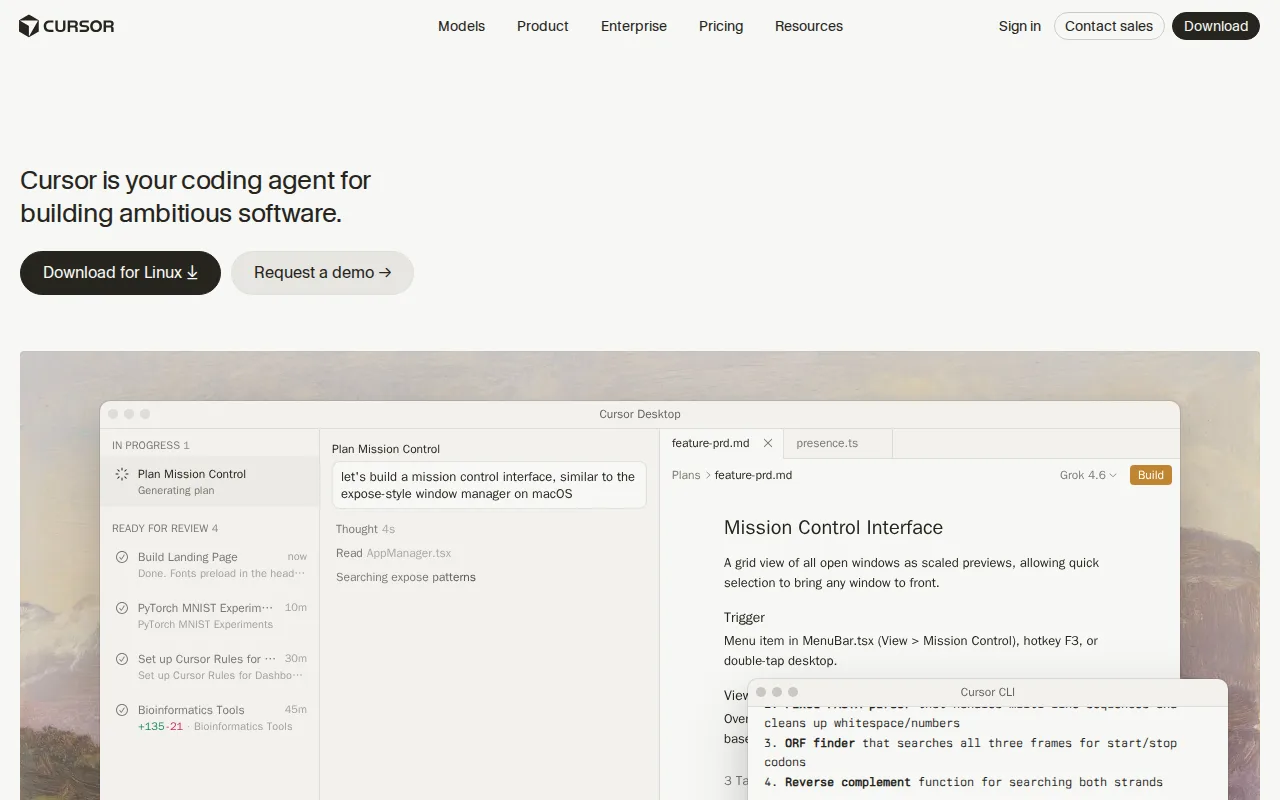
Cursor is the best VSCodium alternative for individual developers and engineering teams who want autonomous AI agents built into the editor's core workflow, capable of planning, writing, testing, and opening pull requests, functionality entirely absent from VSCodium's telemetry-stripped VS Code build. Cursor is itself forked from VS Code, so it keeps a familiar interface and extension model, but its Composer and cloud agents can run long tasks for hours or days independent of the local machine, and support multiple frontier models including Grok and Claude variants so teams aren't locked to one AI provider. Cursor holds a 5.0/5 rating on Capterra, though from only 4 reviews so far, a much thinner sample than more established editors. Cursor's free Hobby tier requires no credit card and includes limited Agent requests, while its Pro tier costs $20/month for extended Agent limits, both priced well above VSCodium's own $0 cost with no paid tier at all. VSCodium remains the better choice for anyone who wants a completely free editor with predictable costs and no Microsoft-adjacent licensing baggage: Cursor's usage-based pricing on top of its subscription can make monthly costs unpredictable for heavy users, and the price jump from Pro ($20/month) to Ultra ($200/month) is steep, while VSCodium never charges anything and needs no account at all.
Compared to VSCodium: autonomous AI agents that plan, write, test, and open pull requests vs VSCodium's stripped-down VS Code build with no AI features, 5.0/5 from 4 Capterra reviews vs no ratings on file for VSCodium, Pro at $20/month vs VSCodium's $0 cost with no paid tier
Wins:Autonomous agents (Composer, cloud agents) can plan, write, test, and open pull requests with minimal hand-holding, functionality VSCodium's build doesn't include · Supports multiple frontier AI models (Grok, Claude, Cursor's own Composer model), avoiding lock-in to a single provider · 5.0/5 rating on Capterra, though VSCodium's own listing carries no external ratings to compare against
Loses:Pro tier costs $20/month and usage-based charges on top can make total monthly cost unpredictable, unlike VSCodium's permanent $0 cost with no paid tier · 5.0/5 rating rests on just 4 Capterra reviews, a thin sample size for confidence · No iOS or Android app, and no telemetry-free positioning the way VSCodium's build explicitly strips Microsoft's data collection
Pros
- Autonomous agents can plan, write, test, and open pull requests with minimal hand-holding.
- Multi-model support (Grok, Claude, Cursor's own Composer) avoids lock-in to a single AI provider.
- Cloud agents keep running on long tasks without tying up the developer's local machine.
- Free Hobby tier requires no credit card, making it easy to evaluate before paying.
Cons
- Usage-based charges on top of the subscription make total monthly cost harder to predict than a flat fee.
- Steep price jump from Pro ($20/month) to Ultra ($200/month) for teams needing higher Agent limits.
- Requires comfort delegating multi-file changes to an agent, a real workflow shift for developers used to manual review of every diff.
- No iOS or Android app; Cursor is desktop- and CLI-only.
Pricing: Free tier · paid from $20/mo — Free Hobby tier or $20/month Pro (up to $200/month Ultra) vs VSCodium's permanent $0 cost with no paid tier
3.Zed — best VSCodium alternative for developers who want a genuinely fast, native (non-Electron) editor with built-in agentic AI support, and who are comfortable using their own API keys or a lean paid AI subscription instead of a bundled enterprise IDE
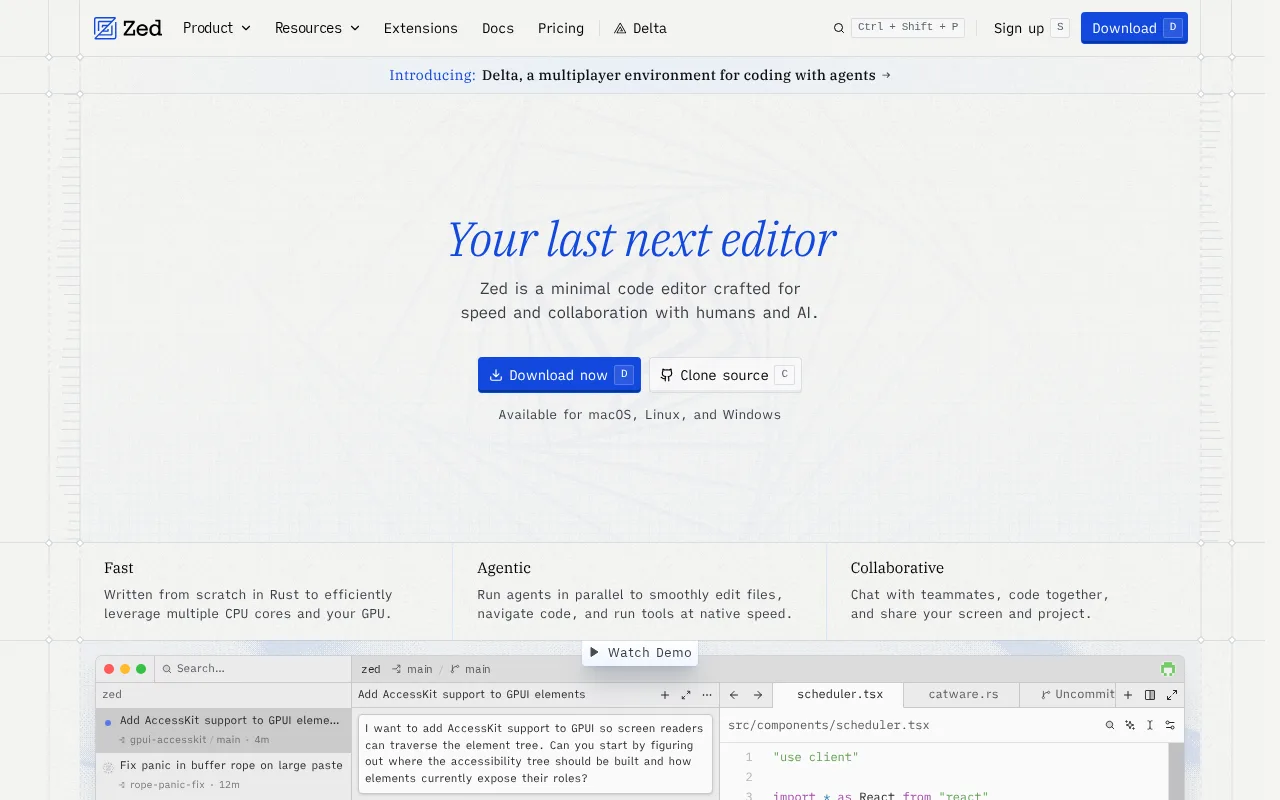
Zed is the best VSCodium alternative for developers who want a genuinely fast, native (non-Electron) editor with built-in agentic AI support, rather than a build of Microsoft's Electron-based VS Code with telemetry removed. Zed is built from scratch in Rust rather than forked from VS Code, and its editor core is free, open-source (GPL-3.0/Apache-2.0) with 89,000-plus GitHub stars, and usable indefinitely, including with a user's own API keys or external agents such as Claude Code, matching VSCodium's own free-forever, no-account model. Zed holds a 5.0/5 rating from 46 Product Hunt reviews, while VSCodium has no external ratings on record. Zed's free Personal plan includes 2,000 accepted edit predictions, and its Pro tier at $10/month adds unlimited edit predictions and $5 of monthly token credits, pricing that only applies to Zed's own hosted AI subscription, not the editor itself, which stays free like VSCodium. Zed also ships native multiplayer collaboration and a debugger built on the Debug Adapter Protocol, features VSCodium's listing doesn't mention. VSCodium remains the better choice for anyone who wants an editor and extension ecosystem functionally identical to mainstream VS Code: Zed's extension ecosystem and IDE-style tooling (debuggers, language-specific integrations) are noticeably thinner than VS Code's, since Zed is a much younger project without VS Code's decade-plus head start on plugins, unlike VSCodium which runs the exact same extension model as VS Code.
Compared to VSCodium: native Rust performance instead of an Electron-based VS Code fork, 89,000+ GitHub stars and 5.0/5 from 46 Product Hunt reviews vs no ratings on file for VSCodium, editor core free like VSCodium with a separate $10/month Pro AI subscription
Wins:Built from scratch in Rust for native performance, rather than running inside Electron/Chromium the way VSCodium's VS Code fork does · 89,000+ GitHub stars and a 5.0/5 rating from 46 Product Hunt reviews, evidence VSCodium's own listing has no external ratings to compare against · Native multiplayer collaboration and a Debug Adapter Protocol-based debugger ship built in, features VSCodium's listing doesn't mention
Loses:Extension ecosystem and IDE-style tooling (debuggers, language-specific integrations) are noticeably thinner than VS Code's, unlike VSCodium which runs the exact same extension model as VS Code · Pro plan's usage-based billing beyond the $5 monthly credit (at API price +10%) can produce unpredictable costs, unlike VSCodium's permanent $0 cost · Windows support is newer than macOS/Linux support and historically lagged in feature parity, unlike VSCodium's identical three-platform build process
Pros
- Genuinely fast, native performance versus Electron-based editors like VS Code.
- Editor core is free, open-source, and usable indefinitely without a paid plan, including with a user's own API keys.
- Native multiplayer collaboration and Claude Code integration built in, not bolted on via extension.
- Business plan requires no minimum seat count for self-serve signup.
Cons
- Smaller extension ecosystem and less mature IDE tooling (debuggers, language-specific integrations) than VS Code.
- Pro plan's usage-based billing beyond the $5 monthly credit (at API price +10%) can produce unpredictable costs for heavy AI users.
- Windows support is newer than macOS/Linux support and historically lagged behind in feature parity.
Pricing: Free tier · paid from $10/mo — Editor core free like VSCodium; Zed's own AI subscription runs $10/month Pro or $30/seat/month Business, costs VSCodium doesn't carry at all (verified undefined NaN, NaN)