2 Best Open-Source Alternatives to Vivaldi in 2026
By Noahlast updated pricing verified
Compared: open-source alternatives to Vivaldi
| Alternative | Best for | Standout | Biggest weakness | Learning curve | Price |
|---|---|---|---|---|---|
| Vivaldireference | power users who want deep tab and workspace customization (tiling, stacking, mouse gestures) built into the browser instead of relying on extensions | Built-in tab tiling, stacking, and workspaces plus a native mail client, calendar, and feed reader bundled directly into the browser rather than requiring separate apps or extensions. | The extensive feature set and settings menus create a steeper learning curve than mainstream browsers, and being Chromium-based, Vivaldi still depends on Google's browser engine even while blocking Google's own tracking. | Moderate | Free |
| Brave | privacy-conscious users who want built-in ad and tracker blocking plus an optional device-wide VPN without installing separate browser extensions | Ships with ad and tracker blocking, script blocking, and fingerprint randomization built in and on by default, with no extensions needed to match what competitors require several add-ons to replicate. | Brave Rewards' opt-in BAT-token ad program has drawn criticism from users who find its ad-serving and crypto-wallet defaults confusing to disable, and the VPN/Firewall add-on requires a separate $9.99/month subscription rather than being bundled free. | Low | Free tier · paid from $9.99/mo |
| Firefox | users who want a non-Chromium, open-source browser with tracker blocking on by default and no ties to Google's or Apple's advertising businesses | Runs on the independent Gecko engine rather than Chromium, giving the web a genuine rendering-engine alternative to Google's dominant Blink/Chromium base, with Enhanced Tracking Protection blocking trackers by default. | Firefox's market share has declined for years as most competing browsers (Chrome, Edge, Brave, Opera) all run on Chromium, meaning some sites and web apps get tested and optimized for Chromium first and occasionally behave inconsistently in Firefox. | Low | Free |
 Vivaldi
 Brave
Brave Firefox
1.Brave — best Vivaldi alternative for privacy-conscious users who want built-in ad and tracker blocking plus an optional device-wide VPN without installing separate browser extensions
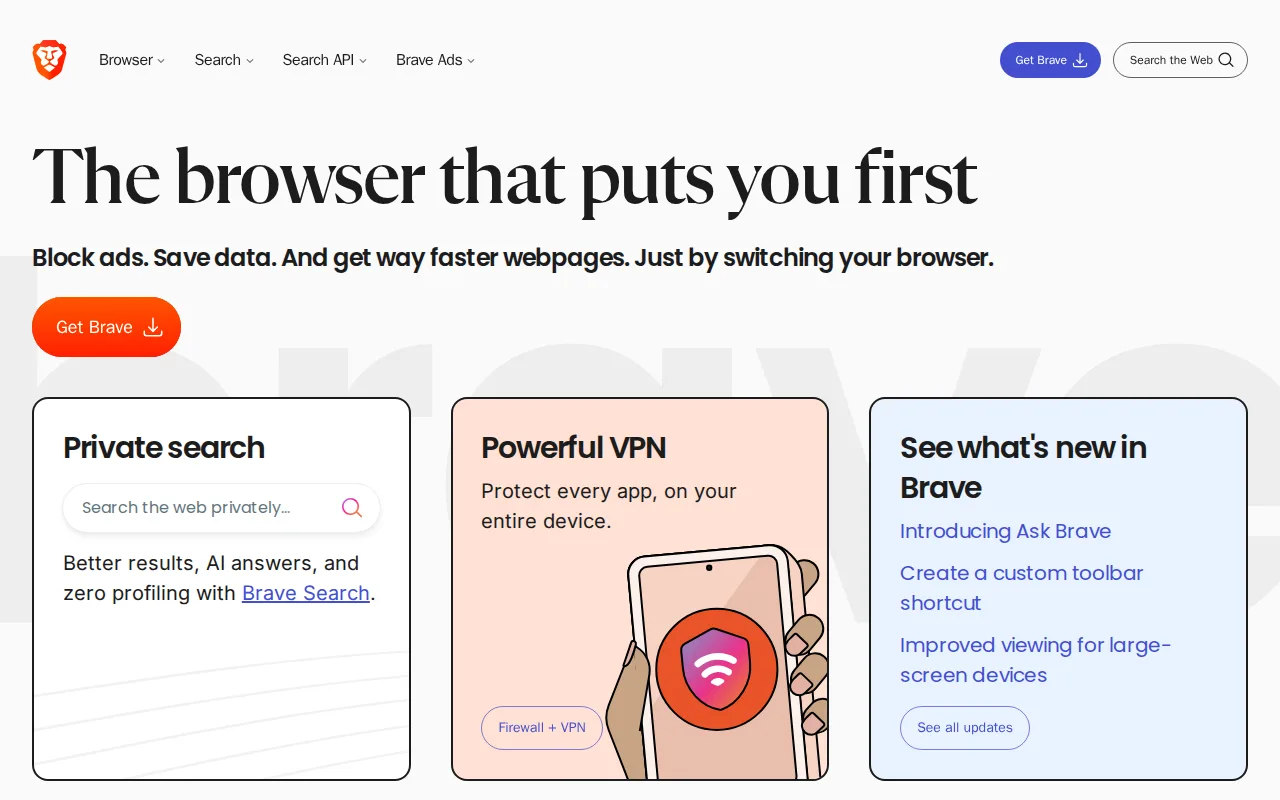
Brave is the best Vivaldi alternative for users who want ad and tracker blocking on by default with no configuration, matching Vivaldi's own built-in blocker but pairing it with an optional device-wide VPN, something Vivaldi doesn't offer natively. Brave's client code is open source under the Mozilla Public License 2.0, the same license Firefox uses, letting security researchers audit it directly, while Vivaldi's core remains closed source despite its privacy-focused positioning. Brave Firewall + VPN costs $9.99/month or $99.99/year and covers up to 10 devices, an add-on Vivaldi's own free browser doesn't provide (though Vivaldi does bundle Proton VPN integration). Vivaldi is still the better choice for power users who want deep tab tiling, stacking, and workspace management plus a native mail client and calendar built directly into the browser: Brave has no equivalent tab-tiling or workspace system, and its opt-in Brave Rewards BAT-token ad program has drawn criticism from users who find it confusing to disable, a complexity Vivaldi's more straightforward productivity-tool bundling avoids.
Compared to Vivaldi: open-source client code (MPL-2.0) vs Vivaldi's closed-source core, optional $9.99/month device-wide VPN vs Vivaldi's Proton VPN integration, no built-in tab tiling or mail client vs Vivaldi's bundled productivity suite
Wins:Client code is open source under MPL-2.0 and independently auditable, unlike Vivaldi's closed-source core · Ad and tracker blocking, script blocking, and fingerprint randomization are on by default with zero configuration required · Brave Search runs on an independent index rather than reselling another engine's results
Loses:No built-in tab tiling, stacking, or workspace system the way Vivaldi bundles directly into the browser · No native mail client, calendar, or feed reader, all of which Vivaldi includes · Brave Rewards' opt-in BAT-token ad program confuses some users about what's on by default versus optional
Pros
- Blocks ads and trackers by default with no extensions required to set up.
- Client code is open source (MPL-2.0) and independently auditable.
- Built-in Brave Search runs on an independent index rather than reselling another engine's results.
- Available on every major desktop and mobile platform with nearly 160 languages supported.
Cons
- Brave Rewards' opt-in BAT-token ad program confuses some users about what's on by default versus optional.
- Brave VPN is a separate $9.99/month subscription, not bundled free with the browser.
- Built on Chromium, so it inherits Google's engine-level decisions and roadmap even while blocking Google's tracking.
- Some sites misidentify Brave's fingerprint randomization as bot activity, occasionally breaking site functionality.
Pricing: Free tier · paid from $9.99/mo — Free browser, optional $9.99/month Firewall + VPN vs Vivaldi's entirely free browser with Proton VPN integration (verified undefined NaN, NaN)
2.Firefox — best Vivaldi alternative for users who want a non-Chromium, open-source browser with tracker blocking on by default and no ties to Google's or Apple's advertising businesses
Firefox is the best Vivaldi alternative for users who want genuine rendering-engine independence: Firefox runs on Mozilla's own Gecko engine rather than Chromium, unlike Vivaldi, which despite its privacy-first positioning still depends on Google's Chromium base. Firefox holds a 4.4/5 rating from 543 Capterra reviews, the only alternative here with a substantial external rating to compare against Vivaldi's own lack of an external rating on record. Firefox's source code is fully public on GitHub under the Mozilla Public License 2.0, and Mozilla, a non-profit foundation, states it does not sell user browsing data, matching Vivaldi's own no-data-selling stance. Vivaldi is still the better choice for power users who specifically want deep tab tiling, stacking, and workspaces plus a bundled mail client, calendar, and feed reader built directly in: Firefox has no equivalent tab-management system and relies on its 30,000+ extension ecosystem for similar functionality rather than shipping it natively, and Firefox's market share decline means some sites are tested against Chromium first and can render inconsistently.
Compared to Vivaldi: runs on independent Gecko engine vs Vivaldi's Chromium base, has an external Capterra rating (4.4/5 from 543 reviews) vs Vivaldi's none, no native tab tiling/mail client vs Vivaldi's bundled productivity suite
Wins:Runs on the independent Gecko rendering engine, preserving web rendering-engine diversity unlike Vivaldi's Chromium base · 4.4/5 rating from 543 Capterra reviews, giving buyers an external signal Vivaldi's listing doesn't have · Enhanced Tracking Protection blocks trackers and third-party cookies by default with no extra configuration
Loses:No built-in tab tiling, stacking, or workspace system; achieving similar organization requires extensions · No native mail client, calendar, or feed reader bundled into the browser, unlike Vivaldi's built-in productivity suite · Market share has declined for years, so some sites are tested against Chromium first and can render inconsistently
Pros
- Free and open source, published on GitHub under the Mozilla Public License 2.0.
- Enhanced Tracking Protection blocks third-party trackers and cookies by default.
- Runs on the independent Gecko engine rather than Chromium, preserving rendering-engine diversity on the web.
- Built-in Reader Mode, picture-in-picture, and PDF editing without extra extensions.
Cons
- Market share has declined for years, so some sites are tested against Chromium first and can render inconsistently.
- Fewer and sometimes lower-quality extensions available compared to the Chrome Web Store.
- Sync and account features are less tightly integrated with a broader productivity suite than Edge (Microsoft 365) or Chrome (Google Workspace).
- Performance and memory usage can lag Chrome on some heavy, JavaScript-intensive web apps.
Pricing: Free — Free with no paid tier vs Vivaldi's entirely free browser (verified undefined NaN, NaN)