2 Best Open-Source Alternatives to Turso in 2026
By Noahlast updated pricing verified
Compared: open-source alternatives to Turso
| Alternative | Best for | Standout | Biggest weakness | Learning curve | Price |
|---|---|---|---|---|---|
| Tursoreference | developers building AI agent or multi-tenant applications that need thousands of lightweight SQLite databases instead of one large shared database | Spin up unlimited per-tenant SQLite databases (one per user, agent, or device) with fast copy-on-write branching and built-in vector search for RAG workloads. | The jump from the $24.92/month Scaler plan to the $416.58/month Pro plan is steep, and per-unit overage charges for storage, row reads/writes, and syncs can make monthly costs unpredictable at high traffic. | Moderate | Free tier · paid from $4.99/mo |
| Neon | developers who want instant, low-cost database branching for every pull request or preview deployment without provisioning full new Postgres instances | Instant copy-on-write database branching that forks a full production dataset in seconds, paired with scale-to-zero compute billing so idle branches cost nothing. | Paid tiers are pure usage-based billing with no flat monthly price, so cost is harder to predict up front than a fixed-price competitor, and extra branches beyond the included count cost $1.50/branch-month, which adds up for teams branching aggressively per pull request. | Low | Free |
| Supabase | developers who want a Postgres-based backend (auth, storage, realtime, auto-generated APIs) they can self-host later, rather than committing to a proprietary NoSQL platform like Firebase | Auto-generated REST, GraphQL, and Realtime APIs derived straight from a project's Postgres schema, with Row Level Security enforcing per-row authorization at the database layer instead of in application code. | Pricing beyond the $25/month Pro base is usage-based and billed per project rather than per account, so teams running multiple projects or exceeding the 100,000 MAU / 250GB egress limits can see invoices climb well past the advertised starting price. | Moderate | Free tier · paid from $25/mo |
 Turso
Turso Neon
Neon Supabase
1.Neon — best Turso alternative for developers who want instant, low-cost database branching for every pull request or preview deployment without provisioning full new Postgres instances
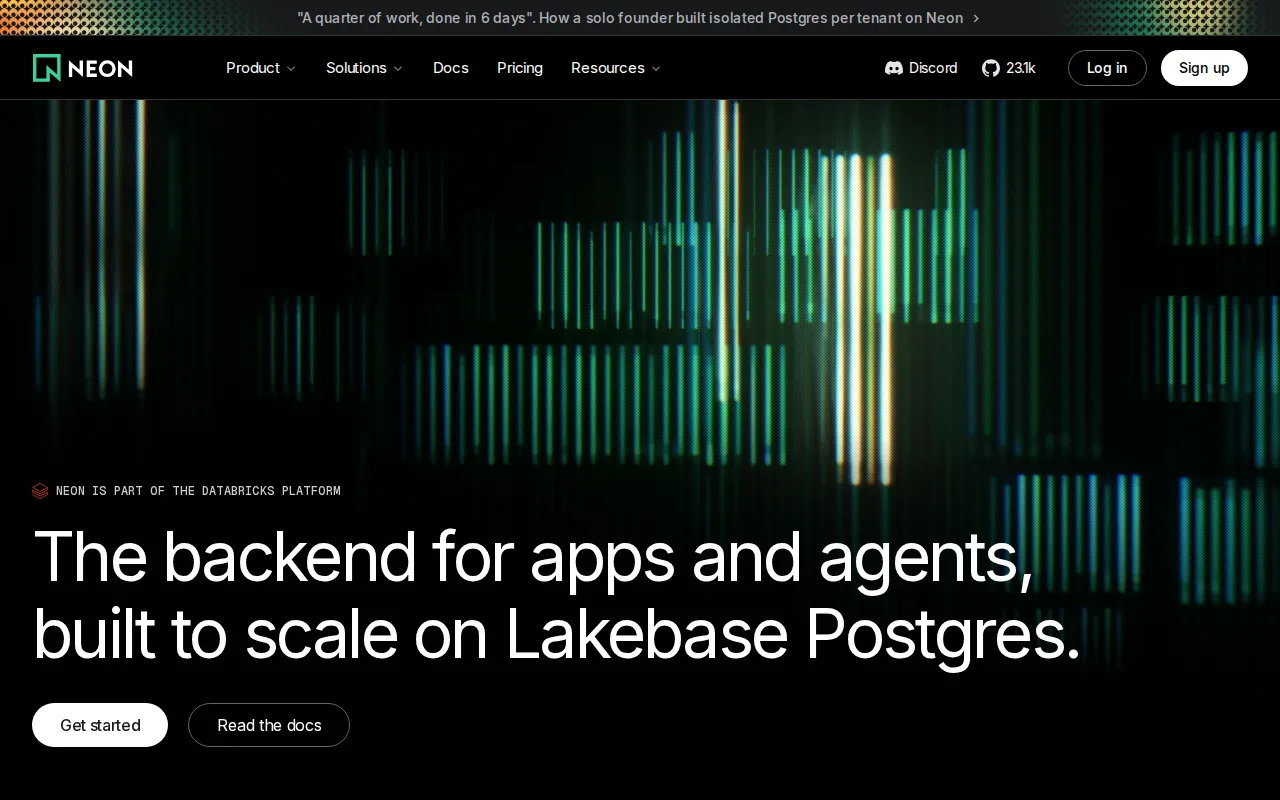
Neon is the best Turso alternative for developers who want instant, Git-style Postgres branching and compute that scales to zero when idle, rather than Turso's SQLite-per-tenant model. Neon's copy-on-write branching forks a full production dataset in seconds, and its Free plan requires no credit card, including 100 compute-hours and 10 branches per project, comparable to Turso's own free plan covering 100 databases and 500 million monthly row reads. Neon's Launch tier bills purely on usage at $0.106 per compute-hour with no monthly minimum, a smoother cost curve than Turso's steep jump from $24.92/month Scaler to $416.58/month Pro. Neon holds a 5/5 rating on Product Hunt from 82 reviews, more reviews than Turso's own 5/5 from 15, both perfect scores. Turso remains the better choice for developers who specifically need many isolated per-tenant databases with built-in vector search: Neon is Postgres-only without Turso's per-tenant SQLite architecture or native vector search for RAG workloads, and its scale-to-zero compute introduces a cold-start delay when a suspended branch wakes up, which can affect latency-sensitive workloads.
Compared to Turso: instant Postgres branching vs Turso's per-tenant SQLite model, usage-based Launch pricing at $0.106/compute-hour vs Turso's steep $24.92-to-$416.58/month tier jump, 82 Product Hunt reviews vs Turso's 15
Wins:Instant copy-on-write branching forks a full production dataset in seconds, with a free tier requiring no credit card · Usage-based Launch pricing with no monthly minimum avoids Turso's steep jump from $24.92/month Scaler to $416.58/month Pro · 82 Product Hunt reviews, more than Turso's own 15, both at a perfect 5/5 score
Loses:Postgres-only, without Turso's per-tenant SQLite architecture or native vector search for RAG workloads · Scale-to-zero introduces a cold-start delay when a suspended compute branch wakes up, which can affect latency-sensitive workloads · Free tier storage is capped at just 0.5 GB per project, smaller than Turso's free-tier 5GB storage allowance
Pros
- Instant database branching copies a full dataset in seconds instead of requiring a new server provision.
- Scale-to-zero compute means idle branches and dev databases cost nothing when not in use.
- Fully Postgres-compatible, so existing drivers, ORMs, and extensions work without changes.
- Free tier requires no credit card and includes 100 compute-hours plus 10 branches per project.
Cons
- Usage-based pricing with no flat monthly rate makes budgeting harder to predict than fixed-price competitors.
- Extra branches beyond the included count cost $1.50/branch-month, which can add up for teams that branch per pull request.
- Free tier storage is capped at 0.5 GB per project, small for anything beyond prototyping.
- Scale-to-zero introduces a cold-start delay when a suspended compute branch wakes up, which can affect latency-sensitive workloads.
Pricing: Free — Free plan (100 compute-hours, no card required), then $0.106/compute-hour usage-based Launch pricing vs Turso's free plan (100 databases, 5GB storage) plus Developer at $4.99/month (verified undefined NaN, NaN)
2.Supabase — best Turso alternative for developers who want a Postgres-based backend (auth, storage, realtime, auto-generated APIs) they can self-host later, rather than committing to a proprietary NoSQL platform like Firebase
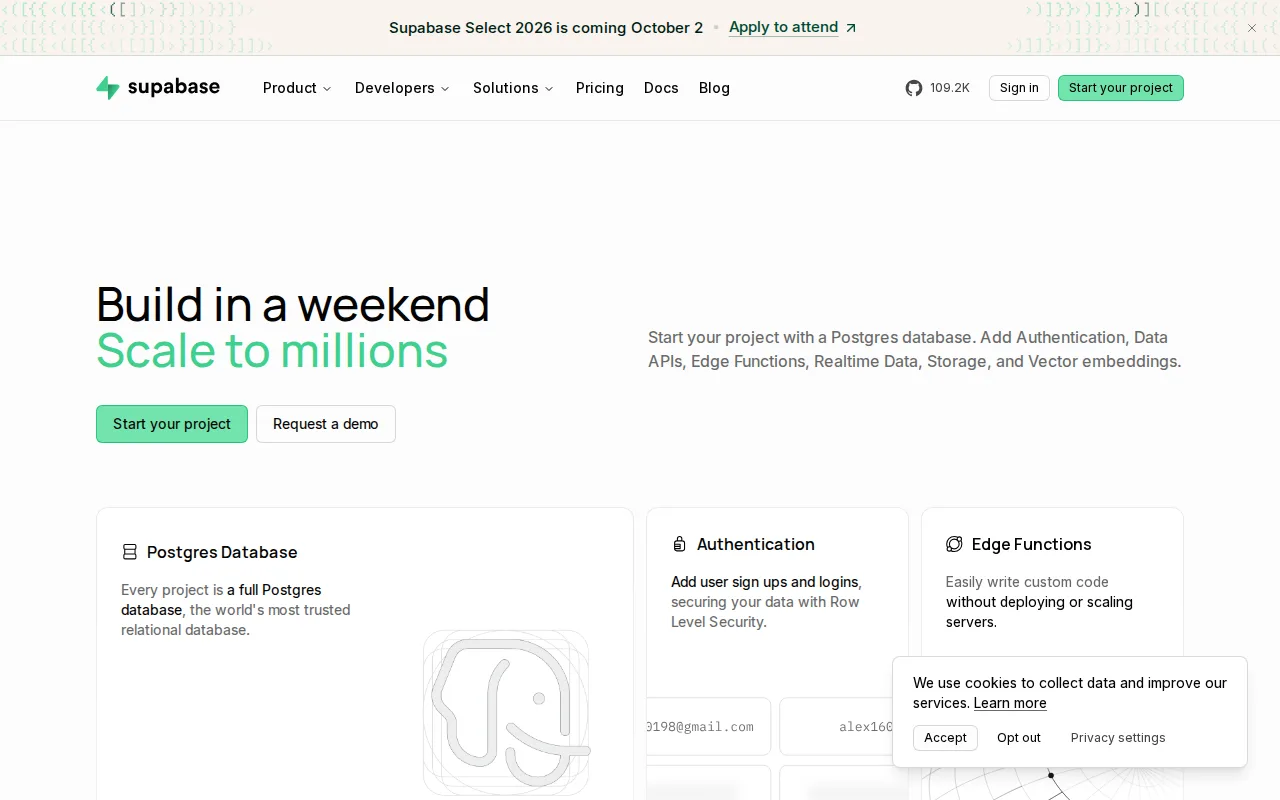
Supabase is the best Turso alternative for developers who want a full backend, database, authentication, file storage, and realtime sync, built on Postgres rather than Turso's collection of per-tenant SQLite databases. Supabase's free plan covers 2 projects, a 500MB database, and 50,000 monthly active users, and its Pro tier costs $25/month with a $10/month compute credit included, above Turso's $4.99/month Developer tier but bundling far more than a database alone. Supabase auto-generates REST, GraphQL, and Realtime APIs directly from a project's Postgres schema, with Row Level Security enforcing per-row authorization, capabilities Turso's SQLite-focused platform doesn't offer. Supabase holds a 5.0/5 rating from 861 Product Hunt reviews, by far the largest review sample among Turso's listed alternatives, well above Turso's own 5/5 from just 15 reviews. Turso remains the better choice for applications that specifically need many isolated, lightweight per-tenant databases with native vector search: Supabase's model is centered on a small number of shared Postgres projects per account rather than spinning up thousands of individual databases, and its compute is billed per project, so accounts running several projects stack recurring charges beyond the flat $25/month Pro fee.
Compared to Turso: full backend (auth, storage, realtime, auto-generated APIs) vs Turso's SQLite-only focus, Pro at $25/month vs Turso's $4.99/month Developer tier, 861 Product Hunt reviews vs Turso's 15
Wins:Bundles authentication, S3-compatible file storage, realtime websocket sync, and edge functions alongside the database, well beyond Turso's SQLite-only focus · Auto-generates REST, GraphQL, and Realtime APIs directly from the Postgres schema, with Row Level Security for per-row authorization · 861 Product Hunt reviews, by far the largest sample among Turso's listed alternatives, at a matching 5.0/5 score
Loses:Centers on a small number of shared Postgres projects per account (2 on the free plan) rather than Turso's model of spinning up thousands of isolated per-tenant databases · No native vector search bundled the way Turso includes it for RAG workloads without a separate vector database · Compute is billed per project, so accounts running several projects stack recurring charges beyond the flat $25/month Pro fee
Pros
- Full Postgres database rather than a proprietary NoSQL store, so existing SQL skills and extensions like pgvector and PostGIS carry over directly.
- Auto-generates REST, GraphQL, and Realtime APIs from the schema, with Row Level Security for per-row authorization.
- Apache-2.0-licensed core stack is self-hostable, avoiding hard vendor lock-in.
- Free tier includes unlimited API requests, 50,000 monthly active users, and a 500MB database with no time limit on the account.
Cons
- Compute is billed per project, so accounts running several projects stack recurring charges beyond the flat $25/month Pro fee.
- MAU overage ($0.00325/user past 100,000) and egress overage ($0.09/GB past 250GB) can produce unpredictable invoices at scale.
- Free-tier projects pause automatically after 1 week of inactivity.
- Row Level Security has a steeper learning curve than Firebase's simpler client-side security rules for teams new to SQL.
Pricing: Free tier · paid from $25/mo — Free plan (2 projects, 500MB database), then $25/month Pro (with $10/month compute credit) vs Turso's free plan (100 databases) plus Developer at $4.99/month (verified undefined NaN, NaN)