Syncthing — A free, open-source continuous file synchronization tool that syncs files directly between devices with no central server, licensed under MPL-2.0.

By Noahlast updated pricing verified
Syncthing screenshots & video
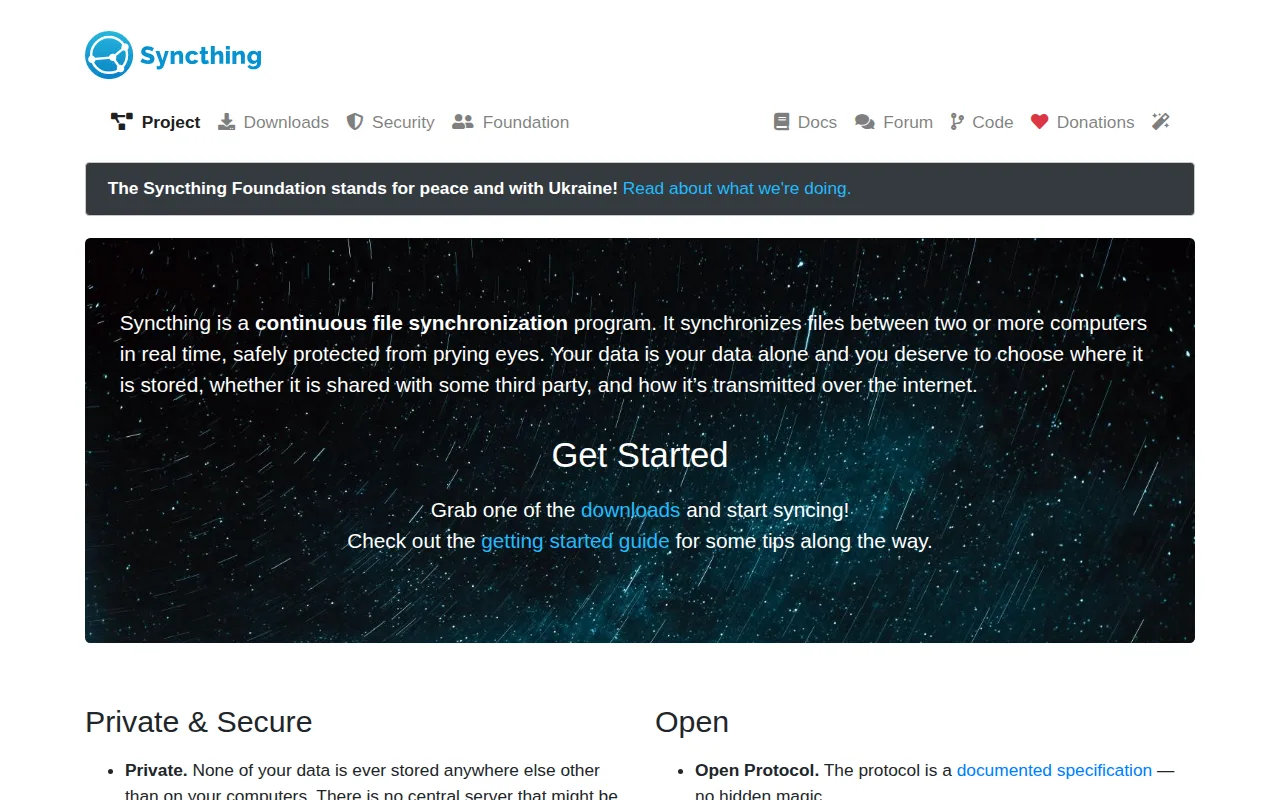
Syncthing in 20 seconds
Best for: privacy-conscious individuals and self-hosters who want continuous file sync without a third-party cloud server
Pricing: Completely free and open source; optional paid commercial support available separately from Kastelo Inc.
- Syncthing is free and open source under the MPL-2.0 license, with 87.8K stars on GitHub.
- Files sync directly between a user's own devices with no central server storing a copy.
- Syncthing runs on Windows, macOS, Linux, and Android via an official app.
- Security uses TLS with perfect forward secrecy and cryptographic device authentication.
- Kastelo Inc. offers separate paid commercial support contracts, but the software itself has no paid tier.
Limitations: No official iOS app due to Apple's background-execution restrictions.; Initial multi-device setup requires manual configuration versus a plug-and-play cloud service.; No built-in cloud backup since there is no central server.
Top alternatives: Resilio Sync, Nextcloud, Dropbox, Google Drive, ownCloud — full list
What is Syncthing?
Syncthing is a continuous file synchronization tool that transfers files directly between a user's own devices over an encrypted, authenticated connection, with no central server storing or relaying the data. Devices discover each other automatically on the local network or over the internet (via UPnP or relay servers when direct connection isn't possible), and synchronization happens continuously as files change. The project emphasizes three principles: privacy (data never touches a third party's server by default), security (TLS with perfect forward secrecy, cryptographic device IDs, no unauthenticated device can join a sync group), and openness (a documented protocol specification, public development process, and open issue tracker). Syncthing runs on Windows, macOS, Linux, and Android (via an official Android app), and is manageable through a browser-based web GUI. It is licensed under MPL-2.0, free with no paid tier, and has accumulated 87.8K stars on GitHub. Kastelo Inc. offers separate paid commercial support contracts for organizations that want an SLA, but this does not gate any feature of the software itself.
Syncthing is an open-source, peer-to-peer file synchronization program that keeps folders updated in real time across multiple computers without routing data through a third-party cloud server, aimed at privacy-conscious individuals and self-hosters who want Dropbox-style sync under their own control. It runs on Windows, macOS, Linux, and Android, uses TLS encryption with perfect forward secrecy and cryptographic device authentication, and is entirely free with no paid tier; the project is licensed under MPL-2.0 and has 87.8K stars on GitHub. Kastelo Inc. separately offers paid commercial support contracts for organizations, but the software itself carries no license fee.
Standout feature: True peer-to-peer synchronization with no central server: files transfer directly between a user's own devices over an encrypted, authenticated connection, so no third party ever holds a copy.
Biggest weakness: There is no official iOS client because Apple's platform restrictions limit background sync behavior the way Syncthing's protocol needs, and setup across multiple machines requires more manual configuration (adding devices, sharing folders, handling network discovery) than a plug-and-play cloud service like Dropbox.
Pros
- Completely free and open source (MPL-2.0), with no paid tier or feature gating.
- True peer-to-peer sync means no third-party server ever holds a copy of user files.
- Strong security model: TLS with perfect forward secrecy and cryptographic device authentication.
- Runs on Windows, macOS, Linux, and Android, manageable via a browser-based web GUI.
Cons
- No official iOS app, since Apple's background-execution restrictions limit continuous peer-to-peer sync.
- Initial setup across multiple machines requires manual device pairing and folder-sharing configuration.
- No built-in cloud backup; since there's no central server, losing all synced devices simultaneously means losing the data.
- No official mobile app for iOS means Apple users need third-party, unofficial clients if they want Syncthing on iPhone or iPad.
Syncthing pricing
Free · verified from the vendor's pricing page
| Plan | Price | Notes |
|---|---|---|
| Open source | Free | Free and open source with no paid tier or feature gating; Kastelo Inc. offers optional commercial support contracts separately for organizations. |
What reviewers say
Scores belong to their platforms; we display them with attribution and never fold them into our own ratings.