1 Best Open-Source Alternatives to Standard Notes in 2026
By Noahlast updated
All 4 Standard Notes alternatives
Compared: open-source alternatives to Standard Notes
| Alternative | Best for | Standout | Biggest weakness | Learning curve | Price |
|---|---|---|---|---|---|
| Standard Notesreference | privacy-focused professionals and journalists who want a fully open-source, end-to-end encrypted notes app they can self-host instead of trusting a vendor's servers | Fully open-source (AGPL-3.0) client and server code that can be self-hosted, combined with end-to-end encryption that keeps even Standard Notes/Proton from reading note content. | The free tier's editor is intentionally minimal (plain text-focused), so richer formatting, extended note history, and file attachments require a paid plan whose current price is not transparently listed on the marketing site without navigating to a signup flow, and the plain-text-first design means it lacks the richer block-based editing found in competitors like Notion. | Low | Free |
| Joplin | People who want an offline-first, end-to-end encrypted Markdown note app with a free self-hosted sync option and no vendor lock-in. | End-to-end encryption is available on every sync method, including the free options (Dropbox, OneDrive, WebDAV, Nextcloud), not just the paid Joplin Cloud tier. | Joplin's editor and web clipper feel less polished than Notion or Evernote, and Joplin Cloud has no free plan of its own, so ongoing hosted sync costs money even though the app itself is free. | Moderate | Free tier · paid from $3.23/mo |
 Standard Notes
 Joplin
1.Joplin — best Standard Notes alternative for people who want an offline-first, end-to-end encrypted Markdown note app with a free self-hosted sync option and no vendor lock-in.
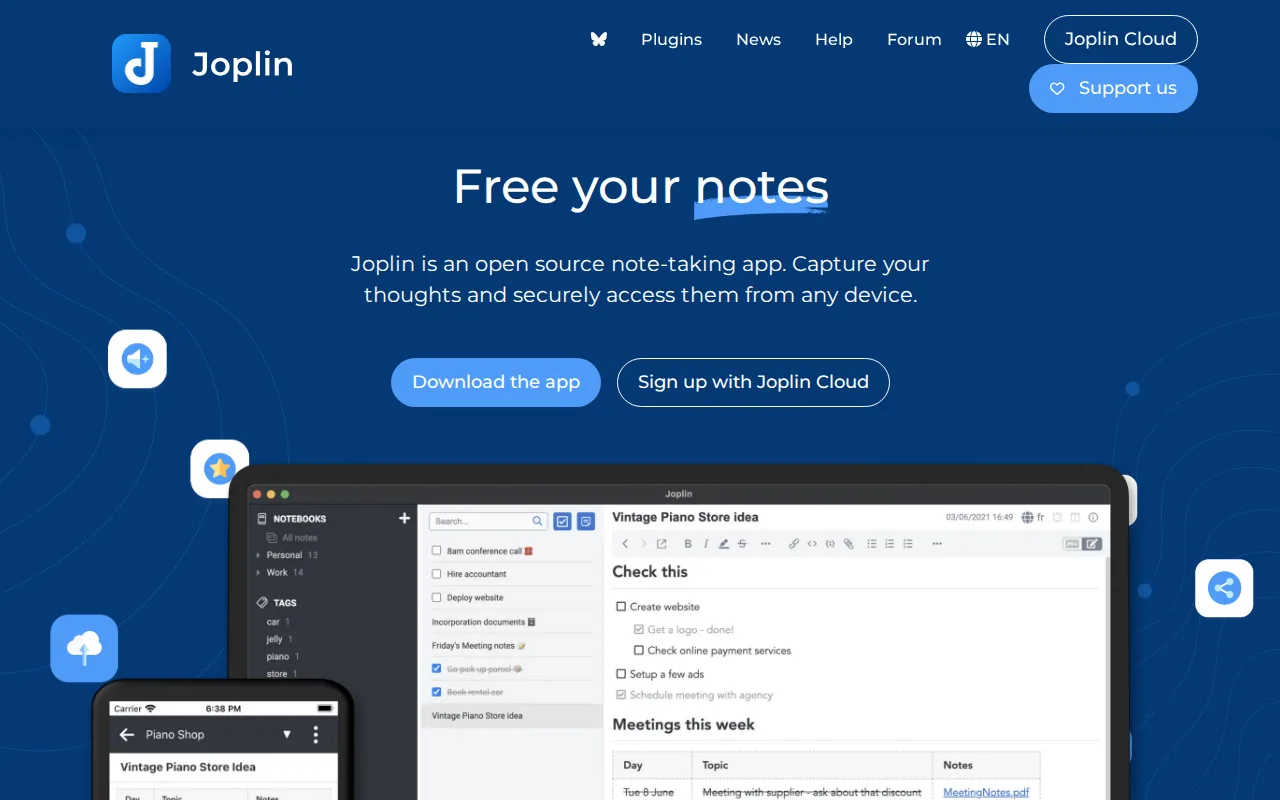
Joplin is the best Standard Notes alternative for privacy-focused users who want open source and control over their own sync backend, the same core value Standard Notes offers but with a different storage model. Joplin holds a 4.5/5 rating from 90 Capterra reviews, matching Standard Notes' own 4.5/5 score but built on a sample more than six times larger than Standard Notes' 14 reviews. Joplin's GitHub repository carries 46,000 stars and 5,100 forks under an MIT license, a public adoption signal none of the other alternatives in our listing data or Standard Notes itself carry in structured form. Joplin's self-hosted tier is free ($0), matching Standard Notes' own free tier, and its end-to-end encrypted sync works over any storage backend the user chooses, Joplin Cloud, Dropbox, OneDrive, WebDAV, or S3, a flexibility beyond Standard Notes' own sync infrastructure. Joplin Cloud's paid tiers are transparently priced at $2.99/month (Basic) and $5.99/month (Pro), both verified 2026-08-01, unlike Standard Notes' own paid plan, whose exact current price could not be verified because its pricing page returned a 403 to automated fetches. Standard Notes remains the better choice for anyone who wants native apps across the most platforms: Standard Notes ships on web, Windows, macOS, Linux, iOS, and Android from one shared codebase, while Joplin's own listing notes its UI polish lags the commercial competition and it has no built-in real-time collaboration.
Compared to Standard Notes: 46,000-star, MIT-licensed GitHub repository vs no structured GitHub stats for Standard Notes, transparently priced $2.99-$5.99/month Cloud tiers vs Standard Notes' paid plan with no independently verified current price, encrypted sync to any backend of your choice (Dropbox, OneDrive, WebDAV, S3) vs Standard Notes' own sync infrastructure
Wins:46,000 GitHub stars and 5,100 forks under an MIT license, a public adoption signal not recorded in structured form for Standard Notes · End-to-end encrypted sync works over any storage backend the user chooses (Joplin Cloud, Dropbox, OneDrive, WebDAV, S3), more flexible than Standard Notes' own sync infrastructure · Joplin Cloud pricing ($2.99-$5.99/month) is transparently published and verified 2026-08-01, unlike Standard Notes' unverified current paid-plan price
Loses:UI polish lags the commercial competition, per its own listing, while Standard Notes ships a more consistent app experience across platforms · No built-in real-time collaboration, a gap Standard Notes' own listing doesn't resolve either but doesn't claim to address
Pros
- Fully open-source core app under a permissive license, with source code on GitHub
- Notes stored as local Markdown files with attachments, avoiding proprietary lock-in
- End-to-end encryption supported on all sync backends, including free ones like Dropbox and WebDAV
- Extensible via a plugin API, custom themes, and both Markdown and Rich Text editors
- Available on Windows, macOS, Linux, Android, iOS, and as a terminal app
Cons
- No free tier for the official Joplin Cloud sync service; cheapest paid plan is 2.99 EUR/month billed monthly
- Basic Joplin Cloud plan caps attachments at 10 MB and storage at 2 GB, well below Pro's 30 GB
- Notebook sharing and email-to-note require the Pro tier or higher, not included in Basic
- UI and mobile clipper are less refined than commercial alternatives like Notion or Evernote
Pricing: Free tier · paid from $3.23/mo — $0 (self-hosted) to $5.99/month (Cloud Pro), all verified 2026-08-01, vs Standard Notes' free tier with an unverified paid-plan price (verified undefined NaN, NaN)