2 Best Open-Source Alternatives to Stackby in 2026
By Noahlast updated pricing verified
Compared: open-source alternatives to Stackby
| Alternative | Best for | Standout | Biggest weakness | Learning curve | Price |
|---|---|---|---|---|---|
| Stackbyreference | small teams building CRMs, project trackers, or inventory systems who want Airtable-style relational tables with built-in automation and AI fields at a lower per-seat price | API connector blocks and AI-powered database fields built directly into the spreadsheet-database grid, letting teams pull in live data from other services without separate integration tools. | Reviewers report that automation, formulas, and filtering features can be unreliable in practice, with at least one user describing core automations as broken, and some report performance lag and data stability issues as stacks grow; business intelligence and reporting tools also remain limited compared to more mature competitors like Airtable. | Low | Free tier · paid from $9/mo |
| Baserow | teams that want an Airtable-like no-code database with the option to self-host for free under MIT, avoiding per-user fees at scale | MIT-licensed core can be self-hosted at no cost with no per-user pricing, avoiding Airtable's escalating per-seat cost as a team's row and collaborator count grows. | Self-hosted deployments lose premium and enterprise features (advanced permissions, audit logs, AI-assisted database building) unless paired with a commercial license, so the "fully free" self-hosted version is meaningfully less capable than the paid cloud tiers. | Moderate | Free tier · paid from $10/mo |
| NocoDB | teams wanting an Airtable-style spreadsheet interface over a real MySQL/Postgres database, self-hosted for free with no record caps | The self-hosted Community edition is free with no record, storage, or seat limits, unlike Airtable's free-tier record ceilings and per-seat pricing. | The Sustainable Use License is source-available fair-code, not OSI-approved open source, and self-hosting still requires the team to manage its own Docker deployment, backups, and upgrades; the paid cloud tiers' record and automation-run caps (e.g., 1,000 records on the free cloud plan) are considerably tighter than the unlimited self-hosted Community edition. | Moderate | Free tier · paid from $12/mo |
 Stackby
 Baserow
 NocoDB
1.Baserow — best Stackby alternative for teams that want an Airtable-like no-code database with the option to self-host for free under MIT, avoiding per-user fees at scale
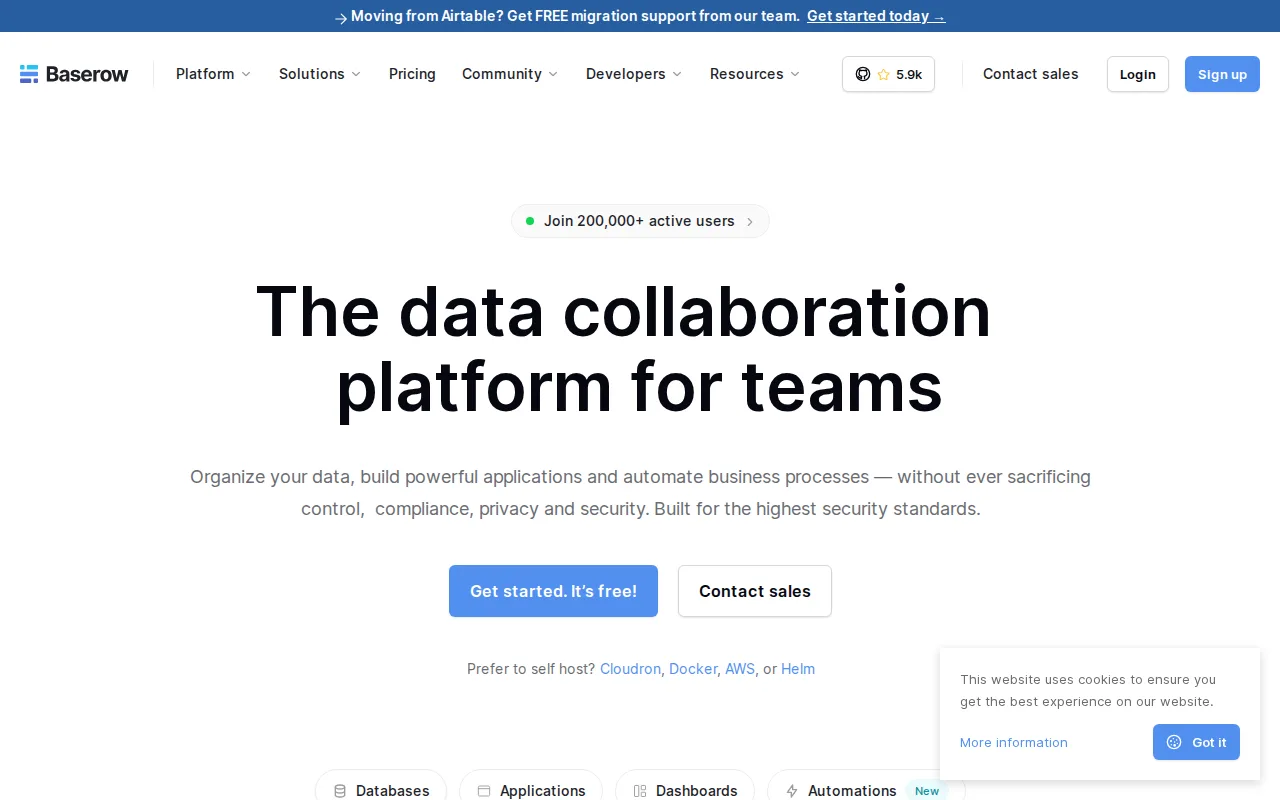
Baserow is the best Stackby alternative for teams that want to self-host their spreadsheet-database platform rather than depend on a cloud-only vendor, since Baserow's MIT-licensed core (MPL-2.0 license) can be self-hosted for free via Docker, AWS, or Helm with no per-user fee, an option Stackby's web-only, cloud-hosted model doesn't offer at all. Baserow's cloud Free tier includes 3,000 rows per workspace and 2GB storage, and its Premium tier at $10/user/month billed yearly adds AI-assisted database building through its Kuma assistant, a feature Stackby's own AI database fields compete with directly. Baserow holds a 4.7/5 rating from 69 Capterra reviews and 5.0/5 from 6 Product Hunt reviews, evidence in the same range as Stackby's 4.8/5 from 82 Capterra reviews. Stackby is still the better choice for teams that want a more generous free tier without touching infrastructure: Stackby's free plan supports up to 5 editors and 50 read-only guests across 20 stacks, while Baserow's premium features (advanced permissions, audit logs, AI assistant) are withheld from its free self-hosted edition entirely, making the genuinely free Baserow tier meaningfully less capable than its paid cloud tiers.
Compared to Stackby: MIT-licensed core is free to self-host with no per-user fee, Kuma AI assistant on Premium at $10/user/month, but free self-hosted edition lacks advanced permissions and AI features
Wins:MIT-licensed core (MPL-2.0) can be self-hosted for free with no per-user fee, an option Stackby doesn't offer · Kuma AI assistant builds databases from natural-language descriptions on the Premium tier · GDPR, HIPAA, and SOC 2 compliance available on the managed cloud offering
Loses:Free self-hosted edition withholds premium features like advanced permissions, audit logs, and the Kuma AI assistant · Cloud Free tier caps at 3,000 rows per workspace, tighter than Stackby's 1,500 rows per stack across 20 stacks combined · Smaller third-party integration and template ecosystem than Stackby's apps marketplace
Pros
- MIT-licensed core is genuinely free to self-host with no per-user fees.
- Multiple view types (Grid, Kanban, Calendar, Timeline, Form, Gallery, Survey) cover most no-code database use cases.
- Automations and an app builder are included alongside the core database, reducing the need for separate tools.
- GDPR, HIPAA, and SOC 2 compliance available on the managed cloud offering.
Cons
- Premium features like the Kuma AI assistant, advanced permissions, and audit logs are withheld from the free self-hosted edition.
- Row and storage limits on the Free and Premium cloud tiers (3,000 and 50,000 rows respectively) can be restrictive for larger datasets.
- Enterprise pricing is not published and requires a sales conversation.
- Smaller third-party integration and template ecosystem than Airtable's much larger, longer-established marketplace.
Pricing: Free tier · paid from $10/mo — $10/user/month Premium (billed yearly, $12/month monthly) vs Stackby's $9/user/month Economy; Baserow's core is also free to self-host (verified undefined NaN, NaN)
2.NocoDB — best Stackby alternative for teams wanting an Airtable-style spreadsheet interface over a real MySQL/Postgres database, self-hosted for free with no record caps
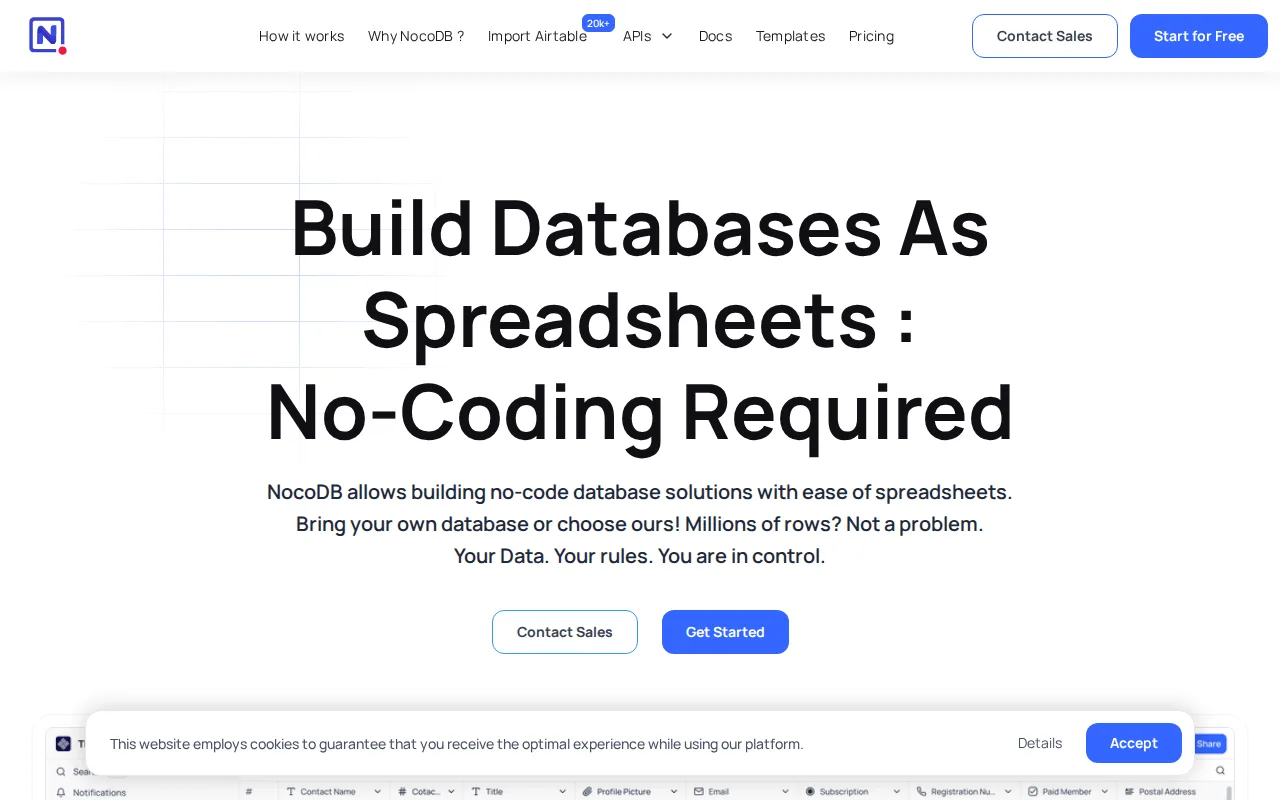
NocoDB is the best Stackby alternative for teams that want a genuinely free, self-hosted database with no record, storage, or seat limits, since its Community edition is free forever with unlimited records under the Sustainable Use License, unlike Stackby's cloud-only model, which caps the free plan at 1,500 rows per stack. NocoDB connects directly to an existing MySQL or PostgreSQL database rather than requiring data migration into a proprietary format, and its GitHub repository has over 63,000 stars, showing far more open development activity than Stackby's closed-source product. NocoDB's cloud tiers scale from a $0 free plan (1,000 records, 3 editor seats) to Plus at $12/user/month billed annually, close to Stackby's own $9/user/month Economy tier. Stackby is still the better choice for teams that want a more polished managed cloud experience without touching Docker: NocoDB has no external ratings of note in our listing data beyond 2 Product Hunt reviews, versus Stackby's 82 Capterra reviews, and the Sustainable Use License is source-available fair-code rather than OSI-approved open source, a licensing nuance Stackby's proprietary model sidesteps by simply being commercial from the start.
Compared to Stackby: Community edition is free forever with unlimited records, connects directly to existing MySQL/Postgres databases, but only 2 Product Hunt reviews vs Stackby's 82 Capterra
Wins:Self-hosted Community edition is free forever with unlimited records, storage, and seats, unlike Stackby's capped cloud-only free plan · Connects directly to an existing MySQL or PostgreSQL database instead of requiring migration into a proprietary format · Over 63,000 GitHub stars showing active open development, more visible activity than Stackby's closed-source model
Loses:Only 2 Product Hunt reviews on record in our listing data, far thinner evidence than Stackby's 82 Capterra reviews · Sustainable Use License is source-available fair-code, not OSI-approved open source · Self-hosting requires managing Docker infrastructure, backups, and upgrades that Stackby's managed cloud service handles automatically
Pros
- Self-hosted Community edition is free forever with unlimited records, storage, and seats.
- Connects directly to an existing MySQL or PostgreSQL database instead of requiring data migration into a proprietary format.
- Multiple views (Grid, Kanban, Gallery, Form, Calendar) over the same underlying data.
- Over 63,000 GitHub stars and an active open-source community driving development.
Cons
- Sustainable Use License is fair-source, not OSI-approved open source, unlike fully permissively-licensed alternatives.
- Free cloud tier is capped at 1,000 records and 1 GB storage, far below the unlimited self-hosted Community edition.
- Self-hosting requires managing your own Docker infrastructure, updates, and backups.
- Higher paid tiers (Scale at $45/user/month) get expensive quickly for teams needing SSO or row-level security at scale.
Pricing: Free tier · paid from $12/mo — Free self-hosted Community edition with unlimited records; cloud Plus is $12/user/month vs Stackby's $9/user/month Economy (verified undefined NaN, NaN)