4 Best Free Alternatives to Roam Research in 2026
By Noahlast updated
All 4 Roam Research alternatives
Compared: free alternatives to Roam Research
| Alternative | Best for | Standout | Biggest weakness | Learning curve | Price |
|---|---|---|---|---|---|
| Roam Researchreference | researchers, writers, and knowledge workers who want to build a browsable graph of cross-linked notes around a daily-notes workflow, rather than filing notes into folders | Automatic linked references on every page, showing every other note that mentions it, built around a daily-notes-first workflow rather than a folder hierarchy. | No permanent free plan exists, unlike open-source alternatives such as Obsidian and Logseq that offer the same bidirectional-linking model at no cost; the app is also fully client-rendered JavaScript, which makes it slower to load and harder to search or reference externally than a static-content tool. | Steep | From $15/mo |
| Obsidian | individuals building a long-lived personal knowledge base who want their notes to stay plain markdown files they can read, back up, and move without the app | Every note is a plain markdown file in a normal folder on the device, so the vault opens offline and instantly, syncs with whatever tool you already use, and remains readable if Obsidian ever disappears. | Obsidian is built around one person's local vault, so the things a team takes for granted cost extra or do not exist: real-time collaboration only arrives through paid shared vaults on Obsidian Sync, and there is no web version at all, which means a vault is unreachable from any machine where you cannot install the app. Getting the same notes onto a phone and a laptop also means $4-$8/user/month for Sync or assembling your own iCloud, Dropbox, or Git setup, since the free app ships no sync of its own. | Moderate | Free tier · paid from $4/mo |
| Logseq | individuals who want a local-first, privacy-respecting outliner that stores notes as portable plain-text files instead of locking them into a proprietary cloud database | Notes are stored as local plain-text Markdown or Org-mode files rather than a proprietary database, so users can version them with Git, sync through any cloud provider they choose, or work entirely offline. | Real-time collaboration and multi-device sync are still in alpha testing and require opt-in signup, so teams that need reliable built-in sync today must rely on third-party file-sync tools, and Android support remains in development while iOS is already available. | Moderate | Free |
| Notion | Teams that want to consolidate scattered docs, wikis, and lightweight project trackers into one linked workspace, and are willing to spend time designing their own database structure. | Custom Agents and Notion Agent, which can complete multi-step tasks using context pulled from Notion pages, connected apps (Slack, GitHub, Google Drive), and the web, billed at $10 per 1,000 Notion credits after a free trial. | Free and Plus plans only give trial access to Notion AI features (chat, meeting notes, research mode); full AI usage requires the Business plan at $20/member/month or separate Notion credits for Custom Agents and Workers, which adds an unpredictable usage-based cost on top of the seat price. | Steep | Free tier · paid from $10/mo |
| Anytype | privacy-conscious individuals and small teams who want a Notion-style flexible workspace that works fully offline and doesn't require trusting a third party with unencrypted data | Local-first, end-to-end encrypted storage with optional peer-to-peer sync, so the app is fully functional offline and data isn't dependent on a company's cloud servers by default. | The client is released under a source-available license, not a standard OSI-approved open-source license, so it doesn't carry the same community-audit and fork guarantees as fully open-source competitors like Logseq; the product is also younger and less mature than Notion or Obsidian, with a smaller plugin and integration ecosystem. | Moderate | Free |
 Roam Research
 Obsidian
 Logseq
 Notion
 Anytype
1.Obsidian — best Roam Research alternative for individuals building a long-lived personal knowledge base who want their notes to stay plain markdown files they can read, back up, and move without the app
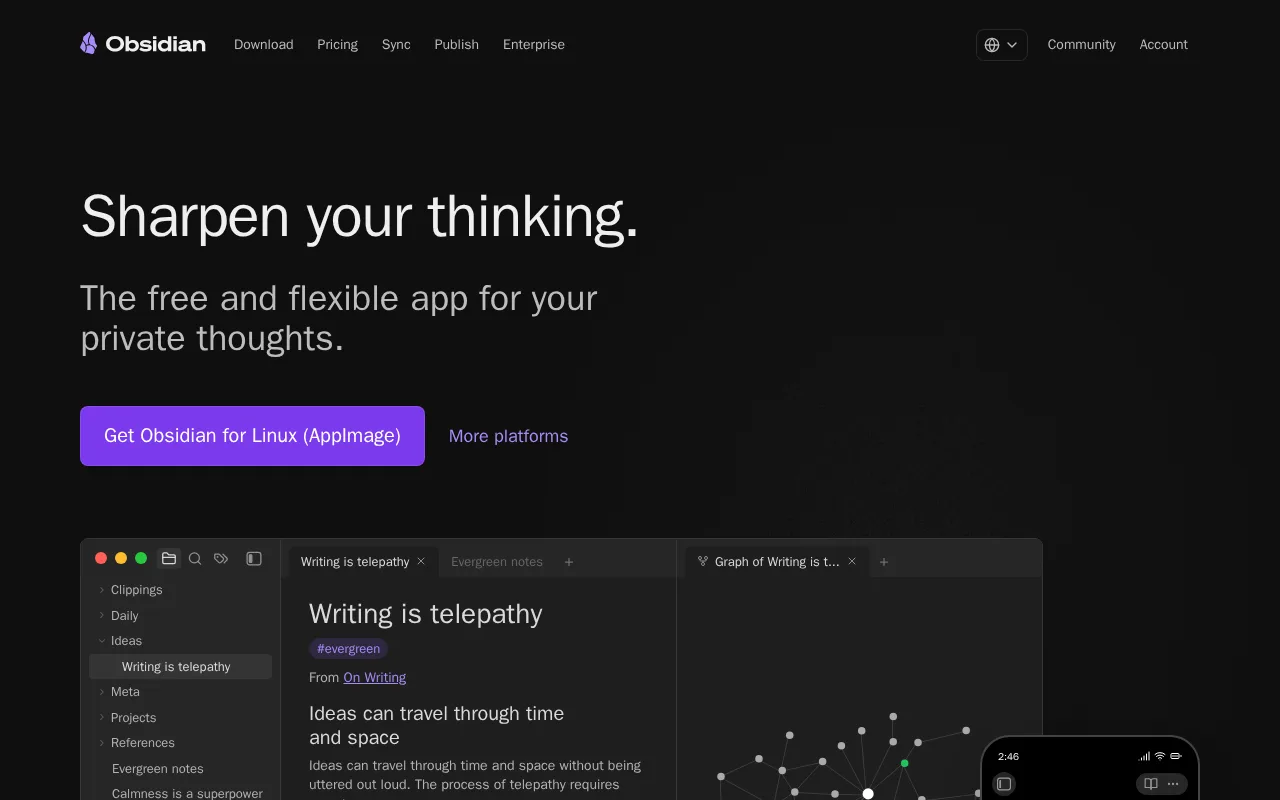
Obsidian is the best Roam Research alternative for individuals building a long-lived personal knowledge base who want to own their data outright instead of trusting a closed, cloud-only vendor. Obsidian stores notes as local Markdown files on disk, so the knowledge base stays portable and private, a structural difference from Roam Research, which is closed-source and runs entirely as a client-rendered web app with a Firebase backend. Obsidian holds a 4.8/5 rating from 500 Capterra reviews, a far larger and more recently verified track record than Roam Research's single 4.8/5 score built from just 8 Product Hunt reviews. Obsidian's Personal tier is free ($0), while Roam Research has no permanent free plan at all and starts at $15/month for its Pro tier; Obsidian only charges for optional add-ons, $4/month for Sync and $50/year for Commercial use. Its plugin ecosystem, with over 1,000 community plugins, extends far beyond Roam Research's built-in feature set. Roam Research remains the better choice for anyone who specifically wants built-in real-time multiplayer collaboration on a shared graph, since Obsidian has no native real-time collaboration, and for daily-notes-first workflows, since Roam Research's automatic Daily Notes page and linked-references model were the format Obsidian's own backlink system was built to compete with.
Compared to Roam Research: 4.8/5 rating from 500 Capterra reviews vs Roam's single 4.8/5 from just 8 reviews, free Personal tier ($0) vs Roam's $15/month with no permanent free plan, local Markdown files you own outright vs Roam's closed-source, client-rendered cloud app
Wins:4.8/5 rating from 500 Capterra reviews, a far larger review base than Roam's 8 Product Hunt reviews · Free Personal tier ($0) with paid add-ons only for Sync ($4/month) and Commercial use ($50/year), versus Roam's $15/month Pro tier and no permanent free plan · Local plain-text Markdown files stored on disk, giving outright data ownership that Roam's closed-source, Firebase-backed cloud app doesn't offer
Loses:No native real-time multiplayer collaboration, unlike Roam Research's built-in shared-graph collaboration · No automatic Daily Notes entry point out of the box; Roam Research's daily-notes-first workflow is a structural feature Obsidian's backlink system was built to compete with, not replicate
Pros
- The app is free without limits and needs no account; notes are stored locally as plain markdown files in open formats, so there is no lock-in.
- 7,647 community plugins and 755 themes let the editor be reshaped for research, writing, task management, or visualization.
- Works fully offline on Windows, macOS, Linux, iOS, and Android, with no server round-trip to open a note.
- Obsidian states notes stay on the device and are inaccessible to the company, its apps collect no telemetry, and Obsidian Sync is AES-256 end-to-end encrypted.
- Paid products are optional services rather than a feature wall: Sync from $4/user/month, Publish from $8/site/month, and a commercial license the FAQ says is not required.
Cons
- There is no web version, so a vault is only reachable from a device where Obsidian is installed.
- Cross-device sync is a paid add-on from $4/user/month, or a do-it-yourself setup on iCloud, Dropbox, or Git.
- Real-time collaboration needs paid shared vaults on Obsidian Sync; there is no free multi-user editing.
- Obsidian's own apps are not open source — obsidian.md publishes open file formats plus public release and plugin repositories, but not the application source.
Pricing: Free tier · paid from $4/mo — $0 (Personal) plus optional $4/month Sync add-on vs Roam Research's $15/month Pro tier with no permanent free plan (verified undefined NaN, NaN)
2.Logseq — best Roam Research alternative for individuals who want a local-first, privacy-respecting outliner that stores notes as portable plain-text files instead of locking them into a proprietary cloud database
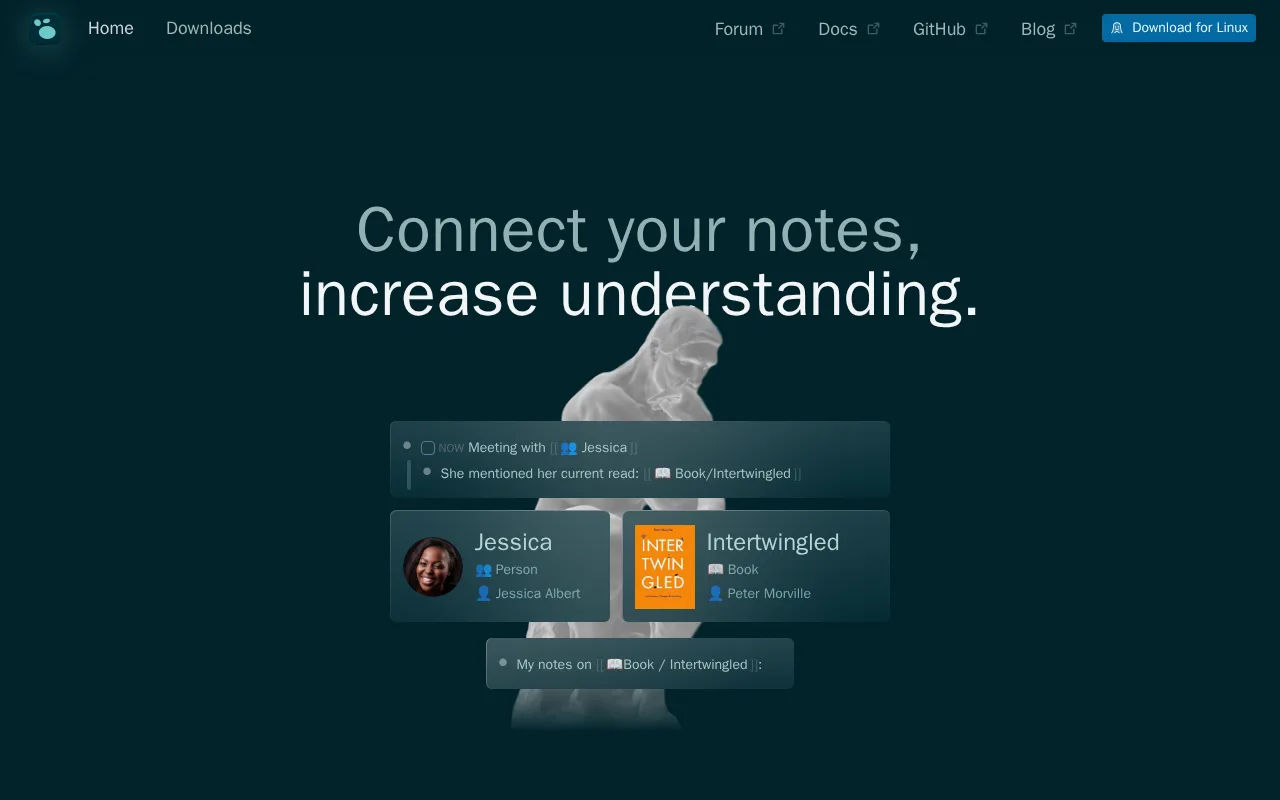
Logseq is the best Roam Research alternative for individuals who want a completely free, open-source outliner instead of paying Roam Research's $15/month subscription for the same bidirectional-linking model. Logseq is licensed under AGPLv3 with 44,500+ GitHub stars and has no paid tier at all, while Roam Research is closed-source and has no permanent free plan, starting at $15/month for Pro. Logseq holds a 4.9/5 rating from 65 Product Hunt reviews, verified 2026-08-21, edging out Roam Research's own 4.8/5 score from just 8 reviews. Like Roam Research, Logseq centers on a daily-journal-first workflow with bidirectional linking between blocks and pages, so the core interaction model transfers directly; it also stores notes as local plain-text Markdown or Org-mode files rather than a proprietary database, letting users version them with Git or sync through any cloud provider they choose. Roam Research remains the better choice for teams that need reliable, mature real-time collaboration today: Logseq's real-time collaboration and sync feature (RTC) is still in alpha testing and requires opt-in signup, not yet a production-ready feature, while Roam Research supports real-time multiplayer collaboration on shared graphs as a standard capability.
Compared to Roam Research: 4.9/5 rating from 65 Product Hunt reviews vs Roam's 4.8/5 from just 8 reviews, completely free with no paid tier vs Roam's $15/month Pro plan, local plain-text Markdown/Org-mode files vs Roam's closed-source, proprietary graph format
Wins:4.9/5 rating from 65 Product Hunt reviews, a larger sample than Roam's 8 reviews · Completely free and open source (AGPLv3) with no paid tier at all, versus Roam's $15/month Pro subscription and no permanent free plan · Notes stored as local plain-text Markdown or Org-mode files, letting users version with Git or sync through any cloud provider, unlike Roam's closed-source, proprietary format
Loses:Real-time collaboration and sync (RTC) are still in alpha testing and require opt-in signup, not yet a reliable production feature, unlike Roam Research's standard real-time multiplayer collaboration · No official Android app yet (in development), while Roam Research ships an iOS companion app but neither has a confirmed Android release in this data
Pros
- Completely free and open source (AGPL-3.0) with no paid tier or feature gating.
- Local-first plain-text storage (Markdown or Org-mode) keeps notes portable and outside vendor lock-in.
- Bidirectional linking and a daily-journal workflow suit outliner-style thinking better than document-first note apps.
- Plugin ecosystem and native PDF annotation extend the app without needing a separate tool.
Cons
- Built-in real-time collaboration and sync (RTC) are still in alpha and require opt-in, not yet a reliable production feature.
- Android app is still in development, while competitors offer mobile apps on both platforms already.
- Outliner-based, block-structured notes have a learning curve for users coming from document-style editors like Notion.
- As a volunteer/community-driven open-source project, there is no paid support tier or SLA to fall back on.
Pricing: Free — $0, completely free with no paid tier, vs Roam Research's $15/month Pro plan (verified undefined NaN, NaN)
3.Notion — best Roam Research alternative for teams that want to consolidate scattered docs, wikis, and lightweight project trackers into one linked workspace, and are willing to spend time designing their own database structure.
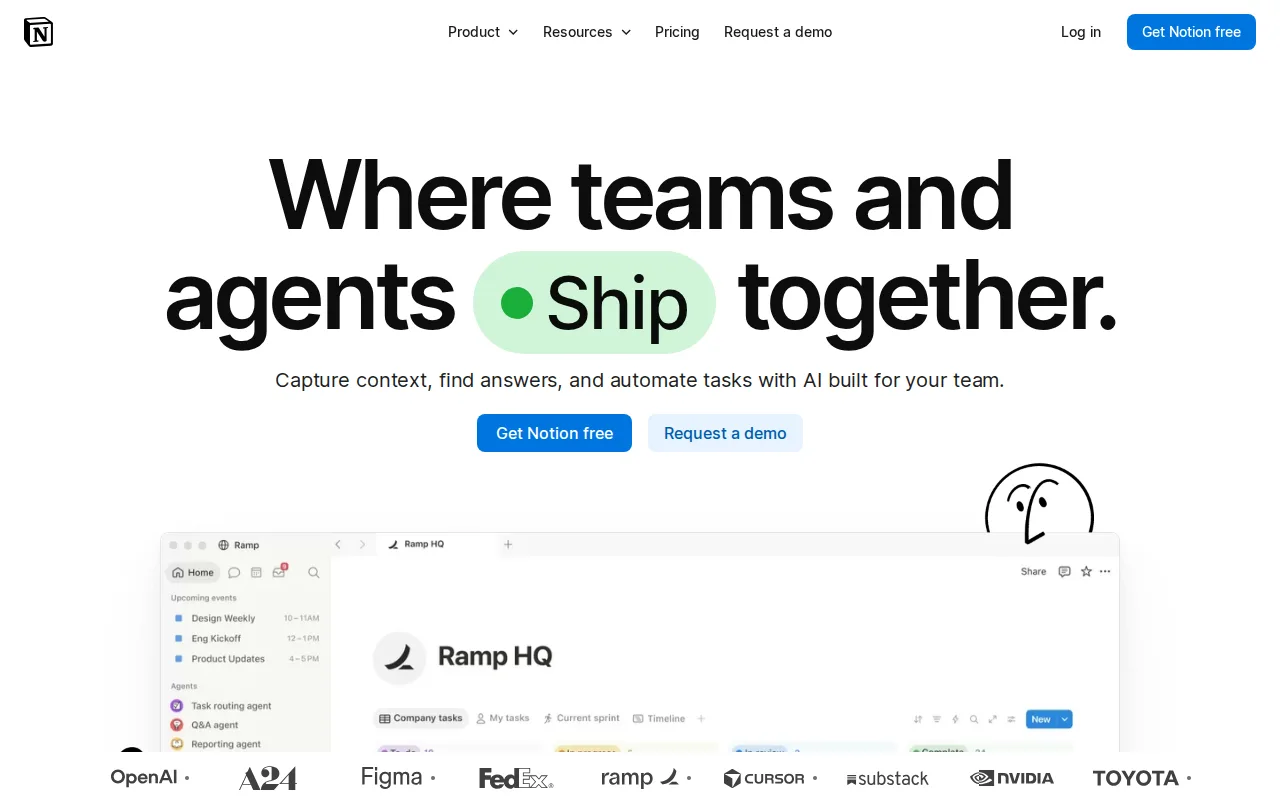
Notion is the best Roam Research alternative for teams that want documents, a wiki, and lightweight project tracking in one workspace rather than Roam Research's networked-notes-only focus built for individual researchers. Notion holds a 4.7/5 rating from 6,100 G2 reviews and another 2,600 on Capterra, a combined review base of roughly 8,700, dwarfing Roam Research's single 4.8/5 score from just 8 Product Hunt reviews. Notion offers a generous free tier ($0) for personal use, while Roam Research has no permanent free plan at all and starts at $15/month for Pro; Notion's paid Plus tier is $10/month and Business is $20/month, both still confirmed as live pricing verified 2026-08-01. Notion's relational databases embedded directly in documents give it project-tracking and team-collaboration depth that Roam Research's linked-references model doesn't attempt to match. Roam Research remains the better choice for researchers and writers who specifically want a daily-notes-first, bidirectional-linking workflow: Notion's block-based page structure is optimized for docs, wikis, and databases rather than the automatic linked-references list Roam Research surfaces on every page, and Notion's own listing notes it can get sluggish on large workspaces with unreliable offline support, a tradeoff purpose-built note apps like Roam Research don't carry.
Compared to Roam Research: 4.7/5 rating from 6,100 G2 reviews plus 2,600 on Capterra vs Roam's 4.8/5 from just 8 reviews, free tier ($0) vs Roam's $15/month with no permanent free plan, relational databases embedded in documents vs Roam's linked-references-only model
Wins:4.7/5 rating from a combined 8,700 G2 and Capterra reviews, a far larger sample than Roam's 8 reviews · Free tier ($0) for personal use, versus Roam's $15/month Pro plan with no permanent free option · Relational databases with rollups and multiple views embedded directly in documents, extending well beyond Roam's linked-references model
Loses:Gets sluggish on large workspaces with unreliable offline support, a tradeoff Roam Research's purpose-built note structure doesn't carry · Block-based page structure is optimized for docs, wikis, and databases, not Roam Research's daily-notes-first, bidirectional-linking workflow
Pros
- Single tool covers docs, wikis, databases, and basic project tracking, reducing tool-switching
- Free plan supports unlimited pages and blocks for solo use, with only multi-member workspaces hitting block limits
- Deep customization through nested pages, linked databases, and templates
- Public API, webhooks, and 1-way database syncs (Jira, GitHub, Asana) for connecting external tools
Cons
- Per-member pricing on paid tiers ($10-$20/month) gets expensive fast for larger teams compared to flat-fee tools
- Offline support is limited to recently viewed or favorited pages on paid plans rather than full offline access
- Flexible block-and-database model has a steep learning curve for teams used to fixed-structure apps
- Meaningful AI features (Notion Agent, Enterprise Search, AI Meeting Notes) require the $20/month Business plan or higher
Pricing: Free tier · paid from $10/mo — $0 (Free) to $10/month (Plus) or $20/month (Business) vs Roam Research's $15/month Pro plan with no permanent free tier (verified undefined NaN, NaN)
4.Anytype — best Roam Research alternative for privacy-conscious individuals and small teams who want a Notion-style flexible workspace that works fully offline and doesn't require trusting a third party with unencrypted data
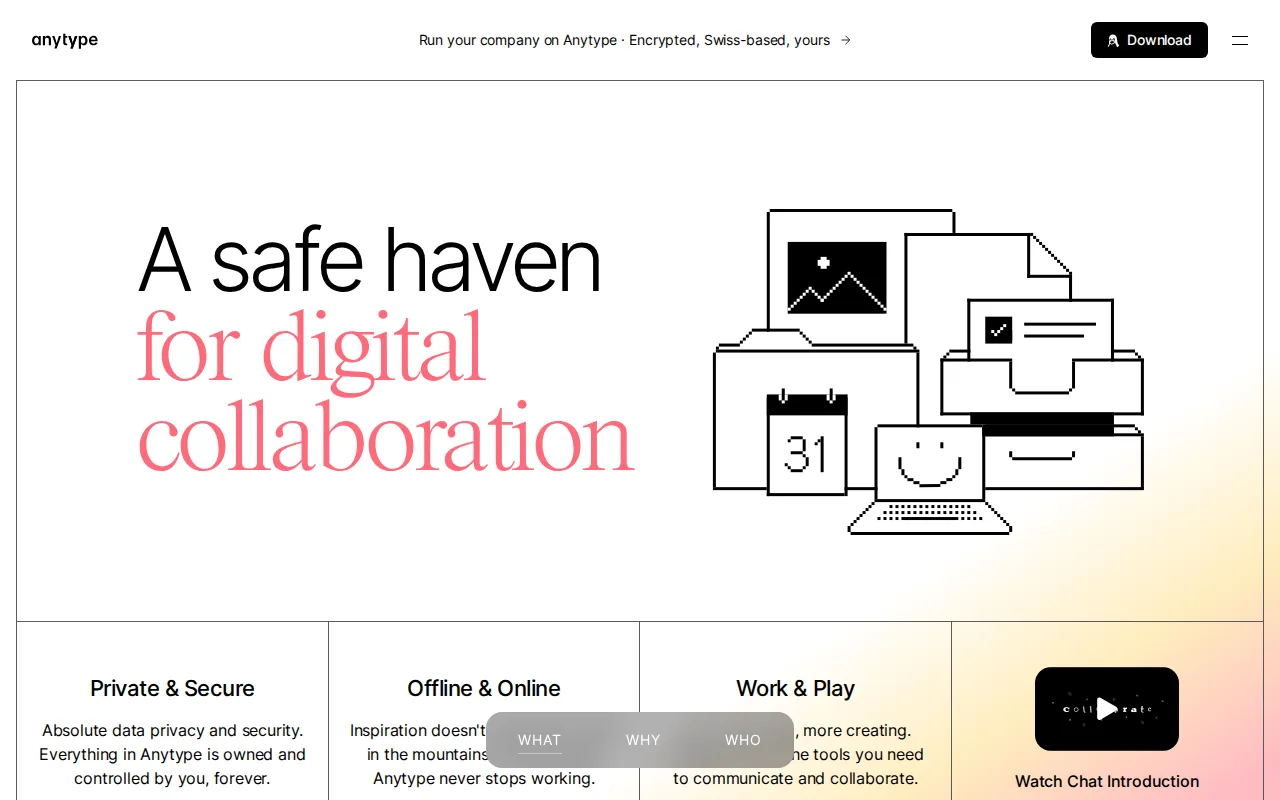
Anytype is the best Roam Research alternative for privacy-conscious individuals who want a local-first, end-to-end encrypted personal knowledge base instead of trusting Roam Research's closed-source, Firebase-backed cloud service with unencrypted content. Anytype holds a 4.9/5 rating from 104 Product Hunt reviews, including a 2023 Golden Kitty Award, far outpacing Roam Research's single 4.8/5 score from just 8 reviews. Anytype's desktop and mobile clients are free with core offline features fully usable with no feature paywall, while Roam Research has no permanent free plan and starts at $15/month for Pro. Data in Anytype lives primarily on the user's own device with zero-knowledge encryption and optional peer-to-peer sync, giving it a privacy guarantee Roam Research's cloud-hosted, unencrypted model doesn't offer. Anytype's GitHub repository for the desktop client has 8.7k stars, evidence of open development Roam Research's fully closed-source codebase carries none of. Roam Research remains the better choice for researchers who specifically want a mature, battle-tested product: Anytype uses a source-available license rather than a standard OSI-approved open-source license, is younger and less mature with a smaller plugin ecosystem, and its paid Any-Sync Network membership pricing for expanded cloud sync isn't clearly published, unlike Roam Research's single, if unverified, $15/month Pro price point.
Compared to Roam Research: 4.9/5 rating from 104 Product Hunt reviews (plus a 2023 Golden Kitty Award) vs Roam's 4.8/5 from just 8 reviews, free desktop and mobile apps with no feature paywall vs Roam's $15/month Pro plan, local-first zero-knowledge encryption vs Roam's cloud-hosted, unencrypted Firebase backend
Wins:4.9/5 rating from 104 Product Hunt reviews plus a 2023 Golden Kitty Award, versus Roam's 4.8/5 from just 8 reviews · Free desktop and mobile apps with no feature paywall on core offline functionality, versus Roam's $15/month Pro plan with no permanent free tier · Local-first architecture with end-to-end, zero-knowledge encryption, a privacy guarantee not present in Roam's cloud-hosted, unencrypted Firebase backend
Loses:Uses a source-available license rather than a standard OSI-approved open-source license, and is a younger, less battle-tested product with a smaller plugin ecosystem than long-established competitors · Any-Sync Network membership pricing for expanded cloud storage and sync isn't clearly published, unlike Roam Research's single (if unverified) $15/month Pro price point
Pros
- Local-first architecture means the app works fully offline with data stored on-device.
- End-to-end, zero-knowledge encryption for any data that does sync.
- Free desktop and mobile apps with no feature paywall on core offline functionality.
- Composable block system (databases, kanban, calendar) offers Notion-like flexibility.
Cons
- Uses a source-available license rather than a standard OSI-approved open-source license.
- Smaller plugin and third-party integration ecosystem than Notion or Obsidian.
- Paid Any-Sync Network membership pricing is not clearly published, making cost planning harder.
- Younger, less battle-tested product than long-established note-taking competitors.
Pricing: Free — $0 (free local-first client); Any-Sync Network paid tiers for cloud sync are unpublished, vs Roam Research's $15/month Pro plan