Roam Research — A networked note-taking tool built around bidirectional links and a daily-notes workflow, aimed at researchers and knowledge workers who want a graph of connected ideas instead of a folder tree; paid only, no permanent free plan.

By Noahlast updated
Roam Research screenshots & video
Roam Research in 20 seconds
Best for: researchers, writers, and knowledge workers who want a graph of cross-linked notes built around a daily-notes workflow
Pricing: Subscription-only, historically around $15/month for the Pro plan (roughly $13.75/month billed annually); no permanent free tier, and current exact pricing could not be verified from a static page.
- Roam Research organizes notes as a bidirectionally linked graph rather than folders, with automatic linked references on every page.
- Every Roam graph opens to an automatically generated Daily Notes page.
- Roam Research has no permanent free plan; it is subscription-only.
- Roam Research is available on the web, as a desktop app, and via the Roam Mobile iOS app; no Android app was confirmed.
- Roam Research holds a 4.8/5 rating from 8 reviews on Product Hunt.
Limitations: No permanent free plan, unlike open-source competitors offering the same linking model at no cost.; Steep learning curve for users unfamiliar with outliner- and link-based note structures.; No confirmed Android app.; Fully client-rendered app, so pricing and much of the marketing site could not be verified by direct fetch.
Top alternatives: Obsidian, Logseq, Notion, Anytype, RemNote — full list
What is Roam Research?
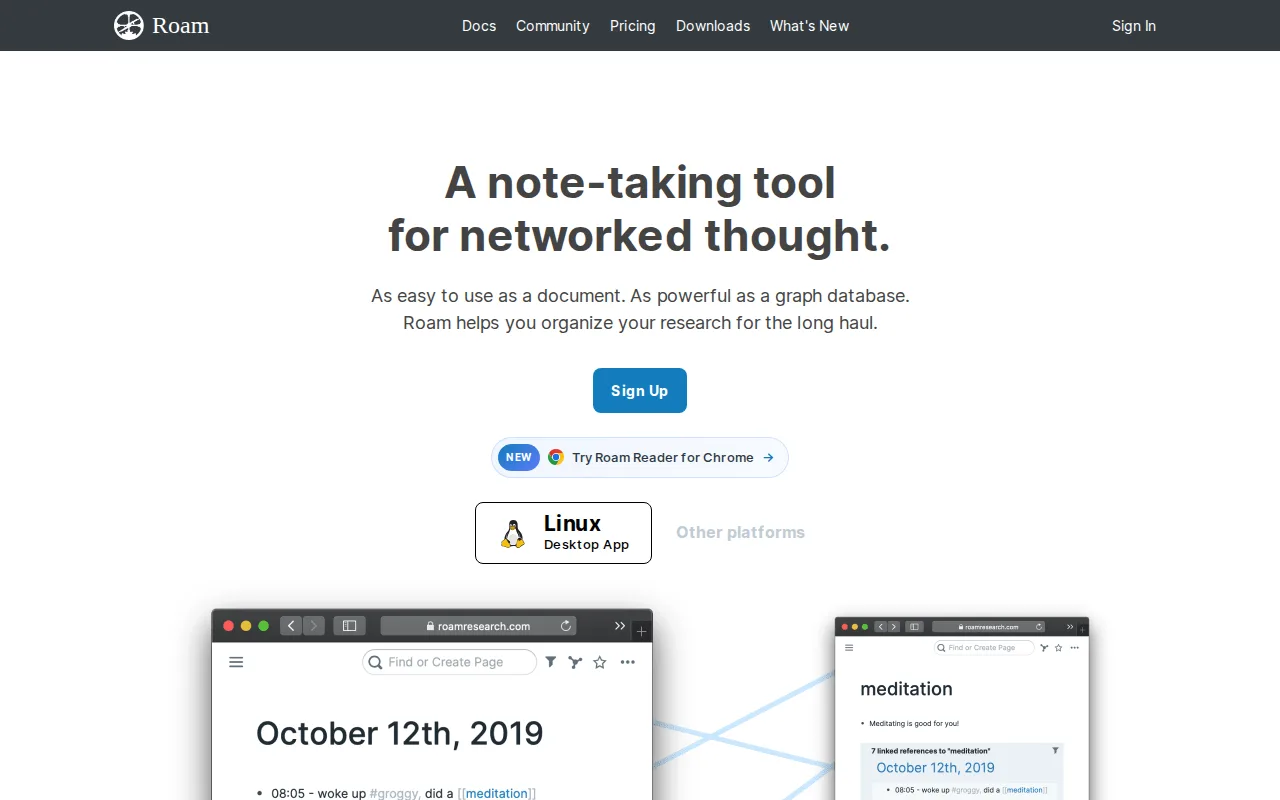
Roam Research is a note-taking tool built around networked, bidirectional links between notes rather than a folder or notebook hierarchy, popularizing what is often called the "tools for thought" or networked note-taking category.
Every Roam graph opens to an automatically generated Daily Notes page, and any note can link to any other note via [[double brackets]] or #tags, creating a browsable graph of connections plus an automatic "linked references" list on every page showing everywhere else that note was mentioned. This differs from folder-based apps like Evernote or OneNote, and from single-database apps like Notion, by treating the link graph itself as the primary organizing structure rather than a secondary feature.
Roam Research is closed-source and runs as a web application (with an iOS companion app, Roam Mobile) built on ClojureScript with a Firebase backend; it supports real-time multiplayer collaboration on shared graphs. It popularized the bidirectional-linking model that open-source alternatives like Obsidian and Logseq, and commercial competitors like Notion and Tana, later adopted or extended.
Roam Research is a note-taking application built for networked thought: notes are linked bidirectionally so ideas connect into a graph rather than sitting in isolated folders, and every session starts from an automatically created daily-notes page. It targets researchers, writers, and knowledge workers who outline and cross-reference ideas rather than file documents away, and it supports real-time collaboration alongside the option to keep data local. Roam Research is a closed-source, subscription-only product with no permanent free tier; a Pro plan has historically run around $15/month (or roughly $13.75/month billed annually), though this could not be verified against a live pricing page, because the site is a fully client-rendered application with no static pricing content.
Standout feature: Automatic linked references on every page, showing every other note that mentions it, built around a daily-notes-first workflow rather than a folder hierarchy.
Biggest weakness: No permanent free plan exists, unlike open-source alternatives such as Obsidian and Logseq that offer the same bidirectional-linking model at no cost; the app is also fully client-rendered JavaScript, which makes it slower to load and harder to search or reference externally than a static-content tool.
Pros
- Bidirectional linking and automatic linked references make it easy to rediscover forgotten connections between notes.
- Daily Notes page gives every session a default entry point without deciding where to file a new note.
- Real-time multiplayer collaboration on shared graphs.
- Holds a 4.8/5 rating from 8 reviews on Product Hunt.
Cons
- No permanent free plan; every user must subscribe to use the product beyond a trial.
- The outliner-based, link-heavy structure has a steep learning curve compared to flat document editors.
- No official Android app was found, limiting mobile access largely to iOS and the web.
- Fully client-rendered web app, which makes performance more dependent on graph size and device than in file-based alternatives.
Roam Research pricing
From $15/mo
| Plan | Price | Notes |
|---|---|---|
| Pro | $15/mo | Billed monthly; historically also offered at a lower effective rate (around $13.75/month) when billed annually. No permanent free plan is offered. Not independently verified; Roam's site is a fully client-rendered app with no static pricing page to fetch. |
What reviewers say
Scores belong to their platforms; we display them with attribution and never fold them into our own ratings.