2 Best Open-Source Alternatives to Opera in 2026
By Noahlast updated pricing verified
Compared: open-source alternatives to Opera
| Alternative | Best for | Standout | Biggest weakness | Learning curve | Price |
|---|---|---|---|---|---|
| Operareference | everyday users who want built-in ad blocking, a free VPN, and an AI chat assistant bundled into the browser instead of installed as separate extensions | A free built-in VPN and ad blocker shipped inside the browser by default, with no extension installs or subscription required, plus Opera AI chat and Tab Islands for tab organization. | Opera's free built-in VPN is a basic privacy tool, not a full-featured VPN service, with fewer server locations and less consistent speed than dedicated VPN products, and the browser's extra features (AI, Flow, Tab Islands) add complexity some users don't want in a simple browser. | Low | Free |
| Brave | privacy-conscious users who want built-in ad and tracker blocking plus an optional device-wide VPN without installing separate browser extensions | Ships with ad and tracker blocking, script blocking, and fingerprint randomization built in and on by default, with no extensions needed to match what competitors require several add-ons to replicate. | Brave Rewards' opt-in BAT-token ad program has drawn criticism from users who find its ad-serving and crypto-wallet defaults confusing to disable, and the VPN/Firewall add-on requires a separate $9.99/month subscription rather than being bundled free. | Low | Free tier · paid from $9.99/mo |
| Firefox | users who want a non-Chromium, open-source browser with tracker blocking on by default and no ties to Google's or Apple's advertising businesses | Runs on the independent Gecko engine rather than Chromium, giving the web a genuine rendering-engine alternative to Google's dominant Blink/Chromium base, with Enhanced Tracking Protection blocking trackers by default. | Firefox's market share has declined for years as most competing browsers (Chrome, Edge, Brave, Opera) all run on Chromium, meaning some sites and web apps get tested and optimized for Chromium first and occasionally behave inconsistently in Firefox. | Low | Free |
 Opera
Opera Brave
Brave Firefox
1.Brave — best Opera alternative for privacy-conscious users who want built-in ad and tracker blocking plus an optional device-wide VPN without installing separate browser extensions
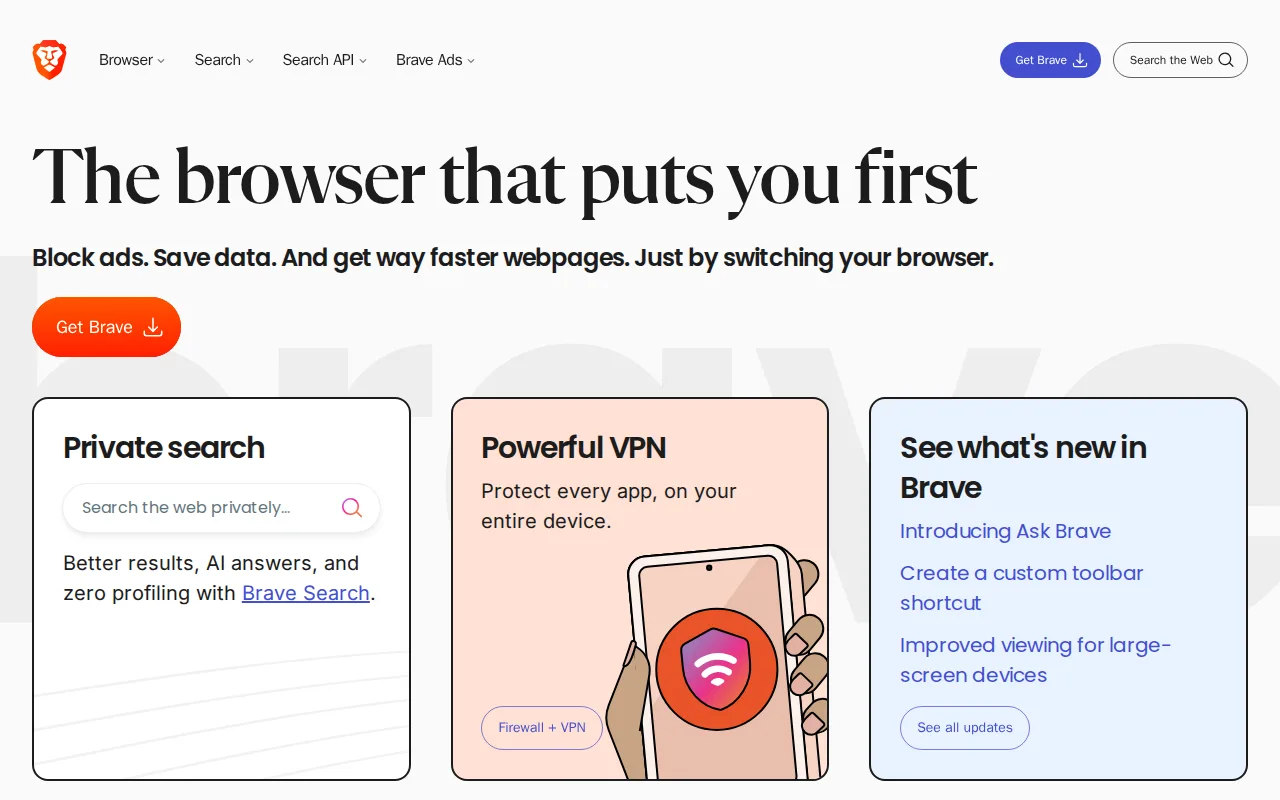
Brave is the best Opera alternative for people who want to read the code behind their privacy settings. Brave's client code is released under the Mozilla Public License 2.0 so security researchers can audit it directly, where Opera's browser is free but closed. Brave blocks ads, trackers, and third-party cookies by default and adds script blocking and fingerprint randomization on top, going further than Opera's built-in ad blocker, and it defaults to Brave Search, which runs on an independent index rather than reselling Google or Bing results. Opera's own biggest weakness is that its free bundled VPN is a basic privacy tool with fewer server locations and less consistent speed than dedicated products; Brave answers that with Brave Firewall + VPN at $9.99/month or $99.99/year, which encrypts all device traffic rather than only browser traffic, covering up to 10 devices across 300+ servers in 40+ regions with a 7-day free trial. Brave runs on Windows, macOS, Linux, iOS, and Android in nearly 160 languages. Opera is still the better choice if you want a VPN without paying — Brave's costs $119.88 a year at the monthly rate — and Brave's own listed drawbacks include confusion over its opt-in BAT-token Rewards program and crypto-wallet defaults, plus sites that misread its fingerprint randomization as bot activity.
Compared to Opera: client code open source under MPL-2.0 rather than closed, ad, tracker, script, and fingerprint blocking on by default, and a device-wide VPN at $9.99/month against Opera's free but basic bundled one
Wins:Client code is open source under MPL-2.0 and independently auditable; Opera's browser is free but closed source · Blocks ads, trackers, and third-party cookies by default plus script blocking and fingerprint randomization, going past Opera's built-in ad blocker · Brave Firewall + VPN encrypts all device traffic across up to 10 devices via 300+ servers in 40+ regions, where Opera's listing calls its own bundled VPN basic with fewer locations
Loses:Brave's VPN is a $9.99/month or $99.99/year subscription — $119.88 a year at the monthly rate — where Opera bundles a VPN into the browser for free · Brave's own listed drawbacks include confusion over the opt-in BAT-token Rewards program and crypto-wallet defaults, complexity Opera does not carry · Fingerprint randomization sometimes trips site bot-detection and breaks functionality, a compatibility risk Opera's lighter defaults avoid
Pros
- Blocks ads and trackers by default with no extensions required to set up.
- Client code is open source (MPL-2.0) and independently auditable.
- Built-in Brave Search runs on an independent index rather than reselling another engine's results.
- Available on every major desktop and mobile platform with nearly 160 languages supported.
Cons
- Brave Rewards' opt-in BAT-token ad program confuses some users about what's on by default versus optional.
- Brave VPN is a separate $9.99/month subscription, not bundled free with the browser.
- Built on Chromium, so it inherits Google's engine-level decisions and roadmap even while blocking Google's tracking.
- Some sites misidentify Brave's fingerprint randomization as bot activity, occasionally breaking site functionality.
Pricing: Free tier · paid from $9.99/mo — Both browsers are free; Brave's Firewall + VPN add-on costs $9.99/month or $99.99/year for up to 10 devices, where Opera includes a basic VPN at no cost and sells Opera Pro VPN as its paid upgrade (verified undefined NaN, NaN)
2.Firefox — best Opera alternative for users who want a non-Chromium, open-source browser with tracker blocking on by default and no ties to Google's or Apple's advertising businesses
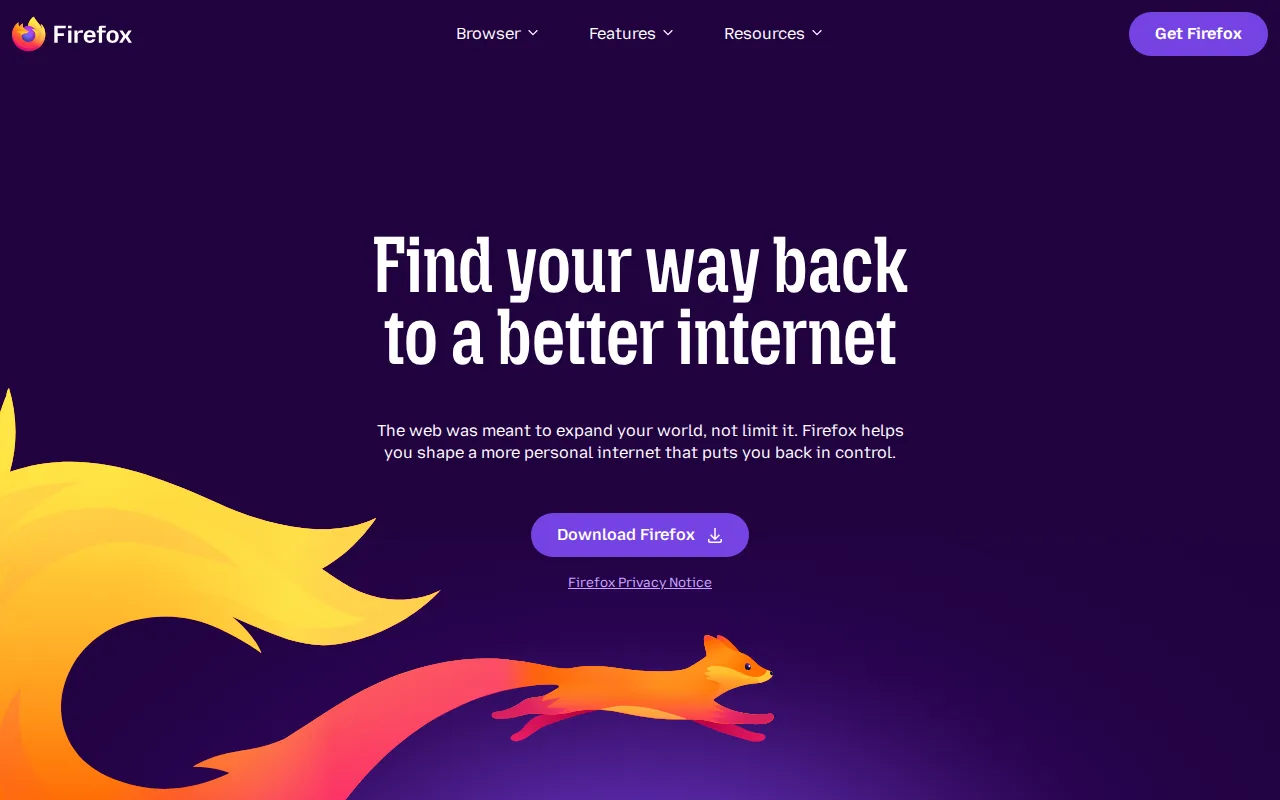
Mozilla Firefox is the only browser in this comparison that is not built on Chromium, which is exactly the concern Opera's own listing raises about itself. Firefox runs on Gecko, Mozilla's own layout engine, so switching to it means a genuinely different rendering path rather than another interface on Google's engine — Opera, Google Chrome, Microsoft Edge, Brave, and Vivaldi all share Chromium. Mozilla Firefox is free to download, blocks trackers automatically with no setup, and ships Total Cookie Protection, which confines cookies to the site that set them so they cannot follow a user around the web. Mozilla's own Firefox pages advertise more than 30,000 extensions, tab groups comparable to Opera's Tab Islands, reader mode, picture-in-picture video, and in-browser PDF editing, plus access to multiple AI chatbots without lock-in to one provider — or turning AI off entirely, where Opera ships a single Opera AI assistant. Mozilla states it is not owned by shareholders and does not sell personal data. Opera is still the better choice for anyone who wants the extras Opera bundles: Mozilla's Firefox feature pages list tracker blocking, Total Cookie Protection, and tab groups but no VPN inside the browser, and there is no Firefox equivalent to Opera's Flow file sharing between desktop and mobile or to the gaming-tuned Opera GX variant with its CPU and RAM limiters.
Compared to Opera: Mozilla's independent Gecko engine instead of Chromium, Total Cookie Protection with automatic tracker blocking and no setup, and a choice of AI chatbots — or none at all — rather than a single built-in assistant
Wins:Runs on Mozilla's own Gecko layout engine, the only non-Chromium browser here; Opera's listing names its Chromium dependency as a drawback · Total Cookie Protection confines cookies to the site that set them, and tracker blocking is automatic with no setup, per Mozilla's Firefox pages · Mozilla's Firefox pages advertise over 30,000 extensions and a choice of AI chatbots that can be switched off entirely, where Opera ships one Opera AI assistant
Loses:No bundled free VPN inside the browser; Mozilla's Firefox feature pages list tracker blocking, Total Cookie Protection, and tab groups but nothing equivalent to Opera's free VPN · No Flow-style file and link sharing between desktop and mobile, and no gaming-tuned variant like Opera GX with CPU and RAM limiters · No external review rating on record here, where Google Chrome shows 4.8/5 from 2,148 Capterra reviews and Opera 4.4/5 from 15 Product Hunt reviews
Pros
- Free and open source, published on GitHub under the Mozilla Public License 2.0.
- Enhanced Tracking Protection blocks third-party trackers and cookies by default.
- Runs on the independent Gecko engine rather than Chromium, preserving rendering-engine diversity on the web.
- Built-in Reader Mode, picture-in-picture, and PDF editing without extra extensions.
Cons
- Market share has declined for years, so some sites are tested against Chromium first and can render inconsistently.
- Fewer and sometimes lower-quality extensions available compared to the Chrome Web Store.
- Sync and account features are less tightly integrated with a broader productivity suite than Edge (Microsoft 365) or Chrome (Google Workspace).
- Performance and memory usage can lag Chrome on some heavy, JavaScript-intensive web apps.
Pricing: Free — Both are free to download with no paid tier for the browser itself; Opera's only paid line is the optional Opera Pro VPN upgrade (verified undefined NaN, NaN)