1 Best Open-Source Alternatives to Neon in 2026
By Noahlast updated pricing verified
Compared: open-source alternatives to Neon
| Alternative | Best for | Standout | Biggest weakness | Learning curve | Price |
|---|---|---|---|---|---|
| Neonreference | developers who want instant, low-cost database branching for every pull request or preview deployment without provisioning full new Postgres instances | Instant copy-on-write database branching that forks a full production dataset in seconds, paired with scale-to-zero compute billing so idle branches cost nothing. | Paid tiers are pure usage-based billing with no flat monthly price, so cost is harder to predict up front than a fixed-price competitor, and extra branches beyond the included count cost $1.50/branch-month, which adds up for teams branching aggressively per pull request. | Low | Free |
| Supabase | developers who want a Postgres-based backend (auth, storage, realtime, auto-generated APIs) they can self-host later, rather than committing to a proprietary NoSQL platform like Firebase | Auto-generated REST, GraphQL, and Realtime APIs derived straight from a project's Postgres schema, with Row Level Security enforcing per-row authorization at the database layer instead of in application code. | Pricing beyond the $25/month Pro base is usage-based and billed per project rather than per account, so teams running multiple projects or exceeding the 100,000 MAU / 250GB egress limits can see invoices climb well past the advertised starting price. | Moderate | Free tier · paid from $25/mo |
 Neon
Neon Supabase
1.Supabase — best Neon alternative for developers who want a Postgres-based backend (auth, storage, realtime, auto-generated APIs) they can self-host later, rather than committing to a proprietary NoSQL platform like Firebase
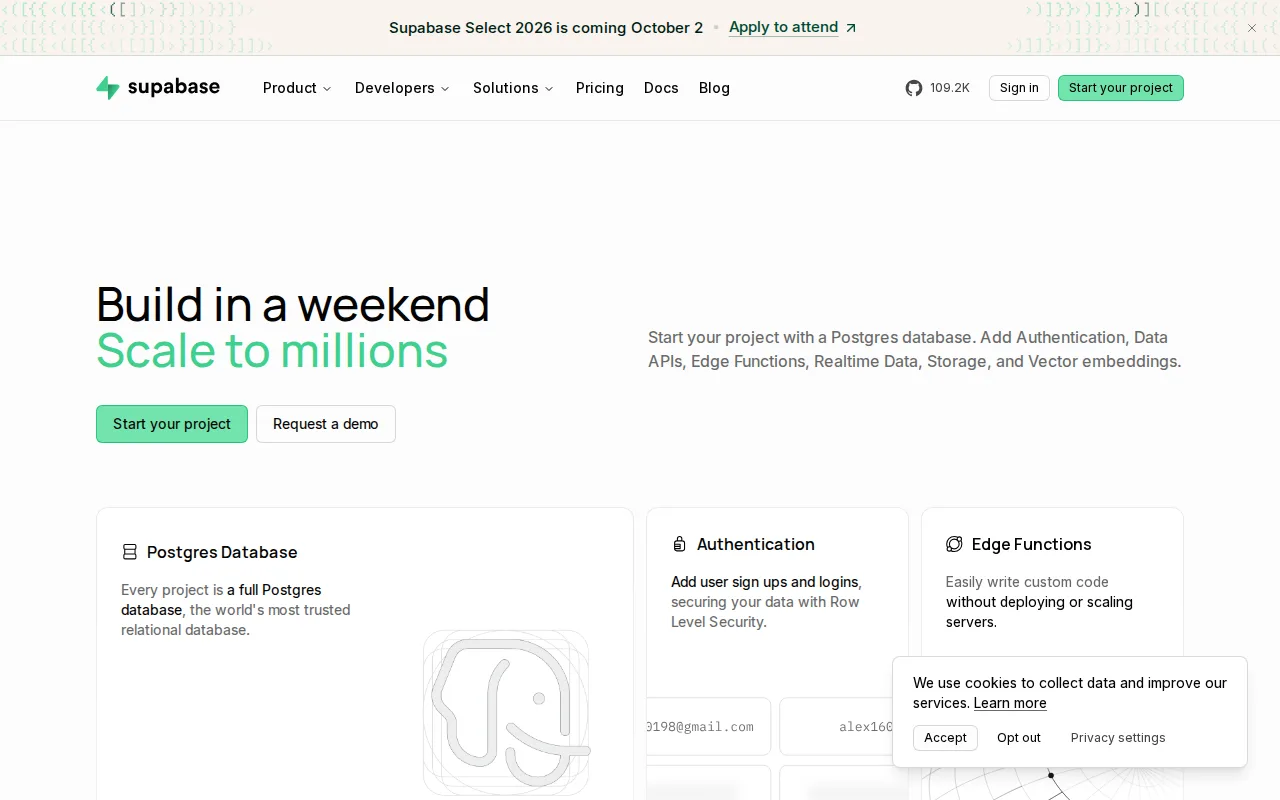
Supabase is the best Neon alternative for developers who want a Postgres-based backend bundling authentication, storage, realtime sync, and auto-generated APIs, not just the database itself that Neon provides. Supabase holds a 5.0/5 rating from 861 Product Hunt reviews, over ten times Neon's own 82 reviews, and its Free plan covers 2 projects with a 500MB database and 50,000 monthly active users at no cost, while Pro is $25/month with a $10/month compute credit included. Like Neon, Supabase's core stack (Postgres, PostgREST, GoTrue auth, Realtime, Storage) is open source and self-hostable, but Supabase adds Row Level Security for per-row authorization, S3-compatible object storage, and Deno-based edge functions that Neon's database-only product doesn't include. Neon is still the better choice for anyone who specifically wants instant, low-cost branching for every pull request: Neon's copy-on-write branching forks a full dataset in seconds with scale-to-zero compute billing, while Supabase's branching and per-project compute costs stack up faster for teams running several projects, since compute is billed per project rather than through Neon's usage-based, no-monthly-minimum model.
Compared to Neon: bundles authentication, storage, realtime sync, and auto-generated REST/GraphQL APIs, not just a database, Row Level Security enforces per-row authorization at the database layer, free tier includes 50,000 monthly active users at no cost
Wins:Bundles authentication, S3-compatible storage, realtime sync, and auto-generated REST/GraphQL/Realtime APIs alongside the database, well beyond Neon's database-only product · Row Level Security enforces per-row authorization directly in Postgres, a feature Neon's plain database layer doesn't provide · Holds a 5.0/5 rating from 861 Product Hunt reviews, over ten times Neon's own 82 reviews
Loses:Compute is billed per project rather than through Neon's usage-based, no-monthly-minimum model, so multi-project accounts stack recurring charges faster · No equivalent to Neon's instant copy-on-write branching purpose-built for per-pull-request preview databases · Free-tier projects pause automatically after 1 week of inactivity, a limit Neon's free tier doesn't impose the same way
Pros
- Full Postgres database rather than a proprietary NoSQL store, so existing SQL skills and extensions like pgvector and PostGIS carry over directly.
- Auto-generates REST, GraphQL, and Realtime APIs from the schema, with Row Level Security for per-row authorization.
- Apache-2.0-licensed core stack is self-hostable, avoiding hard vendor lock-in.
- Free tier includes unlimited API requests, 50,000 monthly active users, and a 500MB database with no time limit on the account.
Cons
- Compute is billed per project, so accounts running several projects stack recurring charges beyond the flat $25/month Pro fee.
- MAU overage ($0.00325/user past 100,000) and egress overage ($0.09/GB past 250GB) can produce unpredictable invoices at scale.
- Free-tier projects pause automatically after 1 week of inactivity.
- Row Level Security has a steeper learning curve than Firebase's simpler client-side security rules for teams new to SQL.
Pricing: Free tier · paid from $25/mo — Neon's Launch tier is pure usage-based billing ($0.106/compute-hour) with no monthly minimum; Supabase Pro is a flat $25/month with a $10/month compute credit included, then usage-based overages (verified undefined NaN, NaN)