3 Best Free Alternatives to MongoDB Atlas in 2026
By Noahlast updated pricing verified
All 4 MongoDB Atlas alternatives
Compared: free alternatives to MongoDB Atlas
| Alternative | Best for | Standout | Biggest weakness | Learning curve | Price |
|---|---|---|---|---|---|
| MongoDB Atlasreference | developers and teams building on a flexible document schema who want a managed, multi-cloud MongoDB deployment instead of self-hosting | Vector Search and Atlas Search run inside the same cluster as the primary document database, so AI retrieval and full-text search don't require a separate search or vector database. | Hourly, resource-based pricing across dedicated tiers, search nodes, stream processing, and data transfer makes total cost hard to predict without using the pricing calculator, and egress/backup fees stack on top of the base cluster rate once you leave the free or Flex tiers. | Moderate | Free |
| Supabase | developers who want a Postgres-based backend (auth, storage, realtime, auto-generated APIs) they can self-host later, rather than committing to a proprietary NoSQL platform like Firebase | Auto-generated REST, GraphQL, and Realtime APIs derived straight from a project's Postgres schema, with Row Level Security enforcing per-row authorization at the database layer instead of in application code. | Pricing beyond the $25/month Pro base is usage-based and billed per project rather than per account, so teams running multiple projects or exceeding the 100,000 MAU / 250GB egress limits can see invoices climb well past the advertised starting price. | Moderate | Free tier · paid from $25/mo |
| Firebase | mobile and web developers who want a fully managed backend (database, auth, hosting, functions) without provisioning or maintaining their own servers | A single integrated platform spanning database, authentication, hosting, serverless functions, crash reporting, and analytics, all provisioned and scaled automatically by Google. | Blaze-plan costs are usage-based across many separate metered services (reads/writes, bandwidth, function invocations, storage), so bills can escalate unpredictably at scale, and Firestore's proprietary NoSQL data model creates real migration lock-in compared to SQL-based backends. | Moderate | Free |
| CockroachDB | teams running multi-region transactional workloads on PostgreSQL-compatible SQL that need automatic failover without manual sharding | Automatic 3x data replication with multi-region survivability and PostgreSQL wire compatibility, so most existing Postgres tooling connects without changes | Self-hosted CockroachDB is no longer open source as of version 24.3 — it runs under a proprietary source-available license, and clusters without a valid license (or past their trial/grace period) are throttled to five concurrent SQL transactions, a change that alienated some users who adopted it for its earlier open-source licensing. | Moderate | Free tier · paid from $0.18/mo |
 MongoDB Atlas
 Supabase
 Firebase
 CockroachDB
1.Supabase — best MongoDB Atlas alternative for developers who want a Postgres-based backend (auth, storage, realtime, auto-generated APIs) they can self-host later, rather than committing to a proprietary NoSQL platform like Firebase
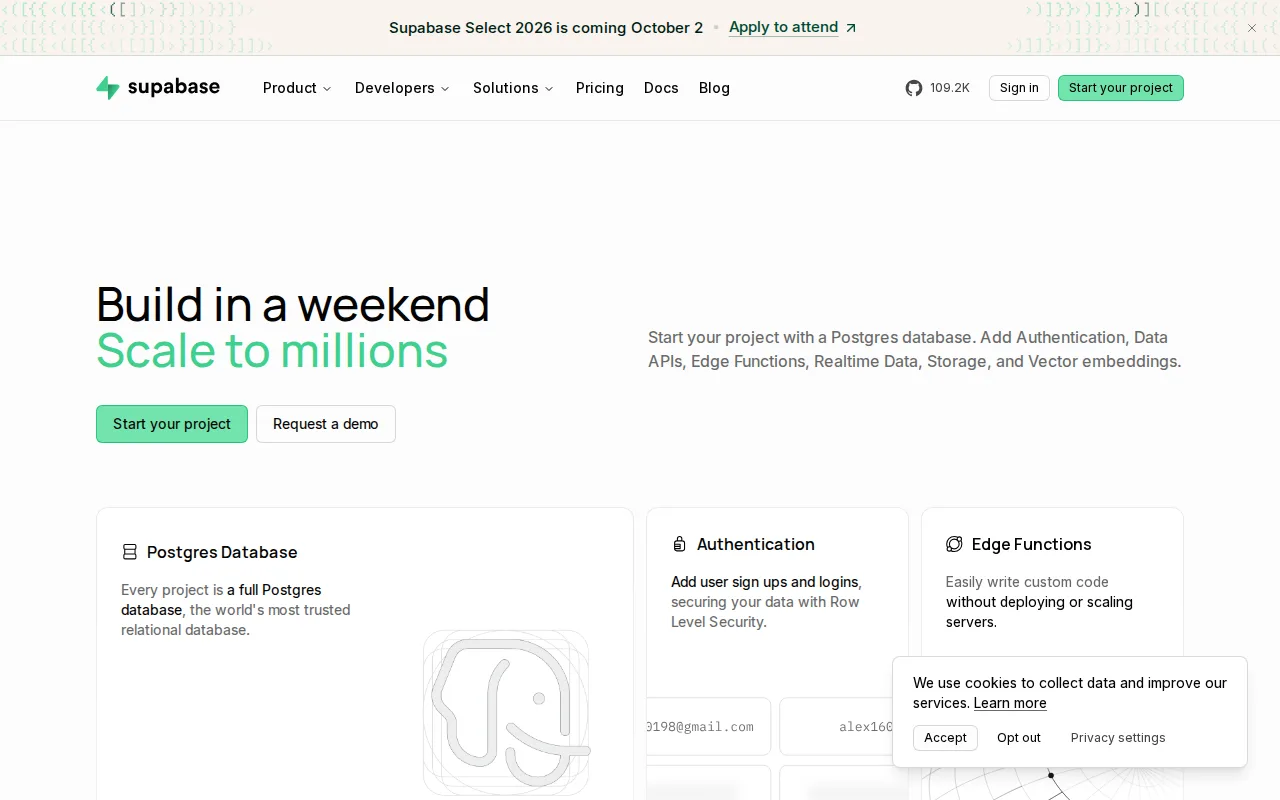
Supabase is the best MongoDB Atlas alternative for developers who want a full SQL backend on Postgres, with auto-generated REST, GraphQL, and Realtime APIs, rather than MongoDB's proprietary document-model database. Supabase's core stack — Postgres, PostgREST, GoTrue auth, Realtime, and Storage — is Apache-2.0 licensed and self-hostable from its GitHub repository, which has more than 108,000 stars, unlike MongoDB Atlas, which is a proprietary managed service layered on the source-available MongoDB server. Supabase holds a 5.0/5 rating from 861 Product Hunt reviews, far more third-party evidence than MongoDB Atlas' own listing, which carries no external ratings at all. Supabase's Free plan covers up to 2 projects with a 500MB database and 50,000 monthly active users at no cost, comparable in spirit to MongoDB Atlas' own free-forever M0 tier (512MB storage). MongoDB Atlas is still the better choice for teams that specifically need a flexible, schema-less document model or built-in vector search running on the same cluster as the primary data: Supabase's Row Level Security has a steeper learning curve than Firebase's simpler client-side rules for teams new to SQL, and Supabase's usage-based overages for compute, monthly active users, and egress beyond the $25/month Pro plan's included allowances can push bills well past the advertised starting price.
Compared to MongoDB Atlas: Apache-2.0-licensed, self-hostable Postgres core vs a proprietary managed service, 5.0/5 rating from 861 Product Hunt reviews vs no external ratings, auto-generated REST/GraphQL/Realtime APIs from the schema
Wins:Apache-2.0-licensed core stack is self-hostable, unlike MongoDB Atlas' proprietary managed service · 5.0/5 rating from 861 Product Hunt reviews vs MongoDB Atlas' no external ratings at all · Auto-generates REST, GraphQL, and Realtime APIs directly from the Postgres schema, with Row Level Security for per-row authorization
Loses:Row Level Security has a steeper learning curve than simpler client-side rules, for teams new to SQL · No built-in vector search running on the same cluster as the primary data the way MongoDB Atlas' Vector Search does · Usage-based overages for compute, MAU, and egress beyond the $25/month Pro plan can push bills well past the advertised starting price
Pros
- Full Postgres database rather than a proprietary NoSQL store, so existing SQL skills and extensions like pgvector and PostGIS carry over directly.
- Auto-generates REST, GraphQL, and Realtime APIs from the schema, with Row Level Security for per-row authorization.
- Apache-2.0-licensed core stack is self-hostable, avoiding hard vendor lock-in.
- Free tier includes unlimited API requests, 50,000 monthly active users, and a 500MB database with no time limit on the account.
Cons
- Compute is billed per project, so accounts running several projects stack recurring charges beyond the flat $25/month Pro fee.
- MAU overage ($0.00325/user past 100,000) and egress overage ($0.09/GB past 250GB) can produce unpredictable invoices at scale.
- Free-tier projects pause automatically after 1 week of inactivity.
- Row Level Security has a steeper learning curve than Firebase's simpler client-side security rules for teams new to SQL.
Pricing: Free tier · paid from $25/mo — Free tier (2 projects, 500MB database) vs MongoDB Atlas' free-forever M0 tier (512MB); Pro at $25/month plus usage overages vs MongoDB Atlas' hourly-billed dedicated clusters from $0.08/hour (verified undefined NaN, NaN)
2.Firebase — best MongoDB Atlas alternative for mobile and web developers who want a fully managed backend (database, auth, hosting, functions) without provisioning or maintaining their own servers
Firebase is the best MongoDB Atlas alternative for mobile and web developers who want a single integrated platform — database, authentication, hosting, serverless functions, crash reporting, and analytics — rather than assembling MongoDB Atlas with separate auth and hosting services. Firebase's free Spark plan requires no payment method at all and includes 1GiB of Firestore storage, 50,000 monthly active Authentication users, and 2 million Cloud Function invocations a month, a broader no-cost bundle than MongoDB Atlas' own free M0 tier, which covers database hosting alone. Firebase holds a 4.6/5 rating from 767 Capterra reviews, far more third-party evidence than MongoDB Atlas' own listing, which carries no external ratings at all. Both use a similar document-model NoSQL database (Firestore vs MongoDB's collections), so the underlying data modeling approach transfers directly between them. MongoDB Atlas is still the better choice for teams that need multi-cloud deployment and built-in vector search alongside the primary database: Firebase runs only on Google Cloud rather than across AWS, Google Cloud, and Azure the way MongoDB Atlas does, and Firebase's Blaze pay-as-you-go pricing spans many separately metered services (reads/writes, bandwidth, function invocations, storage), making cost forecasting at scale harder than MongoDB Atlas' cluster-hour pricing model.
Compared to MongoDB Atlas: single integrated platform (database, auth, hosting, functions, analytics) vs MongoDB Atlas plus separate services, 4.6/5 rating from 767 reviews vs no external ratings, Google Cloud only vs MongoDB Atlas' multi-cloud AWS/GCP/Azure deployment
Wins:Free Spark plan requires no payment method and bundles database, 50,000 Authentication users, and 2 million function invocations a month, broader than MongoDB Atlas' database-only free M0 tier · 4.6/5 rating from 767 Capterra reviews vs MongoDB Atlas' no external ratings at all · Single integrated platform covers database, authentication, hosting, serverless functions, crash reporting, and analytics without assembling separate services
Loses:Runs only on Google Cloud, unlike MongoDB Atlas' multi-cloud deployment across AWS, Google Cloud, and Azure · No built-in vector search alongside the primary database the way MongoDB Atlas' Vector Search offers · Blaze pay-as-you-go pricing spans many separately metered services, making cost forecasting at scale harder than MongoDB Atlas' cluster-hour model
Pros
- Generous free Spark tier with no payment method required, suitable for prototypes and small apps.
- Fully managed infrastructure removes the need to provision or scale servers manually.
- Deep, well-documented SDKs across iOS, Android, web, Flutter, Unity, and C++.
- Integrated operational tooling (Crashlytics, Analytics, Remote Config) reduces the need for separate third-party services.
Cons
- Blaze pay-as-you-go pricing spans many separately metered services, making cost forecasting difficult at scale.
- Firestore's proprietary NoSQL model creates lock-in and a steeper query-design learning curve than SQL databases.
- Some reviewers report recurring bugs and instability in certain SDK versions.
- Complex security rules (Firestore/Realtime Database) require careful configuration to avoid open or over-restrictive access.
Pricing: Free — Free Spark plan (no payment method required) vs MongoDB Atlas' free M0 tier; Blaze pay-as-you-go usage billing vs MongoDB Atlas' hourly-billed dedicated clusters from $0.08/hour (verified undefined NaN, NaN)
3.CockroachDB — best MongoDB Atlas alternative for teams running multi-region transactional workloads on PostgreSQL-compatible SQL that need automatic failover without manual sharding
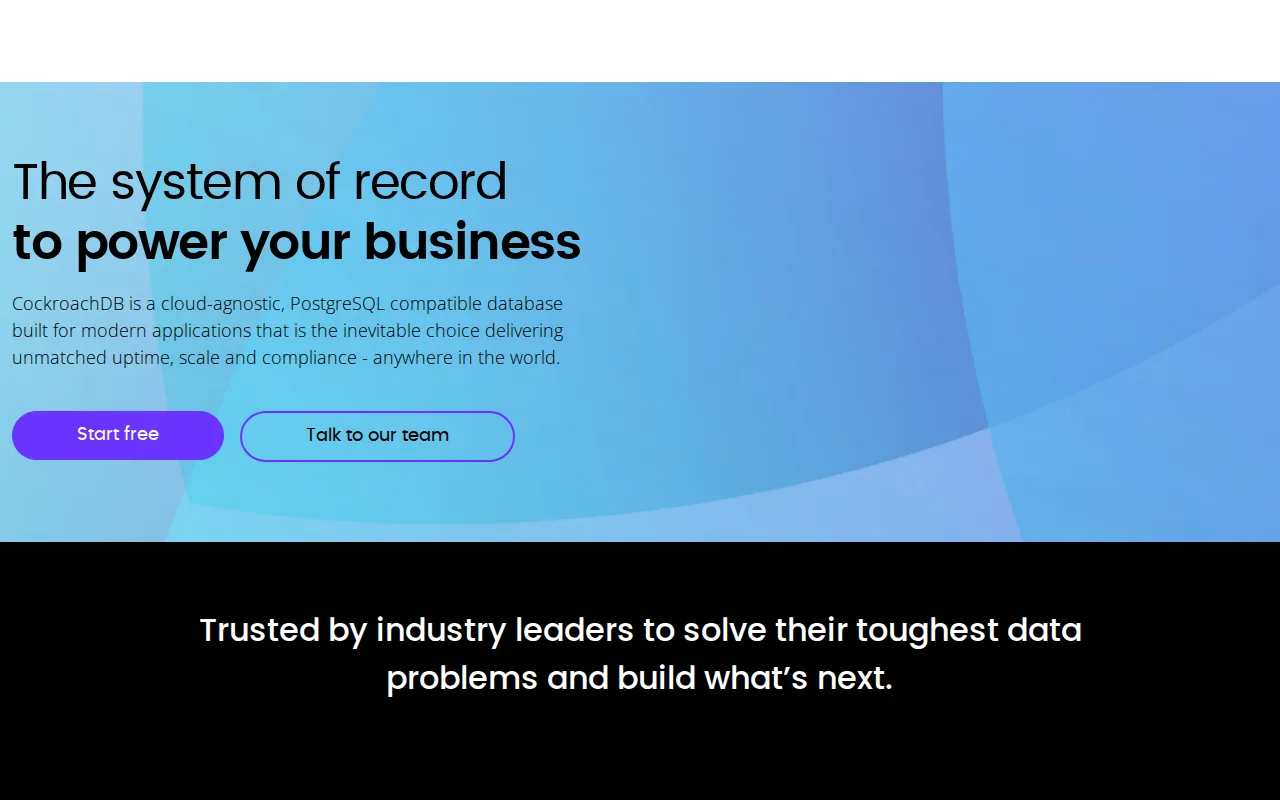
CockroachDB is the best MongoDB Atlas alternative for teams running multi-region transactional workloads that need automatic failover without manual sharding, replicating every piece of data three times across a cluster to survive node, datacenter, or region failures. CockroachDB speaks the PostgreSQL wire protocol, so most existing Postgres drivers and ORMs connect without modification, a different but equally established ecosystem from MongoDB's own driver-based document access. CockroachDB Cloud's Basic tier is free for workloads under 50 million request units and 10 GiB of storage a month, comparable in spirit to MongoDB Atlas' own free-forever M0 tier (512MB storage, up to 100 ops/second). CockroachDB holds a 4.7/5 rating from 3 Product Hunt reviews, thin but still more third-party evidence than MongoDB Atlas' own listing, which carries no external ratings at all. MongoDB Atlas is still the better choice for teams that specifically want a flexible document schema and built-in vector search on the same cluster: CockroachDB is no longer open source as of version 24.3, running self-hosted deployments under a proprietary source-available license, and unlicensed self-hosted clusters are throttled to five concurrent SQL transactions after a grace period, a licensing change that alienated some users who adopted it for its earlier open-source status.
Compared to MongoDB Atlas: automatic 3x data replication with multi-region survivability vs MongoDB Atlas' default deployment, PostgreSQL wire compatibility vs MongoDB's document-driver access, no longer open source as of version 24.3
Wins:Automatic 3x data replication survives node, datacenter, and region failures without manual sharding · PostgreSQL wire compatibility means most existing Postgres drivers and ORMs connect without modification · 4.7/5 rating from 3 Product Hunt reviews vs MongoDB Atlas' no external ratings at all
Loses:No longer open source as of version 24.3 — self-hosted deployments run under a proprietary source-available license · Unlicensed or expired self-hosted clusters are throttled to five concurrent SQL transactions after a grace period · No built-in vector search or full-text search running on the same cluster as the primary data the way MongoDB Atlas offers
Pros
- Automatic 3x replication survives node, datacenter, and region failures without manual intervention.
- PostgreSQL wire-compatible, so most Postgres drivers and ORMs work without modification.
- Cloud Basic tier is genuinely free up to 50 million request units and 10 GiB storage per month.
- Deploys across AWS, GCP, and Azure, plus self-hosted or bring-your-own-cloud options.
Cons
- No longer open source as of version 24.3 — self-hosted runs under a proprietary source-available license.
- Unlicensed or expired self-hosted clusters are throttled to five concurrent SQL transactions after a grace period.
- Enterprise Free self-hosted license requires sending telemetry and cannot be used to host CockroachDB as a service for third parties.
- Cloud compute pricing is billed hourly per vCPU, which takes more effort to estimate than a flat per-seat or per-GB rate.
Pricing: Free tier · paid from $0.18/mo — Cloud Basic tier free (under 50M request units, 10GiB storage) vs MongoDB Atlas' free-forever M0 tier; Standard Cloud at $0.18/hour per 2 vCPUs vs MongoDB Atlas' M10 at $0.08/hour (verified undefined NaN, NaN)