1 Best Open-Source Alternatives to Microsoft Office in 2026
By Noahlast updated pricing verified
All 4 Microsoft Office alternatives
Compared: open-source alternatives to Microsoft Office
| Alternative | Best for | Standout | Biggest weakness | Learning curve | Price |
|---|---|---|---|---|---|
| Microsoft Officereference | Households and small teams who want Word, Excel, PowerPoint, and Outlook synced across Windows, Mac, iOS, and Android with shared cloud storage and Copilot AI built into the apps. | Microsoft Copilot AI is built directly into Word, Excel, PowerPoint, Outlook, and OneNote on every Microsoft 365 Personal, Family, and Premium plan, not sold as a bolt-on. | Copilot AI usage is capped even on the $19.99/month Premium plan, and the only way to avoid a subscription entirely — the $179.99 Office Home 2024 license — drops Outlook, Teams, OneDrive storage, and all AI features. | Moderate | Free tier · paid from $9.99/mo |
| LibreOffice | individuals, schools, and organizations that want a full office suite without a subscription and can work without native real-time cloud co-authoring | A complete six-application office suite (including a desktop database tool in Base, which neither Microsoft nor Google offer at the consumer level) that is entirely free and open source with no feature paywall. | No native real-time multi-user co-authoring in the way Microsoft 365 or Google Workspace offer it, and complex documents with heavy Microsoft-specific formatting (advanced macros, certain chart types, some fonts) can render or convert imperfectly when round-tripped through .docx/.xlsx/.pptx. | Low | Free |
 Microsoft Office
 LibreOffice
1.LibreOffice — best Microsoft Office alternative for individuals, schools, and organizations that want a full office suite without a subscription and can work without native real-time cloud co-authoring
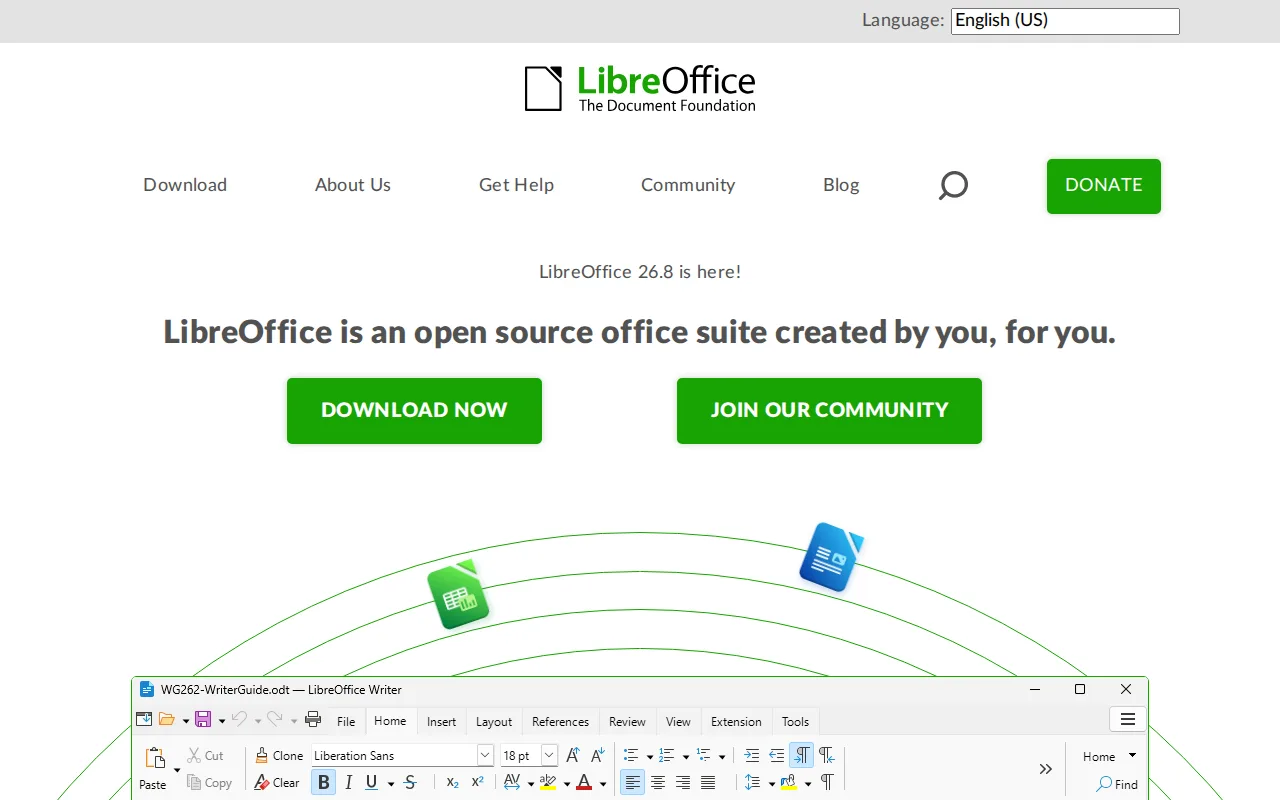
LibreOffice is the best Microsoft Office alternative for anyone who wants to own their office suite outright and never see a bill. LibreOffice is free with no paid tier, no account, and no feature gating, against Microsoft Office's two paid routes: $99.99/year for Microsoft 365 Personal or $179.99 once for Office Home 2024 on a single PC or Mac. It is six applications, not four: Writer, Calc, Impress, Draw for vector graphics and diagrams, Base for desktop databases, and Math for formulas, where the Office Home 2024 license covers Word, Excel, PowerPoint, and OneNote and drops Outlook, Teams, cloud storage, and Copilot. LibreOffice reads and writes .docx, .xlsx, and .pptx alongside native OpenDocument formats, runs on Linux as well as Windows and macOS, and has no 31-day offline lockout, so an unconnected machine keeps full edit access indefinitely. It is maintained by the nonprofit Document Foundation under the MPL-2.0 license with parts under GPL and LGPL. Microsoft Office remains the better choice for collaborative and mobile work. LibreOffice has no native real-time co-authoring, where Microsoft Office co-authors Word, Excel, and PowerPoint across web, desktop, and mobile, and no official iOS or Android apps at all. Complex documents with advanced macros, certain chart types, and some fonts can lose fidelity when round-tripped through Microsoft formats, and there is no bundled cloud storage and no AI.
Compared to Microsoft Office: $0 with no paid tier against $99.99/year or a $179.99 one-time license, six applications including Base and Draw against Office Home 2024's four, and no 31-day offline lockout on editing
Wins:Free forever with no subscription, account, or feature paywall, against $99.99/year for Microsoft 365 Personal or $179.99 once for Office Home 2024 on a single machine · Six applications including Base for desktop databases and Draw for vector graphics, where the Office Home 2024 license covers only Word, Excel, PowerPoint, and OneNote · Runs natively on Linux, which Microsoft Office does not support, and keeps full edit access offline indefinitely rather than dropping to view and print-only after 31 days
Loses:No native real-time co-authoring, where Microsoft Office co-authors Word, Excel, and PowerPoint across web, desktop, and mobile · No official iOS or Android apps, where Microsoft Office ships platform-tailored apps on Windows, Mac, iOS, and Android · No bundled cloud storage against Microsoft 365's 1TB per person, no Copilot AI, and fidelity loss on complex Microsoft-format documents with advanced macros or charts
Pros
- Completely free with no subscription, account, or feature paywall, including a desktop database app (Base) most competitors omit.
- Open source (MPL-2.0/GPL/LGPL) with an active community and frequent releases.
- Broad Microsoft Office format compatibility (.docx, .xlsx, .pptx) for opening and editing existing Office files.
- Runs on Windows, macOS, and Linux, and is the default suite on many Linux distributions.
Cons
- No native real-time cloud co-authoring like Microsoft 365 or Google Workspace, so simultaneous multi-user editing isn't built in.
- Complex Microsoft-format documents (advanced macros, some chart and font rendering) can lose fidelity when converted.
- No official mobile apps for iOS/Android under the LibreOffice brand.
- Interface and default styling feel dated compared to Microsoft Office or Google Workspace.
Pricing: Free — $0 with no subscription or paid tier vs Microsoft 365 Personal's $99.99/year or the $179.99 one-time Office Home 2024 license (verified undefined NaN, NaN)