Medusa — An open-core commerce platform (MIT core license, 35,900+ GitHub stars) for developers building custom B2B, B2C, and marketplace storefronts, self-hosted free or on Medusa Cloud from $29/month.

By Noahlast updated pricing verified
Medusa screenshots & video
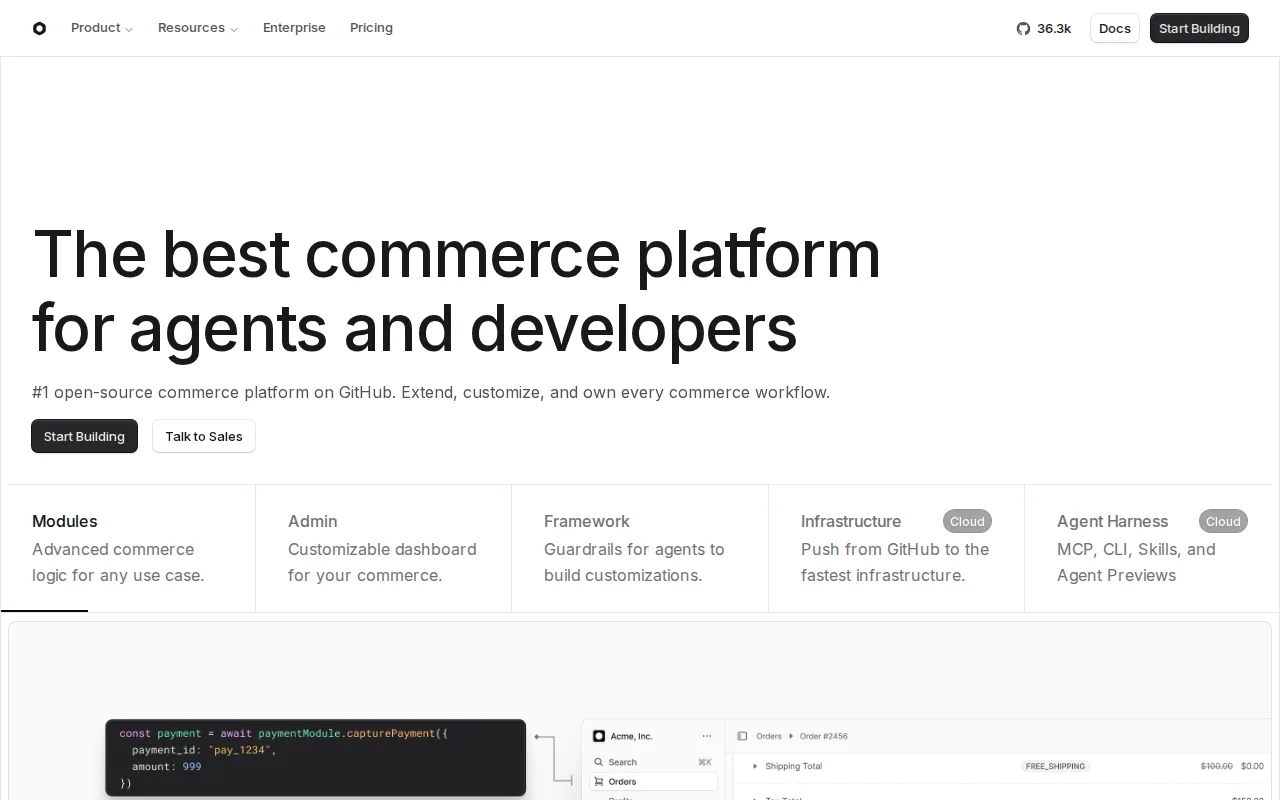
Medusa in 20 seconds
Best for: developer teams building custom B2B, B2C, or marketplace storefronts needing more control than Shopify allows
Pricing: Free to self-host (MIT core); Medusa Cloud starts at $29/month, scaling to $299/month, with a custom-quoted Enterprise tier and no GMV fees.
- Medusa's core is open source under the MIT license, with 35,900+ GitHub stars.
- Self-hosting is free; Medusa Cloud starts at $29/month (Develop tier).
- Medusa Cloud charges no GMV-based fee or commerce tax on any plan.
- The platform supports multi-channel sales, multi-warehouse inventory, and multi-regional pricing for B2B, B2C, and marketplace commerce.
- Medusa has a 4.4/5 rating from 10 reviews on Product Hunt, where it won the 2022 Golden Kitty Award for #1 E-commerce Product of the Year.
Limitations: Requires real developer investment to configure; not a point-and-click store builder.; Enterprise Edition features require a non-public commercial license agreement.; Smaller third-party app and theme ecosystem than Shopify.
Top alternatives: Shopify, Saleor, BigCommerce, Adobe Commerce (Magento), commercetools — full list
What is Medusa?
Medusa is an open-core commerce platform, described by its maintainers as the #1 open-source commerce platform on GitHub, built to give developers full control over commerce logic instead of working within a fixed SaaS storefront template. The platform covers advanced product management with bulk editing and bundles, multi-channel sales across stores, POS, and apps, multi-warehouse inventory with order reservations, multi-regional support for currencies, taxes, and shipping, and a promotion engine for campaigns and discounts. It also ships AI-enabled development tooling, including an MCP server and agentic skills, aimed at teams building AI-agent-driven or 'agentic commerce' storefronts. The customizable admin dashboard and headless architecture make Medusa suited to B2B, B2C, and marketplace use cases that outgrow templated platforms like Shopify. Medusa's core is open source under the MIT license and free to self-host; an Enterprise Edition layer requires a separate commercial license agreement for additional capabilities. Medusa Cloud is the managed hosting alternative, priced at $29/month (Develop) through $299/month (Scale), with a custom-quoted Enterprise tier. Unlike many hosted commerce platforms, Medusa Cloud charges no GMV-based fee or per-transaction commerce tax on any plan — customers pay only for infrastructure.
Medusa is an open-core commerce platform giving developers building blocks for custom ecommerce: advanced product management, multi-channel sales, multi-warehouse inventory, multi-regional pricing and tax, and a promotion engine, all extensible through code rather than locked into a fixed storefront template. The core is MIT-licensed and free to self-host, with an Enterprise Edition requiring a commercial agreement for additional features; Medusa Cloud, the managed hosting option, starts at $29/month (Develop tier) for zero-config infrastructure with GitHub deployment, scaling to $99/month (Launch) and $299/month (Scale), plus a custom-quoted Enterprise tier with SSO, RBAC, and audit logs. Medusa is built for developers and technical teams handling complex commerce operations — B2B, multi-region, or AI-agent-driven storefronts — who need more customization than Shopify or BigCommerce allow, and it charges no GMV (gross merchandise value) tax on any tier.
Standout feature: Charges no GMV-based fee or per-transaction commerce tax on any Cloud tier, unlike many hosted commerce platforms that take a cut of sales alongside infrastructure fees.
Biggest weakness: Medusa requires real developer investment to configure and extend — it is a toolkit rather than a ready-made storefront — and the Enterprise Edition's additional features sit behind a separate, non-public commercial license agreement rather than a fixed published price.
Pros
- MIT-licensed core is free to self-host with no feature gating on the open-source codebase itself.
- No GMV-based fee or commerce tax on any Medusa Cloud plan, unlike hosted platforms that take a percentage of sales.
- Deep customization for complex commerce needs: multi-warehouse inventory, multi-region pricing, B2B and marketplace support.
- 35,900+ GitHub stars and an active open-source community, plus AI-agent tooling (MCP server, agentic skills) for teams building agentic commerce.
Cons
- Requires real developer resources to configure; it's a commerce toolkit, not a point-and-click store builder like Shopify.
- Enterprise Edition features require a separate, non-public commercial license agreement rather than transparent published pricing.
- Cloud Develop's entry tier caps compute hours and edge requests, so active stores may need to move to Launch or Scale quickly.
- Smaller third-party app/theme marketplace than Shopify, meaning more custom development for integrations.
Medusa pricing
Free tier · paid from $29/mo · verified from the vendor's pricing page
| Plan | Price | Notes |
|---|---|---|
| Self-hosted (open source) | Free | MIT-licensed core, free to self-host; Enterprise Edition features require a separate commercial license agreement. |
| Cloud Develop | $29/mo | Zero-config infrastructure with GitHub deployment, storefront and backend hosting, Cloud Development Agent, 1M edge requests/month, 600 compute hours/month, 1 shared server. |
| Cloud Launch | $99/mo | Adds autoscaling infrastructure, custom storefront domains, automatic backups (7-day retention), webhook events, Redis-backed KV store, 5M edge requests/month. |
| Cloud Scale | $299/mo | Adds background workers, priority support, 3 Cloud seats, 10M edge requests/month, custom backend domain, longer backup retention. |
| Cloud Enterprise | Custom | Custom pricing; Enterprise License, 24/7 support, platform SLAs, SLA-backed response times, RBAC, SSO, audit logs, dedicated support engineer, 99.99% uptime guarantee, data sovereignty options. |
What reviewers say
Scores belong to their platforms; we display them with attribution and never fold them into our own ratings.