6 Best Alternatives to Linode (Akamai) for Web in 2026
By Noahlast updated
All 6 Linode (Akamai) alternatives
Compared: Linode (Akamai) alternatives that run on Web
| Alternative | Best for | Standout | Biggest weakness | Learning curve | Price |
|---|---|---|---|---|---|
| Linode (Akamai)reference | developers and small-to-midsize teams who want predictable, bundled cloud infrastructure pricing and a simpler console than AWS or Azure, without needing the full hyperscaler feature catalog | Flat, bundled per-instance pricing that folds CPU, transfer, storage, and RAM into one rate, instead of itemizing bandwidth, storage, and compute as separate line items the way major hyperscalers typically do. | Support response times run slower than premium-tier support at larger hyperscalers per reviewer reports, and advanced networking and load-balancing configuration has a steeper learning curve than the core compute product suggests. | Moderate | Custom pricing |
| DigitalOcean | developers and small engineering teams who want predictable, usage-based cloud pricing for VMs, Kubernetes, and managed databases without navigating AWS's pricing complexity | Simple, transparent per-second billing on Droplets starting at $4/month, combined with a newer AI infrastructure stack (GPU access, a 70+ model inference engine, and managed agent orchestration) on the same account. | Fewer regions and a smaller managed-service catalog than AWS, Azure, or Google Cloud, so teams with complex compliance, networking, or enterprise-integration needs often outgrow DigitalOcean and have to migrate to a hyperscaler. | Low | Free tier · paid from $4/mo |
| Hetzner | developers and small teams who need cheap, no-frills cloud or dedicated compute in EU data centers and don't need a hyperscaler's global edge network | Per-resource pricing that consistently undercuts AWS, DigitalOcean, and Google Cloud on raw compute, with a stateful firewall, private networking, and 20TB of traffic included at no extra cost on cloud plans. | Support is email-only with no phone or live chat, data centers are concentrated in Germany, Finland, and one US location rather than a global points-of-presence network, and Hetzner has periodically restricted or delayed account approvals for new customers in some countries. | Moderate | From $4.59/mo |
| Vultr | developers and small-to-mid-size teams who want self-service, hourly-billed cloud compute in a specific global region without navigating a hyperscaler's full managed-service catalog | Deployment across 30+ global data center regions with instant, self-service provisioning, letting developers place compute close to end users without a hyperscaler-scale sales or onboarding process. | Backups, snapshots, and bandwidth overages are billed separately from the advertised base price (backups run about 20% of instance cost, snapshots and overage bandwidth are billed per GB), so the real monthly cost for a production instance runs meaningfully above the headline $2.50-3.50/month starting price. | Moderate | From $2.50/mo |
| AWS Amplify | teams already building on AWS who want Git-based hosting plus managed auth, data, and storage without assembling separate services | Provisions a full backend (Cognito authentication, data APIs, storage, functions) from a single TypeScript codebase alongside CI/CD hosting on CloudFront | Pricing spans multiple separately-billed AWS services (hosting, Cognito, AppSync, DynamoDB, Lambda), so total cost isn't visible on the Amplify pricing page alone, and the platform assumes comfort with AWS's console and IAM model rather than offering a simplified single-dashboard experience like Vercel or Netlify. | Moderate | Free tier · paid from $0.01/mo |
| OVHcloud | developers and businesses that want European-hosted (data sovereignty) VPS, bare metal, or public cloud infrastructure at lower published prices than the major US hyperscalers | Full control of its own hardware design and 46 data centers gives OVHcloud published, competitive pricing across VPS, bare metal, and public cloud without the quote-gating common at larger enterprise clouds. | Support responsiveness is the most common complaint across both review platforms — G2 reviewers in particular rate it 3.2/5 from 75 reviews, notably lower than the broader Trustpilot sample, and pricing is scheduled to change April 1, 2026, per OVHcloud's own pricing page. | Moderate | From $8.50/mo |
| Google Cloud Platform | developers and enterprises that need pay-as-you-go compute, managed databases, and AI/ML infrastructure (Vertex AI, BigQuery) without owning hardware, especially teams already invested in Google's data and analytics stack | BigQuery and Vertex AI give GCP a data-analytics and AI/ML depth that's tightly integrated with the rest of the platform, a differentiator from AWS and Azure for workloads centered on large-scale analytics or model training. | Pricing is entirely usage-based across 100+ services with no flat starting price, so estimating real monthly cost requires a calculator or careful monitoring, and unexpected usage spikes (a common complaint across all major clouds) can produce a surprise bill once the $300 trial credit and Always Free allowances are exhausted. | Steep | Free |
 Linode (Akamai)
 DigitalOcean
 Hetzner
 Vultr
Vultr AWS Amplify
 OVHcloud
 Google Cloud Platform
1.DigitalOcean — best Linode (Akamai) alternative for developers and small engineering teams who want predictable, usage-based cloud pricing for VMs, Kubernetes, and managed databases without navigating AWS's pricing complexity
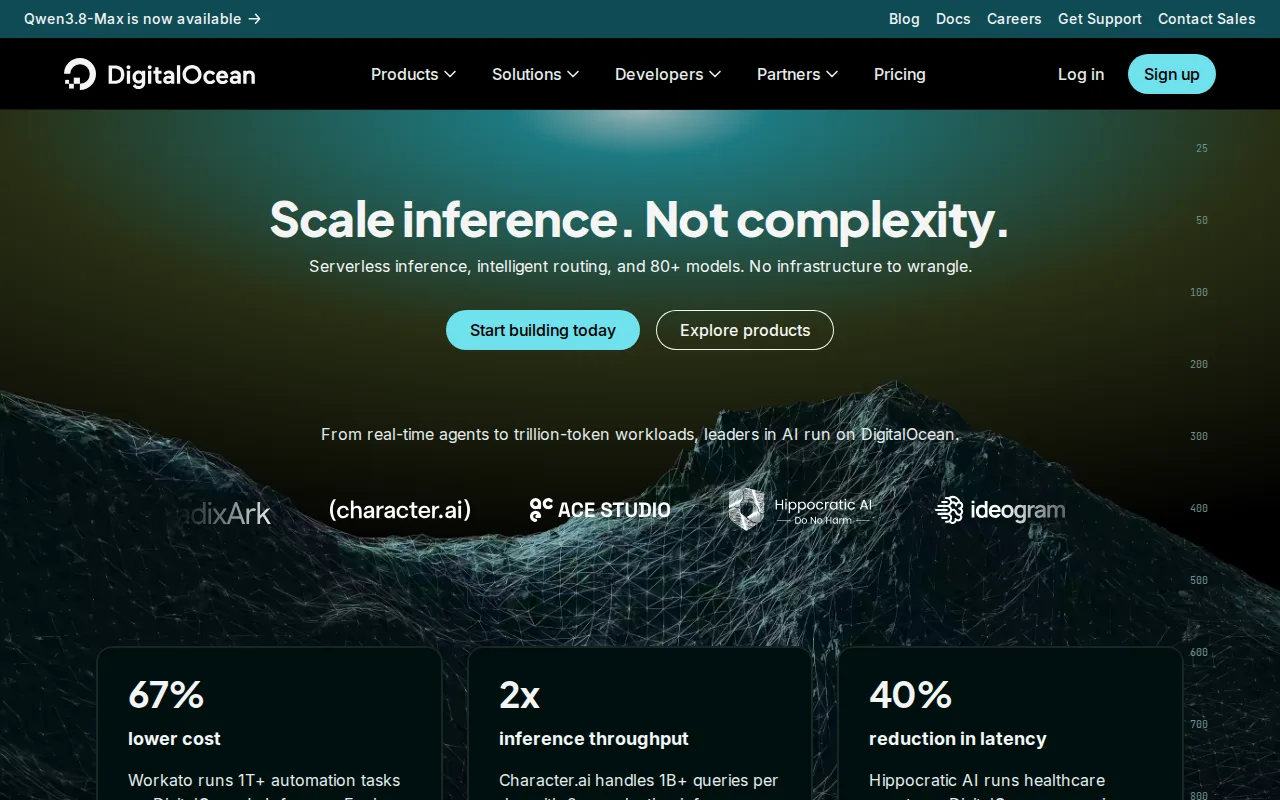
DigitalOcean is the best Linode alternative for developers and small engineering teams who want transparent, per-second-billed pricing published directly on the site rather than Linode's pricing, which lives on a separate Akamai cloud-pricing page rather than linode.com itself. DigitalOcean's Droplets start at $4/month with per-second billing (60-second minimum), and App Platform includes a genuinely free $0/month tier for static sites and small apps, something Linode's bundled-but-unpublished pricing model doesn't offer transparently. DigitalOcean holds a 4.6/5 rating from 159 Capterra reviews, matching Linode's own 4.6/5 but from more than 7x the review volume (159 vs 22). Managed Kubernetes includes a free control plane, a cost hyperscalers usually charge for, and DigitalOcean has built out an AI infrastructure line (GPU access across 20 data centers, a 70+ model inference engine) on the same account. Linode is still the better choice for teams that specifically want Akamai's global edge network for lower-latency edge-native application deployment, or up to $5,000 in promotional cloud credits for new and existing enterprise customers, a larger credit pool than DigitalOcean's modest $5 new-account credit.
Compared to Linode: transparent per-second Droplet pricing from $4/month published directly on the site, genuinely free App Platform tier for static sites, 7x the Capterra review volume (159 vs 22) at the same 4.6/5 score
Wins:Droplet pricing starts at $4/month with per-second billing, published directly rather than on a separate Akamai cloud-pricing page · App Platform includes a genuinely free $0/month tier, not just promotional credits · 159 Capterra reviews at 4.6/5, more than 7x Linode's 22-review sample at the same score
Loses:New-account credit is a modest $5 valid for 90 days, versus Linode's up to $5,000 in promotional credits for new and existing enterprise customers · Not backed by Akamai's global edge network the way Linode is positioned for low-latency edge-native deployment · Fewer regions and a smaller managed-service catalog than AWS, Azure, or Google Cloud, a limitation Linode shares
Pros
- Droplets start at $4/month with simple per-second billing, easier to predict than hyperscaler pricing.
- App Platform includes a genuine free tier, not just a time-limited trial.
- Managed Kubernetes includes a free control plane, a cost hyperscalers usually charge for.
- 4.6/5 rating from 159 Capterra reviews, with reviewers reporting largely positive sentiment.
Cons
- Far fewer regions and managed services than AWS, Azure, or Google Cloud, limiting fit for complex enterprise needs.
- The new-account credit is a modest $5 valid for 90 days, smaller than promotional credits some competitors offer.
- The AI infrastructure line (GPU access, inference engine) is newer and less proven than dedicated AI cloud providers.
- Support and SLA options are thinner than what enterprise customers get from the major hyperscalers.
Pricing: Free tier · paid from $4/mo — $4/month (DigitalOcean Droplets) vs Linode's unpublished, bundled per-instance rate on Akamai's separate pricing page (verified undefined NaN, NaN)
2.Hetzner — best Linode (Akamai) alternative for developers and small teams who need cheap, no-frills cloud or dedicated compute in EU data centers and don't need a hyperscaler's global edge network
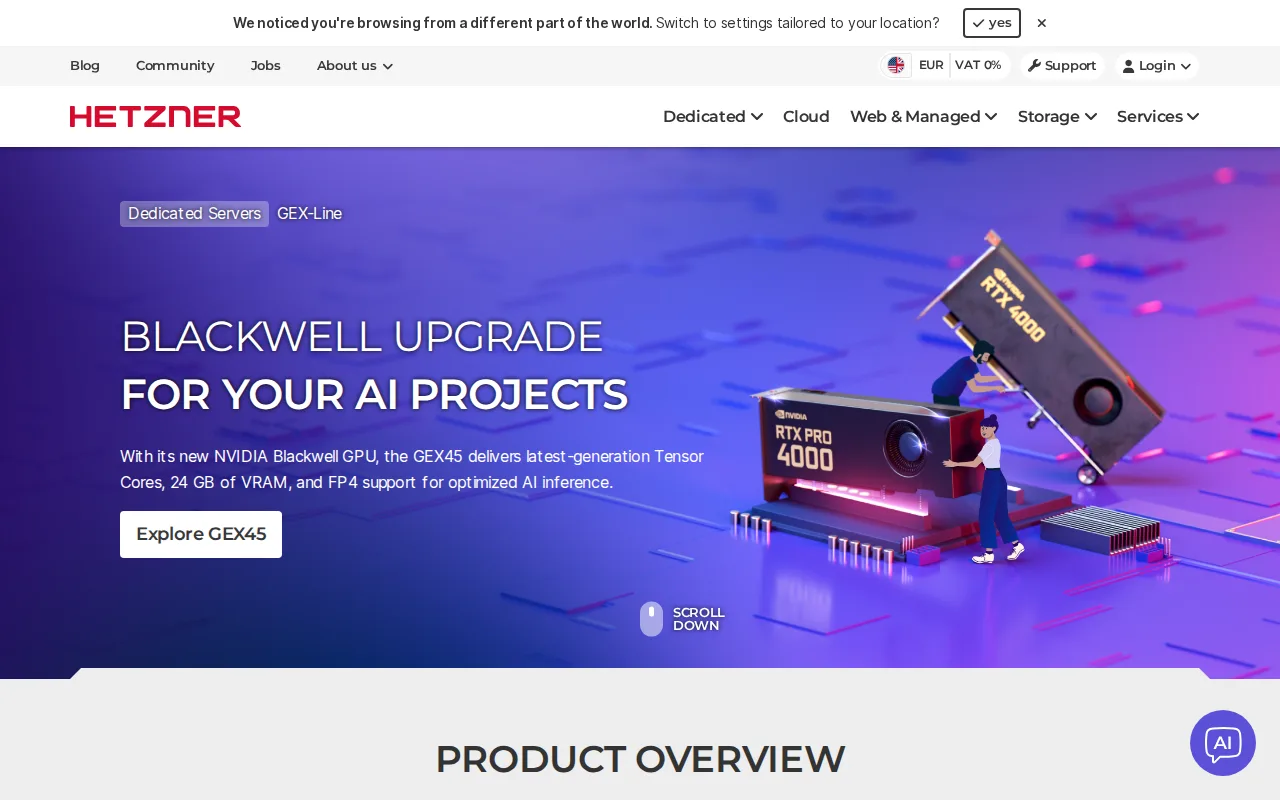
Hetzner is the best Linode alternative for developers and small teams who want the cheapest possible raw compute in EU data centers, undercutting most competitors including Linode on price. Hetzner's entry CX22 cloud instance (2 vCPUs, 4GB RAM, 40GB SSD) costs $4.59/month with a stateful firewall, private networking, and 20TB of traffic included at no extra cost, while Linode bundles similar resources into one flat rate that isn't published in static text on linode.com. Hetzner has no external rating recorded in our listing data, though Linode does carry a 4.6/5 rating from 22 Capterra reviews that Hetzner has no equivalent for here. Data centers are limited to Germany, Finland, and one US location (Ashburn, Virginia), simplifying GDPR data-residency requirements for European customers. Linode is still the better choice for anyone who wants phone or chat support: Hetzner's support is 24/7 email-only with no phone or live chat, and Linode's dashboard is rated more intuitive by reviewers switching from larger hyperscalers, while Hetzner has periodically restricted or delayed account approvals for new signups in some countries.
Compared to Linode: cheaper entry cloud instance ($4.59/mo CX22 vs Linode's unpublished bundled rate), 20TB of traffic and a stateful firewall included at no extra cost, EU-concentrated data centers simplify GDPR data residency
Wins:Entry cloud instance (CX22) costs $4.59/month with pricing published directly, versus Linode's bundled rate hidden on a separate Akamai pricing page · 20TB of traffic, a stateful firewall, and private networking included at no extra cost · EU-concentrated data centers (Germany, Finland) simplify GDPR data-residency requirements for European customers
Loses:No external rating recorded in our listing data, versus Linode's 4.6/5 from 22 Capterra reviews · Support is 24/7 email-only with no phone or live chat, while Linode's dashboard is rated more intuitive by reviewers switching from larger hyperscalers · Data center footprint is limited to Germany, Finland, and one US location, versus Linode's broader global network backed by Akamai's edge infrastructure
Pros
- Cloud and dedicated server prices consistently undercut AWS, DigitalOcean, and Vultr for comparable specs.
- Private networking, a stateful firewall, and free DNS are included at no extra cost.
- Server Auction offers discounted, previously-used dedicated hardware for budget-sensitive projects.
- EU-based data centers simplify GDPR data-residency requirements for European customers.
Cons
- Support is limited to 24/7 email; there is no phone or live chat option.
- Data center footprint is limited to Germany, Finland, and a single US location, versus dozens of regions at AWS or Azure.
- No permanent free compute tier; every server incurs hourly or monthly charges from the first minute.
- Account verification and approval can be slow or restrictive for signups from certain countries.
Pricing: From $4.59/mo — $4.59/month (Hetzner CX22) vs Linode's unpublished, bundled per-instance rate
3.Vultr — best Linode (Akamai) alternative for developers and small-to-mid-size teams who want self-service, hourly-billed cloud compute in a specific global region without navigating a hyperscaler's full managed-service catalog
Vultr is the best Linode alternative for developers who want to deploy compute close to end users across the widest region footprint among these alternatives. Vultr operates data centers in more than 30 global regions, and its entry-level Regular Performance Cloud Compute instance starts around $2.50-3.50/month, cheaper than Linode's bundled rate, though Vultr's own site blocked automated fetching, so these figures are triangulated from third-party sources rather than read directly off vultr.com and should be confirmed before purchasing. Vultr holds a 4.5/5 rating from 40 Capterra reviews, close to Linode's own 4.6/5 from 22 reviews, with a larger review sample. Bare Metal servers (from roughly $120/month) offer single-tenant, no-shared-resource hardware, and the company reports spinning up more than 80 million cloud servers since founding. Linode is still the better choice for anyone who wants confirmed, all-inclusive bundled pricing without add-on surprises: Vultr's backups, snapshots, and bandwidth overages are billed separately from the advertised base price (backups run about 20% of instance cost), while Linode folds CPU, transfer, storage, and RAM into one flat rate.
Compared to Linode: data centers in 30+ global regions versus Linode's more limited footprint, cheaper entry instances (about $2.50-3.50/mo) than Linode's bundled rate, larger Capterra review sample (40 vs 22) at a close 4.5/5 score
Wins:Data centers span more than 30 global regions, a wider footprint than Linode's network for placing compute close to end users · Entry-level Cloud Compute instances start around $2.50-3.50/month, cheaper than Linode's bundled per-instance rate · 40 Capterra reviews at 4.5/5, a larger sample than Linode's 22 reviews at 4.6/5
Loses:Backups, snapshots, and bandwidth overages are billed separately from the advertised base price, while Linode bundles CPU, transfer, storage, and RAM into one flat rate · Vultr's own site blocked automated fetches, so its pricing here is triangulated from third-party sources rather than confirmed directly · No broad managed-service catalog (managed Kubernetes, serverless, AI platform services) comparable to AWS, GCP, or Azure, a gap Linode shares but partly offsets with Akamai's edge network
Pros
- Data centers in 30+ global regions allow placing compute close to end users worldwide.
- Hourly and monthly billing with no long-term contract, similar to DigitalOcean and Linode.
- Product range spans shared Cloud Compute, Optimized Compute, Bare Metal, and GPU instances under one account.
- Entry-level instances start under $5/month, competitive with the cheapest hyperscaler equivalents.
Cons
- Backups, snapshots, and bandwidth overages are extra costs on top of the advertised base compute price.
- No broad managed-service catalog (managed Kubernetes, serverless, AI platform services) comparable to AWS, GCP, or Azure.
- Support quality and billing experience draw more mixed feedback on Trustpilot than on developer-focused review sites.
- No permanently free tier; new-account credit promotions are time-limited (commonly 30 days).
Pricing: From $2.50/mo — About $2.50-3.50/month (Vultr entry Cloud Compute, third-party sourced) vs Linode's unpublished, bundled per-instance rate
4.AWS Amplify — best Linode (Akamai) alternative for teams already building on AWS who want Git-based hosting plus managed auth, data, and storage without assembling separate services
AWS Amplify is the best Linode alternative for teams that want Git-based CI/CD hosting bundled with managed backend services (authentication, data APIs, storage, functions) rather than Linode's raw virtual-compute-and-storage building blocks. Amplify is a different shape of product than Linode: it's a full-stack application platform built on AWS rather than a general-purpose IaaS provider, so it competes with Linode mainly for teams deciding between assembling their own stack on VMs and letting a managed platform provision one. Amplify's AWS Free Tier gives 1,000 free build minutes, 5GB of CDN storage, and 15GB of data transfer per month for 12 months on a new account, after which build compute bills at $0.01-$0.10/minute by instance size. Amplify holds a 4.8/5 rating from 8 Capterra reviews and 5.0/5 from 11 Product Hunt reviews, though both samples are thinner than Linode's own 22-review Capterra base. Linode is still the better choice for anyone who wants raw, general-purpose virtual machines, managed Kubernetes, or managed databases without committing to AWS's broader ecosystem and IAM model: Amplify's backend services are billed separately under their own AWS pricing, making total cost harder to estimate than Linode's single bundled rate.
Compared to Linode: combines Git-based CI/CD hosting with a full backend toolkit (auth, data, storage, functions) provisioned from one codebase, 12-month AWS Free Tier covers 1,000 build minutes and 15GB transfer, no pay-per-seat pricing for team collaboration
Wins:Combines Git-based CI/CD hosting with a full backend toolkit (auth, data, storage, functions) provisioned from a single codebase, a different and broader product shape than Linode's raw compute · 12-month AWS Free Tier covers 1,000 build minutes, 5GB storage, and 15GB data transfer per month at no cost · No pay-per-seat pricing for team collaboration
Loses:Not a general-purpose IaaS provider the way Linode is; no raw virtual machines, managed Kubernetes, or managed databases outside the AWS ecosystem · Backend services (Cognito, AppSync, DynamoDB, Lambda) are billed separately under their own AWS pricing, making total cost harder to estimate than Linode's single bundled rate · Steeper learning curve for teams unfamiliar with AWS's console, IAM permissions, and service naming, versus reviewers rating Linode's dashboard simpler than AWS or Azure
Pros
- Combines Git-based CI/CD hosting with a full backend toolkit (auth, data, storage, functions) provisioned from code.
- 12-month AWS Free Tier covers 1,000 build minutes, 5 GB storage, and 15 GB data transfer per month at no cost.
- No pay-per-seat pricing for team collaboration.
- Extends into any other AWS service as an application's needs grow.
Cons
- Backend services (Cognito, AppSync, DynamoDB, Lambda) are billed separately under their own AWS pricing, making total cost harder to estimate than flat-rate competitors.
- Learning curve is steeper for teams unfamiliar with AWS's console, IAM permissions, and service naming.
- Free tier build minutes and transfer allowances expire after 12 months.
- Fewer opinionated defaults than Vercel or Netlify, requiring more configuration for common frontend framework deployments.
Pricing: Free tier · paid from $0.01/mo — $0.01-$0.10/minute build compute (AWS Amplify, after 12-month free tier) vs Linode's unpublished, bundled per-instance rate — different pricing models, not directly comparable (verified undefined NaN, NaN)
5.OVHcloud — best Linode (Akamai) alternative for developers and businesses that want European-hosted (data sovereignty) VPS, bare metal, or public cloud infrastructure at lower published prices than the major US hyperscalers
OVHcloud is the best Linode alternative for developers and businesses that want fully published pricing across VPS, bare metal, and public cloud, without the JavaScript-hidden or Akamai-page-only pricing Linode uses. OVHcloud VPS plans start around $8.50/month, and Public Cloud compute bills hourly (a b3-8 instance with 8GB RAM and 2 vCores runs about $0.0566/hour), with new Public Cloud customers getting $200 in trial credit plus an additional $100 credit. OVHcloud designs its own servers and runs its own 46 data centers across 4 continents, with anti-DDoS protection included by default across every product line. On review platforms, OVHcloud is rated "Great" at roughly 3.9/5 from over 7,000 Trustpilot reviews, though G2's smaller, more IT-professional-weighted sample rates it lower at 3.2/5 from 75 reviews; Linode's own 4.6/5 from 22 Capterra reviews is a smaller but more consistently positive sample. Linode is still the better choice for anyone who wants a permanently free control plane on Kubernetes or up to $5,000 in enterprise promotional credits: OVHcloud has no permanent free tier, only trial credits, and its own pricing page notes upcoming changes effective April 1, 2026, adding near-term pricing uncertainty.
Compared to Linode: fully published pricing across VPS, bare metal, and public cloud with no quote-gating, 46 self-owned data centers across 4 continents, anti-DDoS protection included by default
Wins:Fully published pricing across VPS, bare metal, and public cloud, without Linode's Akamai-page-only or JavaScript-hidden rates · 46 self-owned, self-designed data centers across 4 continents give OVHcloud full control of hardware and network · Anti-DDoS protection included by default across every product line
Loses:No permanent free tier; only $200 + $100 trial credit for Public Cloud, versus Linode's up to $5,000 in enterprise promotional credits · G2 reviewers rate it notably lower (3.2/5 from 75 reviews) than its broader Trustpilot sample (3.9/5 from 7,000+ reviews), a wider spread than Linode's single 4.6/5 Capterra score · Own pricing page notes upcoming price changes effective April 1, 2026, adding near-term pricing uncertainty Linode's listing doesn't flag
Pros
- Published, transparent pricing across VPS, bare metal, and public cloud rather than requiring a sales quote.
- VPS starts around $8.50/month, undercutting many US hyperscaler entry points for comparable specs.
- Anti-DDoS protection is included by default across product lines rather than sold as an add-on.
- European data center footprint (46 centers, 4 continents) appeals to buyers prioritizing EU data residency.
Cons
- No permanent free tier; only trial credits ($200 + $100 for Public Cloud) rather than an ongoing free plan.
- G2 reviewers rate support and overall experience notably lower (3.2/5) than the broader Trustpilot sample (3.9/5), pointing to inconsistent support quality.
- OVHcloud's own pricing page notes upcoming price changes effective April 1, 2026, adding near-term pricing uncertainty.
- Smaller ecosystem and third-party integration base than AWS, Azure, or Google Cloud.
Pricing: From $8.50/mo — $8.50/month (OVHcloud VPS) vs Linode's unpublished, bundled per-instance rate (verified undefined NaN, NaN)
6.Google Cloud Platform — best Linode (Akamai) alternative for developers and enterprises that need pay-as-you-go compute, managed databases, and AI/ML infrastructure (Vertex AI, BigQuery) without owning hardware, especially teams already invested in Google's data and analytics stack
Google Cloud Platform is the best Linode alternative for teams that have outgrown bundled VPS-style compute and need managed services Linode doesn't carry. Linode's own listing names a thinner managed-service catalog and no permanently free tier as its limits; Google Cloud Platform answers both. Its Always Free tier never expires, covering one e2-micro Compute Engine instance per month in US regions, 5GB of Cloud Storage, and 1TB of BigQuery queries, and new accounts add a $300 credit valid for 90 days. The 100+ service catalog includes GKE, Cloud Run, Cloud SQL, Spanner, BigQuery, and Vertex AI, and usage bills per second or per unit rather than at a flat per-instance rate, with sustained-use discounts applied automatically and 1- or 3-year committed-use discounts for predictable workloads. Linode is still the better choice for teams that want one predictable number: Google Cloud Platform has no flat price at all, so budgeting across 100+ separately priced services (an e2-standard-2 instance runs roughly $0.0335/hour on demand, a rate triangulated from Google's own documentation rather than read directly off cloud.google.com/pricing) takes a calculator, where Linode folds CPU, RAM, transfer, and storage into a single per-instance rate. Its learning curve is rated steep, while reviewers switching from hyperscalers praise Linode's console as simpler than AWS or Azure, and Linode offers enterprise customers up to $5,000 in promotional credits against that $300 trial credit. Google Cloud Platform also has no external review rating on record, versus Linode's 4.6/5 from 22 Capterra reviews.
Compared to Linode: a permanent Always Free tier plus a $300 trial credit valid 90 days where Linode has no free tier at all, a 100+ service catalog including GKE, Cloud Run, Cloud SQL, Spanner, BigQuery, and Vertex AI, usage billed per second or per unit instead of a flat per-instance rate
Wins:Permanent Always Free tier (one e2-micro Compute Engine instance per month in US regions, 5GB of Cloud Storage, 1TB of BigQuery queries) plus a $300 credit valid 90 days, where Linode has no permanently free tier · 100+ services including GKE, Cloud Run, Cloud SQL, Firestore, Spanner, BigQuery, and Vertex AI, the advanced managed services Linode's own listing says it lacks next to AWS and Google Cloud · Usage bills per second or per unit with sustained-use discounts applied automatically, plus 1- or 3-year committed-use discounts for predictable workloads
Loses:No flat price at all: budgeting across 100+ separately priced services takes a calculator, where Linode folds CPU, RAM, transfer, and storage into one per-instance rate · Steep learning curve, while reviewers switching from hyperscalers rate Linode's console simpler than AWS or Azure · New-account credit is $300 for 90 days, against the up to $5,000 in promotional cloud credits Linode offers new and existing enterprise customers
Pros
- Permanent Always Free tier (limited compute, storage, and BigQuery quota) never expires, unlike a time-boxed trial alone.
- BigQuery and Vertex AI give GCP some of the deepest native analytics and AI/ML tooling of the major clouds.
- Sustained-use discounts apply automatically without requiring an upfront reservation commitment.
- $300 trial credit valid for 90 days covers most paid services for early evaluation.
Cons
- No flat subscription price; total cost depends on usage across 100+ separately priced services, making budgeting harder than a fixed-tier competitor.
- The breadth of the service catalog gives GCP a steep learning curve for teams new to cloud infrastructure.
- Committed-use discounts require 1- or 3-year terms, a lock-in tradeoff for teams wanting maximum pricing flexibility.
- Market share trails AWS and Azure, which can mean fewer third-party integrations and community resources for less common GCP services.
Pricing: Free — Always Free tier plus a $300 credit for 90 days, then usage-based per service (about $0.0335/hour on demand for an e2-standard-2 instance), vs Linode's unpublished, bundled per-instance rate