Google Cloud Platform — Pay-as-you-go cloud computing platform spanning compute, storage, databases, and AI, with a permanent Always Free tier and a $300 trial credit.
By Noahlast updated
Google Cloud Platform screenshots & video
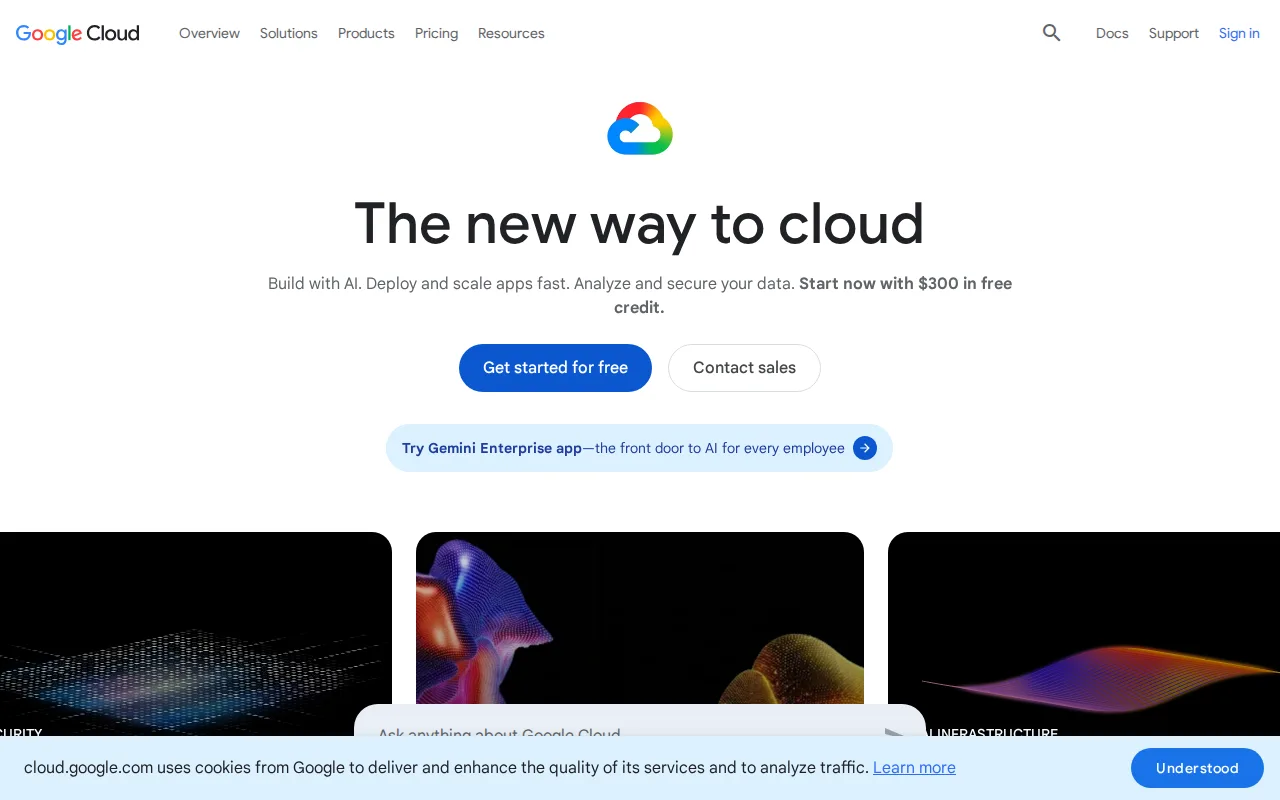
Google Cloud Platform in 20 seconds
Best for: developers and enterprises needing pay-as-you-go cloud infrastructure with strong native data analytics and AI/ML tooling
Pricing: No flat price; pay-as-you-go per service, with a permanent Always Free tier and a $300 trial credit for 90 days.
- GCP offers a permanent Always Free tier including 1 e2-micro Compute Engine instance/month, 5 GB Cloud Storage, and 1 TB/month BigQuery queries.
- New accounts receive a $300 trial credit valid for 90 days.
- Pricing is consumption-based per service; example compute pricing is roughly $0.0335/hour on-demand for an e2-standard-2 instance.
- Sustained-use discounts apply automatically; 1- and 3-year committed-use discounts are available for predictable workloads.
- GCP's service catalog spans 100+ products including Vertex AI for machine learning and BigQuery for large-scale analytics.
Limitations: No flat subscription price, so budgeting requires usage estimation across 100+ separately priced services.; The breadth of the platform gives it a steep learning curve for teams new to cloud infrastructure.; Committed-use discounts require 1- or 3-year terms, trading flexibility for lower rates.
Top alternatives: Amazon Web Services, Microsoft Azure, DigitalOcean, Oracle Cloud Infrastructure, IBM Cloud — full list
What is Google Cloud Platform?
Google Cloud Platform is Google's hyperscale public cloud: a catalog of 100+ services spanning virtual machines and Kubernetes (GKE), serverless compute (Cloud Run, Cloud Functions), managed databases (Cloud SQL, Firestore, Spanner), object and block storage, and networking and security tooling (VPC, Cloud Armor, IAM), plus a distinct AI/ML stack built around Vertex AI and BigQuery ML. It's aimed at developers and enterprises building and scaling applications on infrastructure they don't want to own directly, ranging from solo developers running a single Cloud Run service to enterprises running multi-region Spanner databases. Billing is consumption-based rather than tiered: every service has its own per-unit price (per vCPU-hour, per GB stored, per query byte scanned), and total cost depends on actual usage rather than a fixed plan. Google layers in sustained-use discounts that apply automatically for consistent monthly usage, plus 1- and 3-year committed-use discounts for predictable workloads. New users get a $300 credit valid for 90 days to explore paid services, and a permanent Always Free tier keeps a small set of resources (one e2-micro VM, 5 GB Cloud Storage, 1 TB/month of BigQuery queries, among others) available at no cost indefinitely. GCP is accessed through a web console, the gcloud CLI, and Terraform/API tooling rather than a native desktop app.
Google Cloud Platform (GCP) is Google's public cloud, offering compute (Compute Engine, GKE, Cloud Run, Cloud Functions), storage and databases (Cloud Storage, Cloud SQL, Firestore, Spanner, BigQuery), and AI/ML services (Vertex AI) on consumption-based, pay-as-you-go pricing with sustained-use and committed-use discounts for 1- and 3-year terms. New accounts get a $300 credit valid for 90 days, and a permanent Always Free tier includes limited resources such as one e2-micro Compute Engine instance/month (US regions), 5 GB of Cloud Storage, and 1 TB/month of BigQuery queries, with no auto-charge after the trial credit or free-tier limits are exceeded. There is no flat subscription price; costs depend entirely on which services and volumes a workload consumes, billed per second or per unit (for example, e2-standard-2 compute runs roughly $0.0335/hour on-demand). GCP competes directly with AWS and Microsoft Azure for enterprise and developer cloud infrastructure spend.
Standout feature: BigQuery and Vertex AI give GCP a data-analytics and AI/ML depth that's tightly integrated with the rest of the platform, a differentiator from AWS and Azure for workloads centered on large-scale analytics or model training.
Biggest weakness: Pricing is entirely usage-based across 100+ services with no flat starting price, so estimating real monthly cost requires a calculator or careful monitoring, and unexpected usage spikes (a common complaint across all major clouds) can produce a surprise bill once the $300 trial credit and Always Free allowances are exhausted.
Pros
- Permanent Always Free tier (limited compute, storage, and BigQuery quota) never expires, unlike a time-boxed trial alone.
- BigQuery and Vertex AI give GCP some of the deepest native analytics and AI/ML tooling of the major clouds.
- Sustained-use discounts apply automatically without requiring an upfront reservation commitment.
- $300 trial credit valid for 90 days covers most paid services for early evaluation.
Cons
- No flat subscription price; total cost depends on usage across 100+ separately priced services, making budgeting harder than a fixed-tier competitor.
- The breadth of the service catalog gives GCP a steep learning curve for teams new to cloud infrastructure.
- Committed-use discounts require 1- or 3-year terms, a lock-in tradeoff for teams wanting maximum pricing flexibility.
- Market share trails AWS and Azure, which can mean fewer third-party integrations and community resources for less common GCP services.
Google Cloud Platform pricing
Free
| Plan | Price | Notes |
|---|---|---|
| Always Free tier | Free | Permanent, limited resources at no cost: 1 e2-micro Compute Engine instance/month (US regions), 5 GB/month Cloud Storage, 1 TB/month BigQuery queries, 2M Cloud Functions invocations/month, among other capped allowances. |
| Free trial credit | Free | $300 credit valid for 90 days for new accounts, usable across most paid GCP services; no automatic charge once the credit or trial period ends. |
| Pay-as-you-go | Custom | Usage-based billing per service (per vCPU-hour, per GB stored, per query byte scanned); example: e2-standard-2 compute is roughly $0.0335/hour on-demand. Sustained-use discounts apply automatically; 1- and 3-year committed-use discounts available for predictable workloads. |
What reviewers say
No third-party review scores on file yet.