4 Best Free Alternatives to LibreOffice in 2026
By Noahlast updated pricing verified
All 6 LibreOffice alternatives
Compared: free alternatives to LibreOffice
| Alternative | Best for | Standout | Biggest weakness | Learning curve | Price |
|---|---|---|---|---|---|
| LibreOfficereference | individuals, schools, and organizations that want a full office suite without a subscription and can work without native real-time cloud co-authoring | A complete six-application office suite (including a desktop database tool in Base, which neither Microsoft nor Google offer at the consumer level) that is entirely free and open source with no feature paywall. | No native real-time multi-user co-authoring in the way Microsoft 365 or Google Workspace offer it, and complex documents with heavy Microsoft-specific formatting (advanced macros, certain chart types, some fonts) can render or convert imperfectly when round-tripped through .docx/.xlsx/.pptx. | Low | Free |
| OnlyOffice | organizations that need Microsoft Office-compatible editing but want the option to self-host on their own servers under an open-source license | AGPL 3.0-licensed source code that organizations can audit and self-host, combined with a DocSpace pricing model that charges only for admin seats while unlimited regular users join free. | Business Cloud pricing is per-admin rather than per-user, which can be confusing to compare against competitors, and users switching from Microsoft Office report formatting fidelity issues on complex documents with heavy macros or advanced layout. | Moderate | Free tier · paid from $20/mo |
| WPS Office | students, freelancers, and budget-conscious users who need Microsoft-compatible document, spreadsheet, and presentation editing without a Microsoft 365 subscription | The Sharing plan lets multiple people split one subscription at $2.49/user/month billed annually, each getting their own account and 20GB of storage, cheaper per seat than individual Pro+ subscriptions. | AI tools carry daily usage limits even on the paid Pro+ tier, and the free version has drawn past criticism for bundled-installer behavior and data-handling practices, a concern for privacy-sensitive users. | Low | Free tier · paid from $2.49/mo |
| Microsoft Office | Households and small teams who want Word, Excel, PowerPoint, and Outlook synced across Windows, Mac, iOS, and Android with shared cloud storage and Copilot AI built into the apps. | Microsoft Copilot AI is built directly into Word, Excel, PowerPoint, Outlook, and OneNote on every Microsoft 365 Personal, Family, and Premium plan, not sold as a bolt-on. | Copilot AI usage is capped even on the $19.99/month Premium plan, and the only way to avoid a subscription entirely — the $179.99 Office Home 2024 license — drops Outlook, Teams, OneDrive storage, and all AI features. | Moderate | Free tier · paid from $9.99/mo |
| Zoho Workplace | Small and midsize teams that want business email, office documents, chat, and video meetings from a single vendor at a lower per-seat cost than Google Workspace or Microsoft 365. | One subscription and one admin console cover email (Mail), documents (Writer, Sheet, Show), chat (Cliq), meetings (Meeting), and file storage (WorkDrive) instead of stitching together separate vendors. | Individual Zoho apps like Writer and Sheet have a smaller third-party integration ecosystem and less mature real-time co-editing and file-format fidelity than Google Docs/Sheets or Microsoft 365, which creates friction for teams with heavy Word or Excel workflows. | Moderate | Pricing not verified |
 LibreOffice
 OnlyOffice
 WPS Office
 Microsoft Office
 Zoho Workplace
1.OnlyOffice — best LibreOffice alternative for organizations that need Microsoft Office-compatible editing but want the option to self-host on their own servers under an open-source license
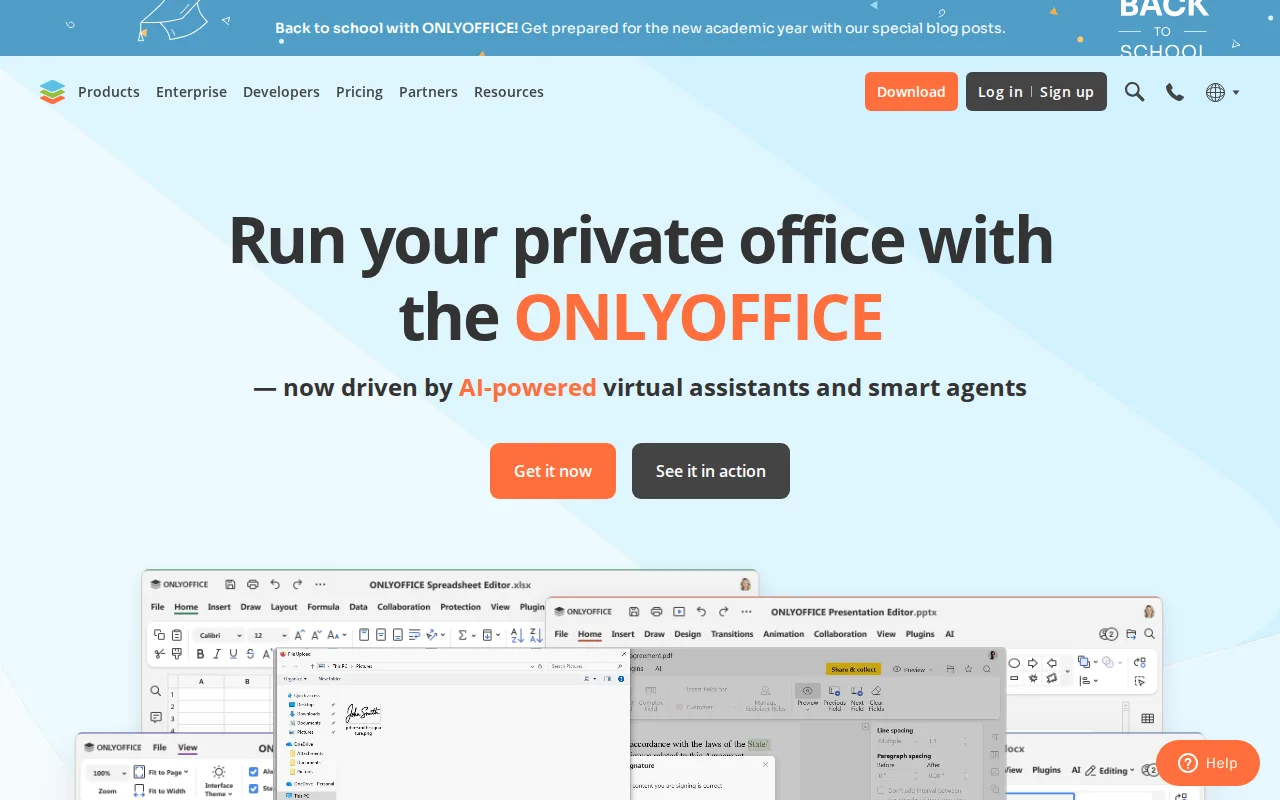
ONLYOFFICE is the best LibreOffice alternative for organizations that want to stay open source but need real-time collaboration. Like LibreOffice, ONLYOFFICE publishes its source (AGPL 3.0 on GitHub) and can be self-hosted, so documents never have to leave an organization's own servers. Unlike LibreOffice, it adds real-time co-editing with character-level change tracking and built-in AI content tools, closing the exact gap LibreOffice's listing calls its biggest weakness. ONLYOFFICE also ships native apps on Windows, macOS, Linux, iOS, and Android, covering the mobile platforms LibreOffice does not, plus 40+ integrations including Nextcloud and Moodle. Its pricing model is unusual and favors large user counts: DocSpace charges per admin, not per user, with unlimited regular users and guests invited free. The Startup plan is free for up to 3 admins with 2GB per space and up to 12 rooms, and Business Cloud is $20/admin/month, discounted from a regular $30. ONLYOFFICE holds 4.5/5 from 324 Capterra reviews. LibreOffice is still the better choice for pure desktop work: it is free at any scale with no admin seats to buy, and it ships Base and Math, which ONLYOFFICE does not. Both also share the same known flaw, since complex Word and Excel documents with heavy macros or advanced layout can lose fidelity in either.
Compared to LibreOffice: real-time co-editing with character-level change tracking that LibreOffice lacks, AGPL 3.0 source you can self-host as LibreOffice's is, and $20/admin/month with unlimited free users where LibreOffice costs nothing at any scale
Wins:Real-time co-editing with character-level change tracking and built-in AI content tools, the collaboration gap LibreOffice's own listing names as its biggest weakness · Native apps on Windows, macOS, Linux, iOS, and Android plus 40+ integrations including Nextcloud and Moodle, covering the mobile platforms LibreOffice has no official apps for · DocSpace charges only for admin seats with unlimited regular users and guests free, and it holds 4.5/5 from 324 Capterra reviews where LibreOffice has no rating on record
Loses:Business Cloud costs $20/admin/month (discounted from $30) and the free Startup tier caps you at 3 admins, 2GB per space, and 12 rooms, while LibreOffice is unlimited and free · Shares LibreOffice's fidelity problem: complex Word and Excel documents with advanced formatting or macros can lose formatting in ONLYOFFICE too, so switching does not fix it · No equivalent to LibreOffice's Base desktop database or Math formula editor, and Enterprise on-premises pricing is unpublished, requiring a sales conversation
Pros
- AGPL 3.0 source code available on GitHub; fully self-hostable for organizations that need to keep data on-premises.
- DocSpace charges only for admin seats, with unlimited regular users invited free.
- Native apps across Windows, macOS, Linux, iOS, and Android, plus 40+ third-party integrations including Nextcloud and Moodle.
- Real-time co-editing with character-level change tracking and built-in AI content tools.
Cons
- Complex documents with advanced Word/Excel formatting or macros can lose fidelity when opened in ONLYOFFICE.
- Enterprise on-premises pricing is not published; requires a sales conversation.
- Per-admin pricing model on Business Cloud takes more effort to compare against per-user competitors.
- DocSpace's interface is less polished than Google Workspace or Notion for non-technical teams.
Pricing: Free tier · paid from $20/mo — $20/admin/month for Business Cloud with unlimited users free (Startup tier free for up to 3 admins) vs LibreOffice at $0 for unlimited users (verified undefined NaN, NaN)
2.WPS Office — best LibreOffice alternative for students, freelancers, and budget-conscious users who need Microsoft-compatible document, spreadsheet, and presentation editing without a Microsoft 365 subscription
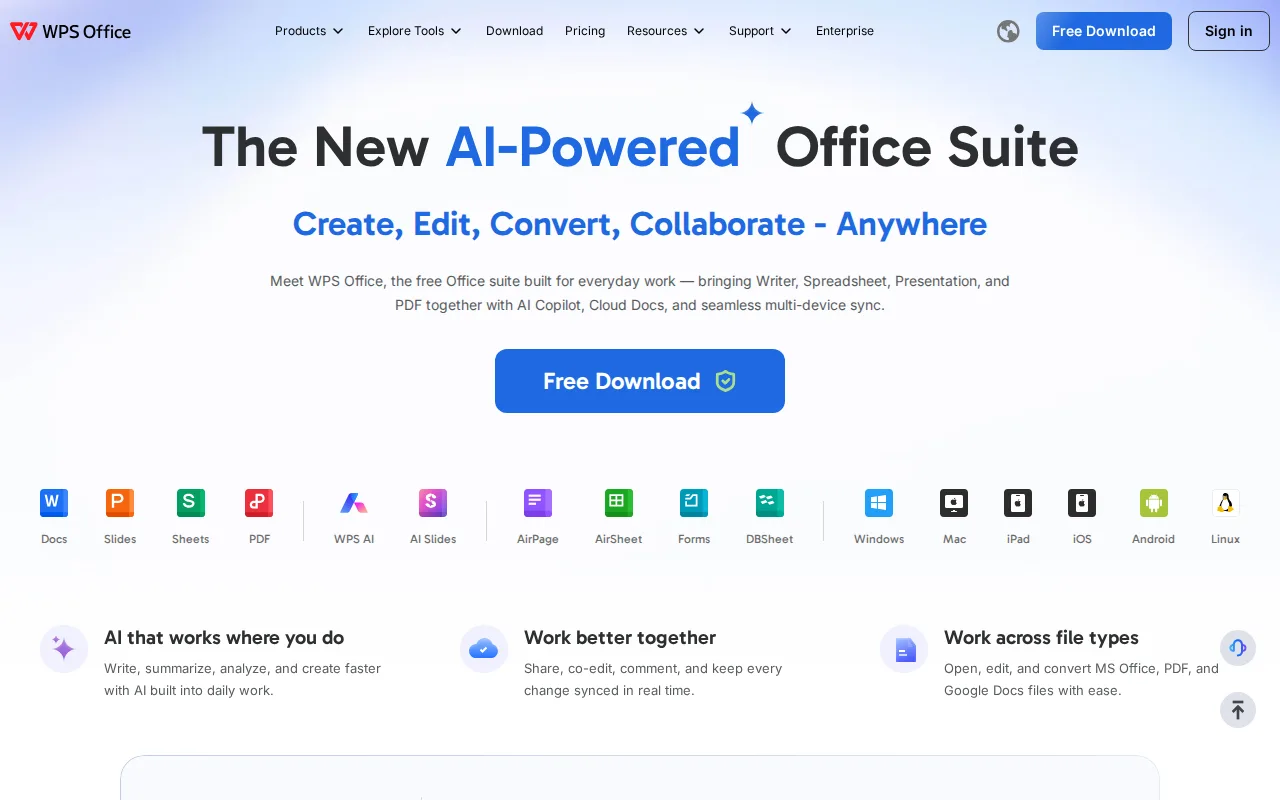
WPS Office is the best LibreOffice alternative for people who want a free desktop suite on Linux but also need it on a phone. WPS Office covers more platforms than anything else on this page (Windows, macOS, Linux, iOS, Android, and web) where LibreOffice publishes no official mobile apps under its own brand. Its free Standard tier is a real product rather than a trial, with native DOCX, XLSX, and PPTX support, 47 file formats, 46 languages, and 1GB of cloud storage. Its paid plans are the cheapest here: Pro+ is $5.83/month billed annually at $69.99/year, and the Sharing plan splits a subscription at $2.49/user/month billed annually ($29.99/user/year), with each member getting their own account and 20GB of storage. WPS Office holds 4.5/5 from 1,537 Capterra reviews; LibreOffice has no external rating on record. LibreOffice is still the better choice on openness and trust. LibreOffice is open source under MPL-2.0 with GPL and LGPL components and is governed by the nonprofit Document Foundation, while WPS Office is proprietary freemium software whose free version has drawn past scrutiny over bundled-installer behavior and data-handling practices. LibreOffice also has no feature paywall at all, where WPS Office locks full PDF editing and e-signatures behind Pro+ and rate-limits AI tools daily even after you pay.
Compared to LibreOffice: iOS, Android, and web apps on top of Windows, macOS, and Linux where LibreOffice is desktop-only, a $2.49/user/month Sharing plan where LibreOffice is free, and proprietary freemium licensing where LibreOffice is open source under MPL-2.0
Wins:Widest platform coverage here (Windows, macOS, Linux, iOS, Android, and web), closing LibreOffice's missing mobile apps while keeping the Linux support Google and Microsoft don't offer · The free Standard tier is a usable product rather than a trial, with native DOCX, XLSX, and PPTX support, 47 file formats, 46 languages, and 1GB of cloud storage · Cheapest paid tiers on this page (Pro+ at $5.83/month, $69.99/year; Sharing at $2.49/user/month, $29.99/user/year), plus 4.5/5 from 1,537 Capterra reviews against no rating on record for LibreOffice
Loses:Proprietary freemium software, where LibreOffice is open source under MPL-2.0 with GPL and LGPL components and governed by the nonprofit Document Foundation · The free version has drawn past scrutiny over bundled-installer behavior and data-handling practices, a concern LibreOffice's licensing and governance don't raise · Feature paywalls LibreOffice has none of: full PDF editing and e-signatures require Pro+, AI tools carry daily usage limits even on the paid tier, and advanced Excel macro compatibility is reported as less complete
Pros
- Free tier is genuinely usable, not just a trial, with native DOCX/XLSX/PPTX compatibility.
- Available across Windows, Mac, Linux, Android, iOS, iPad, and web, more platform coverage than most competitors.
- Pro+ pricing at $5.83/month is well below a Microsoft 365 Personal subscription.
- Sharing plan offers a lower per-seat cost than buying individual Pro+ accounts for a household or small team.
Cons
- AI tools have daily usage limits even after paying for Pro+.
- Free version has drawn past scrutiny over bundled-installer behavior and data-privacy practices.
- Full PDF editing and e-signatures are locked behind the paid Pro+ tier.
- Advanced spreadsheet and macro compatibility with Excel is less complete than Microsoft's own suite, per user reports.
Pricing: Free tier · paid from $2.49/mo — $2.49/user/month billed annually ($29.99/user/year) on the Sharing plan, or $5.83/month for Pro+ ($69.99/year), vs LibreOffice at $0 with no paid tier (verified undefined NaN, NaN)
3.Microsoft Office — best LibreOffice alternative for households and small teams who want Word, Excel, PowerPoint, and Outlook synced across Windows, Mac, iOS, and Android with shared cloud storage and Copilot AI built into the apps.
Microsoft Office is the best LibreOffice alternative for households that keep receiving Microsoft-formatted files and need them to open correctly every time. Microsoft defines the .docx, .xlsx, and .pptx formats, so the fidelity problems LibreOffice's own listing admits to (advanced macros, certain chart types, and some fonts rendering imperfectly on round-trip) do not arise. Microsoft Office also offers two things LibreOffice does not: free browser-based versions of Word, Excel, and PowerPoint, and real-time co-authoring across web, desktop, and mobile. For people who refuse subscriptions, Office Home 2024 is a one-time $179.99 purchase for one PC or Mac. Microsoft 365 Family covers up to 6 people at $12.99/month ($129.99/year) with 1TB of OneDrive each, and Copilot is built into Word, Excel, PowerPoint, Outlook, and OneNote on every subscription tier rather than sold as a bolt-on. LibreOffice is still the better choice for anyone on Linux or on a strict budget. Microsoft Office lists no Linux support at all, where LibreOffice runs natively on Linux and ships as the default suite on many distributions. Office Home 2024's $179.99 buys four apps with no Outlook, Teams, cloud storage, or Copilot, against LibreOffice's six apps for $0, and devices drop to view-and-print-only after 31 days offline.
Compared to LibreOffice: native .docx, .xlsx, and .pptx fidelity from the company that defines those formats, free browser-based Word, Excel, and PowerPoint plus real-time co-authoring LibreOffice has no equivalent to, and no Linux support at all where LibreOffice runs natively on Linux
Wins:Exact fidelity on .docx, .xlsx, and .pptx because Microsoft defines those formats, removing the conversion problems LibreOffice's own listing admits to on complex documents · Free browser-based Word, Excel, and PowerPoint, real-time co-authoring across web, desktop, and mobile, and native iOS and Android apps that LibreOffice doesn't publish · Copilot AI is built into Word, Excel, PowerPoint, Outlook, and OneNote on every Microsoft 365 Personal, Family, and Premium plan, and Family covers up to 6 people at $12.99/month ($129.99/year)
Loses:No Linux support at all (web, Windows, macOS, iOS, and Android only), where LibreOffice runs natively on Linux and ships as the default suite on many distributions · The only non-subscription path, Office Home 2024 at $179.99 for one PC or Mac, drops Outlook, Teams, OneDrive storage, and Copilot entirely, against LibreOffice's six apps for $0 with nothing removed · Devices lose edit access and drop to view-and-print-only after 31 days offline, Copilot usage is capped even on the $19.99/month Premium plan, and AI features on Family and Premium work only for the subscription owner, not shared members
Pros
- Real-time co-authoring on Word, Excel, and PowerPoint across web, desktop, and mobile
- Family plan covers up to 6 people with 1 TB of OneDrive storage each for $12.99/month
- One-time Office Home 2024 purchase ($179.99) avoids subscription billing entirely
- Native, platform-tailored apps on Windows, Mac, iOS, and Android
Cons
- Copilot AI usage is capped ('extensive' but not unlimited) on every paid subscription tier
- Devices lose edit access and drop to view/print-only mode after 31 days offline
- AI features on Family and Premium plans work only for the subscription owner, not shared members
- Office Home 2024 one-time license excludes Outlook, Teams, cloud storage, and Copilot
Pricing: Free tier · paid from $9.99/mo — $9.99/month for Microsoft 365 Personal ($99.99/year), or $179.99 once for Office Home 2024, vs LibreOffice at $0 (verified undefined NaN, NaN)
4.Zoho Workplace — best LibreOffice alternative for small and midsize teams that want business email, office documents, chat, and video meetings from a single vendor at a lower per-seat cost than Google Workspace or Microsoft 365.
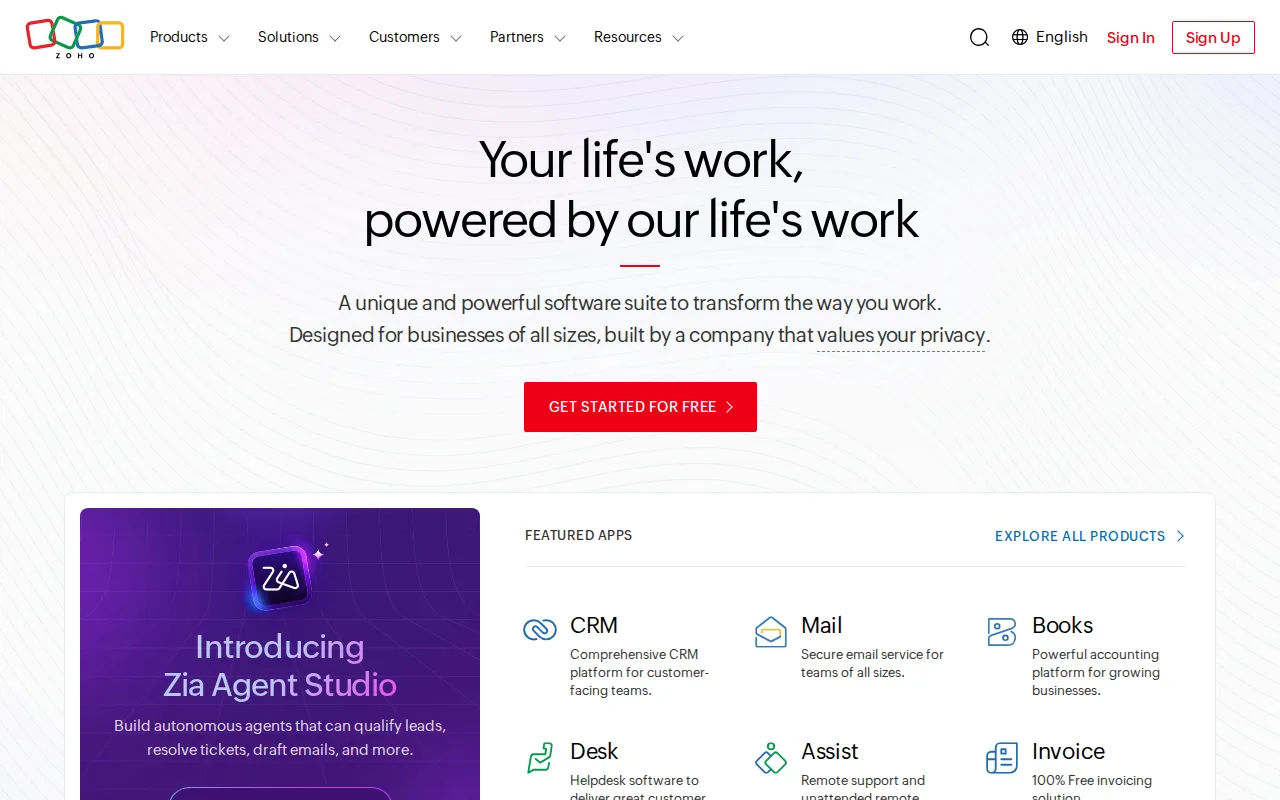
Zoho Workplace is the best LibreOffice alternative for small teams that want business email and video meetings in the same subscription as their documents. LibreOffice is a desktop suite and nothing more: no email, no chat, no video, no shared storage. Zoho Workplace bundles Mail, the Writer, Sheet, and Show editors, Cliq for chat, Meeting for video, and WorkDrive for file storage under one subscription and one vendor, a category LibreOffice does not compete in at all. It also brings the browser-based real-time co-editing LibreOffice lacks, plus iOS and Android apps LibreOffice doesn't publish. Zoho states it does not sell customer data and runs no advertising-based model, and its entry tiers are generally priced below Google Workspace and Microsoft 365. There is a real gap in this comparison to flag: Zoho Workplace's current pricing and storage limits could not be verified on Zoho's own site when this listing was compiled, so no per-seat figure is published here. Confirm the exact numbers before buying, and weigh them against LibreOffice's price of $0. LibreOffice remains the better choice for document work specifically, since Zoho's Writer, Sheet, and Show have documented fidelity problems with complex Word and Excel files, the integration ecosystem is smaller, admins juggle several separate consoles, and Zoho Workplace lists no Linux desktop support.
Compared to LibreOffice: business email, chat, video meetings, and cloud storage bundled with the document editors where LibreOffice is a desktop suite only, no Linux desktop support where LibreOffice runs natively on Linux, and per-seat pricing that could not be verified against LibreOffice's fixed $0
Wins:Bundles business email (Mail), documents (Writer, Sheet, Show), chat (Cliq), video meetings (Meeting), and file storage (WorkDrive) in one subscription and one vendor; LibreOffice offers none of these beyond the documents · Browser-based real-time collaborative editing, the capability LibreOffice's own listing names as its biggest missing feature, plus iOS and Android apps LibreOffice doesn't publish · No advertising-based business model, with Zoho stating it does not sell customer data, and entry tiers generally priced below Google Workspace and Microsoft 365
Loses:Current pricing and storage limits could not be verified on Zoho's site when this listing was compiled, so there is no per-seat figure to compare against LibreOffice's $0 — confirm the numbers before buying · Office document fidelity in Writer, Sheet, and Show can lag Microsoft Office on complex files, and the third-party integration ecosystem is smaller than Microsoft 365's or Google Workspace's · No Linux desktop support (web, Windows, macOS, iOS, and Android only) where LibreOffice runs natively on Linux, and admins juggle several separate Zoho consoles rather than one settings panel
Pros
- Bundles email, docs, chat, video meetings, and cloud storage into one subscription and one admin console
- Generally priced below Google Workspace and Microsoft 365 at entry tiers
- No advertising-based business model; Zoho states it does not sell customer data
- Backed by Zoho's broader 55+ app catalog (CRM, Books, Desk, Bigin) for add-on needs
Cons
- Smaller third-party integration and plugin ecosystem than Microsoft 365 or Google Workspace
- Office document fidelity in Writer, Sheet, and Show can lag Microsoft Office for complex files
- Admins juggle several separate Zoho app consoles (Mail, WorkDrive, Cliq, Meeting) rather than one unified settings panel
- Current pricing and storage limits could not be verified on Zoho's site this session; confirm exact numbers before buying
Pricing: Pricing not verified — Not comparable on record: Zoho Workplace's current per-seat pricing could not be verified on Zoho's site, while LibreOffice is $0 with no paid tier