GNU Emacs — An extensible, self-documenting free software text editor built around an Emacs Lisp interpreter, in continuous development since 1976.

By Noahlast updated pricing verified
GNU Emacs screenshots & video
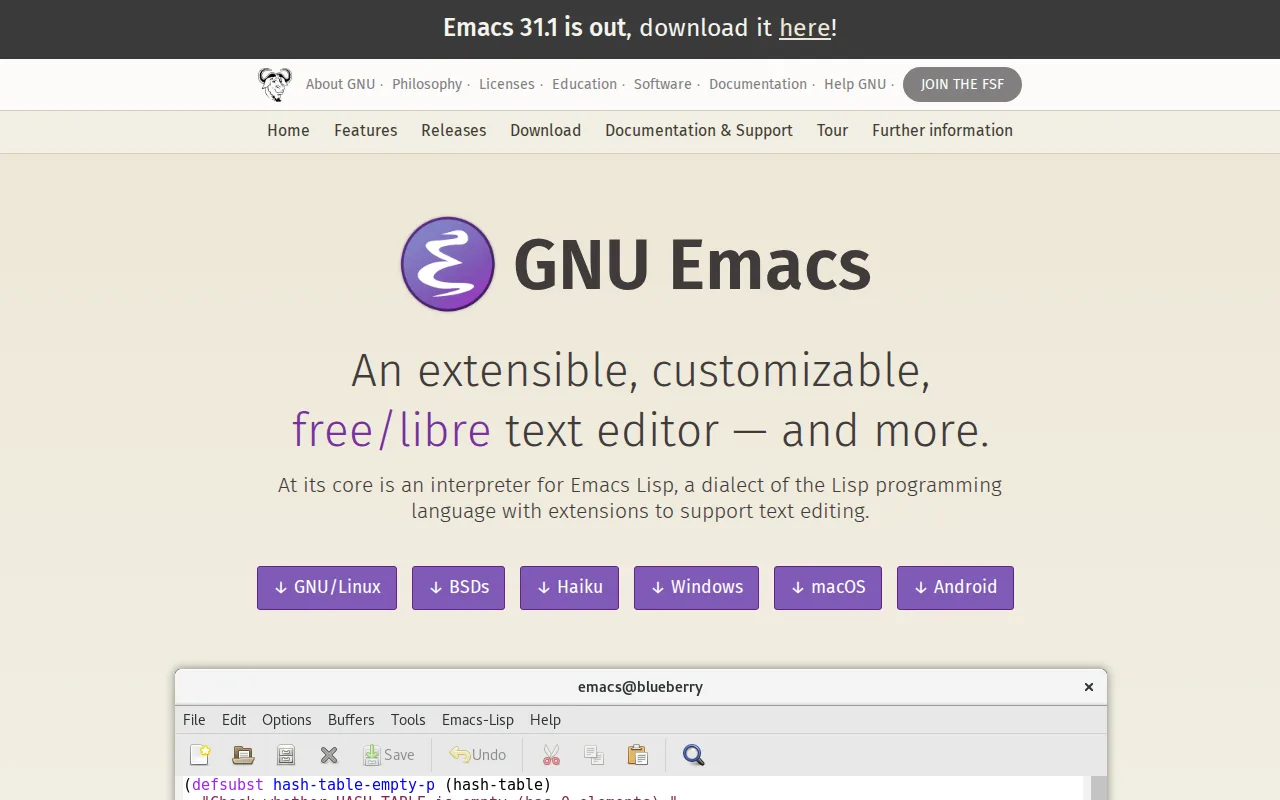
GNU Emacs in 20 seconds
Best for: developers and power users who want a fully reprogrammable editor built on a real Lisp interpreter, not just a configurable one
Pricing: Completely free and open source under the GPLv3; no paid tier exists.
- GNU Emacs is free software under the GNU General Public License v3.
- GNU Emacs is built around an Emacs Lisp interpreter that implements and can redefine nearly all editor behavior.
- GNU Emacs runs on GNU/Linux, BSDs, Haiku, Windows, macOS, and Android.
- GNU Emacs has been in continuous development since 1976.
- GNU Emacs ships with Org mode, a mail/news reader, a calendar, and a debugger interface, extensible via the MELPA package repository.
Limitations: Steep learning curve from keybindings and terminology that predate modern UI conventions.; No official iOS build.; No curated extension marketplace, so package quality and configuration burden vary widely.
Top alternatives: Vim, Neovim, Visual Studio Code, Helix, Sublime Text — full list
What is GNU Emacs?
GNU Emacs is a free software text editor built around Emacs Lisp, a full programming language that both implements the editor's own features and lets users extend or rewrite them. Originally released by Richard Stallman in 1976 and continuously developed since, it remains a flagship GNU Project package and one of the longest-lived pieces of actively maintained software. Beyond text editing, Emacs ships with an ecosystem of built-in and community packages that turn it into a project planner (Org mode), a mail and news reader, a Git interface (Magit), a debugger front-end, an IRC client, and more, all scriptable in the same Lisp dialect. Its package manager (package.el, plus community repositories like MELPA) lets users install and configure extensions without leaving the editor. Emacs has a steeper initial learning curve than mouse-driven editors because its default keybindings predate modern UI conventions, but its self-documenting design, built-in tutorials, help system, and the ability to inspect and redefine any function at runtime, has kept a dedicated user base for decades.
GNU Emacs is a free, open source, extensible text editor maintained by the GNU Project, aimed at developers and power users who want an editing environment they can reprogram rather than merely configure. Its core is an Emacs Lisp interpreter, so nearly every behavior, from syntax highlighting to a built-in mail client, calendar, and debugger interface, is itself Lisp code a user can read, modify, or replace. GNU Emacs is completely free under the GNU General Public License v3, runs on GNU/Linux, BSDs, Haiku, Windows, macOS, and Android, and has no paid tier, subscription, or vendor.
Standout feature: Nearly every part of the editor is implemented in Emacs Lisp and can be inspected, redefined, or extended at runtime, so users script new features (Org mode, Magit, mail clients) rather than being limited to settings a vendor exposes.
Biggest weakness: Default keybindings and terminology predate modern UI conventions, giving Emacs a steep initial learning curve, and its Lisp-based extension model means many packages have inconsistent quality and configuration burdens rest on the user, unlike editors with a curated built-in extension marketplace.
Pros
- Nearly unlimited extensibility through Emacs Lisp; users can redefine core editor behavior, not just install plugins.
- Completely free and open source under the GPLv3, with no paid tier or vendor lock-in.
- Long-lived, active development since 1976 with a large body of community packages (MELPA) and documentation.
- Built-in tools like Org mode (notes, planning) and Magit (Git) turn Emacs into far more than a text editor.
Cons
- Steep learning curve: default keybindings and terminology are unfamiliar to users coming from mouse-driven editors.
- No official iOS build; mobile support is limited to Android via third-party ports.
- Configuration and package quality vary widely since there is no curated, vetted extension marketplace like VS Code's.
- Startup time and memory use can lag behind lighter modal editors like Helix or Neovim on large configurations.
GNU Emacs pricing
Free · verified from the vendor's pricing page
| Plan | Price | Notes |
|---|---|---|
| GNU Emacs | Free | Free software under the GNU General Public License v3. No paid tier, subscription, or vendor; maintained by the GNU Project and volunteer contributors. |
What reviewers say
No third-party review scores on file yet.