2 Best Open-Source Alternatives to Gmail in 2026
By Noahlast updated
Compared: open-source alternatives to Gmail
| Alternative | Best for | Standout | Biggest weakness | Learning curve | Price |
|---|---|---|---|---|---|
| Gmailreference | individuals who want a free, reliable, spam-filtered inbox with strong search, and businesses wanting professional email bundled with Google's collaboration suite | Search-driven inbox management with strong spam filtering and tabbed auto-categorization, tightly integrated with Google Meet, Chat, Calendar, and Drive from the same interface. | Free personal accounts show ads in the inbox and rely on automatic tab categorization that can bury important emails in Promotions or Updates; storage is shared across Gmail, Drive, and Photos rather than dedicated to email, so heavy attachment use eats into the same 15GB quota as everything else. | Low | Free tier · paid from $7/mo |
| Proton Mail | privacy-conscious individuals, journalists, and small teams who want end-to-end encrypted email with open-source, independently audited clients rather than a mainstream provider that can technically read stored mail | Zero-access encryption paired with open-source, independently audited client apps, so Proton itself cannot decrypt a Mail Plus or Unlimited inbox even under legal compulsion. | The free tier caps storage at just 1 GB and one address, and the higher-value Unlimited and Family tiers bundle VPN, Drive, and Pass features that email-only switchers may not need, pushing the effective per-mailbox cost above single-purpose providers like Fastmail. | Low | Free tier · paid from $3.99/mo |
| Tuta | privacy-conscious individuals and organizations, including journalists, healthcare providers, and nonprofits, who want end-to-end encrypted email and calendar with open-source, auditable clients | Post-quantum end-to-end encryption (TutaCrypt) covering both email and calendar by default, with fully open-source client apps auditable on GitHub. | No PGP or S-MIME support for encrypted mail to external, non-Tuta recipients, and no IMAP/SMTP access, so mailboxes only work through Tuta's own apps and webmail. | Low | Free tier · paid from $3.25/mo |
 Gmail
Gmail Proton Mail
 Tuta
Tuta1.Proton Mail — best Gmail alternative for privacy-conscious individuals, journalists, and small teams who want end-to-end encrypted email with open-source, independently audited clients rather than a mainstream provider that can technically read stored mail
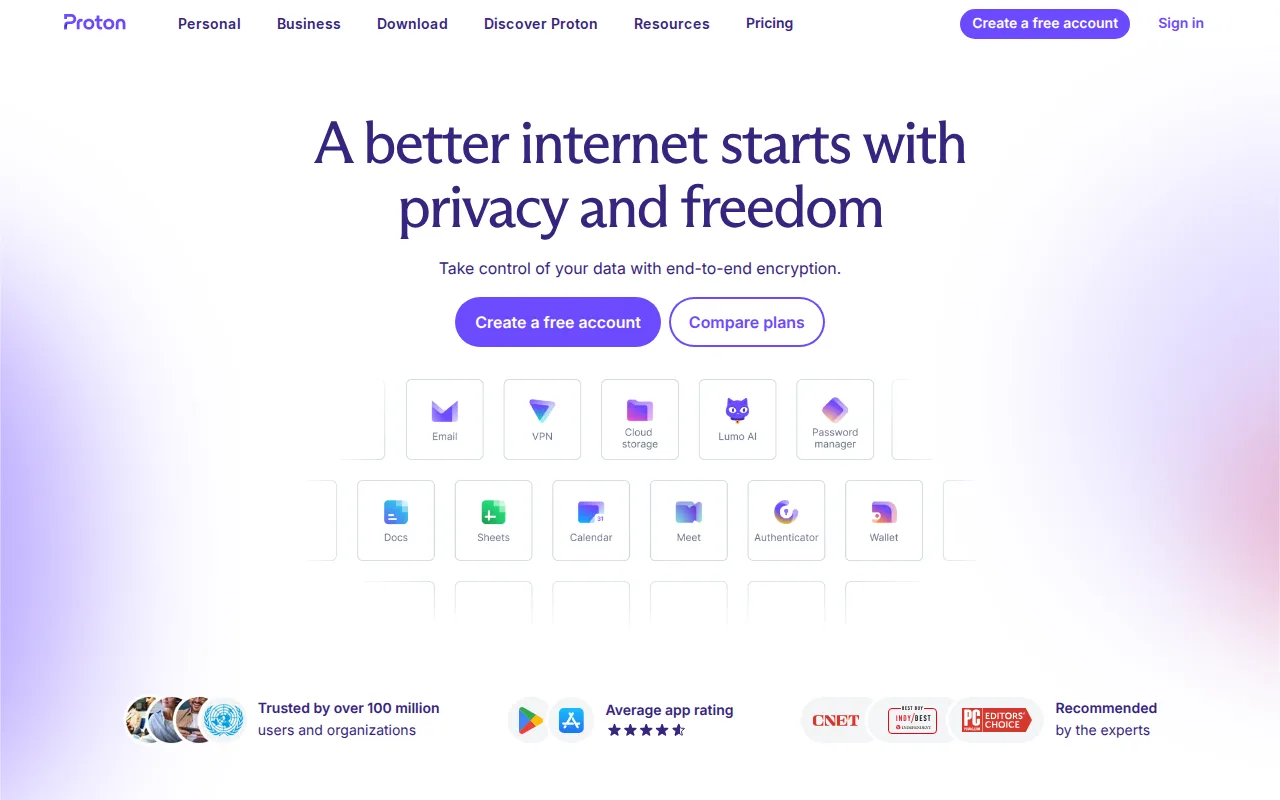
Proton Mail is the best Gmail alternative for privacy-conscious individuals, journalists, and small teams who want an inbox that even the provider itself cannot read, a guarantee Gmail's free and Workspace tiers don't offer. Proton Mail's zero-access encryption applies on every paid plan, and its client apps across web, Windows, macOS, Linux, iOS, and Android are open source and independently audited, unlike Gmail's closed-source clients. The free tier covers 1GB of storage and one address, while Mail Plus adds 15GB, 10 aliases, and a custom domain for $3.99/month billed annually, and Proton Unlimited bundles 500GB of pooled storage with Proton VPN, Drive, and Pass for $9.99/month. Proton reports over 100 million users across its product family, though its Capterra footprint is far thinner at 122 reviews (4.5/5) versus Gmail's 13,516. Gmail is still the better choice for anyone who wants generous free storage without upgrading: Proton's free tier caps out at just 1GB against Gmail's 15GB, and the higher-value Unlimited and Family tiers bundle VPN, Drive, and Pass features that email-only switchers may not need, raising the effective per-mailbox cost.
Compared to Gmail: zero-access encryption on every paid plan, open-source independently audited clients across six platforms, free tier caps at 1GB vs Gmail's free 15GB
Wins:Zero-access encryption means Proton itself cannot read message content on any paid plan, a guarantee Gmail's Workspace tiers don't offer · Open-source, independently audited client apps across web, Windows, macOS, Linux, iOS, and Android, unlike Gmail's closed-source clients · No phone number required to sign up, and Swiss jurisdiction outside US/EU data-sharing agreements
Loses:Free tier caps storage at just 1GB and one address, versus Gmail's free 15GB shared across Gmail, Drive, and Photos · 122 Capterra reviews at 4.5/5, a much thinner sample than Gmail's 13,516 at 4.8/5 · Unlimited and Family tiers bundle VPN, Drive, and Pass, raising the effective cost for switchers who only want email
Pros
- Zero-access encryption means Proton cannot read message content on any paid plan.
- Open-source, independently audited client apps across web, desktop, iOS, and Android.
- No phone number required to sign up, and Swiss jurisdiction outside US/EU data-sharing agreements.
- Bridge app connects Proton Mail to standard IMAP clients like Outlook or Apple Mail on Mail Plus and up.
Cons
- Free tier is limited to 1 GB storage and a single email address.
- Higher tiers bundle VPN, Drive, and Pass, which raises the effective price for users who only want email.
- Custom domain support starts at just 1 domain on Mail Plus, fewer than some business-focused competitors.
Pricing: Free tier · paid from $3.99/mo — Free at 1GB, or Mail Plus $3.99/month for 15GB, vs Gmail's free 15GB tier
2.Tuta — best Gmail alternative for privacy-conscious individuals and organizations, including journalists, healthcare providers, and nonprofits, who want end-to-end encrypted email and calendar with open-source, auditable clients
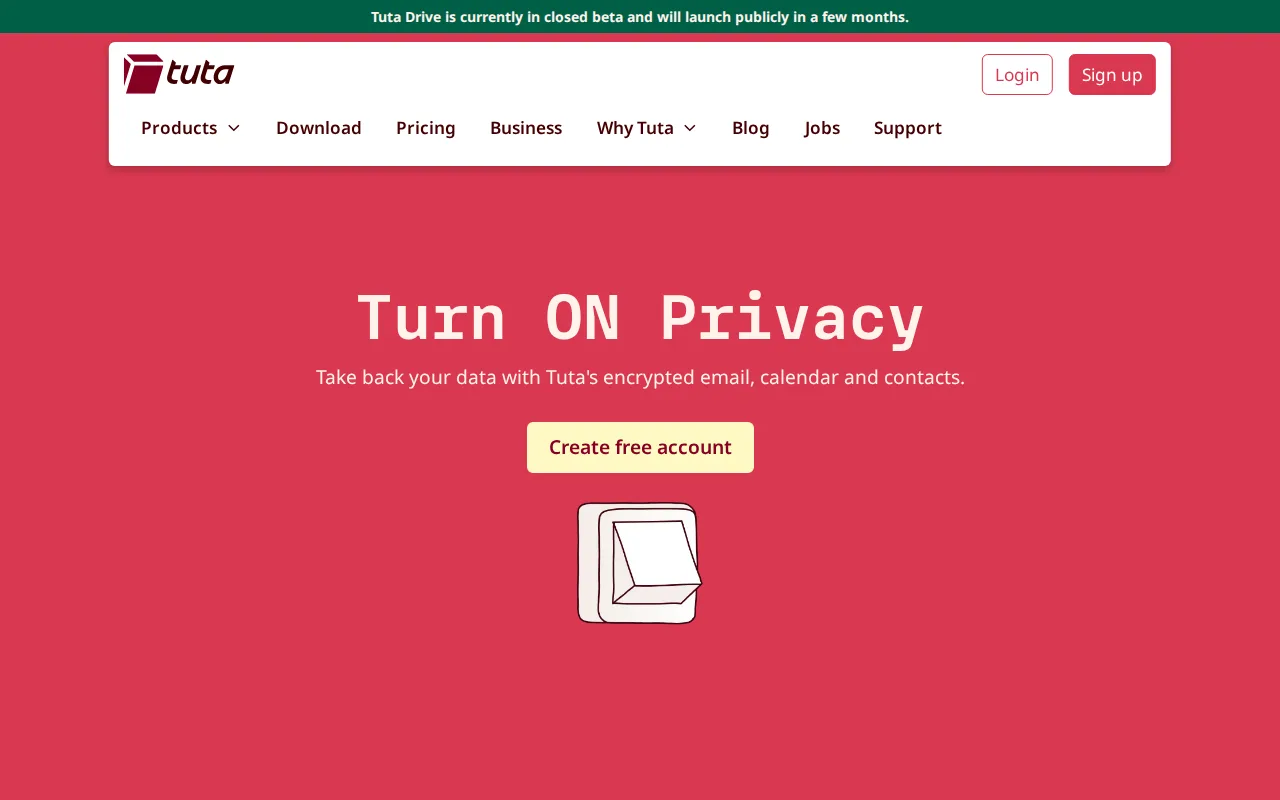
Tuta is the best Gmail alternative for individuals and organizations, including journalists and healthcare providers, who want encryption on both email and calendar by default, not just message bodies, using TutaCrypt, a post-quantum cryptography scheme Gmail's infrastructure doesn't include. All of Tuta's client apps are open source under GPL-3.0 and auditable on GitHub, distributed through the Apple App Store, Google Play, F-Droid, and direct APK downloads, unlike Gmail's closed-source apps. Tuta's free tier includes 1GB of storage, one calendar, and three labels with no custom domain; the paid Revolutionary plan starts around $3.25/month (about €3, discounted further when billed annually) and adds unlimited calendars and labels plus custom domains, while Legend scales to 500GB for roughly $8.65/month. Tuta carries no external rating data on Capterra or Product Hunt, unlike Gmail's 4.8/5 from 13,516 Capterra reviews, so its reputation can't be checked against outside review data here. Gmail is still the better choice for anyone who needs to connect a mailbox to a third-party client: Tuta supports neither IMAP nor SMTP, so it only works through Tuta's own apps and webmail, and it offers no PGP or S-MIME support for encrypted mail to non-Tuta recipients.
Compared to Gmail: post-quantum TutaCrypt encryption covers both email and calendar, fully open-source GPL-3.0 clients vs Gmail's closed-source apps, no IMAP or SMTP support so mailboxes only work through Tuta's own apps
Wins:Post-quantum end-to-end encryption (TutaCrypt) applied to both email and calendar, not just message bodies, unlike Gmail · Fully open-source clients (GPL-3.0) available for independent audit on GitHub, plus F-Droid and direct APK downloads outside the Play Store · Ad-free with no tracking or behavioral advertising built into the business model, unlike Gmail's free tier
Loses:No IMAP or SMTP access, so Tuta inboxes only work through Tuta's own apps and webmail, unlike Gmail which supports third-party clients · No PGP or S-MIME support for encrypted mail to external, non-Tuta recipients · Carries no external rating data on Capterra or Product Hunt, unlike Gmail's 4.8/5 from 13,516 Capterra reviews
Pros
- Post-quantum end-to-end encryption (TutaCrypt) applied to both email and calendar, not just message bodies.
- Fully open-source clients (GPL-3.0) available for independent security audit, plus F-Droid and direct APK downloads outside the Play Store.
- Revolutionary and Legend plans include unlimited calendars and labels, with custom domain support starting at the Revolutionary tier.
- Ad-free, with no tracking or behavioral advertising built into the business model.
Cons
- No PGP or S-MIME support for encrypted messages to non-Tuta recipients.
- No IMAP or SMTP access, so Tuta inboxes can only be used through Tuta's own apps and webmail, not third-party clients like Outlook or Thunderbird.
- Free tier is capped at 1GB storage with no custom domain or extra email aliases.
Pricing: Free tier · paid from $3.25/mo — Free at 1GB, or Revolutionary from about $3.25/month, vs Gmail's free 15GB tier