5 Best Free Alternatives to GIMP in 2026
By Noahlast updated pricing verified
Compared: free alternatives to GIMP
| Alternative | Best for | Standout | Biggest weakness | Learning curve | Price |
|---|---|---|---|---|---|
| GIMPreference | photographers, illustrators, and designers who want a full-featured, scriptable photo editor without paying a subscription or license fee | A scripting API in Python, C, C++, and Scheme lets users automate batch processing and build custom filters and plugins, backed by a large community library of scripts built up over the project's history. | No official vendor support: there is no paid support tier or SLA, so troubleshooting relies entirely on community forums and documentation, and the interface is widely considered less approachable for beginners than Photoshop or Affinity Photo. | Steep | Free |
| Adobe Photoshop | photographers and designers who need pixel-level compositing, retouching, or AI-generated image edits beyond what non-destructive editors offer | Generative Fill and Generative Expand, which use Firefly and partner AI models to add, remove, or extend image content directly from a text prompt inside the layer stack. | Subscription-only with no perpetual license, a steep learning curve for anyone new to layers and masks, and heavy enough on CPU/GPU that Capterra reviewers report performance issues even on capable machines. | Steep | Free tier · paid from $19.99/mo |
| Affinity | designers and photographers who want Photoshop/Illustrator-level editing tools without paying a subscription, and don't need AI generative features | The full Vector, Pixel, and Layout studios are free with no feature restrictions, a direct reversal from Affinity's former one-time-purchase model and from Adobe's subscription pricing. | Generative AI tools (Fill, Expand, AI image/vector generation) require a separate Canva Pro subscription rather than being included, iPad support is still listed as coming soon rather than shipped, and there is no Linux version. | Moderate | Free tier · paid from $14.99/mo |
| Photopea | students, social media creators, and small business owners who need Photoshop-style PSD editing without buying or installing desktop software | Native PSD, AI, XD, and Sketch file compatibility running entirely in the browser, so files stay local instead of uploading to a server. | As a single-developer, ad-supported project, Photopea lacks the cloud sync, version history, and dedicated customer support that a paid product like Photoshop offers, and performance on very large multi-layer files depends entirely on the user's device and browser. | Moderate | Free |
| Krita | digital painters, comic artists, and concept artists who want a full-featured, no-cost illustration tool with a brush engine built specifically for freehand painting rather than photo editing | A brush engine and canvas toolset (rotation, mirroring, stabilizers, wraparound mode) purpose-built for freehand digital painting, on par with paid tools like Clip Studio Paint, at zero cost. | Krita is focused on painting and illustration, not photo editing or precise vector/print production work, so it lacks the CMYK color management, RAW photo support, and print-ready export tooling found in Photoshop or Affinity Photo. | Moderate | Free |
| Pixlr | casual creators, social media managers, and small businesses who want quick AI-assisted photo edits in a browser without paying for Photoshop | A no-signup, ad-supported free tier that includes real AI tools (generative fill, background removal, upscaling) rather than gating every AI feature behind a paywall. | Ads interrupt the editing workflow on the free tier, and the entry-level Plus plan's 80 monthly AI credits run out quickly for anyone generating images or video regularly; professional designers also cite limited customization compared to desktop editors. | Low | Free tier · paid from $1.99/mo |
 GIMP
GIMP Adobe Photoshop
 Affinity
 Photopea
 Krita
Krita Pixlr
Pixlr1.Adobe Photoshop — best GIMP alternative for photographers and designers who need pixel-level compositing, retouching, or AI-generated image edits beyond what non-destructive editors offer
Adobe Photoshop is the best GIMP alternative for photographers and designers who want AI-assisted generative editing and industry-standard file compatibility that GIMP's volunteer-built toolset doesn't match. Photoshop's Generative Fill and Generative Expand use Firefly and partner AI models to add, remove, or extend image content directly from a text prompt inside the layer stack, a capability GIMP has no native equivalent for. Photoshop holds a 4.8/5 rating from 2,466 Capterra reviews, a far larger evidence base than GIMP has collected on any review platform. The Photography plan bundling Photoshop with Lightroom starts at $19.99/month billed annually, or Photoshop alone runs $22.99/month, and Creative Cloud Pro with 20+ apps costs $69.99/month — all recurring costs GIMP, which is entirely free under the GPLv3 with no subscription ever, doesn't carry. GIMP is still the better choice for anyone who wants to avoid subscription lock-in entirely or needs native Linux support, since Photoshop runs on web, Windows, macOS, and iPad but not Linux, and cancelling an annual-billed-monthly Photoshop plan within the first year can trigger an early termination fee GIMP users never face.
Compared to GIMP: AI generative fill and expand tools GIMP lacks natively, 4.8/5 rating from 2,466 Capterra reviews vs no third-party rating data for GIMP, $19.99/month starting price vs GIMP's $0
Wins:AI generative fill and expand add, remove, or extend image content from a text prompt, a capability GIMP doesn't offer natively · 4.8/5 rating from 2,466 Capterra reviews, a far larger evidence base than GIMP has on any review platform · Deep Creative Cloud integration shares fonts, assets, and files with Illustrator and Lightroom, unlike GIMP's standalone workflow
Loses:Starts at $19.99/month for the Photography plan (Photoshop + Lightroom) vs GIMP's permanent $0 price · No native Linux version, while GIMP runs on Windows, macOS, and Linux · Cancelling an annual-billed-monthly plan within the first year can trigger an early termination fee, a cost GIMP never carries
Pros
- Layer-based, pixel-level editing that remains the industry benchmark for compositing and retouching.
- Generative Fill and Remove tool cut hours off object removal and background work.
- Deep Creative Cloud integration shares fonts, assets, and files with Illustrator and Lightroom.
- Free web-based Firefly editor lets anyone try generative editing without a subscription.
Cons
- No perpetual license; access ends when the subscription lapses.
- Steep learning curve for users unfamiliar with layers, masks, and blend modes.
- Demanding on hardware; large multi-layer files can slow even high-end machines.
- Cancelling an annual-billed-monthly plan within the first year can trigger an early termination fee.
Pricing: Free tier · paid from $19.99/mo — $19.99/month (Photoshop + Lightroom) or $22.99/month (Photoshop alone) vs GIMP's $0 (verified undefined NaN, NaN)
2.Affinity — best GIMP alternative for designers and photographers who want Photoshop/Illustrator-level editing tools without paying a subscription, and don't need AI generative features
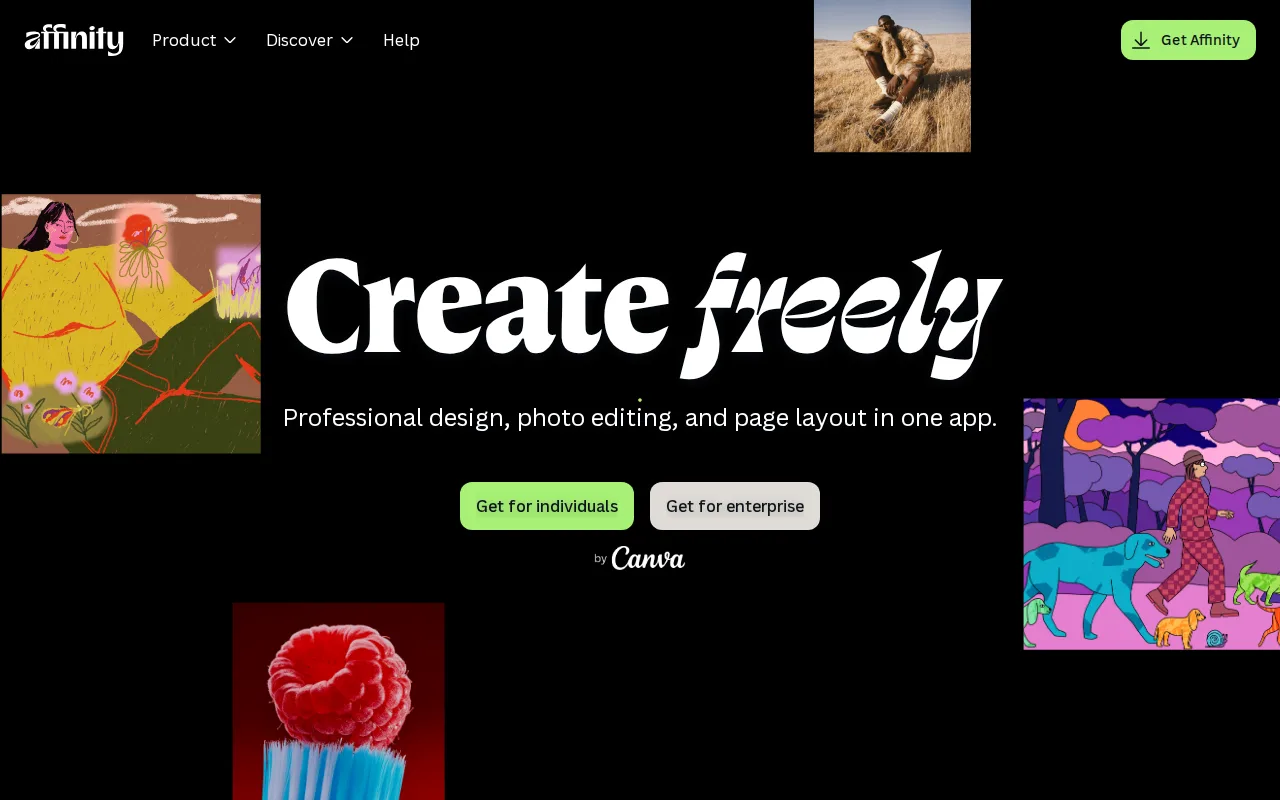
Affinity is the best GIMP alternative for designers who want a modern, professional interface without paying anything, matching GIMP's zero-cost model while trading GIMP's steeper learning curve for a more polished workflow. Since Canva's acquisition, Affinity's core app — unifying what used to be three separate paid apps (Designer, Photo, and Publisher) into Vector, Pixel, and Layout studios — became completely free for individuals in 2026, requiring only a free Canva account and no credit card. That matches GIMP's $0 price exactly, and Affinity holds a 4.8/5 rating from 99 Capterra reviews for Affinity Photo, though that sample is far smaller than what a widely used tool would typically collect. Optional AI features (Generative Fill, Generative Expand, AI image and vector generation) require a Canva Pro subscription at $14.99/month or $119.99/year, a cost GIMP has no equivalent of since it has no generative AI tools at all. GIMP is still the better choice for Linux users and anyone who wants guaranteed long-term source-code access: Affinity runs only on Windows and macOS with no Linux version and no iPad app yet, while GIMP's GPLv3 license guarantees the code stays free and forkable regardless of Canva's future roadmap decisions.
Compared to GIMP: free core app since Canva's 2026 acquisition matches GIMP's $0 price, 4.8/5 rating from 99 Capterra reviews, AI features cost $14.99/month via Canva Pro (GIMP has no AI tools at all)
Wins:More modern, approachable interface than GIMP's, which is widely considered less beginner-friendly · 4.8/5 rating from 99 Capterra reviews for Affinity Photo · Optional Generative Fill, Generative Expand, and AI image/vector generation via Canva Pro, features GIMP doesn't have at any price
Loses:No Linux version, unlike GIMP which runs natively on Windows, macOS, and Linux · No iPad app yet (listed as coming soon), while GIMP has run on desktop platforms for decades · AI features require a $14.99/month (or $119.99/year) Canva Pro subscription on top of the free core app
Pros
- Full professional design suite (vector, raster, layout) free with no time limit or feature gate on the core tools.
- Requires only a free Canva account, no credit card, to unlock everything in the base app.
- Backed by Canva's infrastructure and update cadence rather than a small independent studio.
- Optional Canva Pro AI features integrate directly inside the same app rather than requiring a separate tool.
Cons
- Generative AI features are gated behind a paid Canva Pro subscription ($14.99/month or $119.99/year).
- No iPad app yet; it is listed as coming soon rather than available.
- No Linux support.
- The 2026 rebrand merging three separate apps into one changes workflows for users of the older per-app Affinity Designer/Photo/Publisher versions.
Pricing: Free tier · paid from $14.99/mo — Core app free (same as GIMP's $0); Canva Pro AI add-on $14.99/month or $119.99/year
3.Photopea — best GIMP alternative for students, social media creators, and small business owners who need Photoshop-style PSD editing without buying or installing desktop software
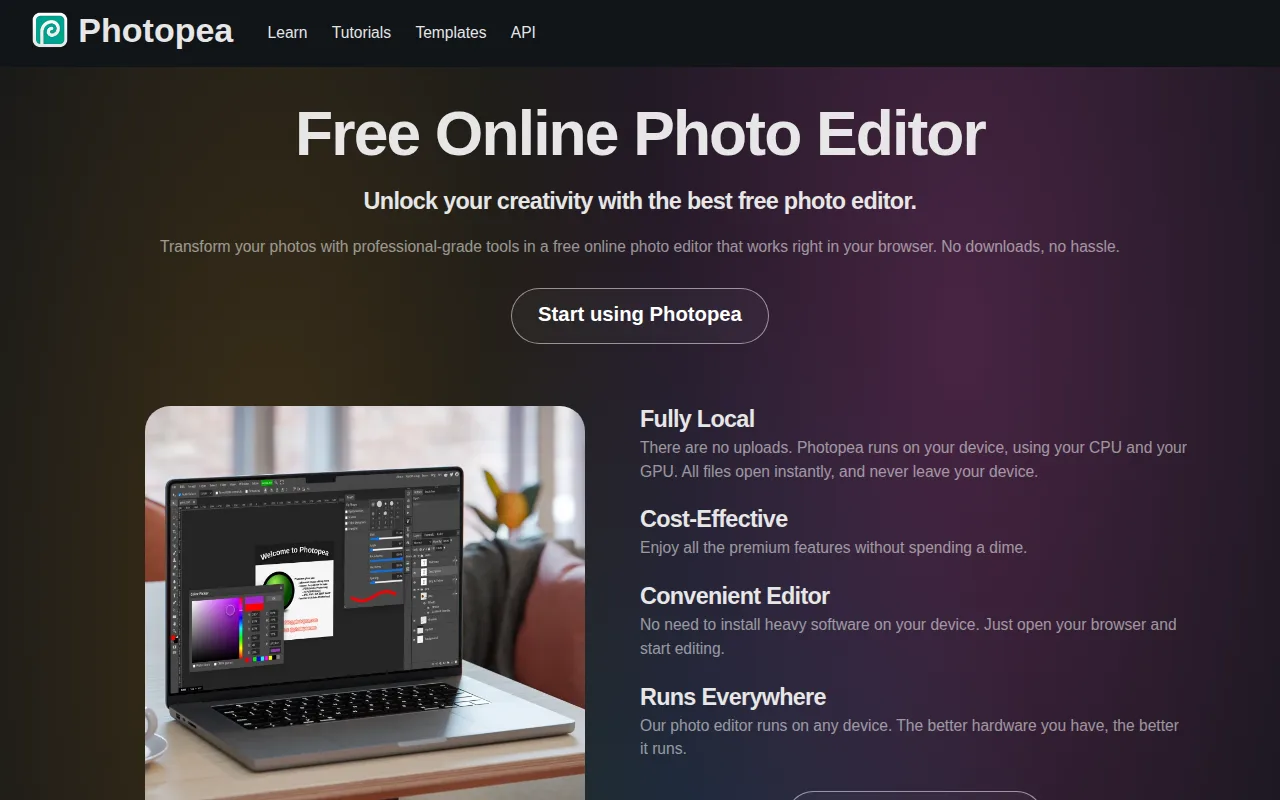
Photopea is the best GIMP alternative for anyone who needs to open and edit native PSD files without installing anything, running entirely at photopea.com with no download, account, or upload of files to a server. Photopea opens and saves real Photoshop PSD files alongside AI, INDD, XD, Sketch, CDR, and 40+ other formats, a compatibility range GIMP's own file handling doesn't fully match since GIMP's PSD import is imperfect for complex layered files. Photopea is free with a full editing toolset — masking, liquify, puppet warp, adjustment layers, and RAW support for CR2, CR3, NEF, ARW, and DNG files — matching GIMP's $0 price, and holds a 4.5/5 rating from 113 Capterra reviews. Because Photopea runs in any modern browser, it works identically on Chromebooks and tablets that can't run GIMP's desktop application at all. GIMP is still the better choice for anyone who wants a dedicated desktop app with no ads and no dependency on a single developer: Photopea is built and maintained largely by one person and has no built-in cloud storage or version history across sessions, while GIMP is a community-maintained project with three-platform desktop installers on Windows, macOS, and Linux.
Compared to GIMP: opens native PSD, AI, XD, and Sketch files GIMP can't fully import, runs in any browser with no install vs GIMP's desktop-only installers, 4.5/5 rating from 113 Capterra reviews vs no third-party rating for GIMP
Wins:Opens and saves native PSD, AI, XD, and Sketch files with no conversion step, more complete than GIMP's imperfect PSD import · Runs in any modern browser with no install, working on Chromebooks and tablets GIMP's desktop app can't run on · 4.5/5 rating from 113 Capterra reviews vs no third-party rating data for GIMP
Loses:No built-in cloud storage or version history across sessions, unlike a dedicated desktop app · Built and maintained largely by a single developer, a thinner support base than GIMP's community of contributors · No scripting API in Python, C, C++, or Scheme the way GIMP offers for batch automation
Pros
- Opens and saves native PSD, AI, and XD files with no conversion step.
- Runs in any modern browser with no installation, account, or upload of files to a server required.
- Full layer-based editing toolset: masking, liquify, puppet warp, and adjustment layers.
- RAW photo format support (CR2, CR3, NEF, ARW, DNG) built in.
Cons
- No built-in cloud storage or version history across sessions.
- Editing performance on large, layer-heavy files depends on the browser and device, unlike a native desktop app.
- Built and maintained largely by a single developer, so support channels are more limited than a commercial vendor's.
- Interface closely mirrors Photoshop's, which can be dense for users who've never used Photoshop before.
Pricing: Free — Free (same as GIMP's $0), ad-supported (verified undefined NaN, NaN)
4.Krita — best GIMP alternative for digital painters, comic artists, and concept artists who want a full-featured, no-cost illustration tool with a brush engine built specifically for freehand painting rather than photo editing
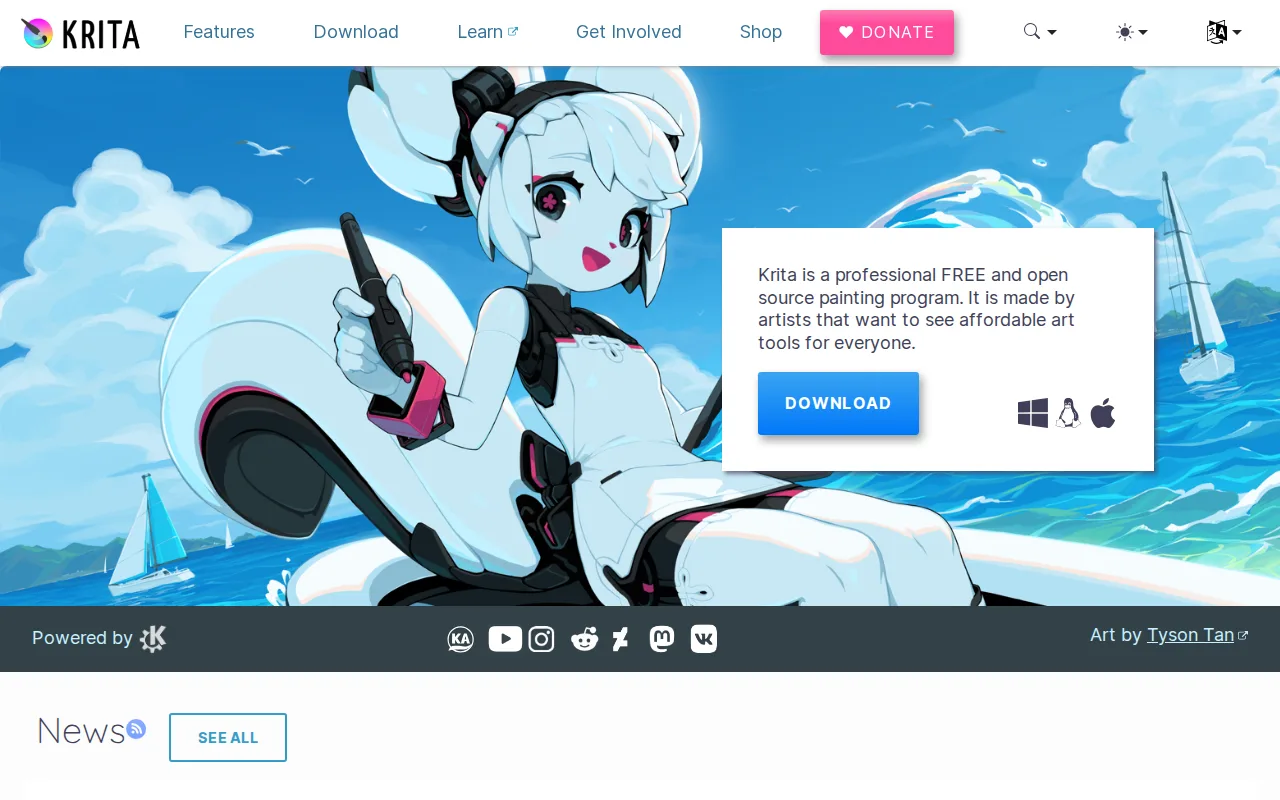
Krita is the best GIMP alternative for digital painters, comic artists, and concept artists who want a brush engine built specifically for freehand illustration rather than GIMP's general-purpose photo-editing toolset. Krita ships canvas rotation, mirroring, stabilizers, and a built-in 2D animation timeline for frame-by-frame work, none of which GIMP offers natively, and like GIMP it is entirely free with no feature paywall. Both tools share the same GPL-3.0 open-source license and the same three-platform desktop coverage — Windows, macOS, and Linux — making Krita the only alternative in this list that matches GIMP's full platform reach. Krita is maintained by the KDE community with funding from the nonprofit Krita Foundation, partly through an identical paid copy sold on the Microsoft Store and Steam that adds no extra features beyond the free direct download. Its only outside rating is a single five-star Product Hunt review, too thin a sample to treat as representative evidence. GIMP is still the better choice for photo retouching and print production: Krita lacks CMYK color management, RAW photo support, and print-ready export tooling, and has no official mobile app, areas where GIMP's general-purpose design covers more ground.
Compared to GIMP: purpose-built brush engine and 2D animation timeline for illustration, matches GIMP's GPL-3.0 license and three-platform coverage exactly, rating rests on a single Product Hunt review
Wins:Brush engine, canvas rotation, mirroring, and stabilizers purpose-built for freehand illustration, an area GIMP's general-purpose toolset doesn't focus on · Built-in 2D animation timeline for frame-by-frame work, which GIMP doesn't offer natively · Matches GIMP's three-platform desktop coverage (Windows, macOS, Linux) exactly, the only alternative here that does
Loses:Lacks CMYK color management and RAW photo support for print production, areas GIMP's general-purpose editor covers · No official mobile app for iOS or Android · Outside rating comes from a single Product Hunt review, far thinner evidence than a widely used tool would carry
Pros
- Completely free with no feature paywall, unlike most professional-grade painting software.
- Brush engine and stabilizers are purpose-built for freehand illustration and comic work.
- Open-source (GPL-3.0) with an active community and regular release cadence.
- Built-in animation timeline supports basic frame-by-frame animation without a separate tool.
Cons
- Not designed for photo editing or retouching; lacks RAW support and CMYK color management for print work.
- Smaller plugin and brush-marketplace ecosystem than Photoshop or Clip Studio Paint.
- No official mobile app for iOS/Android, unlike Procreate or Clip Studio Paint.
- Some advanced features (vector tools, text handling) are less polished than in dedicated design software.
Pricing: Free — Free (same as GIMP's $0); identical paid copy on Microsoft Store/Steam adds no extra features (verified undefined NaN, NaN)
5.Pixlr — best GIMP alternative for casual creators, social media managers, and small businesses who want quick AI-assisted photo edits in a browser without paying for Photoshop
Pixlr is the best GIMP alternative for casual creators and social media managers who want quick AI-assisted edits — generative fill, background removal, face swap, upscaling — without installing GIMP or learning its layer-based workflow. Pixlr's free tier requires no signup and includes real AI tools, though it's ad-supported, unlike GIMP which carries no ads at any tier since it has no monetization at all. Paid plans start at Plus for $1.99/month billed annually (ad-free, 80 monthly AI credits), rising through Premium at $7.99/month and Ultra at $19.99/month to Ultra MAX at $39.99/month for 20,000 monthly credits, all of which cost more than GIMP's permanent $0 price. Pixlr holds a 4.9/5 rating from 53 Product Hunt reviews and ships native iOS and Android apps GIMP doesn't have. GIMP is still the better choice for anyone who wants a real desktop application with no ads and no recurring AI-credit limits: Pixlr has no Windows, macOS, or Linux desktop app at all, running only in the browser or on mobile, and professional designers cite limited precision and customization compared to native desktop editors like GIMP.
Compared to GIMP: real AI tools on a free, no-signup tier GIMP doesn't offer, native iOS and Android apps vs GIMP's desktop-only reach, paid tiers start at $1.99/month above GIMP's permanent $0
Wins:Free tier includes real AI tools — generative fill, background removal, face swap, upscaling — with no signup, features GIMP has no native equivalent for · Native iOS and Android apps extend editing to mobile, where GIMP has no official presence · 4.9/5 rating from 53 Product Hunt reviews vs no third-party rating data for GIMP
Loses:Free tier is ad-supported, unlike GIMP which carries no ads at any tier · No Windows, macOS, or Linux desktop app at all, while GIMP is a full three-platform desktop application · Entry-level Plus plan's 80 monthly AI credits run out quickly, a limit GIMP's unlimited free use doesn't impose
Pros
- Genuine free tier with real AI editing tools and no signup requirement.
- Runs entirely in the browser, with no install needed on any platform.
- Native iOS and Android apps extend editing to mobile.
- Paid tiers are substantially cheaper than Adobe Creative Cloud for casual users.
Cons
- Free tier is ad-supported, which interrupts the editing flow.
- Entry-level Plus tier's 80 monthly AI credits are consumed quickly by generative features.
- Professional designers report limited precision and customization compared to native desktop editors.
- Third-party review counts on Capterra and G2 are inconsistent across sources, making outside validation harder.
Pricing: Free tier · paid from $1.99/mo — Free ad-supported tier, or Plus from $1.99/month; GIMP is $0 with no ads or tier limits at all (verified undefined NaN, NaN)