4 Best Alternatives to Element in 2026
By Noahlast updated pricing verified

From our data: Three of the four alternatives compared to Element carry Capterra ratings: Slack at 4.7/5 from 24,182 reviews, Microsoft Teams at 4.5/5 from 11,129 reviews, and Rocket.Chat at 4.3/5 from 156 reviews, a combined 35,467 Capterra reviews, while Element itself has zero external ratings on file; sorted low to high, the three scores are 4.3, 4.5, and 4.7, putting the median at 4.5.
 Slack
Slack Microsoft Teams
 Mattermost
 Rocket.Chat
How we picked
- Three of the four alternatives compared here carry external ratings fetched on 2026-08-21: Slack holds 4.7/5 from 24,182 Capterra reviews, Microsoft Teams holds 4.5/5 from 11,129 Capterra reviews, and Rocket.Chat holds 4.3/5 from 156 Capterra reviews, while Mattermost's only rating is a single 5/5 Product Hunt review and Element itself has no external ratings on file at all.
- All four alternatives' pricing carries a recorded pricing-verification date (Slack, Microsoft Teams, Mattermost, and Rocket.Chat all 2026-08-21), matching Element's own recorded pricing-verification date of 2026-08-21, though Element's Enterprise and Sovereign tiers, like most of Mattermost's and Rocket.Chat's paid tiers, show no dollar figure since all require contacting sales.
- Ranking reflects each alternative's fit against Element's own Matrix-federated, open-core, compliance-focused model built for government and defense: Slack is ranked first for the largest review base and most polished consumer-grade experience, Microsoft Teams second for Microsoft 365 integration depth, and Mattermost and Rocket.Chat third and fourth for staying closest to Element's own self-hosted, regulated-sector positioning.
- None of the four alternatives, nor Element itself, report any recorded likes or usage count above zero in our listing data, so on-platform engagement signals could not factor into the ranking.
Paid placement never alters editorial rank — read the full methodology.
Element alternatives at a glance
| Alternative | Best for | Standout | Biggest weakness | Learning curve | Price |
|---|---|---|---|---|---|
| Elementreference | government, defense, and enterprise organizations that need self-hosted, end-to-end encrypted chat with the option to federate across organizational boundaries | Matrix federation lets a self-hosted Element server exchange encrypted messages with users on entirely different organizations' servers, something closed platforms like Slack or Teams cannot do. | Enterprise and Sovereign pricing is not published; both require a sales conversation, and Enterprise pricing only applies from a 100-user minimum, making Element's paid tiers impractical to evaluate cost for small teams. | Moderate | Free |
| Slack | teams that need organized, searchable chat with channels, quick huddles, and workflow automation, from small teams on the free tier up to large enterprises needing compliance controls | Channel-based organization combined with a massive third-party app ecosystem (1.7 million weekly active app integrations) and built-in AI search and summarization through Slackbot. | The Free plan's 90-day rolling message history forces most active teams onto a paid tier quickly, and compliance-critical features (SAML, data loss prevention, legal holds) are reserved for the custom-priced Enterprise+ tier rather than being available at Business+. | Low | Free tier · paid from $8.75/mo |
| Microsoft Teams | organizations already using Microsoft 365 that need chat, video meetings, and calling tightly integrated with Word, Excel, Outlook, and SharePoint, from small teams under 300 people up to large enterprises | Native integration with the rest of Microsoft 365 (SharePoint, OneDrive, Office apps, Loop components) plus Copilot-generated meeting notes and Teams Phone calling add-ons in one platform. | Reviewers report recurring bugs — crashes, login errors, sync failures, and unreliable presence/status indicators — and the free tier caps group video calls at 60 minutes; unlocking the full desktop Office apps requires bundling into a Microsoft 365 Business plan at $23.50/user/month rather than a standalone upgrade, and there's no official Linux client. | Moderate | Free tier · paid from $4/mo |
| Mattermost | regulated, government, or defense organizations that need self-hosted, air-gapped, or sovereign-cloud team chat with compliance controls a SaaS-only tool like Slack can't provide | Deployment flexibility for compliance-sensitive organizations: the same platform can run fully air-gapped or in a sovereign cloud with FIPS 140-3/STIG-hardened compliance options, not available from mainstream SaaS chat tools. | No paid tier publishes flat per-user pricing; Professional, Enterprise, and Enterprise Advanced all require a sales conversation and prepaid annual seat commitment, making it harder to budget or compare cost against competitors up front, and self-hosting the free core requires ongoing server maintenance. | Moderate | Free |
| Rocket.Chat | regulated and security-conscious organizations (government, defense, healthcare, financial services) that need a self-hostable or air-gapped team chat platform, plus teams wanting a free, open-source Slack alternative | A fully open-source (MIT-licensed), self-hosted Community Edition with no user limit, alongside government and defense deployment options authorized up to DoD Impact Level 6 for classified environments. | None of the paid tiers publish list pricing — Commercial, Government, and Defense plans all require contacting sales for a quote, making it hard to budget or compare costs against competitors like Slack or Mattermost without a sales call. | Moderate | Free |
 Element
1.Slack — best Element alternative for teams that need organized, searchable chat with channels, quick huddles, and workflow automation, from small teams on the free tier up to large enterprises needing compliance controls
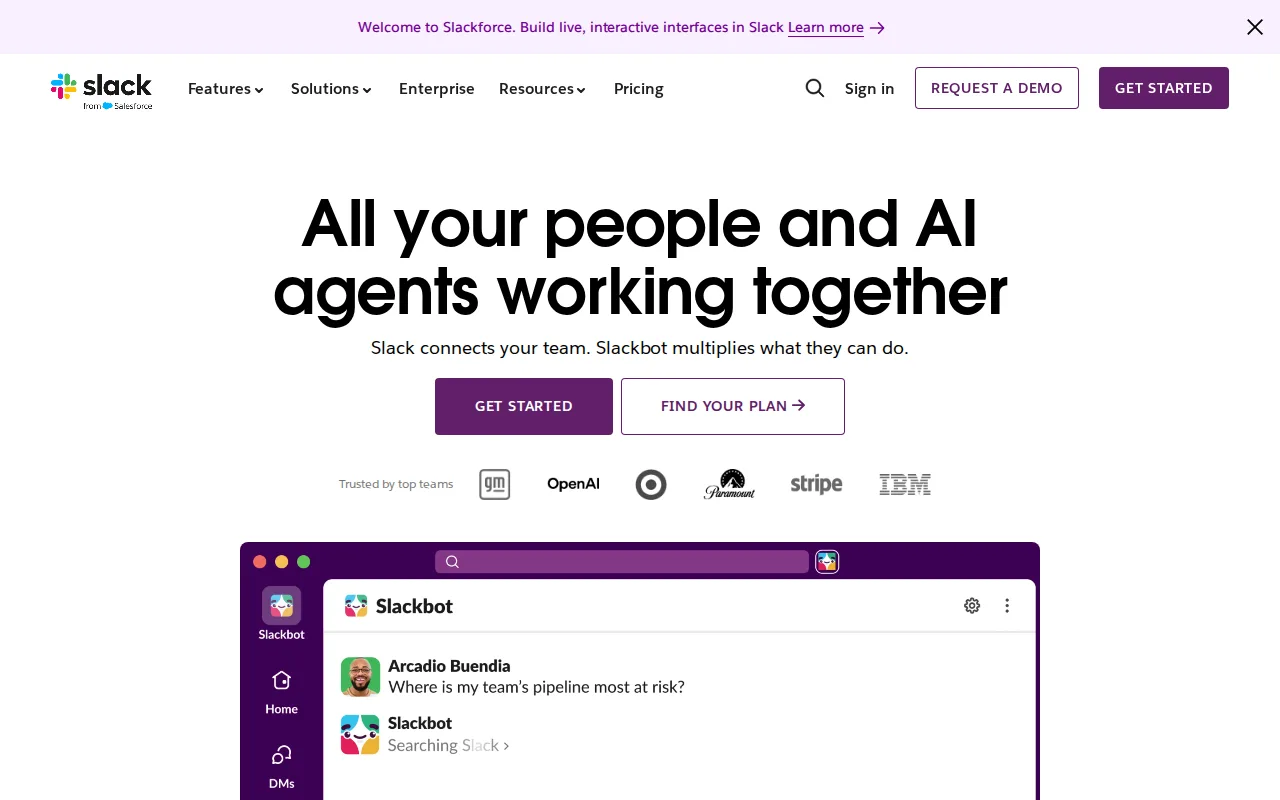
Slack is the best Element alternative for teams that want a polished, widely adopted channel-based chat platform rather than Element's Matrix-federated, self-hosted model built primarily for government and defense customers. Slack holds a 4.7/5 rating from 24,182 Capterra reviews, by far the largest review base in this comparison, while Element carries no external ratings on file at all in our listing data. Slack's Pro tier costs $8.75/user/month ($7.25/month billed annually) with no seat minimum, a far lower barrier to entry than Element's Enterprise tier, which only becomes available from a 100-user minimum and requires a sales conversation for pricing. Slack's 1.7 million weekly active third-party app integrations, including native Salesforce CRM and Google Drive integration, dwarf what a self-hosted Element/Matrix deployment typically connects to out of the box. Element remains the better choice for organizations that specifically need Matrix federation, letting a self-hosted server exchange encrypted messages with users on entirely different organizations' servers, a capability closed platforms like Slack cannot do, and for anyone who needs Element's Sovereign tier for fully air-gapped, offline-capable deployments. Slack's Free plan also caps message history at a rolling 90 days, tighter than Element's free, AGPL-licensed Community edition, which has no such cap. For polished, widely adopted business chat without a 100-user minimum, though, Slack is the more accessible, better-reviewed choice.
Compared to Element: 4.7/5 rating from 24,182 Capterra reviews vs Element's no external ratings on file, no seat minimum vs Element's 100-user Enterprise minimum, 1.7 million weekly active app integrations vs Element's smaller Matrix-ecosystem app support
Wins:4.7/5 rating from 24,182 Capterra reviews, the largest review base in this comparison, versus Element's zero external ratings · Pro tier starts at $8.75/user/month with no seat minimum, unlike Element's Enterprise tier, which only becomes available from 100 users · 1.7 million weekly active app integrations, including native Salesforce CRM and Google Drive, beyond a typical self-hosted Matrix deployment's ecosystem
Loses:No Matrix federation; a self-hosted Slack workspace can't exchange encrypted messages with users on entirely different organizations' servers the way Element can · No fully air-gapped, offline-capable deployment option comparable to Element's Sovereign tier for government and defense customers · Free plan's rolling 90-day message history is more limited than Element's free, AGPL-licensed Community edition, which has no message-history cap
Pros
- Organized, searchable channel-based messaging that scales better than a flat group-chat model.
- Huge third-party integration ecosystem, including native Salesforce CRM and Google Drive integration.
- Built-in Huddles provide quick audio/video calls without a separate meeting tool.
- AI-powered search, summarization, and workflow automation available on Business+.
Cons
- Free tier's 90-day message history is limiting for active teams.
- Advanced compliance features (SAML, DLP, legal holds) require the custom-priced Enterprise+ tier.
- Per-user pricing adds up for larger teams, especially at the $18/user/month Business+ tier.
- Some advanced AI features are gated behind Business+ rather than included in Pro.
Pricing: Free tier · paid from $8.75/mo — $8.75/user/month (Pro, annual) or $18/user/month (Business+) vs Element's free Community edition at $0, with Enterprise/Sovereign pricing available only by contacting sales (verified undefined NaN, NaN)
2.Microsoft Teams — best Element alternative for organizations already using Microsoft 365 that need chat, video meetings, and calling tightly integrated with Word, Excel, Outlook, and SharePoint, from small teams under 300 people up to large enterprises
Microsoft Teams is the best Element alternative for organizations already running on Microsoft 365 that need chat, video meetings, and calling tightly integrated with Word, Excel, and SharePoint, rather than Element's Matrix-federated, encryption-first model. Teams holds a 4.5/5 rating from 11,129 Capterra reviews, evidence of enterprise adoption Element's own listing has no equivalent for since Element carries no external ratings on file. Teams Essentials starts at $4/user/month, a transparent published price point Element's own Enterprise tier doesn't offer since it requires a sales conversation and only becomes available from a 100-user minimum. AI-generated meeting notes, live captions, and real-time translation on paid Teams tiers give it a business-meeting toolset Element's chat-and-call-focused client doesn't attempt to replicate. Element remains the better choice for organizations that specifically need cross-organization federated messaging or fully air-gapped deployment: Teams has no equivalent to Matrix federation, which lets a self-hosted Element server exchange encrypted messages with users on entirely different organizations' servers, and Teams has no official native Linux client, unlike Element, which ships native apps for Linux alongside Windows, macOS, iOS, and Android. Reviewers also report recurring bugs in Teams, including crashes and sync failures, issues not flagged in Element's own listing. For organizations already inside the Microsoft ecosystem needing published, accessible pricing, though, Teams is the more transparent, better-reviewed fit.
Compared to Element: 4.5/5 rating from 11,129 Capterra reviews vs Element's no external ratings on file, $4/user/month Essentials tier with no seat minimum vs Element's sales-quoted Enterprise tier requiring 100 users, native Windows/macOS/iOS/Android apps vs Element's addition of native Linux support
Wins:11,129 Capterra reviews at 4.5/5 gives Teams a verified enterprise track record Element's zero-rating listing doesn't have · Essentials tier is transparently priced at $4/user/month with no seat minimum, unlike Element's sales-quoted, 100-user-minimum Enterprise tier · AI-generated meeting notes, live captions, and real-time translation on paid tiers, absent from Element's encryption-first client
Loses:No Matrix federation; Teams can't exchange encrypted messages with users on entirely different organizations' servers the way a self-hosted Element deployment can · No official native Linux client, unlike Element, which ships native apps for Linux alongside Windows, macOS, iOS, and Android · No fully air-gapped, offline-capable deployment option comparable to Element's Sovereign tier for government and defense customers
Pros
- Free tier is usable for small teams with unlimited 1:1 messaging and calling.
- Tight native integration with Word, Excel, PowerPoint, Outlook, and SharePoint.
- AI-generated meeting notes, live captions, and real-time translation on paid tiers.
- Scales from a $4/user/month Essentials plan up to enterprise-grade Teams Phone and Teams Premium add-ons.
Cons
- Users report recurring bugs: crashes, login errors, sync failures, and unreliable status indicators.
- Free tier caps group video calls at 60 minutes.
- Full desktop Office apps require a $23.50/user/month Microsoft 365 Business Standard plan, not a lower-cost Teams-only upgrade.
- No official native Linux client.
Pricing: Free tier · paid from $4/mo — $4/user/month (Essentials, annual) vs Element's free Community edition at $0, with Enterprise/Sovereign pricing available only by contacting sales (verified undefined NaN, NaN)
3.Mattermost — best Element alternative for regulated, government, or defense organizations that need self-hosted, air-gapped, or sovereign-cloud team chat with compliance controls a SaaS-only tool like Slack can't provide
Mattermost is the best Element alternative for regulated, government, or defense organizations that need self-hosted, air-gapped, or sovereign-cloud team chat, staying closest to Element's own positioning for NATO, UN agencies, and European governments and militaries. Mattermost's core is free and MIT-licensed with no user limit, a more permissive license than Element's Community edition, which is AGPL-3.0, a copyleft license some organizations find more restrictive for commercial use. Mattermost's nearly 39,000 GitHub stars reflect an actively maintained open-core project, and it's used by organizations including the U.S. Air Force and NASA, a regulated-sector adoption track record comparable to Element's own government and defense customer base. Element remains the better choice for organizations that specifically need Matrix federation, letting a self-hosted Element server exchange encrypted messages with users on entirely different organizations' servers, a decentralized-communication capability Mattermost's more centralized deployment model doesn't offer the same way. Mattermost's Professional, Enterprise, and Enterprise Advanced tiers all require a sales conversation with no published flat pricing, matching the same lack of published pricing in Element's own Enterprise and Sovereign tiers. Mattermost's only external rating in our listing data is a single 5/5 Product Hunt review, thin evidence on either side of this comparison since Element itself has no ratings at all. For regulated deployments without Matrix's specific federation requirement, though, Mattermost's MIT-licensed core offers comparable compliance depth.
Compared to Element: MIT-licensed free core vs Element's AGPL-3.0-licensed Community edition, no Matrix-style cross-organization federation vs Element's core differentiator, both requiring a sales conversation for Enterprise-tier pricing
Wins:MIT-licensed free core is a more permissive license than Element's AGPL-3.0 Community edition, which carries copyleft terms some organizations find restrictive · Nearly 39,000 GitHub stars reflect an actively maintained open-core project with broad community adoption · Used by organizations including the U.S. Air Force, NASA, and Samsung, comparable regulated-sector trust to Element's own listed customers
Loses:No Matrix federation; Mattermost can't exchange encrypted messages across separate organizations' servers the way Element's decentralized architecture is built to do · Only a single 5/5 Product Hunt review on file, thin external validation matching Element's own lack of any external ratings · No published flat pricing for any paid tier; all require a sales conversation, the same gap in Element's own Enterprise and Sovereign tiers
Pros
- Self-hosted core is free (MIT-licensed) with no user limit, avoiding SaaS vendor lock-in.
- Deployment options (on-premise, private cloud, air-gapped) support compliance needs that pure-SaaS chat tools can't meet.
- Native apps across web, Windows, macOS, Linux, iOS, and Android.
- Open-core model means the underlying chat engine's code is auditable even though advanced features are commercially licensed.
Cons
- No published flat pricing for any paid tier; all require contacting sales and a prepaid annual commitment.
- Self-hosting the free core requires ongoing server maintenance, scaling, and upgrades.
- Advanced features (sovereign AI, high availability, air-gapped support) sit behind the commercial Enterprise license, not the open-source core.
- Smaller third-party app/integration ecosystem than Slack, which has a much larger app marketplace.
Pricing: Free — Free MIT-licensed core at $0; paid Professional/Enterprise/Enterprise Advanced tiers unpublished (contact sales) vs Element's free AGPL Community edition at $0, with Enterprise/Sovereign also requiring a sales conversation (verified undefined NaN, NaN)
4.Rocket.Chat — best Element alternative for regulated and security-conscious organizations (government, defense, healthcare, financial services) that need a self-hostable or air-gapped team chat platform, plus teams wanting a free, open-source Slack alternative
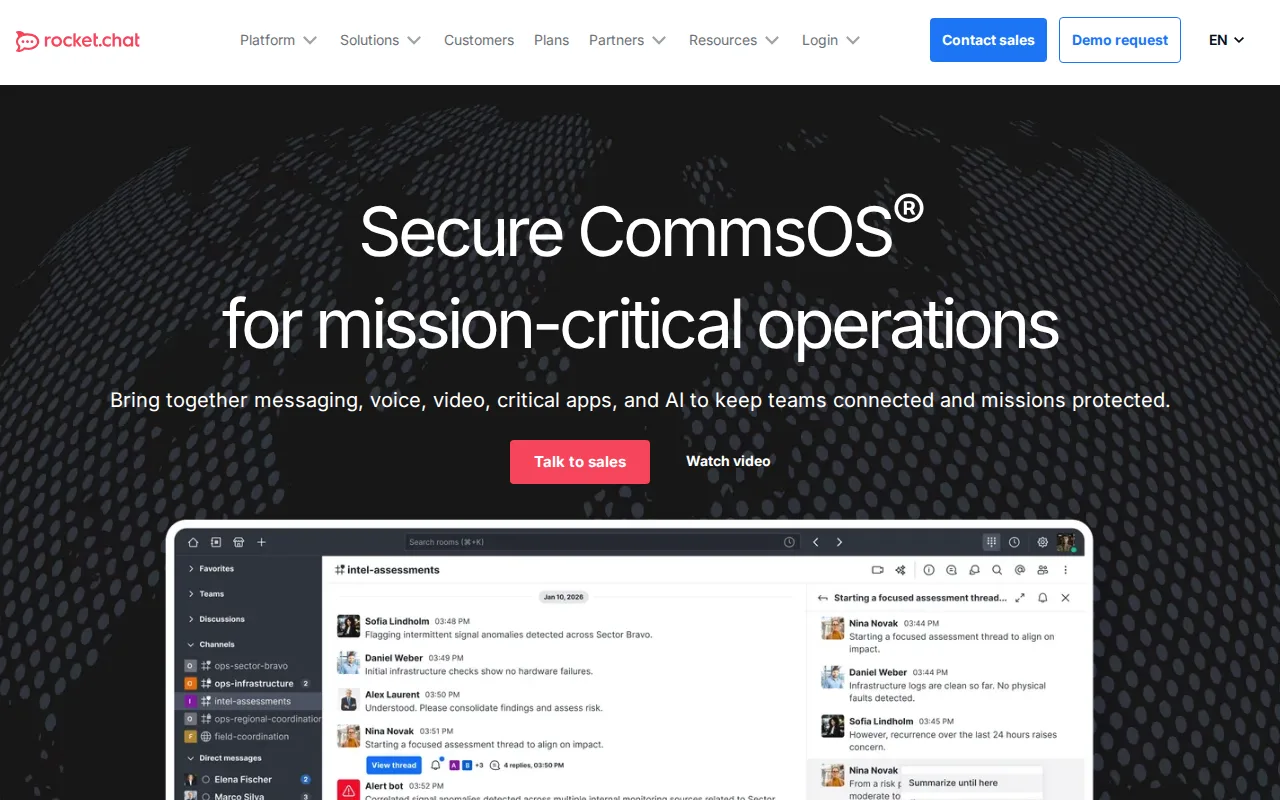
Rocket.Chat is the best Element alternative for teams that want a fully open-source, self-hostable chat platform with a similar open-core structure to Element's own Matrix-based product. Rocket.Chat's Community Edition is free under the MIT license with no user limit, and its over 46,000 GitHub stars mean the underlying code is fully auditable, a transparency comparable to Element's own AGPL-3.0-licensed Community edition. Rocket.Chat holds a 4.3/5 rating from 156 Capterra reviews, external validation Element's own listing has none of since Element carries no external ratings on file in our listing data. Rocket.Chat's Government and Defense tiers support air-gapped deployment with a DoD Authorization to Operate up to Impact Level 6, a level of regulated-sector deployment matching Element's own Sovereign tier positioning for government and defense customers. Element remains the better choice for organizations that specifically need Matrix's decentralized federation, letting a self-hosted Element server message users on entirely different organizations' servers without shared infrastructure, a capability Rocket.Chat's own federated communications feature approaches differently since it isn't built on the open Matrix protocol. Rocket.Chat's Commercial, Government, and Defense tiers all require a sales conversation with no published list pricing, matching the same lack of published pricing in Element's own Enterprise and Sovereign tiers. For self-hosted, auditable chat with an external rating Element's listing doesn't have, though, Rocket.Chat is a close structural match.
Compared to Element: 4.3/5 rating from 156 Capterra reviews vs Element's no external ratings on file, DoD Impact Level 6-authorized deployment vs Element's comparable Sovereign tier, federated communications vs Element's Matrix-protocol-based cross-organization federation
Wins:4.3/5 rating from 156 Capterra reviews, external validation Element's own listing has none of on file · Over 46,000 GitHub stars reflect broad open-source adoption and code auditability · Government and Defense deployment tiers authorized up to DoD Impact Level 6 for classified environments, matching Element's own Sovereign tier ambitions
Loses:Federated communications aren't built on the open Matrix protocol, so cross-organization messaging works differently than Element's decentralized, protocol-standard federation · No published list pricing for Commercial, Government, or Defense tiers, all requiring a sales conversation, the same gap in Element's own Enterprise and Sovereign tiers · Self-hosting the Community Edition adds administration and infrastructure overhead comparable to what self-hosting Element's own Community edition requires
Pros
- Community Edition is free, open-source (MIT license), and self-hostable with no user limit.
- Deployment options span standard cloud hosting to fully air-gapped, classified environments.
- Federated communications let separate Rocket.Chat deployments message across organizational boundaries.
- Extensible via custom and pre-built apps, plus native voice, video, and screen sharing.
Cons
- No published list pricing for any paid tier; every quote requires a sales conversation.
- Self-hosting the Community Edition adds administration and infrastructure overhead compared to SaaS competitors.
- Government/Defense-specific features add complexity that most mainstream business customers won't need.
Pricing: Free — Free Community Edition at $0; Commercial/Government/Defense tiers unpublished (contact sales) vs Element's free AGPL Community edition at $0, with Enterprise/Sovereign also requiring a sales conversation (verified undefined NaN, NaN)
Which one is right for you?
- You want a polished, widely adopted business chat tool without Element's 100-user minimum for enterprise pricing.Slack
- Your organization already runs on Microsoft 365 and wants chat tightly integrated with Word, Excel, and SharePoint.Microsoft Teams
- You need FIPS 140-3/STIG-hardened compliance for a regulated organization but don't specifically need Matrix federation.Mattermost
- You want an open-source, self-hosted alternative with an external rating and a similar open-core structure to Element's own model.Rocket.Chat
- You need DoD Impact Level 6-authorized deployment for a government or defense organization.Rocket.Chat
- You want the largest third-party app ecosystem available for a workplace chat tool.Slack
Frequently asked questions
What is the best alternative to Element?
- Slack is the best-reviewed alternative to Element, holding a 4.7/5 rating from 24,182 Capterra reviews and no seat minimum for paid tiers. Microsoft Teams suits Microsoft 365-integrated organizations, while Mattermost and Rocket.Chat stay closest to Element's own self-hosted, regulated-sector positioning.
Is there a free alternative to Element?
- Yes — Mattermost and Rocket.Chat both offer free, MIT-licensed, self-hosted editions with no user limit, comparable to Element's own free AGPL-3.0 Community edition. Slack and Microsoft Teams also have free tiers, though with usage caps Element's own free tier doesn't share.
Can Slack replace Element?
- Slack can replace Element for general team chat, since both offer free tiers and channel-based messaging, but Slack lacks Element's Matrix federation, which lets a self-hosted server message users on entirely different organizations' servers. Slack holds a 4.7/5 rating from 24,182 Capterra reviews versus Element's zero external ratings.
What is the closest alternative to Element for cross-organization federated messaging?
- No alternative compared here fully matches Element's Matrix-protocol federation, which lets separate organizations' servers exchange encrypted messages without shared infrastructure. Rocket.Chat comes closest with its own federated communications feature, though it isn't built on the open Matrix standard the way Element is.
Is Mattermost cheaper than Element?
- Both Mattermost's and Element's core products are free and self-hostable ($0), with Mattermost's core MIT-licensed and Element's core AGPL-3.0-licensed. Paid Enterprise-tier pricing is unpublished for both, since Mattermost's Professional/Enterprise tiers and Element's Enterprise/Sovereign tiers all require contacting sales.
Which Element alternative is best for a government or defense organization?
- Mattermost and Rocket.Chat are the best Element alternatives for government or defense use, both offering air-gapped deployment options, with Rocket.Chat's Defense tier authorized up to DoD Impact Level 6. Neither publishes flat pricing for these tiers, matching Element's own unpublished Enterprise and Sovereign pricing.