1 Best Open-Source Alternatives to commercetools in 2026
By Noahlast updated
All 5 commercetools alternatives
Compared: open-source alternatives to commercetools
| Alternative | Best for | Standout | Biggest weakness | Learning curve | Price |
|---|---|---|---|---|---|
| commercetoolsreference | large enterprise retailers running unified B2C and B2B commerce across web, mobile, in-store, and AI shopping channels who need a fully custom frontend | MosAIc and AI Hub extend the commerce API layer to agent-driven shopping channels like ChatGPT, Gemini, and Copilot, alongside traditional headless storefront and POS integration | No public pricing at all — every deployment requires a sales conversation and typically a systems integrator, which makes commercetools impractical for small or mid-market merchants who want to evaluate cost before committing engineering time. | Steep | Custom pricing |
| Medusa | developer teams building custom B2B, B2C, or marketplace commerce storefronts that need more control than templated platforms like Shopify allow | Charges no GMV-based fee or per-transaction commerce tax on any Cloud tier, unlike many hosted commerce platforms that take a cut of sales alongside infrastructure fees. | Medusa requires real developer investment to configure and extend — it is a toolkit rather than a ready-made storefront — and the Enterprise Edition's additional features sit behind a separate, non-public commercial license agreement rather than a fixed published price. | Steep | Free tier · paid from $29/mo |
 commercetools
 Medusa
1.Medusa — best commercetools alternative for developer teams building custom B2B, B2C, or marketplace commerce storefronts that need more control than templated platforms like Shopify allow
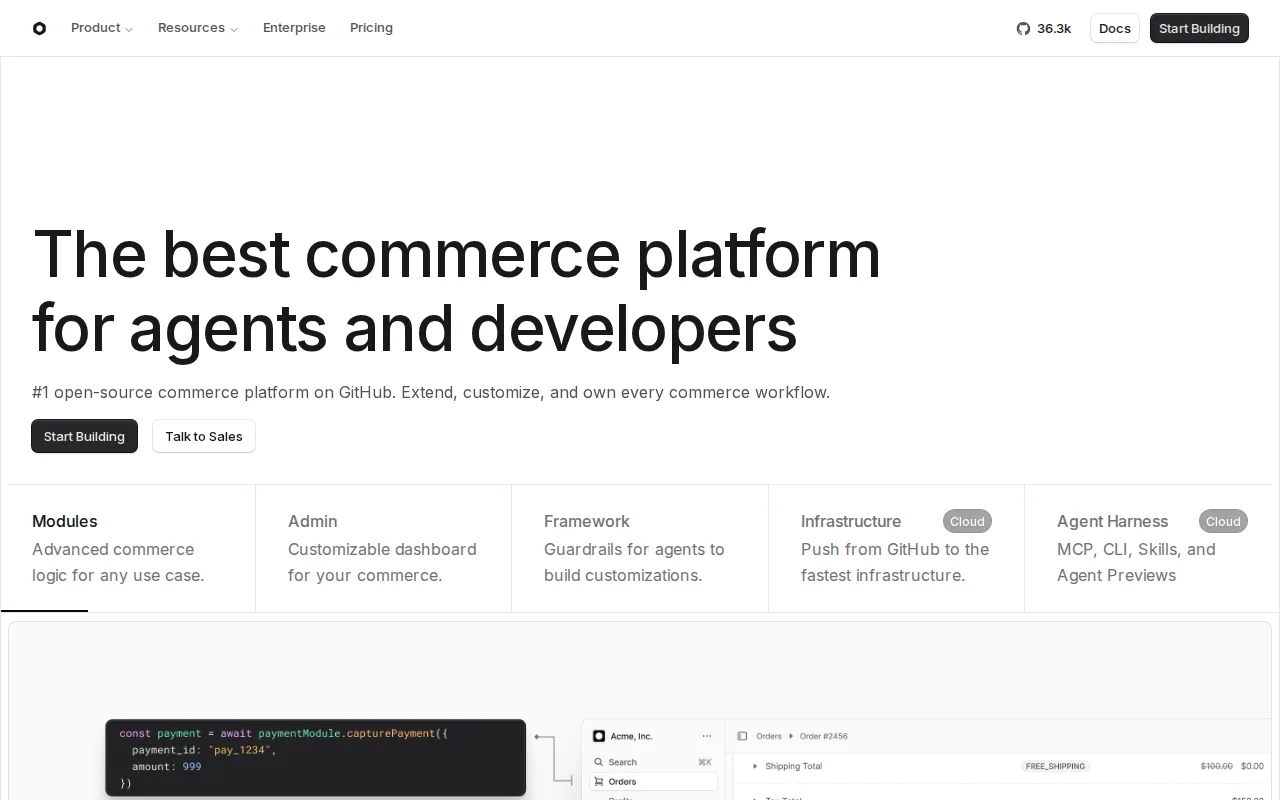
Medusa is the best commercetools alternative for developer teams who want an open-source, self-hostable commerce toolkit instead of a fully custom-quoted enterprise contract. Medusa's core is MIT-licensed and free to self-host, with Medusa Cloud starting at just $29/month for zero-config managed infrastructure, a published, self-serve price point commercetools doesn't offer at all — commercetools publishes no pricing and requires a sales conversation for every deployment. Medusa has 35,900+ GitHub stars and charges no GMV-based fee or per-transaction commerce tax on any Cloud tier, and it ships AI-enabled development tooling, including an MCP server and agentic skills, for teams building agentic commerce storefronts, a similar direction to commercetools' own MosAIc and AI Hub. commercetools is still the better choice for the largest enterprise retailers: it reports over 550 customers processing more than $110 billion in annualized GMV, a scale of proven enterprise deployment Medusa's newer ecosystem hasn't matched, and commercetools' vendor-managed infrastructure and support contracts fit organizations that don't want to operate or extend commerce logic themselves the way Medusa's toolkit requires.
Compared to commercetools: MIT-licensed core free to self-host, published self-serve Cloud pricing starting at $29/month vs commercetools' quote-only model, no GMV-based fee or commerce tax on any Cloud tier
Wins:MIT-licensed core is free to self-host, with no equivalent free option from commercetools · Medusa Cloud publishes self-serve pricing starting at $29/month, vs commercetools' fully custom, quote-only pricing · No GMV-based fee or per-transaction commerce tax on any Cloud tier
Loses:Requires real developer investment to configure and extend — a toolkit, not a ready-made enterprise deployment · Has not matched commercetools' proven scale: commercetools reports 550+ enterprise customers and over $110B in annualized GMV · Enterprise Edition features require a separate, non-public commercial license agreement, similar to commercetools' own opacity at that tier
Pros
- MIT-licensed core is free to self-host with no feature gating on the open-source codebase itself.
- No GMV-based fee or commerce tax on any Medusa Cloud plan, unlike hosted platforms that take a percentage of sales.
- Deep customization for complex commerce needs: multi-warehouse inventory, multi-region pricing, B2B and marketplace support.
- 35,900+ GitHub stars and an active open-source community, plus AI-agent tooling (MCP server, agentic skills) for teams building agentic commerce.
Cons
- Requires real developer resources to configure; it's a commerce toolkit, not a point-and-click store builder like Shopify.
- Enterprise Edition features require a separate, non-public commercial license agreement rather than transparent published pricing.
- Cloud Develop's entry tier caps compute hours and edge requests, so active stores may need to move to Launch or Scale quickly.
- Smaller third-party app/theme marketplace than Shopify, meaning more custom development for integrations.
Pricing: Free tier · paid from $29/mo — $0 self-hosted or $29/month (Medusa Cloud Develop) vs custom quote only (commercetools) (verified undefined NaN, NaN)