1 Best Open-Source Alternatives to Capture One in 2026
By Noahlast updated
All 4 Capture One alternatives
Compared: open-source alternatives to Capture One
| Alternative | Best for | Standout | Biggest weakness | Learning curve | Price |
|---|---|---|---|---|---|
| Capture Onereference | portrait, fashion, product, and commercial photographers who need tethered shooting and fine-grained color grading beyond what Lightroom offers | Tethered capture support for 550+ camera models with live-viewer collaboration (Capture One Live, Studio tier), letting a remote art director or client watch a shoot in real time. | Reviewers consistently cite a steeper learning curve than Lightroom and pricing that runs higher, especially once you need the Studio or All in One tiers for team or mobile workflows rather than the base Pro plan. | Steep | Custom pricing |
| darktable | photographers who want a fully non-destructive, database-driven raw editing workflow on Linux, Windows, or macOS without paying an Adobe Lightroom subscription | A fully non-destructive, GPU-accelerated raw processing pipeline with a database-backed lighttable for organizing large photo libraries, built entirely by a volunteer photographer-developer community with no paid tier at all. | The dense, module-heavy interface has a steeper learning curve for photographers coming from more guided commercial tools, and darktable lacks the polish, tutorials, and plugin ecosystem of Adobe Lightroom. | Steep | Free |
 Capture One
 darktable
1.darktable — best Capture One alternative for photographers who want a fully non-destructive, database-driven raw editing workflow on Linux, Windows, or macOS without paying an Adobe Lightroom subscription
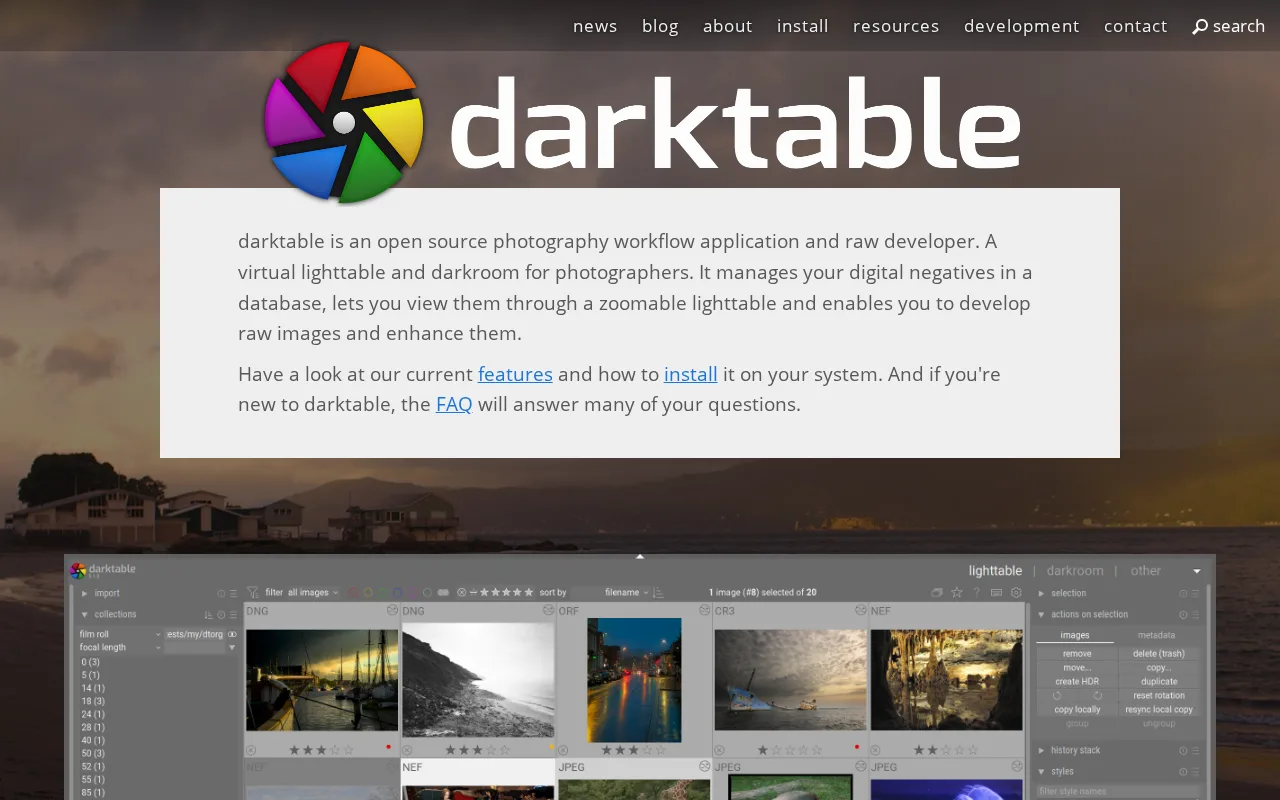
darktable is the best Capture One alternative for photographers who want a fully non-destructive, database-driven raw editing workflow without paying anything at all, unlike Capture One's four subscription tiers plus a separate perpetual license option. darktable is released under the GPL-3.0 license with its full source hosted on GitHub (darktable-org/darktable, 13,000 stars), and there is no paid tier, subscription, or feature gate of any kind, a stark contrast to Capture One, whose exact subscription and perpetual license prices aren't even shown as static text on its own pricing page. darktable runs natively on Linux, Windows 10+, and macOS, adding Linux support that Capture One's Windows/macOS/iOS platform list doesn't include. Capture One is still the better choice for professional studio photographers who need tethered shooting and guided commercial polish: darktable's dense, module-heavy interface has a steeper learning curve than Capture One's more guided workflow, it has no official cloud sync or mobile companion app, and it carries no external rating data at all in our listing data, unlike Capture One's 4.7/5 from 66 Capterra reviews, so there's no independent review volume to weigh darktable's real-world reliability against.
Compared to Capture One: completely free and open source (GPL-3.0) with no paid tier at all, native Linux support, but a steeper interface learning curve and no cloud sync
Wins:Completely free and open source under GPL-3.0, with no subscription or paid tier at all, unlike Capture One's four subscription tiers plus a separate perpetual license · Full source code published on GitHub (13,000 stars), unlike Capture One's closed-source model · Native Linux support, a platform Capture One's Windows/macOS/iOS list doesn't include
Loses:Dense, module-heavy interface has a steeper learning curve than Capture One's more guided workflow · No official cloud sync or mobile companion app, unlike Capture One's iPad/iPhone app on higher tiers · Carries no external rating data at all in our listing data, unlike Capture One's 4.7/5 from 66 Capterra reviews
Pros
- Completely free and open source under GPL-3.0, with no subscription or paid tier at all.
- Fully non-destructive raw editing backed by a searchable image database (the lighttable).
- A GPU-accelerated processing pipeline handles large raw files and complex edit stacks responsively.
- Runs natively on Linux, Windows, and macOS, unlike some raw editors that are Mac- or Windows-only.
Cons
- The dense, module-heavy interface has a steeper learning curve than guided commercial tools like Lightroom.
- A smaller plugin and tutorial ecosystem than Adobe Lightroom, since development depends on volunteer contributors.
- No official cloud sync or mobile companion app, unlike Lightroom's cross-device workflow.
- Big-endian and 32-bit platforms are not officially supported, and camera raw-format support can lag behind brand-new camera releases.
Pricing: Free — Free, with no paid tier of any kind, vs Capture One's subscription tiers or perpetual license, priced only through an interactive calculator (verified undefined NaN, NaN)