1 Best Open-Source Alternatives to Calendly in 2026
By Noahlast updated pricing verified
Compared: open-source alternatives to Calendly
| Alternative | Best for | Standout | Biggest weakness | Learning curve | Price |
|---|---|---|---|---|---|
| Calendlyreference | individuals and small teams who need to eliminate scheduling back-and-forth via a shared booking link, especially sales and recruiting teams needing round-robin routing | Notetaker and Callie, which extend Calendly beyond booking into recording meetings, drafting follow-ups, and coordinating scheduling over email automatically. | The free plan is limited to a single event type and one calendar connection, pushing most real usage onto per-seat paid plans, and per-seat pricing compounds quickly for larger sales or recruiting teams. | Low | Free tier · paid from $10/mo |
| Cal.com | individuals and technical teams who want an open-source, self-hostable Calendly alternative with API-level control over booking flows | The scheduling engine is genuinely self-hostable via Docker, with a fully open community fork (cal.diy, MIT-licensed) that strips out enterprise/commercial code entirely, giving teams a real self-hosted path rather than an open-source demo that funnels users to the paid cloud. | Self-hosting requires ongoing infrastructure maintenance and doesn't include Cal.com's managed support, while advanced features like SSO and fine-grained access control are gated behind the pricier Organizations and Enterprise tiers on the hosted product. | Moderate | Free tier · paid from $12/mo |
 Calendly
 Cal.com
1.Cal.com — best Calendly alternative for individuals and technical teams who want an open-source, self-hostable Calendly alternative with API-level control over booking flows
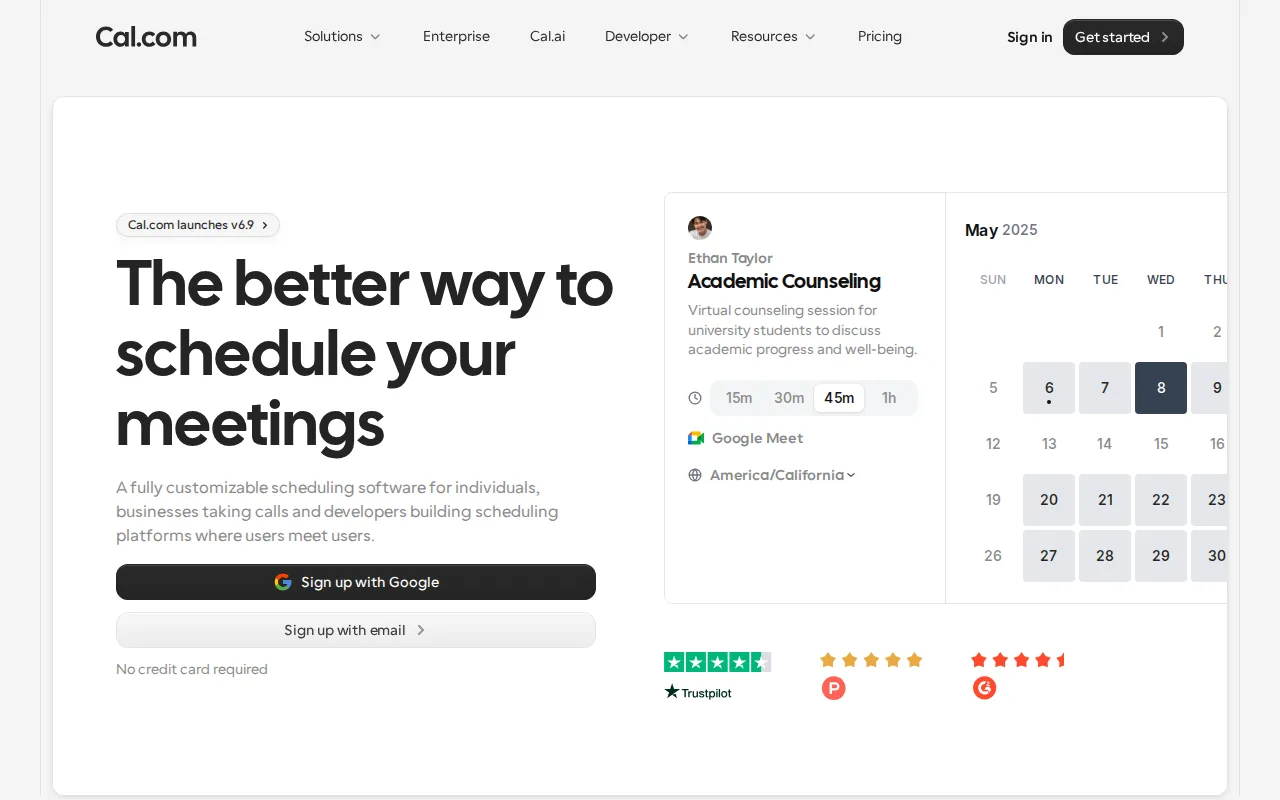
Cal.com is the best Calendly alternative for individuals and technical teams who want an open-source, self-hostable scheduling platform with API-level control over booking flows. Cal.com's Free tier includes unlimited event types and calendars for a single user with no artificial feature caps, versus Calendly's Free plan, which is restricted to one event type and one calendar connection; Cal.com's Teams plan then starts at $12/user/month, close to Calendly's $10/seat. Cal.com's scheduling engine is genuinely self-hostable via Docker, with a fully open community fork (cal.diy, MIT-licensed) that strips out enterprise/commercial code entirely, giving teams a real self-hosted path rather than an open-source demo that funnels users to a paid cloud. Cal.com holds a 4.8/5 rating from 85 Product Hunt reviews, and even its free plan includes 100+ integrations plus built-in Stripe and PayPal payment collection at booking time, without a separate add-on. Calendly is still the better choice for teams that want fully managed hosting with zero infrastructure work: self-hosting Cal.com requires ongoing infrastructure maintenance and forgoes managed support, SSO and fine-grained access control are gated behind the pricier Organizations and Enterprise tiers, and self-hosted deployments can lag behind the hosted cloud product on the latest feature releases.
Compared to Calendly: unlimited event types and calendars on the free tier vs Calendly's single-event-type limit, genuinely self-hostable via Docker with an MIT-licensed community fork, built-in Stripe/PayPal payment collection on the free plan
Wins:Free tier includes unlimited event types and calendars for a single user with no artificial feature caps, vs Calendly's Free plan limited to one event type and one calendar · Genuinely self-hostable via Docker, with a fully open MIT-licensed community fork (cal.diy) available · Built-in Stripe and PayPal payment collection at time of booking, even on the free plan
Loses:Self-hosting requires ongoing infrastructure maintenance and forgoes Cal.com's managed support and updates · SSO and advanced access control are gated to the pricier Organizations and Enterprise tiers · Team-oriented per-user billing ($12-28/user/month) can add up faster than Calendly's flat team pricing at small seat counts
Pros
- Free tier includes unlimited event types and calendars for a single user, with no artificial feature caps.
- Genuinely self-hostable via Docker, with a fully open MIT-licensed community fork (cal.diy) available.
- 100+ integrations and two-way Salesforce/HubSpot sync are available even on the free plan.
- Built-in Stripe and PayPal payment collection at time of booking without a separate add-on.
Cons
- Self-hosting requires ongoing infrastructure maintenance and forgoes Cal.com's managed support and updates.
- SSO and advanced access control are gated to the pricier Organizations and Enterprise tiers.
- Team-oriented features require per-user billing ($12-28/user/month), which adds up faster than Calendly's flat team pricing at small seat counts.
- Self-hosted deployments can lag behind the hosted cloud product on the latest feature releases.
Pricing: Free tier · paid from $12/mo — $12/user/month Teams vs Calendly's $10/seat/month Standard (verified undefined NaN, NaN)