2 Best Open-Source Alternatives to Zulip in 2026
By Noahlast updated pricing verified
Compared: open-source alternatives to Zulip
| Alternative | Best for | Standout | Biggest weakness | Learning curve | Price |
|---|---|---|---|---|---|
| Zulipreference | distributed and remote teams, open-source projects, and research groups who need many parallel conversations to stay organized without a flat, scrolling chat feed | Topic-based threading splits every channel into named sub-conversations by default, so a team can hold dozens of parallel discussions in one channel without losing track of any of them, and the full self-hosted edition is genuinely free with no per-user cap on core features. | Topic-based threading is a real behavior change from flat-stream chat apps like Slack or Microsoft Teams, so teams migrating over often need a deliberate adjustment period, and self-hosting requires the same ongoing server maintenance any self-hosted Basic/Business/Enterprise pricing. | Moderate | Free tier · paid from $3.50/mo |
| Mattermost | regulated, government, or defense organizations that need self-hosted, air-gapped, or sovereign-cloud team chat with compliance controls a SaaS-only tool like Slack can't provide | Deployment flexibility for compliance-sensitive organizations: the same platform can run fully air-gapped or in a sovereign cloud with FIPS 140-3/STIG-hardened compliance options, not available from mainstream SaaS chat tools. | No paid tier publishes flat per-user pricing; Professional, Enterprise, and Enterprise Advanced all require a sales conversation and prepaid annual seat commitment, making it harder to budget or compare cost against competitors up front, and self-hosting the free core requires ongoing server maintenance. | Moderate | Free |
| Rocket.Chat | regulated and security-conscious organizations (government, defense, healthcare, financial services) that need a self-hostable or air-gapped team chat platform, plus teams wanting a free, open-source Slack alternative | A fully open-source (MIT-licensed), self-hosted Community Edition with no user limit, alongside government and defense deployment options authorized up to DoD Impact Level 6 for classified environments. | None of the paid tiers publish list pricing — Commercial, Government, and Defense plans all require contacting sales for a quote, making it hard to budget or compare costs against competitors like Slack or Mattermost without a sales call. | Moderate | Free |
 Zulip
Zulip Mattermost
 Rocket.Chat
1.Mattermost — best Zulip alternative for regulated, government, or defense organizations that need self-hosted, air-gapped, or sovereign-cloud team chat with compliance controls a SaaS-only tool like Slack can't provide

Mattermost is the best Zulip alternative for regulated, government, or defense organizations that need air-gapped or sovereign-cloud deployment with FIPS 140-3 and STIG-hardened compliance options, a level of deployment control beyond Zulip's own self-hosted or Cloud offerings. Both products ship a free, self-hosted core: Mattermost's is MIT-licensed and released monthly, while Zulip's is Apache 2.0-licensed with 25,700+ GitHub stars, and both are genuinely usable without a paid tier. Mattermost's paid Professional, Enterprise, and Enterprise Advanced tiers are all sold as prepaid annual seat-based subscriptions with no published flat pricing, requiring a sales conversation to get a number — a bigger transparency gap than Zulip, whose Cloud Standard ($6.67/user/month) and Cloud Plus ($10/user/month) prices are published outright. Mattermost holds a 5.0/5 rating from a single Product Hunt review, a much thinner sample than Zulip's own 196 Capterra reviews at 4.9/5. Zulip is still the better choice for teams that want transparent, published pricing and topic-based threading: Mattermost's advanced features (sovereign AI, high availability, air-gapped support) sit behind a commercial Enterprise license requiring a sales quote, while Zulip's Cloud tiers are self-serve with listed prices, and Zulip's topic-based threading has no direct Mattermost equivalent for splitting parallel conversations within one channel.
Compared to Zulip: air-gapped and sovereign-cloud deployment with FIPS 140-3/STIG compliance, both offer a free self-hosted core, no published pricing on paid tiers vs Zulip's listed Cloud Standard/Plus prices
Wins:Air-gapped and sovereign-cloud deployment options with FIPS 140-3 and STIG-hardened compliance, beyond Zulip's own self-hosted or Cloud deployment scope · Used by organizations including the U.S. Air Force, NASA, and Samsung, a scale reference not available for Zulip · Playbook workflow automation and Kanban-style task boards built into the platform, beyond Zulip's channel-and-topic messaging focus
Loses:No published flat pricing for any paid tier; Professional, Enterprise, and Enterprise Advanced all require a sales conversation, unlike Zulip's listed $6.67/user/month Cloud Standard and $10/user/month Cloud Plus prices · 5.0/5 rating from a single Product Hunt review is a far thinner sample than Zulip's 196 Capterra reviews · No direct equivalent to Zulip's topic-based threading for splitting many parallel conversations within one channel
Pros
- Self-hosted core is free (MIT-licensed) with no user limit, avoiding SaaS vendor lock-in.
- Deployment options (on-premise, private cloud, air-gapped) support compliance needs that pure-SaaS chat tools can't meet.
- Native apps across web, Windows, macOS, Linux, iOS, and Android.
- Open-core model means the underlying chat engine's code is auditable even though advanced features are commercially licensed.
Cons
- No published flat pricing for any paid tier; all require contacting sales and a prepaid annual commitment.
- Self-hosting the free core requires ongoing server maintenance, scaling, and upgrades.
- Advanced features (sovereign AI, high availability, air-gapped support) sit behind the commercial Enterprise license, not the open-source core.
- Smaller third-party app/integration ecosystem than Slack, which has a much larger app marketplace.
Pricing: Free — Paid tiers unpublished (contact sales) vs Zulip's listed Cloud Standard at $6.67/user/month and Cloud Plus at $10/user/month; both offer a free self-hosted core (verified undefined NaN, NaN)
2.Rocket.Chat — best Zulip alternative for regulated and security-conscious organizations (government, defense, healthcare, financial services) that need a self-hostable or air-gapped team chat platform, plus teams wanting a free, open-source Slack alternative
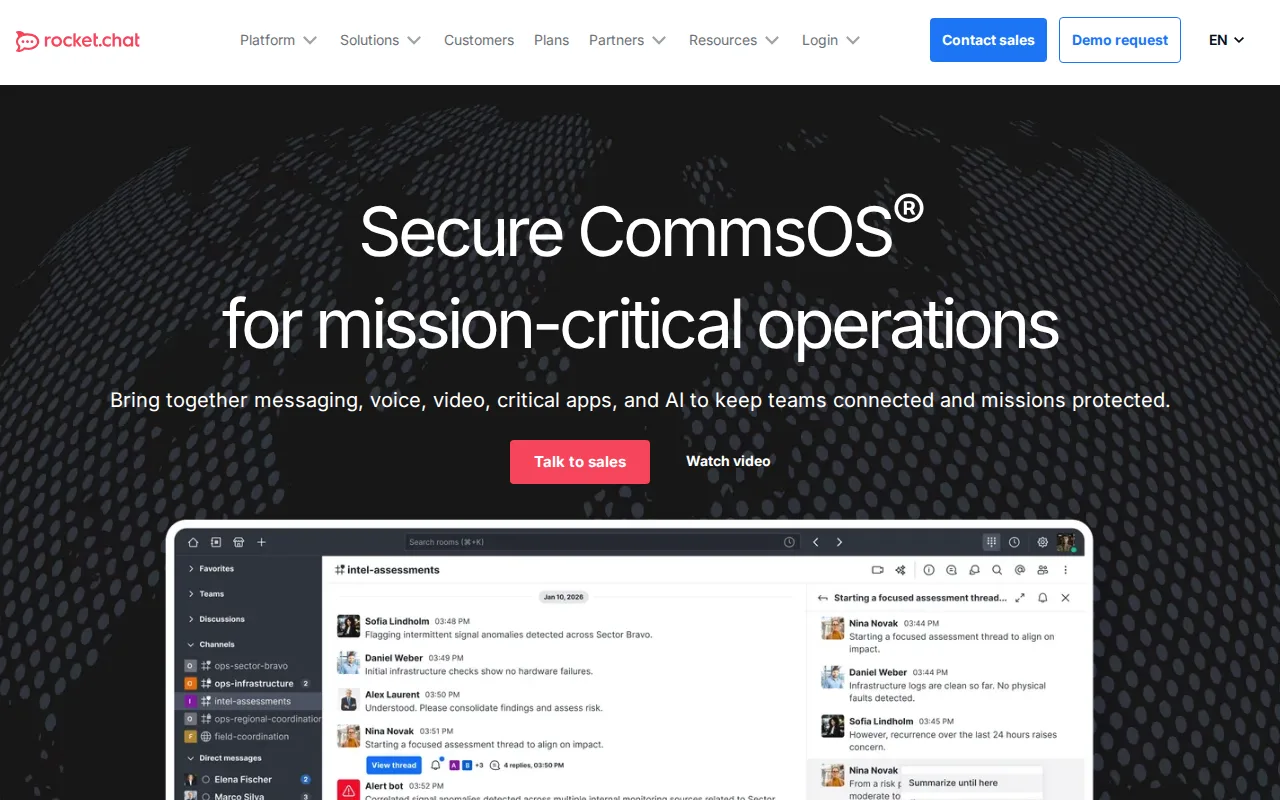
Rocket.Chat is the best Zulip alternative for teams that want a free, self-hosted platform under a permissive MIT license rather than Zulip's Apache 2.0 license, with over 46,000 GitHub stars on its Community Edition. Both products' self-hosted cores are free with no user limit, but Rocket.Chat's Community Edition includes unified messaging, voice, video, and screen sharing out of the box, a broader real-time communication scope than Zulip's channel-and-topic text focus. Rocket.Chat's paid Commercial, Government, and Defense tiers all require a custom quote with no published pricing, the same transparency gap as several other self-hosted competitors, while Zulip's Cloud Standard ($6.67/user/month) and Cloud Plus ($10/user/month) prices are published outright. Rocket.Chat holds a 4.3/5 rating from 156 Capterra reviews, a smaller sample than Zulip's own 196 reviews at a lower 4.3 vs 4.9 score. Rocket.Chat also offers federated communications letting separate deployments message across organizational boundaries, a capability not documented for Zulip. Zulip is still the better choice for teams that specifically want organized, threaded conversations: Rocket.Chat has no direct equivalent to Zulip's topic-based threading for splitting many parallel discussions within a single channel, and self-hosting Rocket.Chat's Community Edition adds the same administration and infrastructure overhead as self-hosting Zulip.
Compared to Zulip: MIT-licensed self-hosted Community Edition (46,000+ GitHub stars) vs Zulip's Apache 2.0 license, unified messaging/voice/video/screen sharing out of the box, no published pricing on Commercial/Government/Defense tiers vs Zulip's listed Cloud prices
Wins:Community Edition is MIT-licensed with over 46,000 GitHub stars, a more permissive license than Zulip's Apache 2.0 · Unified messaging, voice, video, and screen sharing built into the free Community Edition, a broader real-time scope than Zulip's channel-and-topic text focus · Federated communications let separate Rocket.Chat deployments message across organizational boundaries, a capability not documented for Zulip
Loses:No published pricing for any paid tier; Commercial, Government, and Defense plans all require a sales conversation, unlike Zulip's listed $6.67/user/month Cloud Standard and $10/user/month Cloud Plus · 4.3/5 rating from 156 Capterra reviews, both a smaller sample and lower score than Zulip's 4.9/5 from 196 reviews · No direct equivalent to Zulip's topic-based threading for splitting many parallel discussions within a single channel
Pros
- Community Edition is free, open-source (MIT license), and self-hostable with no user limit.
- Deployment options span standard cloud hosting to fully air-gapped, classified environments.
- Federated communications let separate Rocket.Chat deployments message across organizational boundaries.
- Extensible via custom and pre-built apps, plus native voice, video, and screen sharing.
Cons
- No published list pricing for any paid tier; every quote requires a sales conversation.
- Self-hosting the Community Edition adds administration and infrastructure overhead compared to SaaS competitors.
- Government/Defense-specific features add complexity that most mainstream business customers won't need.
Pricing: Free — Free self-hosted Community Edition (no user limit) matches Zulip's free self-hosted tier; Rocket.Chat's paid tiers are unpublished vs Zulip's listed $6.67-$10/user/month Cloud pricing (verified undefined NaN, NaN)