3 Best Free Alternatives to Substack in 2026
By Noahlast updated pricing verified
Compared: free alternatives to Substack
| Alternative | Best for | Standout | Biggest weakness | Learning curve | Price |
|---|---|---|---|---|---|
| Substackreference | independent writers and journalists who want to monetize a newsletter with paid subscriptions without paying a monthly platform fee, in exchange for giving up 10% of revenue | A built-in discovery network (Notes and cross-publication recommendations) that helps new writers find their first paying subscribers without an existing email list. | Substack only supports Stripe for payment processing, which locks out writers in countries where Stripe isn't available, and the post editor lacks the formatting, HTML, and layout control of a dedicated CMS like WordPress or Ghost. | Low | Free |
| beehiiv | independent newsletter writers and small publishers who want built-in monetization (ad network, digital products) alongside a free tier up to 2,500 subscribers | A built-in Ad Network that connects publishers directly with sponsors inside the platform, letting writers monetize a free newsletter without arranging sponsorships manually. | The Ad Network, digital product sales, and email automations are all locked behind the $43/month Scale plan, and beehiiv's own branding stays on outgoing emails until the $96/month Max tier, which reviewers note as expensive for creators who haven't yet monetized their list. | Low | Free tier · paid from $43/mo |
| Ghost | independent writers, podcasters, and businesses who want to run a paid newsletter or membership site without giving up a revenue cut, and who are willing to self-host or pay for managed hosting | Native email newsletter delivery and Stripe-based paid memberships are built into the core product, and Ghost is fully self-hostable under an MIT license with no forced revenue share on subscriptions. | Self-hosting requires real server administration (Node.js, MySQL, and updates), and the managed Ghost(Pro) service has no permanent free tier; the Business plan jumps to $199/month once a publication passes 1,000-10,000 members, a steep step for growing creators. | Moderate | Free tier · paid from $18/mo |
| Patreon | creators (podcasters, YouTubers, writers, musicians, artists) who want to sell recurring paid membership tiers directly to their existing fan base instead of relying on ad revenue or one-off sales | Built-in recurring membership-tier infrastructure — billing, tier gating, community posts, and payouts — purpose-built for creators rather than adapted from a generic e-commerce or newsletter tool. | Fees compound against creators: the new flat 10% platform fee plus 2.9%+$0.30 payment processing (or 5%+$0.10 on small pledges) can take a meaningful cut of low-value memberships, and Trustpilot reviewers rate the overall support experience around 1.2/5, citing duplicate billing, account suspensions, and slow issue resolution. | Low | Free |
 Substack
 beehiiv
 Ghost
Ghost Patreon
1.beehiiv — best Substack alternative for independent newsletter writers and small publishers who want built-in monetization (ad network, digital products) alongside a free tier up to 2,500 subscribers
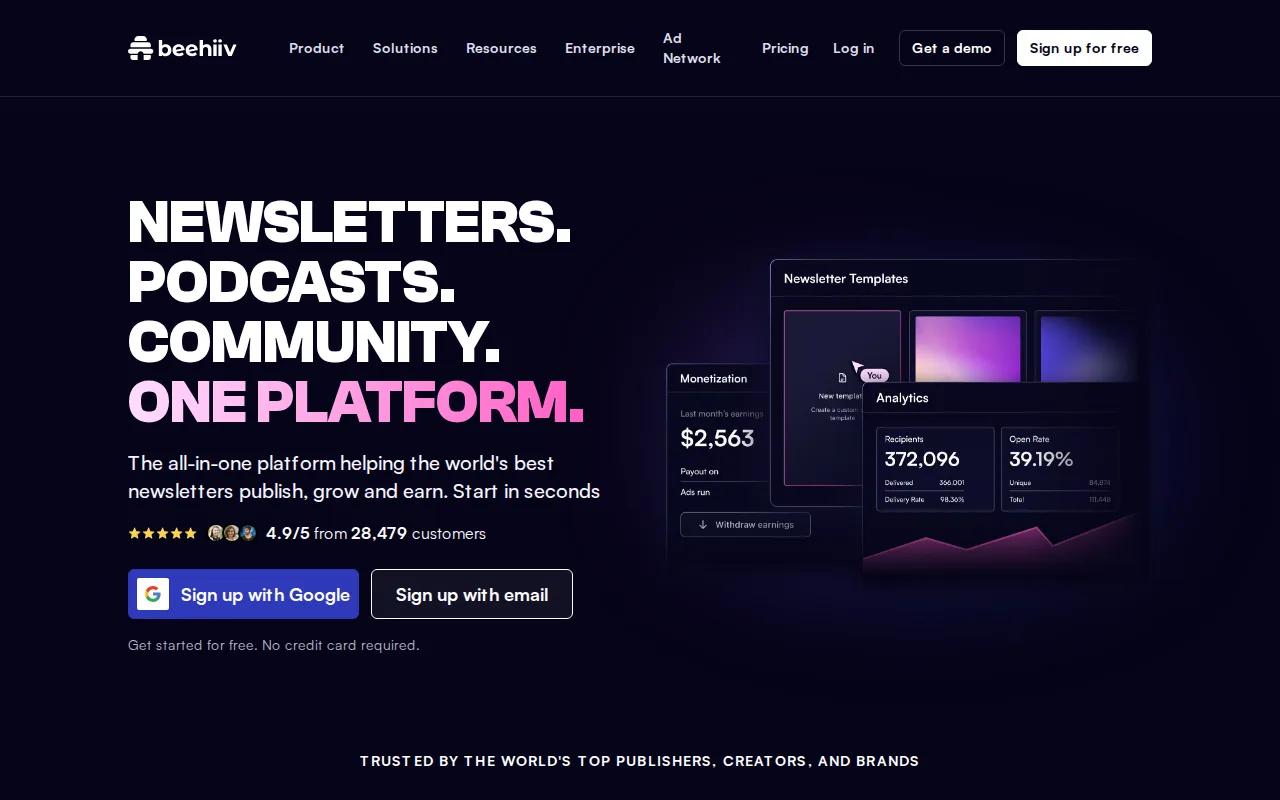
beehiiv is the best Substack alternative for writers who want to monetize a newsletter through sponsorships without arranging deals manually. beehiiv's free Launch plan covers up to 2,500 subscribers with unlimited email sends, a website, podcast hosting, and basic analytics, comparable to Substack's own free publishing tier. Where beehiiv differs is its built-in Ad Network, available on the $43/month Scale plan (billed at $517/year), which connects publishers directly with sponsors inside the platform, a monetization path Substack doesn't offer natively since Substack's own model is a 10% cut of paid-subscription revenue rather than sponsorship placement. beehiiv holds a 4.4/5 rating from 16 Capterra reviews, a larger sample than Substack's 3.8/5 from 13 Product Hunt reviews, though both remain small. Substack is still the better choice for writers who only want simple paid-subscription monetization without adopting a new pricing model: beehiiv's Ad Network, digital product sales, and automations all require the $43/month Scale plan, and beehiiv's own branding stays on outgoing emails until the $96/month Max tier, costs a writer earning nothing doesn't have to weigh against Substack's pure percentage-of-revenue fee.
Compared to Substack: built-in Ad Network vs no sponsorship tooling, free tier capped at 2,500 subscribers vs Substack's uncapped free tier, flat $43/month Scale plan vs Substack's 10% revenue cut
Wins:Built-in Ad Network connects publishers directly with sponsors inside the platform, a monetization path Substack doesn't offer natively · Combines newsletter, website, podcast hosting, and digital product sales in one tool, beyond Substack's newsletter-and-website focus · 4.4/5 rating from 16 Capterra reviews vs Substack's 3.8/5 from 13 Product Hunt reviews
Loses:Free Launch plan caps at 2,500 subscribers, while Substack's free publishing tier has no subscriber cap · Ad Network, digital products, and automations all require the $43/month Scale plan, an added cost Substack doesn't impose since its fee is percentage-based · beehiiv's own branding stays on outgoing emails until the $96/month Max tier
Pros
- Free Launch plan supports up to 2,500 subscribers with unlimited sends and a full website, not just a stripped-down trial.
- Built-in Ad Network lets publishers monetize through sponsorships without a separate platform.
- Combines newsletter, website, podcast hosting, and digital product sales in one tool instead of several.
- Recommendation network helps new publications gain subscribers by cross-promoting with other beehiiv newsletters.
Cons
- Ad Network, digital products, and automations require the $43/month Scale plan, not available on the free tier.
- beehiiv branding remains on emails until the $96/month Max tier.
- Subscriber cap of 100,000 on Scale and Max means fast-growing publishers eventually need a custom Enterprise quote.
- Small third-party review base (16 Capterra reviews) makes it harder to gauge broad user sentiment compared to more established platforms.
Pricing: Free tier · paid from $43/mo — Free up to 2,500 subscribers, then $43/month Scale ($517/year) vs Substack's free publishing plus 10% cut of paid-subscription revenue (verified undefined NaN, NaN)
2.Ghost — best Substack alternative for independent writers, podcasters, and businesses who want to run a paid newsletter or membership site without giving up a revenue cut, and who are willing to self-host or pay for managed hosting
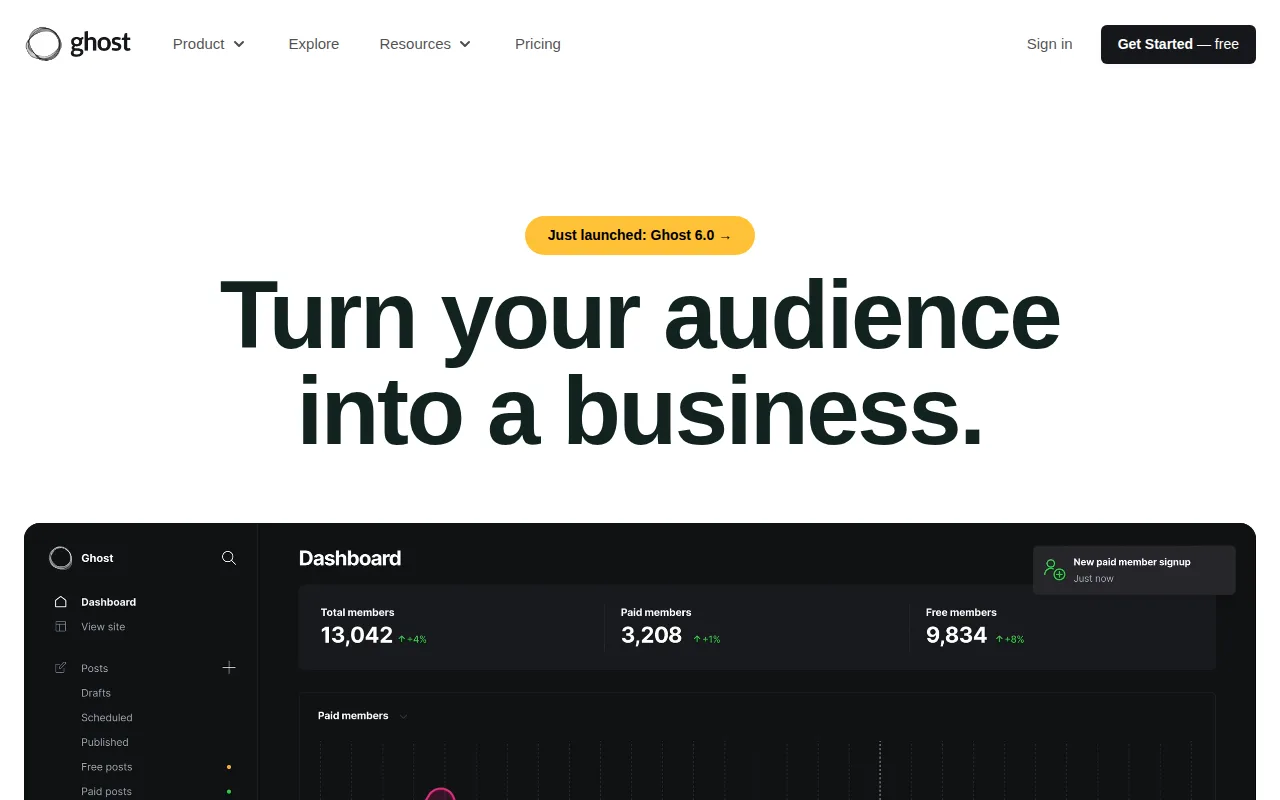
Ghost is the best Substack alternative for writers and businesses who want to avoid giving up any percentage of subscription revenue and are willing to self-host or pay a flat hosting fee instead. Ghost is fully open source under the MIT license and free to self-host on your own server, or available as the managed Ghost(Pro) service starting at $18/month billed yearly for the Starter plan (up to 1,000 members), rising to $199/month for Business (up to 10,000 members). Unlike Substack, which takes 10% of gross paid-subscription revenue plus Stripe's processing fee, Ghost(Pro) takes no cut of subscription revenue at all beyond its flat monthly hosting fee, so a writer with a large paid list keeps more per subscriber as revenue grows. Ghost holds a 4.4/5 rating from 21 Product Hunt reviews, more reviews than Substack's 3.8/5 from 13. Substack is still the better choice for writers who don't want to manage hosting or pay anything upfront: Ghost's self-hosted option requires running a Node.js server and MySQL database, a real technical barrier, and the managed Ghost(Pro) service has no permanent free tier, while Substack stays entirely free to publish until a writer actually earns paid-subscription revenue.
Compared to Substack: no revenue cut on subscriptions vs Substack's 10% fee, self-hostable under the MIT license vs a closed platform, Ghost(Pro) starts at $18/month vs Substack's free-until-you-earn model
Wins:Takes no percentage cut of subscription revenue on Ghost(Pro), vs Substack's 10% of gross paid-subscription revenue · Fully open source (MIT license) and self-hostable for free, an option Substack's closed platform doesn't offer · 4.4/5 rating from 21 Product Hunt reviews vs Substack's 3.8/5 from 13
Loses:Self-hosting requires managing a Node.js server and MySQL database, a real barrier compared to Substack's zero-setup publishing · No permanent free tier on managed Ghost(Pro); Starter costs $18/month billed yearly while Substack stays free until a writer earns paid-subscription revenue · Business tier jumps to $199/month once a publication needs up to 10,000 members, a steep step Substack's percentage-based fee doesn't impose at any size
Pros
- Fully open source under the MIT license, with the option to self-host at no cost.
- Native newsletter delivery and paid membership billing are built in, not third-party plugins.
- Ghost(Pro) takes no cut of subscription revenue beyond the flat monthly hosting fee.
- Custom domain and themes are included on Ghost(Pro) plans without extra add-on charges.
Cons
- Self-hosting requires managing a Node.js server and MySQL database, a real barrier for non-technical creators.
- No permanent free tier on the managed Ghost(Pro) service; pricing starts at $18/month billed yearly.
- Business tier jumps to $199/month, a large step up from Publisher's $29/month once member counts grow.
- Smaller theme and plugin ecosystem than WordPress, since Ghost is scoped specifically to publishing rather than general-purpose site building.
Pricing: Free tier · paid from $18/mo — Free to self-host, or Ghost(Pro) from $18/month billed yearly vs Substack's free publishing plus 10% cut of paid-subscription revenue (verified undefined NaN, NaN)
3.Patreon — best Substack alternative for creators (podcasters, YouTubers, writers, musicians, artists) who want to sell recurring paid membership tiers directly to their existing fan base instead of relying on ad revenue or one-off sales
Patreon is the best Substack alternative for creators who want to sell tiered membership perks like exclusive posts, community chats, and early access directly to fans, rather than gating individual newsletter posts. Patreon's built-in tier system, community feed, and payout tooling are purpose-built for recurring memberships, and the platform is free to set up, only charging once a creator earns. As of August 2025, new Patreon creators pay a flat 10% platform fee on membership revenue, matching Substack's own 10% cut of paid-subscription revenue, plus payment processing (2.9% + $0.30 per charge, or 5% + $0.10 on pledges under $3); creators who joined before August 4, 2025 can keep legacy rates as low as 5% if their page stays continuously published. Patreon also ships iOS and Android apps, platforms Substack covers as well. Substack is clearly the better choice for creators who care about vendor trust and support quality: Patreon's Trustpilot rating sits around 1.2/5 from over 800 reviews, driven by complaints about duplicate billing, account suspensions, and slow customer support, a reputation risk that doesn't show up anywhere in Substack's own review data.
Compared to Substack: tiered membership perks and a community feed vs single-tier paid posts, matching flat 10% platform fee for new creators, but a 1.2/5 Trustpilot rating from 800+ reviews
Wins:Built-in tiered membership system with community posts and perks, purpose-built for creators who want more than a single paid-subscription tier · Legacy creators who joined before August 2025 can keep a lower 5% platform fee, undercutting Substack's flat 10% cut · iOS and Android apps alongside the web, matching Substack's own three-platform coverage
Loses:Trustpilot rating around 1.2/5 from over 800 reviews, citing duplicate billing, account suspensions, and slow support, a reputation risk Substack's data doesn't show · New creators pay the same flat 10% platform fee as Substack, plus separate payment processing (2.9%+$0.30, or 5%+$0.10 on small pledges), so there's no fee advantage for creators who joined after August 2025 · iOS purchases are often routed through Apple's in-app purchase system, adding Apple's own cut on top of Patreon's fee, a complication Substack's Stripe-only model avoids
Pros
- No fee to sign up or browse; Patreon only takes a cut once a creator starts earning.
- Built-in tiered membership, community post, and payout tooling purpose-built for creators.
- iOS and Android apps in addition to the web, with mobile payouts gradually rolling out.
- Legacy creators who joined before August 2025 can keep a lower 5% platform fee.
Cons
- Trustpilot rating around 1.2/5 from 800+ reviews, with duplicate billing and slow customer support as recurring complaints.
- New creators pay a flat 10% platform fee plus separate payment processing (2.9%+$0.30, or 5%+$0.10 on small pledges).
- iOS purchases are often routed through Apple's in-app purchase system, adding Apple's own cut on top of Patreon's fee.
- Account suspensions are a frequently cited complaint, cutting off a creator's income with limited recourse reported by reviewers.
Pricing: Free — Flat 10% platform fee for new creators (same as Substack's 10% cut), or as low as 5% for legacy creators, plus payment processing on both platforms