1 Best Open-Source Alternatives to Slack in 2026
By Noahlast updated pricing verified
Compared: open-source alternatives to Slack
| Alternative | Best for | Standout | Biggest weakness | Learning curve | Price |
|---|---|---|---|---|---|
| Slackreference | teams that need organized, searchable chat with channels, quick huddles, and workflow automation, from small teams on the free tier up to large enterprises needing compliance controls | Channel-based organization combined with a massive third-party app ecosystem (1.7 million weekly active app integrations) and built-in AI search and summarization through Slackbot. | The Free plan's 90-day rolling message history forces most active teams onto a paid tier quickly, and compliance-critical features (SAML, data loss prevention, legal holds) are reserved for the custom-priced Enterprise+ tier rather than being available at Business+. | Low | Free tier · paid from $8.75/mo |
| Mattermost | regulated, government, or defense organizations that need self-hosted, air-gapped, or sovereign-cloud team chat with compliance controls a SaaS-only tool like Slack can't provide | Deployment flexibility for compliance-sensitive organizations: the same platform can run fully air-gapped or in a sovereign cloud with FIPS 140-3/STIG-hardened compliance options, not available from mainstream SaaS chat tools. | No paid tier publishes flat per-user pricing; Professional, Enterprise, and Enterprise Advanced all require a sales conversation and prepaid annual seat commitment, making it harder to budget or compare cost against competitors up front, and self-hosting the free core requires ongoing server maintenance. | Moderate | Free |
 Slack
Slack Mattermost
1.Mattermost — best Slack alternative for regulated, government, or defense organizations that need self-hosted, air-gapped, or sovereign-cloud team chat with compliance controls a SaaS-only tool like Slack can't provide
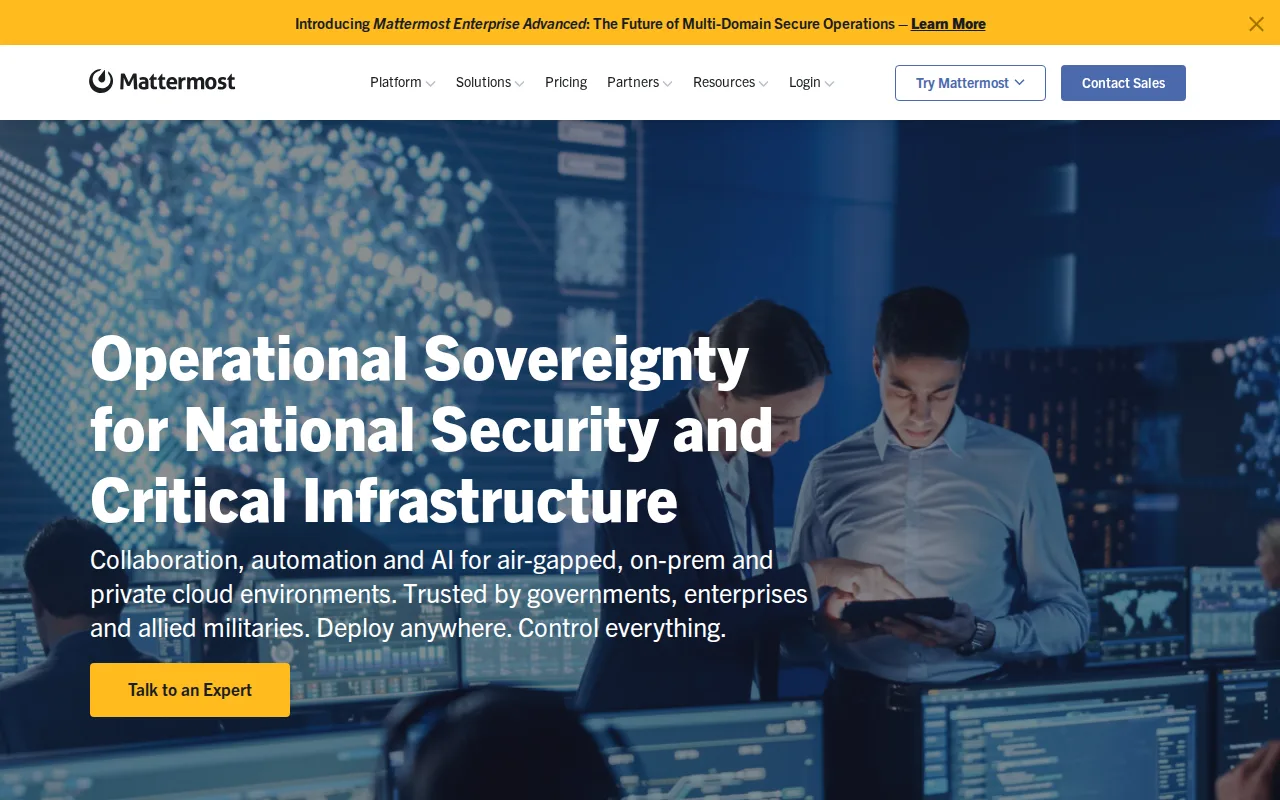
Mattermost is the best Slack alternative for regulated, government, or defense organizations that need self-hosted, air-gapped, or sovereign-cloud team chat, deployment options Slack's SaaS-only model can't provide at all. Mattermost's core is MIT-licensed and free to self-host with no per-user cap, versus Slack's cheapest paid tier at $8.75/user/month, and its Enterprise tier adds FIPS 140-3 and STIG-hardened compliance options used by customers including the U.S. Air Force and NASA. Its GitHub repository has nearly 39,000 stars, evidence of an actively maintained open-core project, though Mattermost's own external rating rests on just a single 5/5 Product Hunt review, far thinner evidence than Slack's 24,182 Capterra reviews. Slack is clearly the better choice for teams that want transparent, published per-seat pricing and a large third-party app ecosystem: none of Mattermost's paid tiers (Professional, Enterprise, Enterprise Advanced) publish flat per-user dollar pricing, all requiring a sales conversation and a prepaid annual commitment, and Mattermost's integration marketplace is far smaller than Slack's 1.7 million weekly active third-party app connections.
Compared to Slack: MIT-licensed self-hosted core is free with no user cap, adds FIPS 140-3/STIG compliance, but no paid tier publishes flat pricing
Wins:Self-hosted core is free (MIT-licensed) with no user cap, avoiding Slack's $8.75/user/month floor entirely · FIPS 140-3 and STIG-hardened compliance options plus air-gapped deployment, used by the U.S. Air Force and NASA · Full source code auditable on GitHub (nearly 39,000 stars), unlike Slack's closed-source model
Loses:No paid tier (Professional, Enterprise, Enterprise Advanced) publishes flat per-user pricing; all require a sales conversation · External rating rests on a single 5/5 Product Hunt review, far thinner evidence than Slack's 24,182 Capterra reviews · Smaller third-party app ecosystem than Slack's 1.7 million weekly active app integrations
Pros
- Self-hosted core is free (MIT-licensed) with no user limit, avoiding SaaS vendor lock-in.
- Deployment options (on-premise, private cloud, air-gapped) support compliance needs that pure-SaaS chat tools can't meet.
- Native apps across web, Windows, macOS, Linux, iOS, and Android.
- Open-core model means the underlying chat engine's code is auditable even though advanced features are commercially licensed.
Cons
- No published flat pricing for any paid tier; all require contacting sales and a prepaid annual commitment.
- Self-hosting the free core requires ongoing server maintenance, scaling, and upgrades.
- Advanced features (sovereign AI, high availability, air-gapped support) sit behind the commercial Enterprise license, not the open-source core.
- Smaller third-party app/integration ecosystem than Slack, which has a much larger app marketplace.
Pricing: Free (verified undefined NaN, NaN)