5 Best Alternatives to Proton VPN for iOS in 2026
By Noahlast updated
Compared: Proton VPN alternatives that run on iOS
| Alternative | Best for | Standout | Biggest weakness | Learning curve | Price |
|---|---|---|---|---|---|
| Proton VPNreference | privacy-conscious users and journalists who want an open-source, independently audited VPN with a genuinely unlimited-data free tier, or paid subscribers wanting 10-device coverage bundled with Proton's email and storage products | The free tier has no data cap, unlike most competitors' free plans, and VPN Accelerator claims up to a 400% speed boost over standard WireGuard on high-latency or lossy connections. | The free tier is capped at one device and a small pool of server locations, and users who only want a fast, single-purpose VPN end up paying for Mail, Drive, Pass, and Calendar features bundled into the higher-value Unlimited plan if they upgrade past VPN Plus. | Low | Free tier · paid from $4.99/mo |
| NordVPN | individuals wanting a fast, easy-to-set-up VPN with a large server network and native apps across desktop and mobile platforms | A very large global server network with consistently fast connection speeds, bundled with Threat Protection ad/malware blocking on every plan and optional password-manager, cloud-storage, and identity-protection add-ons. | The advertised low prices require committing to a 2-year term paid upfront; the standalone monthly plan costs roughly 4x more per month ($14.99 vs $3.49), and reviewers frequently complain about renewal prices jumping sharply once the promotional period ends, making it easy to be surprised by auto-renewal charges. | Low | From $3.49/mo |
| ExpressVPN | consumers who want a simple, reliable VPN that works out of the box across many device types (routers, smart TVs, browsers) without manual protocol configuration | The proprietary Lightway protocol combined with RAM-only "TrustedServer" infrastructure, so no user data is ever written to a physical disk on any server. | List price is high relative to most VPN competitors ($12.99/month for Basic billed monthly), and the low advertised per-month rates only apply on 1- or 2-year commitments with bundled bonus months, so the effective cost jumps sharply if a user doesn't pre-pay for a long term. | Low | From $2.79/mo |
| Mullvad | privacy-conscious individuals who want anonymous signup and a single flat-rate plan instead of tiered VPN pricing | Anonymous account-number signup with no email required, combined with cash or cryptocurrency payment options and a fully open-source, independently audited client. | No free tier and no long-term discount: the price is a flat €5/month whether paid monthly or in advance, so heavy multi-year commitments don't get cheaper the way many competitors' 2-3 year plans do. | Low | Custom pricing |
| Surfshark | individuals who want unlimited-device VPN coverage bundled with antivirus and identity-theft monitoring under one subscription, instead of paying for separate security tools | Unlimited simultaneous device connections on every plan, unusual among VPN providers that typically cap seats at 5-10 devices. | The advertised price requires paying for a full 24-month term upfront; the low headline rate doesn't apply to month-to-month billing, and published renewal prices after the initial discounted term are substantially higher. | Low | From $2.49/mo |
| Private Internet Access | privacy-focused users who want unlimited simultaneous device connections on a single no-logs VPN subscription at a lower price than premium competitors | Unlimited simultaneous device connections on one subscription, plus client apps (desktop, iOS, browser extensions) published as open source on GitHub under the MIT license. | PIA is owned by Kape Technologies, whose earlier history as adware maker Crossrider still draws skepticism from privacy-focused reviewers; the 1-year plan also renews at $49.99/year after a discounted $39.95 first year, a price jump new subscribers should plan for. | Low | From $2.03/mo |
 Proton VPN
 NordVPN
 ExpressVPN
 Mullvad
 Surfshark
 Private Internet Access
1.NordVPN — best Proton VPN alternative for individuals wanting a fast, easy-to-set-up VPN with a large server network and native apps across desktop and mobile platforms

NordVPN is the best Proton VPN alternative for individuals who want a very large global server network with consistently fast connection speeds and don't mind committing to a multi-year plan to get the lowest price. NordVPN's Basic tier costs $3.49/month on a 2-year plan, cheaper than Proton VPN's $4.99/month VPN Plus price, and NordVPN holds a 4.6/5 rating from 1,393 Capterra reviews, more review volume than Proton VPN's 44 Capterra reviews. Threat Protection ad and malware-domain blocking comes included on every NordVPN plan, matching Proton VPN's own built-in ad/malware blocker, and the Complete tier adds 1TB of encrypted cloud storage and the NordPass password manager for $4.49/month. Proton VPN is still the better choice for anyone who wants a genuinely unlimited-data free tier: NordVPN has no ongoing free plan at all, only a 3-day trial for new Android users, while Proton VPN's free tier has no data cap, and NordVPN's advertised low pricing requires a 2-year upfront commitment, with the standalone monthly plan costing roughly 4x more per month ($14.99 vs $3.49).
Compared to Proton VPN: cheaper on a 2-year plan ($3.49/mo vs $4.99/mo VPN Plus), higher Capterra review volume (1,393 vs 44 reviews), Complete tier bundles 1TB cloud storage and a password manager
Wins:Basic tier costs $3.49/month on a 2-year plan, cheaper than Proton VPN's $4.99/month VPN Plus · 4.6/5 rating from 1,393 Capterra reviews vs Proton VPN's 4.5/5 from 44 reviews · Complete tier bundles 1TB of encrypted cloud storage and the NordPass password manager for $4.49/month
Loses:No ongoing free tier at all, only a 3-day trial for new Android users, unlike Proton VPN's uncapped-data free plan · Advertised low pricing requires a 2-year upfront commitment; standalone monthly billing costs $14.99/month, roughly 4x more · Reviewers report occasional speed drops and some Windows app connectivity issues
Pros
- Large global server network with fast, reliable connection speeds.
- Native apps across Windows, macOS, Linux, iOS, and Android, plus browser extensions.
- Threat Protection ad/malware blocking included on every plan, not an upsell.
- 30-day money-back guarantee on all plans.
Cons
- Advertised low pricing requires a 2-year upfront commitment; monthly-only billing costs significantly more per month.
- Renewal pricing after the promotional period is a frequent source of user complaints.
- No ongoing free tier; only a 3-day trial for new Android users.
- Reviewers report occasional speed drops depending on server load and time of day, plus some Windows app connectivity issues.
Pricing: From $3.49/mo — $3.49/month Basic (2-year plan) vs Proton VPN's $4.99/month VPN Plus (billed annually)
2.ExpressVPN — best Proton VPN alternative for consumers who want a simple, reliable VPN that works out of the box across many device types (routers, smart TVs, browsers) without manual protocol configuration
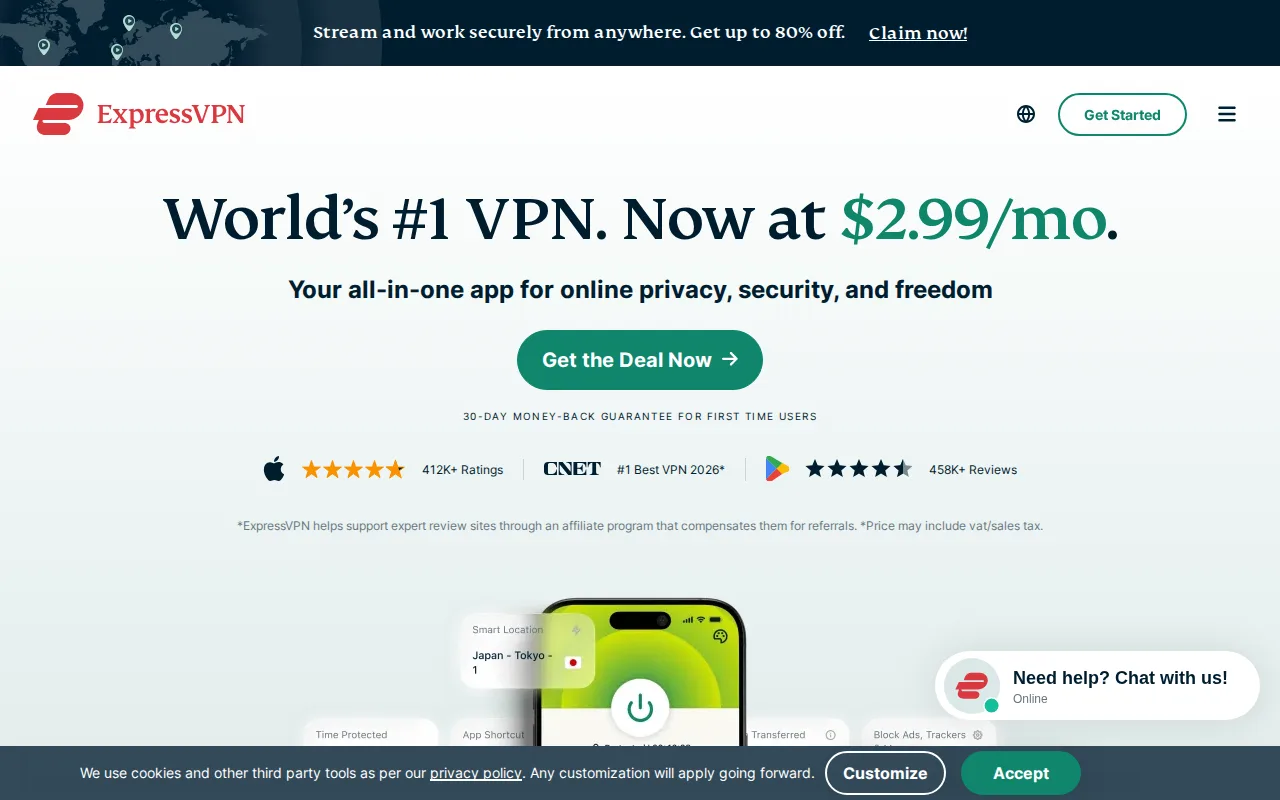
ExpressVPN is the best Proton VPN alternative for users who want a proprietary, speed-optimized protocol and hardware-level privacy guarantees on top of standard encryption. ExpressVPN's own Lightway protocol is designed for faster connection times than legacy protocols, and its TrustedServer technology runs every server on RAM-only disks so no data is ever written to a hard drive, a specific infrastructure claim Proton VPN's own listing doesn't make. ExpressVPN holds a 4.6/5 rating from 287 Capterra reviews, more review volume than Proton VPN's 44 Capterra reviews, and its lowest advertised rate on a 2-year plan is $2.79/month, cheaper than Proton VPN's $4.99/month VPN Plus. Proton VPN is still the better choice for anyone who wants a genuinely free, uncapped-data tier or a lower list price without a long commitment: ExpressVPN has no free tier at all, and its Basic plan billed monthly costs $12.99/month, well above Proton VPN's $4.99/month VPN Plus price, with the low $2.79/month rate only available on a 2-year prepaid term.
Compared to Proton VPN: RAM-only TrustedServer infrastructure with no data ever written to disk, cheaper on a 2-year plan ($2.79/mo vs $4.99/mo VPN Plus), higher Capterra review volume (287 vs 44 reviews)
Wins:RAM-only TrustedServer infrastructure means no user data is ever written to a physical disk on any server · 2-year plan rate of $2.79/month undercuts Proton VPN's $4.99/month VPN Plus price · 4.6/5 rating from 287 Capterra reviews vs Proton VPN's 4.5/5 from 44 reviews
Loses:No free tier at all, unlike Proton VPN's uncapped-data free plan · Monthly billing without a long-term commitment costs $12.99/month, well above Proton VPN's $4.99/month VPN Plus · Some reviewers report intermittent connection drops and slower performance when switching servers
Pros
- Independently audited no-logs policy and RAM-only server infrastructure for stronger privacy assurances.
- Proprietary Lightway protocol delivers faster connection times than legacy VPN protocols.
- Broad device and platform support, including routers, smart TVs, and browser extensions.
- 30-day money-back guarantee on all subscription terms.
Cons
- Monthly billing without a long-term commitment is notably more expensive than most competitors.
- No free tier; even a short trial requires payment upfront (refundable within 30 days).
- Some reviewers report intermittent connection drops and slower performance when switching servers.
- Pricing structure with bonus months and multiple simultaneous-connection tiers can be confusing to compare against flat-rate competitors.
Pricing: From $2.79/mo — $2.79/month Basic (2-year plan) vs Proton VPN's $4.99/month VPN Plus (billed annually)
3.Mullvad — best Proton VPN alternative for privacy-conscious individuals who want anonymous signup and a single flat-rate plan instead of tiered VPN pricing
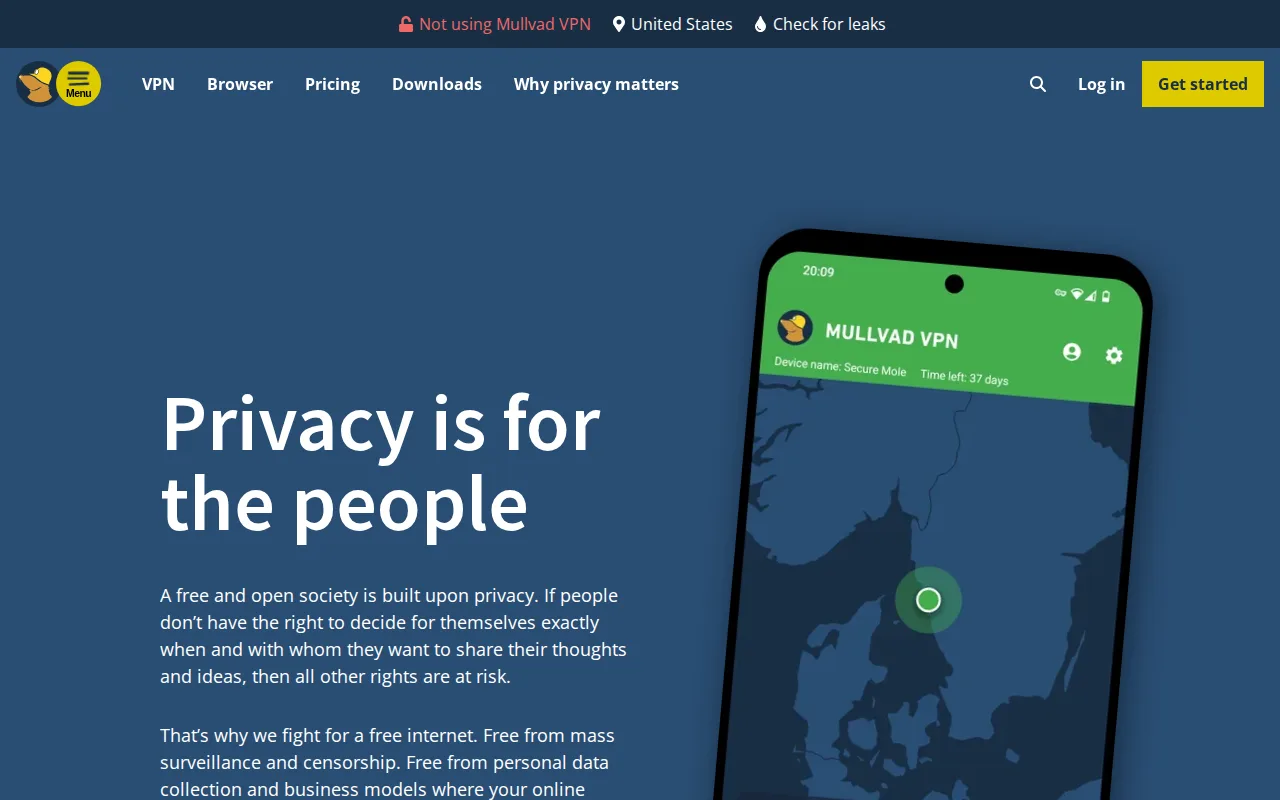
Mullvad is the best Proton VPN alternative for privacy-conscious users who want to sign up with no email address or personal information at all, generating a random account number instead, and pay with cash or cryptocurrency for full anonymity. Mullvad charges a single flat rate of €5/month (roughly $5.40) regardless of plan or commitment length, close to Proton VPN's $4.99/month VPN Plus price, with no tiers to compare. Both services publish fully open-source client apps for independent audit: Mullvad's under GPL-3.0 on GitHub, matching Proton VPN's own open-source, independently audited apps, and Mullvad adds DAITA traffic-analysis defense and quantum-resistant tunnel options beyond standard WireGuard. Proton VPN is still the better choice for anyone who wants a genuinely free tier or a discount for paying in advance: Mullvad has no free plan and no discount for annual or multi-year prepayment, unlike Proton VPN's uncapped-data free tier, and Mullvad's smaller server network can matter for streaming geo-unblocking, where Proton VPN's VPN Plus tier offers dedicated streaming-service unblocking.
Compared to Proton VPN: anonymous account-number signup with no email required, cash/cryptocurrency payment options, DAITA traffic-analysis defense and quantum-resistant tunnels beyond standard WireGuard
Wins:Anonymous signup with a random account number; no email or personal information required, unlike Proton VPN · Cash and cryptocurrency payment options for users who want to avoid linking a card to the account · DAITA traffic-analysis defense and quantum-resistant tunnel options beyond standard WireGuard
Loses:No free tier at all, unlike Proton VPN's uncapped-data free plan · No discount for paying annually or multi-year in advance, unlike many VPN competitors' longer-term plans · Smaller server network than large competitors, which can matter for streaming geo-unblocking that Proton VPN's VPN Plus specifically supports
Pros
- Anonymous signup with a random account number; no email or personal information required.
- Cash and cryptocurrency payment options for users who want to avoid linking a card to the account.
- Client apps are open source (GPL-3.0) and published on GitHub, with regular independent security audits.
- DAITA traffic-analysis defense and quantum-resistant tunnel options beyond standard WireGuard.
Cons
- No free tier; every user pays the same flat €5/month with no trial beyond the money-back guarantee window.
- No discount for paying annually or multi-year in advance, unlike competitors that cut price sharply on longer commitments.
- Smaller server network than large competitors like NordVPN or ExpressVPN, which can matter for streaming geo-unblocking.
- No bundled extras (password manager, ad blocker as a separate product, antivirus) that some competitors include in higher tiers.
Pricing: Custom pricing — Flat €5/month (~$5.40) vs Proton VPN's $4.99/month VPN Plus (verified undefined NaN, NaN)
4.Surfshark — best Proton VPN alternative for individuals who want unlimited-device VPN coverage bundled with antivirus and identity-theft monitoring under one subscription, instead of paying for separate security tools
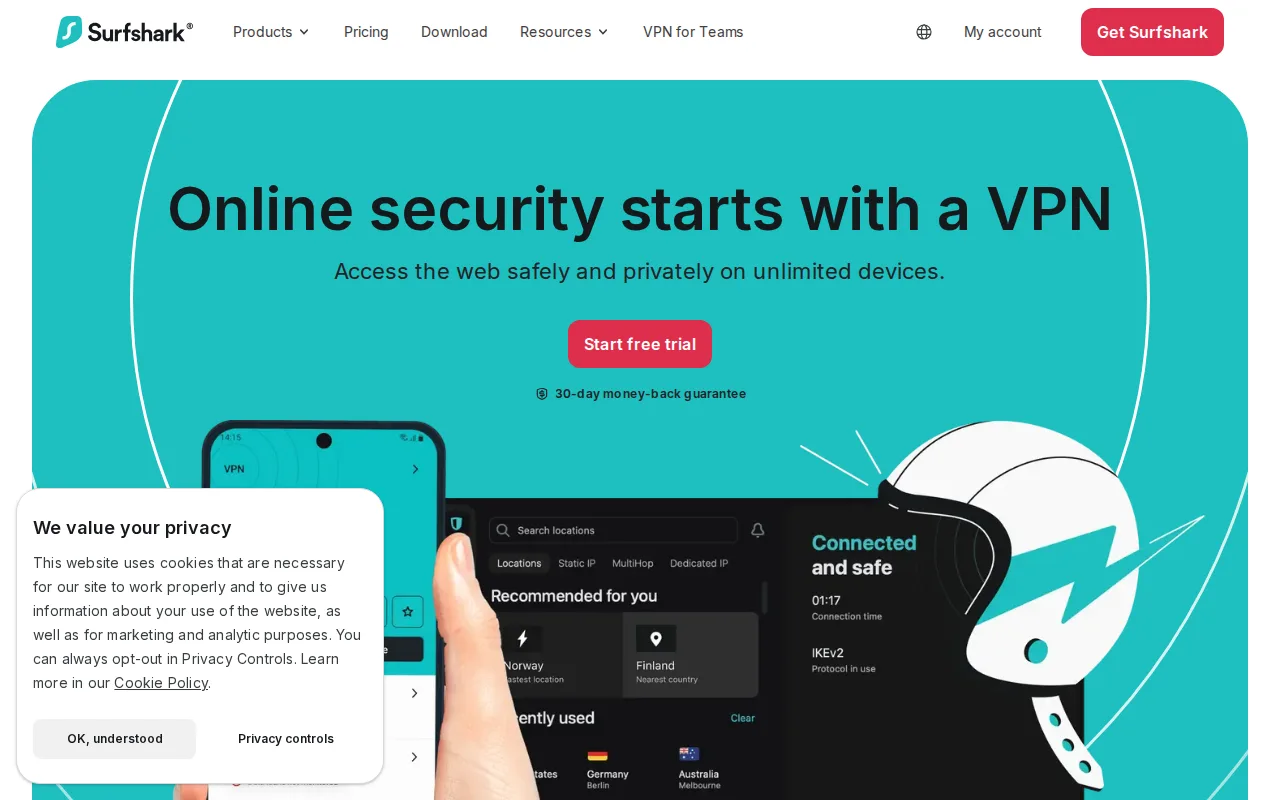
Surfshark is the best Proton VPN alternative for households or small teams who want unlimited simultaneous device connections on every plan, rather than Proton VPN's cap of 10 devices on VPN Plus. Surfshark's advertised rate on a 24-month term is $2.49/month, cheaper than Proton VPN's $4.99/month VPN Plus, and it bundles antivirus, breach alerts, and identity-theft coverage up to $1 million into the Surfshark One tier at no extra monthly cost. Surfshark holds a 4.5/5 rating from 61 Capterra reviews, close to Proton VPN's 4.5/5 from 44 reviews, and its network spans 4,500+ RAM-only servers across 100+ countries. Proton VPN is still the better choice for anyone who wants a genuinely free tier or straightforward monthly billing: Surfshark has no permanently free plan, and its lowest advertised price requires a full 24-month term paid upfront, with renewal pricing after that term reported as substantially higher, a pattern Proton VPN's simpler free-and-paid structure avoids.
Compared to Proton VPN: unlimited simultaneous device connections vs Proton VPN's 10-device cap on VPN Plus, cheaper on a 24-month plan ($2.49/mo vs $4.99/mo), bundled antivirus and $1M identity-theft coverage
Wins:Unlimited simultaneous device connections on every plan, versus Proton VPN VPN Plus's 10-device limit · 24-month plan rate of $2.49/month undercuts Proton VPN's $4.99/month VPN Plus price · Bundles antivirus, breach alerts, and identity-theft coverage up to $1M at no extra cost
Loses:No permanently free tier, unlike Proton VPN's uncapped-data free plan · Lowest advertised price requires a full 24-month term paid upfront · Renewal pricing after the initial discounted term is reported as materially higher
Pros
- Unlimited simultaneous device connections on every plan, with no per-device fee.
- 4,500+ RAM-only servers across 100+ countries with a no-logs policy.
- Bundles antivirus, breach alerts, and identity-theft coverage up to $1M instead of requiring separate subscriptions.
- 30-day money-back guarantee on all plans.
Cons
- Lowest advertised price requires a 24-month upfront commitment; monthly billing costs significantly more per month.
- Renewal pricing after the initial discounted term is materially higher, a common VPN-industry pattern that catches new subscribers off guard.
- No permanently free tier.
Pricing: From $2.49/mo — $2.49/month Starter/One (24-month plan) vs Proton VPN's $4.99/month VPN Plus (billed annually) (verified undefined NaN, NaN)
5.Private Internet Access — best Proton VPN alternative for privacy-focused users who want unlimited simultaneous device connections on a single no-logs VPN subscription at a lower price than premium competitors
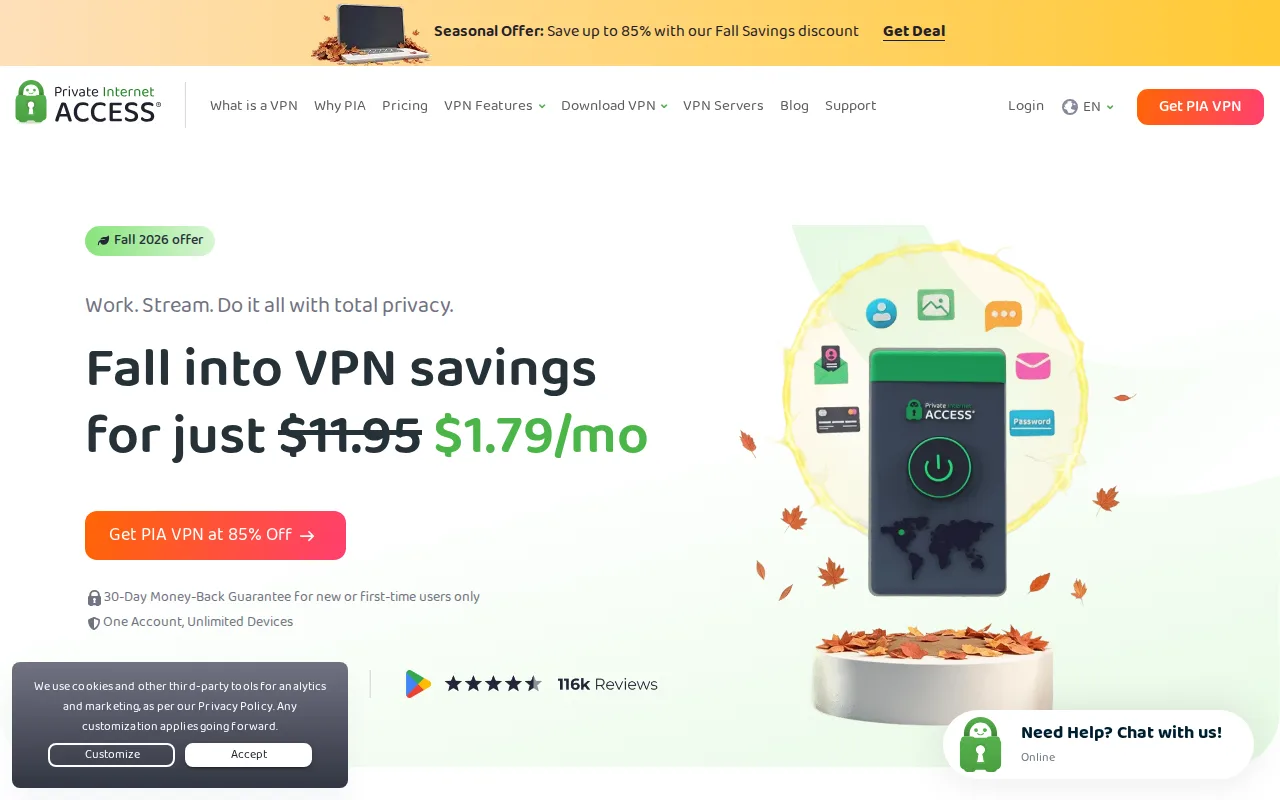
Private Internet Access (PIA) is the best Proton VPN alternative for users who want open-source client apps and unlimited simultaneous device connections on a single subscription, at a lower long-term price than Proton VPN's VPN Plus tier. PIA's 1-year plan works out to an effective $3.33/month, cheaper than Proton VPN's $4.99/month VPN Plus, and its no-logs policy has been independently audited by Deloitte, matching the third-party-audit standard Proton VPN's own open-source apps rely on. PIA's desktop, iOS, and browser-extension apps are published as open source on GitHub under the MIT license, and every plan allows unlimited simultaneous device connections rather than the 10-device cap on Proton VPN's VPN Plus tier. Proton VPN is still the better choice for anyone who wants a genuinely free tier or a cleaner ownership history: PIA has no free plan at all, unlike Proton VPN's uncapped-data free tier, and PIA is owned by Kape Technologies, whose earlier history as adware maker Crossrider still draws skepticism from some privacy-focused reviewers, a trust concern Proton VPN's Swiss, Proton AG ownership doesn't carry.
Compared to Proton VPN: cheaper on a 1-year plan ($3.33/mo vs $4.99/mo VPN Plus), unlimited simultaneous device connections vs a 10-device cap, Deloitte-audited no-logs policy
Wins:1-year plan works out to an effective $3.33/month, cheaper than Proton VPN's $4.99/month VPN Plus · Unlimited simultaneous device connections on a single subscription, versus Proton VPN VPN Plus's 10-device cap · No-logs policy independently audited by Deloitte, with desktop and browser-extension apps open source under MIT license
Loses:No free tier at all, unlike Proton VPN's uncapped-data free plan · Owned by Kape Technologies, whose earlier history as adware maker Crossrider draws skepticism from some privacy-focused reviewers · 1-year plan price jumps from $39.95 to $49.99 upon renewal after the first year
Pros
- Unlimited simultaneous device connections on a single subscription.
- Desktop, iOS, and browser extension client apps are open source under MIT license.
- Supports WireGuard and OpenVPN, split tunneling, and multi-hop routing.
- No-logs policy has been independently audited by Deloitte.
Cons
- Kape Technologies' ownership history (formerly adware maker Crossrider) is a trust concern some privacy-focused users raise.
- The 1-year plan's price jumps from $39.95 to $49.99 upon renewal after the first year.
- MACE ad/tracker blocker and dedicated IP are separate features, not a full replacement for a dedicated ad blocker.
Pricing: From $2.03/mo — $3.33/month effective (1-year plan) vs Proton VPN's $4.99/month VPN Plus (billed annually) (verified undefined NaN, NaN)