1 Best Open-Source Alternatives to Outlook in 2026
By Noahlast updated pricing verified
Compared: open-source alternatives to Outlook
| Alternative | Best for | Standout | Biggest weakness | Learning curve | Price |
|---|---|---|---|---|---|
| Outlookreference | individuals who want a free, ad-supported webmail and calendar client, with the option to upgrade to an ad-free inbox, larger storage, and Copilot AI through a Microsoft 365 subscription | Unified email, calendar, contacts, and (on Microsoft 365 plans) Copilot AI drafting in one interface, tightly integrated with Word, Excel, and Teams rather than functioning as a standalone mail app. | The standalone, low-cost Outlook.com Premium subscription was discontinued for new users in 2017, so removing ads and getting 100GB of storage now requires a full Microsoft 365 subscription starting at $9.99/month rather than a cheaper email-only upgrade; reviewers also report slowdowns and sync issues with large inboxes and unreliable attachment search. | Low | Free tier · paid from $9.99/mo |
| Proton Mail | privacy-conscious individuals, journalists, and small teams who want end-to-end encrypted email with open-source, independently audited clients rather than a mainstream provider that can technically read stored mail | Zero-access encryption paired with open-source, independently audited client apps, so Proton itself cannot decrypt a Mail Plus or Unlimited inbox even under legal compulsion. | The free tier caps storage at just 1 GB and one address, and the higher-value Unlimited and Family tiers bundle VPN, Drive, and Pass features that email-only switchers may not need, pushing the effective per-mailbox cost above single-purpose providers like Fastmail. | Low | Free tier · paid from $3.99/mo |
 Outlook
 Proton Mail
1.Proton Mail — best Outlook alternative for privacy-conscious individuals, journalists, and small teams who want end-to-end encrypted email with open-source, independently audited clients rather than a mainstream provider that can technically read stored mail
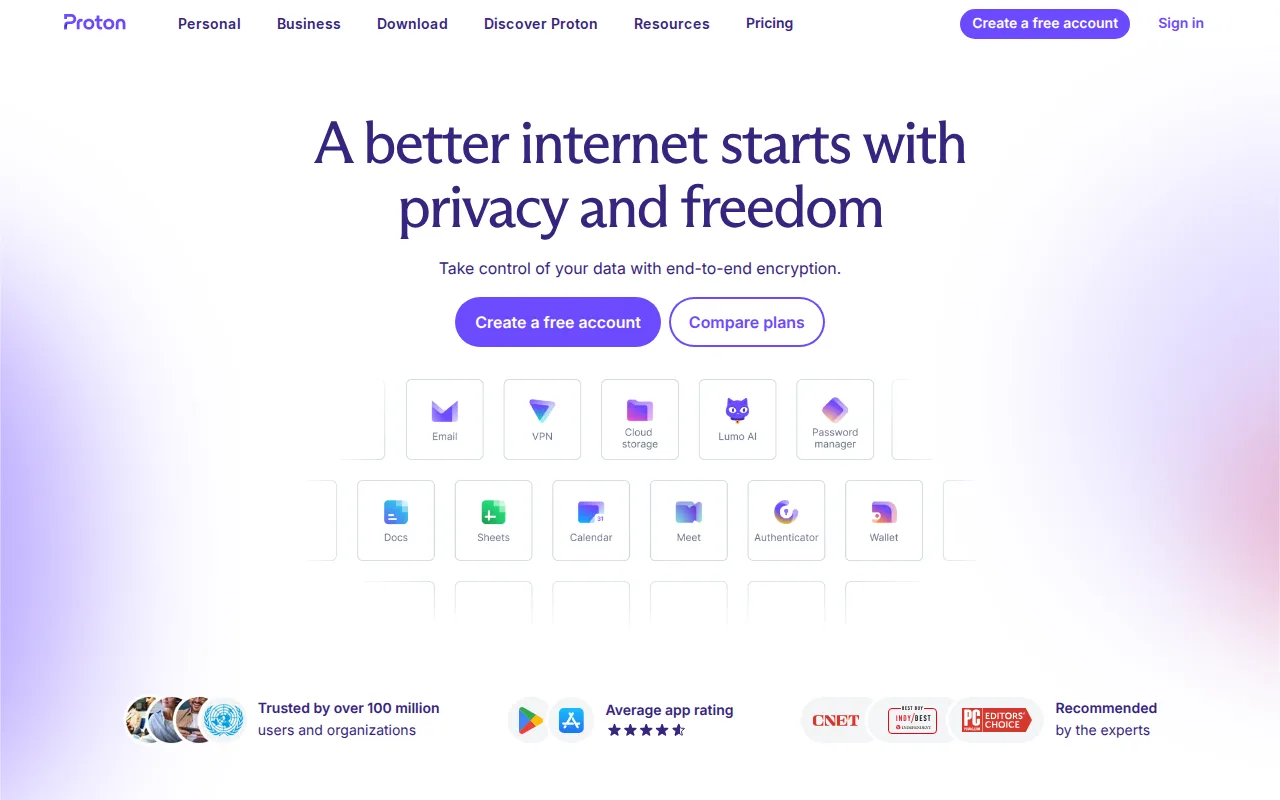
Proton Mail is the best Outlook alternative for privacy-conscious individuals, journalists, and small teams who want end-to-end and zero-access encryption rather than Outlook's standard, non-encrypted-by-default mailbox. Proton Mail's zero-access encryption means Proton itself cannot read message content on any paid plan, a guarantee Outlook's listing does not make, and its client apps across web, Windows, macOS, Linux, iOS, and Android are open source and independently audited. Proton Mail's free tier costs $0/month with 1GB storage and one address, while its Mail Plus tier runs $3.99/month billed annually for 15GB, 10 aliases, and a custom domain, cheaper than Outlook's $9.99/month Microsoft 365 Personal, the only route to an ad-free, larger-storage Outlook inbox. Proton Mail holds a 4.5/5 rating from 122 Capterra reviews, close to Outlook's 4.5/5 from 2,501 reviews though on a much smaller review base. No phone number is required to sign up for Proton Mail, and Swiss jurisdiction keeps it outside US/EU data-sharing agreements. Outlook remains the better choice for users who need deep Word, Excel, and Teams integration or don't want to pay from day one for privacy features: Proton Mail's free tier caps out at just 1GB and one address, far smaller than Outlook.com's free ad-supported storage allotment, and higher Proton tiers bundle VPN, Drive, and Pass, which raises the effective cost for anyone who only wants email.
Compared to Outlook: zero-access encryption on every paid plan vs Outlook's standard non-encrypted-by-default mailbox, Mail Plus at $3.99/month vs Outlook's $9.99/month Microsoft 365 Personal for an ad-free inbox, 4.5/5 rating from 122 Capterra reviews vs Outlook's 4.5/5 from 2,501 reviews on a much larger base
Wins:Zero-access encryption means Proton cannot read message content on any paid plan, a guarantee Outlook's listing doesn't make · Mail Plus tier costs $3.99/month billed annually, well below the $9.99/month Microsoft 365 subscription Outlook requires to go ad-free · Open-source, independently audited client apps across web, desktop, iOS, and Android
Loses:Free tier caps storage at just 1GB and one address, smaller than Outlook.com's free ad-supported storage allotment · 4.5/5 rating rests on only 122 Capterra reviews, versus Outlook's 2,501, a far smaller evidence base · Higher Unlimited and Family tiers bundle VPN, Drive, and Pass, raising the effective cost for email-only switchers
Pros
- Zero-access encryption means Proton cannot read message content on any paid plan.
- Open-source, independently audited client apps across web, desktop, iOS, and Android.
- No phone number required to sign up, and Swiss jurisdiction outside US/EU data-sharing agreements.
- Bridge app connects Proton Mail to standard IMAP clients like Outlook or Apple Mail on Mail Plus and up.
Cons
- Free tier is limited to 1 GB storage and a single email address.
- Higher tiers bundle VPN, Drive, and Pass, which raises the effective price for users who only want email.
- Custom domain support starts at just 1 domain on Mail Plus, fewer than some business-focused competitors.
Pricing: Free tier · paid from $3.99/mo — $3.99/month (Mail Plus, annual) vs Outlook's $9.99/month (Microsoft 365 Personal) for an ad-free, larger-storage inbox