4 Best Free Alternatives to Ko-fi in 2026
By Noahlast updated
Compared: free alternatives to Ko-fi
| Alternative | Best for | Standout | Biggest weakness | Learning curve | Price |
|---|---|---|---|---|---|
| Ko-fireference | individual creators (artists, musicians, podcasters, writers) who want to combine one-off tips, a small digital/physical goods shop, and memberships on one page without separate tools for each | Zero platform fee on tips and donations even on the free plan, unlike most competitors that take a cut of every transaction type regardless of tier. | The free plan's 5% fee on shop sales, memberships, and commissions (plus separate payment processing) stacks up for creators whose revenue is mostly commercial rather than tips, and there is no official mobile app, only a pinned web page, which limits on-the-go management compared to competitors with native apps. | Low | Free tier · paid from $12/mo |
| Patreon | creators (podcasters, YouTubers, writers, musicians, artists) who want to sell recurring paid membership tiers directly to their existing fan base instead of relying on ad revenue or one-off sales | Built-in recurring membership-tier infrastructure — billing, tier gating, community posts, and payouts — purpose-built for creators rather than adapted from a generic e-commerce or newsletter tool. | Fees compound against creators: the new flat 10% platform fee plus 2.9%+$0.30 payment processing (or 5%+$0.10 on small pledges) can take a meaningful cut of low-value memberships, and Trustpilot reviewers rate the overall support experience around 1.2/5, citing duplicate billing, account suspensions, and slow issue resolution. | Low | Free |
| Substack | independent writers and journalists who want to monetize a newsletter with paid subscriptions without paying a monthly platform fee, in exchange for giving up 10% of revenue | A built-in discovery network (Notes and cross-publication recommendations) that helps new writers find their first paying subscribers without an existing email list. | Substack only supports Stripe for payment processing, which locks out writers in countries where Stripe isn't available, and the post editor lacks the formatting, HTML, and layout control of a dedicated CMS like WordPress or Ghost. | Low | Free |
| Gumroad | solo creators and small teams selling digital downloads, courses, or paid memberships who want to start selling today without a subscription commitment | No monthly subscription cost combined with Gumroad acting as merchant of record, so it collects and remits sales tax and VAT globally on the creator's behalf. | Rated 'Bad' on Trustpilot by hundreds of sellers over payouts held or accounts suspended without warning, often triggered automatically by a single buyer chargeback; per-transaction fees (up to 30% via Discover) run higher than a flat monthly SaaS fee once sales volume is high. | Low | Free |
| Buy Me a Coffee | solo creators — artists, podcasters, writers, developers — who want tips, memberships, and a small digital shop on one page without paying a monthly platform subscription | One page carries one-time tips, unlimited membership tiers, and an unlimited-product shop, and supporters can pay in one tap with a card, Apple Pay, Google Pay, or Cash App without creating an account. | The 5% platform fee is permanent — there is no paid plan that buys it down, so a creator earning $2,000 a month hands over $100 before Stripe's 2.9% + $0.30 per charge, 0.5% payout fee, and the extra 1% on international payments, while Ko-fi sells a $12/month plan that removes its equivalent fee entirely. Payouts also run only through Stripe, so creators in countries Stripe does not serve cannot get paid at all. | Low | Free |
 Ko-fi
Ko-fi Patreon
 Substack
 Gumroad
 Buy Me a Coffee
1.Patreon — best Ko-fi alternative for creators (podcasters, YouTubers, writers, musicians, artists) who want to sell recurring paid membership tiers directly to their existing fan base instead of relying on ad revenue or one-off sales
Patreon is the best Ko-fi alternative for creators whose income comes from recurring memberships rather than one-off tips. Ko-fi bolts memberships onto a tip page; on Patreon, tiered subscriptions are the product, with billing, tier gating, a community post feed, and payouts built around them. Patreon also closes Ko-fi's most concrete platform gap: Patreon ships native iOS and Android apps, while Ko-fi is web-only, with mobile access limited to a page pinned to a phone's home screen. On fees the comparison is unambiguous, and it favors Ko-fi. New creators joining Patreon after August 2025 pay a flat 10% platform fee on membership revenue plus processing (2.9% + $0.30, or 5% + $0.10 on pledges under $3), so $1,000 of monthly membership revenue costs $100 in platform fees. The same $1,000 costs $50 on Ko-fi's free plan and $12 with Ko-fi Gold, or $6/month billed annually. Ko-fi is the better choice for most small creators for that reason alone, and the support record reinforces it: Patreon's Trustpilot rating sits around 1.2/5 from 800+ reviews citing duplicate billing, account suspensions, and slow support, against roughly 4/5 from 700+ Trustpilot reviews for Ko-fi. Patreon earns the top slot here on membership infrastructure and audience, not on price.
Compared to Ko-fi: purpose-built tiered membership infrastructure instead of memberships bolted onto a tip page, native iOS and Android apps where Ko-fi is web-only, and a flat 10% platform fee where Ko-fi takes 0% on tips and 5% on membership revenue
Wins:Membership tiers, gating, community posts, and payouts are the core product rather than an add-on to a tip page · Native iOS and Android apps alongside the web, closing Ko-fi's gap of having no official mobile app at all · No monthly software fee — Patreon only earns once a creator earns — and creators who joined before August 4, 2025 keep a legacy rate as low as 5%
Loses:New creators pay a flat 10% platform fee, double Ko-fi's 5% commercial rate and far above Ko-fi's 0% on tips: $1,000/month costs $100 against $50 on Ko-fi free or $12 with Ko-fi Gold · Small pledges are hit hardest, since processing runs 5% + $0.10 on pledges under $3 on top of the 10% platform fee, and iOS purchases are often routed through Apple's in-app purchase system, adding Apple's cut · Patreon's Trustpilot rating is around 1.2/5 from 800+ reviews over duplicate billing, account suspensions, and slow support, against roughly 4/5 from 700+ Trustpilot reviews for Ko-fi
Pros
- No fee to sign up or browse; Patreon only takes a cut once a creator starts earning.
- Built-in tiered membership, community post, and payout tooling purpose-built for creators.
- iOS and Android apps in addition to the web, with mobile payouts gradually rolling out.
- Legacy creators who joined before August 2025 can keep a lower 5% platform fee.
Cons
- Trustpilot rating around 1.2/5 from 800+ reviews, with duplicate billing and slow customer support as recurring complaints.
- New creators pay a flat 10% platform fee plus separate payment processing (2.9%+$0.30, or 5%+$0.10 on small pledges).
- iOS purchases are often routed through Apple's in-app purchase system, adding Apple's own cut on top of Patreon's fee.
- Account suspensions are a frequently cited complaint, cutting off a creator's income with limited recourse reported by reviewers.
Pricing: Free — Flat 10% of membership revenue for new creators with no monthly fee vs Ko-fi's 0% on tips and 5% on memberships, or $12/month for Ko-fi Gold ($6/month billed annually) at 0%
2.Substack — best Ko-fi alternative for independent writers and journalists who want to monetize a newsletter with paid subscriptions without paying a monthly platform fee, in exchange for giving up 10% of revenue
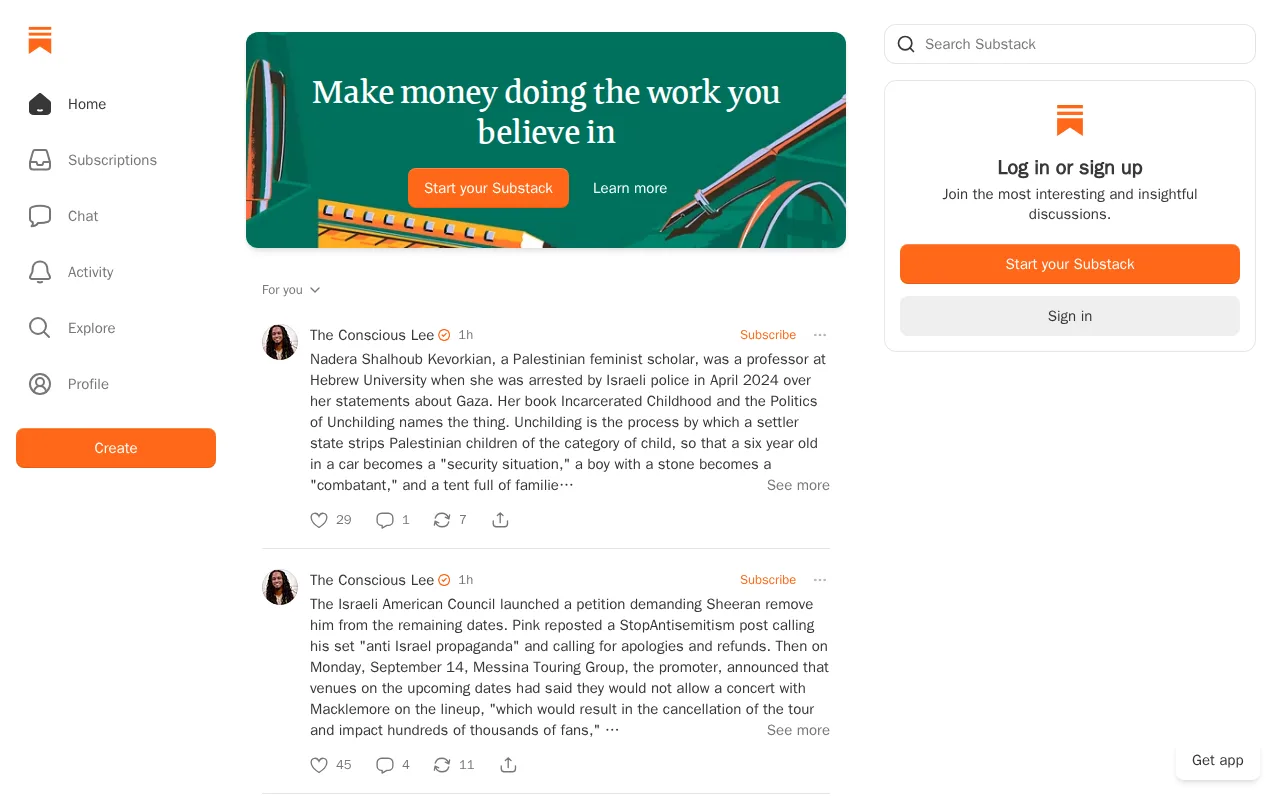
Substack is the best Ko-fi alternative for creators whose product is writing sent by email. Ko-fi can post supporter-only updates on Ko-fi Gold, but Substack is a full newsletter platform: a built-in editor, email delivery, a hosted site on a custom domain, podcast hosting, live chat, and free plus paid tiers on one publication. Its real edge over Ko-fi is discovery. The Notes feed and cross-publication recommendation network help a writer find paying subscribers without an existing list, where Ko-fi's own listing concedes that most Ko-fi traffic has to come from a creator's existing following. Substack holds 3.8/5 from 13 Product Hunt reviews, too thin a sample to weigh against Ko-fi's roughly 4/5 from 700+ Trustpilot reviews. Ko-fi is still cheaper for anyone already earning. Substack takes 10% of gross paid-subscription revenue plus Stripe's 2.9% + $0.30, so a writer charging $10/month keeps about $8.40 per subscriber, and $1,000/month of subscription revenue costs $100 in platform fees against $50 on Ko-fi's free plan or $12 with Ko-fi Gold. Substack is also Stripe-only, which locks out writers in countries Stripe doesn't serve, where Ko-fi supports both Stripe and PayPal, and its editor has limited layout control and no custom HTML.
Compared to Ko-fi: a full newsletter platform with email delivery, a hosted site, and podcast hosting instead of supporter-only posts, a built-in discovery network where Ko-fi admits traffic must come from your existing following, and a 10% cut of subscription revenue where Ko-fi takes 5% or $12/month for Gold
Wins:Complete newsletter stack — built-in editor, email delivery, hosted site on a custom domain, podcast hosting, and live chat — with no add-on fees, none of which Ko-fi offers · Built-in discovery through Notes and cross-publication recommendations, which addresses the low discoverability Ko-fi names as its own con · Writers own the subscriber list outright and can export it at any time, and one publication runs free and paid tiers side by side so the free list becomes the paid one, where Ko-fi has no email-marketing product at all
Loses:Takes 10% of gross paid-subscription revenue plus Stripe's 2.9% + $0.30, so $1,000/month costs $100 against $50 on Ko-fi's free plan and $12 with Ko-fi Gold · Stripe-only payment processing excludes writers in countries where Stripe doesn't operate, while Ko-fi supports both Stripe and PayPal · The editor has limited layout control and no custom HTML, and Substack has no shop or commissions mechanic, where Ko-fi runs tips, shop, memberships, and commissions on one page
Pros
- No monthly fee; Substack only makes money when a writer earns paid-subscription revenue.
- Writers keep full ownership of their subscriber list and can export it to another platform at any time.
- Built-in discovery through Notes and cross-publication recommendations helps new writers find readers.
- Free and paid tiers, live chat, and podcast hosting are included on every publication with no add-on fees.
Cons
- 10% platform fee plus Stripe processing costs eat into revenue at every price point, more expensive at scale than flat-fee platforms like Ghost.
- Payment processing is Stripe-only, excluding writers in countries where Stripe doesn't operate.
- The post editor is basic: limited layout control, no custom HTML, fewer formatting options than WordPress or Ghost.
- Established writers with large paid lists often migrate to flat-fee platforms once the percentage cut exceeds a fixed subscription cost.
Pricing: Free — 10% of gross paid-subscription revenue plus Stripe fees, with no monthly fee, vs Ko-fi's 5% on membership revenue or $12/month for Ko-fi Gold ($6/month billed annually) at 0% (verified undefined NaN, NaN)
3.Gumroad — best Ko-fi alternative for solo creators and small teams selling digital downloads, courses, or paid memberships who want to start selling today without a subscription commitment
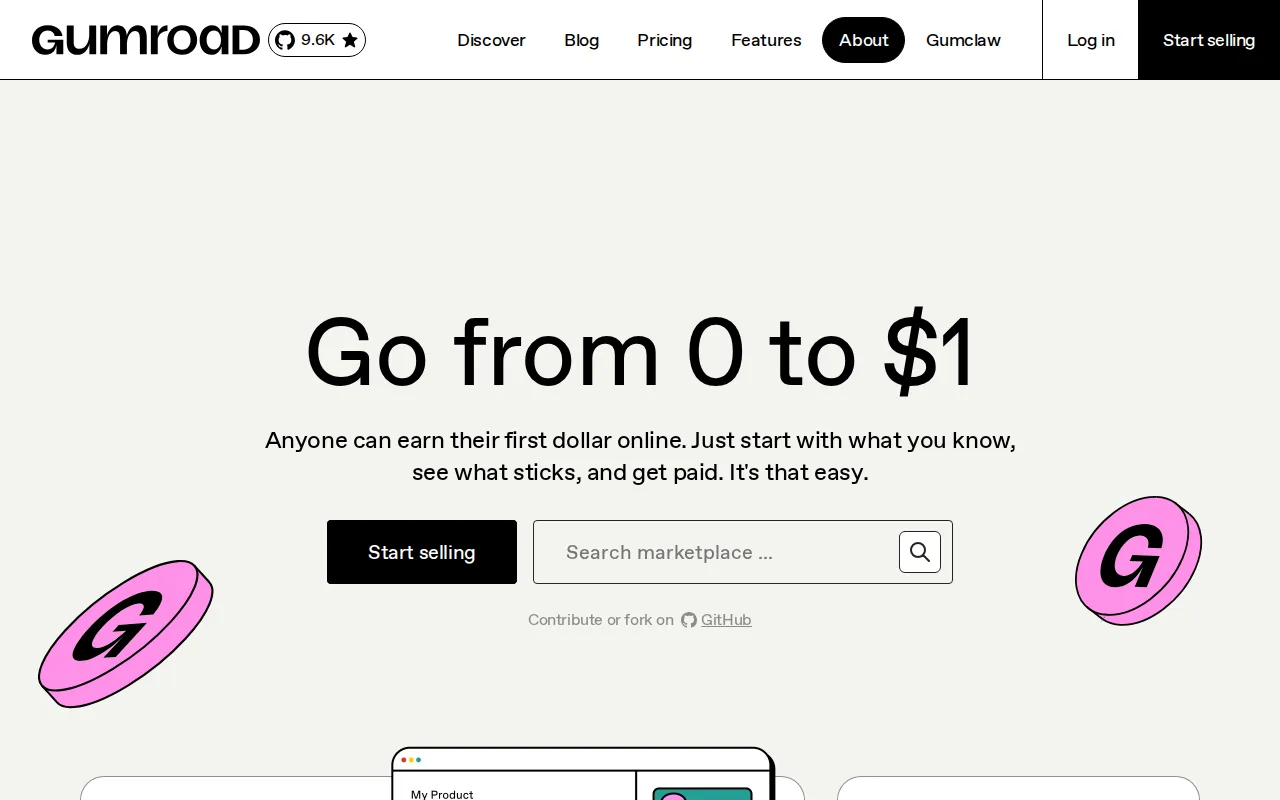
Gumroad is the best Ko-fi alternative for creators whose revenue is digital product sales rather than tips. Both charge no monthly fee, but Gumroad does two things Ko-fi does not. Since January 2025 Gumroad has been merchant of record on every transaction, calculating, collecting, and remitting sales tax and VAT worldwide instead of leaving a creator to register in each jurisdiction, which is a real burden for a shop selling to EU buyers. And in 2024 Gumroad open-sourced its full production Ruby on Rails codebase under the MIT license, so the platform can be audited or self-hosted; Ko-fi is proprietary and hosted only. Gumroad holds 4.2/5 from 16 G2 reviews. Ko-fi is the cheaper option at any shop size. Gumroad takes 10% + $0.50 per transaction on direct sales and 30% when a buyer arrives through its Discover marketplace, so $1,000 of monthly shop revenue costs $100 plus $0.50 per sale, against $50 on Ko-fi's free plan and $12 with Ko-fi Gold. Gumroad's seller reputation is the weakest point in this comparison: it is rated 'Bad' on Trustpilot, with recurring reports of payouts frozen or accounts suspended after a single chargeback, where Ko-fi sits around 4/5 from 700+ Trustpilot reviews.
Compared to Ko-fi: merchant of record handling sales tax and VAT worldwide since January 2025, a full MIT-licensed open-source codebase you can self-host, and a 10% + $0.50 per-transaction fee where Ko-fi charges 5% on shop sales or $12/month for Gold
Wins:Acts as merchant of record, calculating, collecting, and remitting sales tax and VAT worldwide since January 2025, which Ko-fi does not do · Full production codebase open-sourced under the MIT license (the antiwork/gumroad repository), so it can be audited or self-hosted; Ko-fi is proprietary and hosted only · The Discover marketplace can surface products to new buyers with no marketing spend, addressing the low discoverability Ko-fi names as its own con, at a 30% fee
Loses:10% + $0.50 per transaction on direct sales is double Ko-fi's 5% shop fee: $1,000 of monthly sales costs $100 plus $0.50 per sale, against $50 on Ko-fi free and $12 with Ko-fi Gold · Sales that come through Discover cost 30% per transaction, six times Ko-fi's 5% platform fee on shop revenue · Rated 'Bad' on Trustpilot with recurring reports of frozen payouts and accounts suspended after a single chargeback, against roughly 4/5 from 700+ Trustpilot reviews for Ko-fi, and management is web-only with no native mobile app, the same gap Ko-fi has
Pros
- No monthly fee; pay only 10% + $0.50 per sale through your own links, so cost scales with revenue.
- Acts as merchant of record, automatically collecting and remitting sales tax and VAT worldwide.
- Full production codebase open-sourced under the MIT license, so the platform can be audited or self-hosted.
- Discover marketplace can surface products to new buyers with no separate marketing spend, at a 30% fee.
Cons
- Rated 'Bad' on Trustpilot, with recurring seller complaints about payouts frozen or accounts suspended after a single chargeback.
- 10-30% per-transaction fees cost more than a flat monthly plan once sales volume is high.
- No dedicated native mobile app for managing a storefront; management is web-only.
- Limited built-in email marketing and storefront customization compared with Shopify or Podia.
Pricing: Free — 10% + $0.50 per direct transaction, or 30% via Discover, with no monthly fee vs Ko-fi's 5% on shop sales or $12/month for Ko-fi Gold ($6/month billed annually) at 0% (verified undefined NaN, NaN)
4.Buy Me a Coffee — best Ko-fi alternative for solo creators — artists, podcasters, writers, developers — who want tips, memberships, and a small digital shop on one page without paying a monthly platform subscription
Buy Me a Coffee is the closest product-shape match to Ko-fi on this list: one page carrying tips, membership tiers, and a shop. Buy Me a Coffee also closes the gap Ko-fi names as its own weakness, shipping iPhone and Android apps for earnings, payouts, posts, and messages where Ko-fi is web-only and mobile access means pinning a page to a home screen. Supporter-only posts sit on its free plan, where Ko-fi puts them behind Ko-fi Gold at $12/month ($6/month billed annually). On fees, Ko-fi wins. Buy Me a Coffee charges a flat 5% platform fee on every transaction with no paid tier that buys it down, while Ko-fi takes 0% on tips even on its free plan, so $1,000 of monthly tips costs $50 on Buy Me a Coffee and nothing on Ko-fi. On shop and membership revenue the free plans tie at 5%, but Ko-fi Gold takes that to 0%, turning $50 a month into $12. Processing is separate on both at roughly 2.9% + $0.30, and Buy Me a Coffee adds 0.5% payout processing, 1% on non-US payments, and 0.5% on subscriptions, so recurring memberships sit nearer 5.5%. Payouts are Stripe-only at a $10 minimum after moderation; Ko-fi supports Stripe and PayPal. Buy Me a Coffee holds 3.9/5 from 1,627 Trustpilot reviews and 3.5/5 from 26 on Product Hunt, against roughly 4/5 from 700+ Trustpilot reviews for Ko-fi. For a creator earning mostly from tips, Ko-fi stays cheaper; the reason to move is the phone app.
Compared to Ko-fi: native iPhone and Android apps where Ko-fi is web-only, a flat 5% platform fee on every transaction including tips where Ko-fi takes 0% on tips and donations, and no paid tier that buys that 5% down where Ko-fi Gold removes its own 5% for $12/month ($6/month billed annually)
Wins:Native iPhone and Android apps cover earnings, payouts, posts, and supporter messages from a phone, closing the no-mobile-app gap Ko-fi names as one of its own weaknesses · Supporter-only and member-only posts, galleries, and email to supporters are included on the free plan, where Ko-fi puts supporter-only and scheduled posts behind Ko-fi Gold at $12/month ($6/month billed annually) · Supporters pay in one tap by card, Apple Pay, Google Pay, or Cash App without creating an account, and the shop takes unlimited digital or physical products with no listing fees
Loses:The flat 5% platform fee applies to tips, which Ko-fi takes 0% on even on its free plan: $1,000 of monthly tips costs $50 on Buy Me a Coffee and nothing on Ko-fi · No paid tier removes the 5%, so shop and membership revenue that ties with Ko-fi's free plan at 5% costs $50 per $1,000 against $12 on Ko-fi Gold, and the extra 0.5% on subscription payments puts recurring memberships nearer 5.5% · Payouts run through Stripe only, at a $10 minimum balance after an account moderation review, where Ko-fi supports both Stripe and PayPal, and public scores are lower: 3.9/5 from 1,627 Trustpilot reviews and 3.5/5 from 26 Product Hunt reviews against roughly 4/5 from 700+ Trustpilot reviews for Ko-fi
Pros
- No monthly fee and no listing fees: publishing, posts, galleries, supporter emails, memberships, and the shop are all on the single free plan.
- One page combines one-time tips, unlimited membership tiers, and an unlimited-product shop, so a creator does not stitch together separate tools.
- Supporters check out in one tap with a card, Apple Pay, Google Pay, or Cash App and never have to create an account.
- Creator apps for iPhone and Android cover earnings, payouts, posts, and supporter messages from a phone.
- Creators own their supporter list — Buy Me a Coffee states it does not email supporters and the list can be exported at any time.
Cons
- The flat 5% platform fee applies to every transaction with no paid plan that removes it.
- Stripe fees stack on top: 2.9% + $0.30 per charge, 0.5% for payouts, +1% international, +0.5% on subscription payments.
- Payouts are Stripe-only and start at a $10 balance after account moderation, which shuts out creators in countries Stripe does not support.
- Public review scores are middling: a 3.9/5 TrustScore across 1,627 Trustpilot reviews and 3.5/5 from 26 Product Hunt reviews.
Pricing: Free — A flat 5% platform fee on every transaction with no monthly fee and no plan that removes it, plus Stripe's 2.9% + $0.30 and 0.5% payout processing, vs Ko-fi's 0% on tips and 5% on shop, membership, and commission revenue, or $12/month for Ko-fi Gold ($6/month billed annually) at 0% (verified undefined NaN, NaN)