6 Best Alternatives to Kagi for Web in 2026
By Noahlast updated pricing verified
Compared: Kagi alternatives that run on Web
| Alternative | Best for | Standout | Biggest weakness | Learning curve | Price |
|---|---|---|---|---|---|
| Kagireference | privacy-conscious individuals willing to pay for search who want ad-free, unpersonalized results and are frustrated with ad-heavy or SEO-spam-filled results from free search engines | A Fair Pricing Policy that automatically credits any month a subscriber doesn't use their plan toward the next billing cycle, unusual for a subscription product. | There is no ongoing free tier, only a one-time 100-search trial, so anyone who wants to keep using Kagi past the trial must pay at least $5/month, a real barrier compared to fully free competitors like Google, Bing, or DuckDuckGo. | Low | From $5/mo |
| Google Meet | individuals and teams already using Gmail, Calendar, and Google Workspace who want video calls that launch directly from a calendar invite with no separate app install | Gemini-powered automatic note-taking, live meeting summaries, and real-time translation are built into paid tiers, generated directly inside the call rather than through a separate transcription add-on. | The free tier caps group calls at 60 minutes with no recording, and Google Workspace's plan-comparison page does not display exact per-user dollar prices without going through a purchase or sign-in flow, making cost comparison against Zoom or Microsoft Teams harder upfront. | Low | Free |
| DuckDuckGo | privacy-conscious users who want tracker blocking and non-personalized search by default without paying, plus an optional bundle of VPN and identity protection for those who want it | Search results and ads are not built from a stored personal profile, and the browser blocks third-party trackers by default without requiring separate extensions or configuration. | Search result relevance and freshness can lag Google for niche, local, or highly current queries, since DuckDuckGo relies partly on licensed results from Bing and other sources rather than its own comprehensive index. | Low | Free tier · paid from $9.99/mo |
| Brave Search | developers building AI or LLM applications who want search results from an independent index, priced per request, instead of reselling Google or Bing data | Runs on an independently crawled search index rather than reselling another provider's results, exposed through a per-request API purpose-built for grounding LLM answers with citations. | Consumer Brave Search Premium (the ad-free tier) doesn't publish its price on Brave's own help documentation, and as a smaller independent index it has less comprehensive long-tail and local search coverage than Google. | Low | Free tier · paid from $4/mo |
| Startpage | privacy-conscious users who want Google-quality search results without personalized ad tracking or search history logging | Delivers Google's own search results while stripping trackers and not storing IP addresses or search history, plus an Anonymous View proxy for opening results without revealing your identity to the destination site. | Startpage is not open source and its privacy claims cannot be independently audited the way an open-source alternative's can, and since 2019 majority ownership by adtech company System1 has drawn scrutiny from privacy advocates who question how the contextual-advertising business model is implemented behind the scenes. | Low | Free |
| Bing | users who want Microsoft's Copilot AI assistant integrated directly into search results, or who are already inside the Windows/Edge ecosystem | Copilot is built directly into the search results page, letting users ask follow-up questions and get AI-generated answers alongside traditional links without leaving Bing. | Bing holds a small fraction of Google's global search market share, so many location-specific and long-tail queries return thinner or less locally relevant results, and most publishers optimize their content for Google first. | Low | Free |
| Google Search | anyone doing general web search who wants the broadest, most current index along with integrated Maps, Shopping, and AI Overviews, without paying anything | The largest and most frequently updated web index of any search engine, combined with Maps, Shopping, Flights, and AI-generated Overviews built directly into the results page. | Results pages are increasingly dominated by ads and AI Overviews above organic links, and search history is linked to a signed-in Google account for ad personalization by default unless a user opts into Incognito mode or disables activity tracking. | Low | Free |
 Kagi
Kagi Google Meet
 DuckDuckGo
 Brave Search
 Startpage
 Bing
Bing Google Search
1.Google Meet — best Kagi alternative for individuals and teams already using Gmail, Calendar, and Google Workspace who want video calls that launch directly from a calendar invite with no separate app install
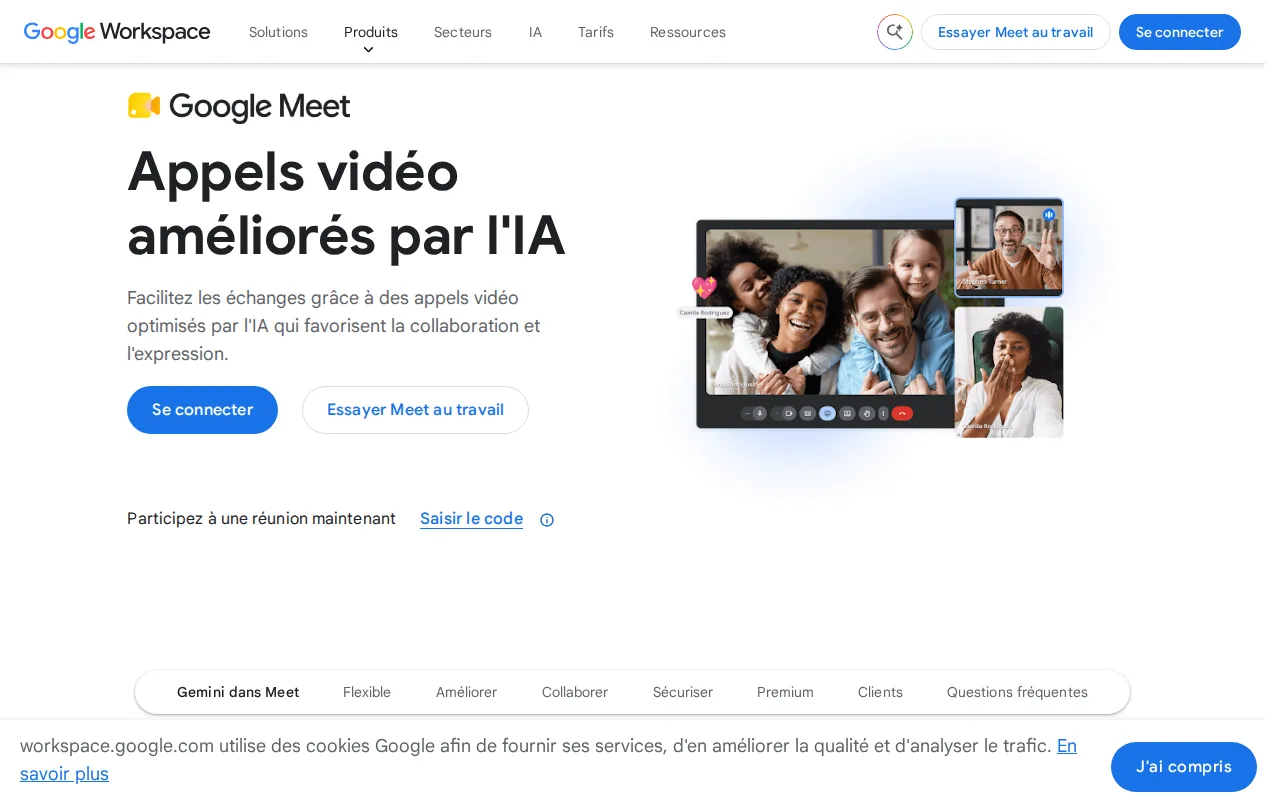
Google Meet is a video conferencing app, not a search engine, so it doesn't compete with Kagi on core search functionality at all; it appears in our listing data as a bundled Google product some users evaluate together when moving off Google's broader ecosystem. Google Meet's Free plan supports up to 100 participants and 60-minute group calls, at $0 against Kagi's $5-25/month search subscription, while paid Google Workspace tiers add Gemini-powered live captions, translation, and meeting recording, none of which relate to Kagi's search-and-AI-assistant product. For anyone actually comparing search tools, Kagi remains the relevant choice: it delivers ad-free, unpersonalized, customizable search results for $5-25/month, while Google Meet offers no search functionality whatsoever, only video calling. The realistic use case for Google Meet appearing alongside Kagi is a household or team auditing every Google-linked subscription at once, not a direct feature-for-feature substitute, and buyers should evaluate it purely on video-conferencing merits (participant caps, recording, Workspace pricing) rather than as a search replacement.
Compared to Kagi: a video conferencing product with no search functionality at all vs Kagi's core ad-free search subscription, free 100-participant tier vs Kagi's $5-25/month pricing, relevant only for Google-account bundling, not search
Wins:Free for video meetings up to 100 participants, a different product category than Kagi's paid search subscription · Meetings launch directly from a Google Calendar invite with no separate app install
Loses:No search functionality whatsoever, so it cannot actually substitute for Kagi's core product for anyone searching the web · Free tier caps group calls at 60 minutes with no recording, a limitation irrelevant to search but real for anyone using it as a video tool · Requires a Google account, the same ecosystem lock-in some Kagi switchers are trying to reduce by leaving Google Search
Pros
- Meetings launch directly from a Google Calendar invite with no separate app download required on desktop.
- Gemini features generate live captions, real-time translation, and automatic meeting notes on paid tiers.
- Free tier supports up to 100 participants, generous enough for most small-team or casual calls.
- Tight integration with Google Docs, Sheets, and Slides for in-meeting collaboration.
Cons
- Free tier caps group calls at 60 minutes and includes no recording option.
- No native Windows or macOS desktop app; runs only through the browser or mobile apps.
- Exact per-user pricing for Workspace Business Starter, Standard, and Plus is not shown on the plan-comparison page without starting a purchase flow.
- Meeting recording and Studio Sound require at least the Business Standard tier, not available on Business Starter.
Pricing: Free
2.DuckDuckGo — best Kagi alternative for privacy-conscious users who want tracker blocking and non-personalized search by default without paying, plus an optional bundle of VPN and identity protection for those who want it
DuckDuckGo is the best Kagi alternative for privacy-conscious users who want tracker blocking and non-personalized search by default without paying anything, unlike Kagi's fully paid model with no ongoing free tier. DuckDuckGo's core search engine and browser are free with no account required, while Kagi requires at least $5/month after a one-time 100-search trial to keep searching at all. DuckDuckGo holds a 4.5/5 rating from 10 Capterra reviews, close to Kagi's own 5/5 from 3 Product Hunt reviews, both drawn from small samples. DuckDuckGo also sells an optional Privacy Pro subscription around $9.99/month that bundles a VPN, data broker removal, and identity theft restoration, a broader privacy bundle than Kagi's search-and-AI-assistant subscription covers. Kagi is still the better choice for users who want a customizable, ad-free ranking algorithm and a bundled AI assistant on every tier: DuckDuckGo's search relevance for local, niche, or fast-moving queries can lag Google since it relies partly on licensed Bing results, and its ad revenue model means search results still include contextual ads, even without tracking, unlike Kagi's fully ad-free result pages.
Compared to Kagi: free core search and browser vs Kagi's $5/month-minimum subscription, tracker blocking on by default, but still shows contextual ads unlike Kagi's fully ad-free results
Wins:Core search engine and browser are free with no account required, vs Kagi's $5/month Starter minimum after a one-time trial · Tracker blocking is on by default in the browser, not an opt-in extension · Privacy Pro bundles a VPN, data broker removal, and identity restoration into one subscription, a broader bundle than Kagi's search-plus-AI-assistant model
Loses:Search relevance for local, niche, or fast-moving queries can lag Google, since DuckDuckGo relies partly on licensed Bing results · Ad revenue model means search results still include contextual ads, even without tracking, unlike Kagi's fully ad-free results · No ranking customization (boosting or blocking specific domains), a feature included on every Kagi paid tier
Pros
- Core search engine and browser are free with no account or personal data required.
- Tracker blocking is on by default in the browser, not an opt-in extension.
- Privacy Pro bundles VPN, data broker removal, and identity restoration into one subscription instead of three.
- Non-personalized search avoids the filter-bubble effect of profile-based ranking.
Cons
- Search relevance for local, niche, or fast-moving queries can lag Google.
- Privacy Pro's VPN has fewer server locations than dedicated VPN providers.
- Duck.ai and other newer features are less mature than the core search product.
- Ad revenue model means search results still include contextual ads, even without tracking.
Pricing: Free tier · paid from $9.99/mo — $0 core search vs Kagi's $5/month Starter; Privacy Pro at $9.99/month vs Kagi's $10/month Professional
3.Brave Search — best Kagi alternative for developers building AI or LLM applications who want search results from an independent index, priced per request, instead of reselling Google or Bing data
Brave Search is the best Kagi alternative for users and developers who want results from an independently crawled index rather than reselling another provider's data, at no cost for consumer search versus Kagi's $5/month-minimum subscription. Consumer search at search.brave.com is free with no account required, while Kagi requires payment after a one-time 100-search trial to keep using the service. Brave also exposes a per-request API for developers: $5 per 1,000 requests for the Search plan, priced entirely differently from Kagi's flat monthly subscription model. Brave Search's pricing was independently verified, matching Kagi's own verification date. Kagi is still the better choice for consumers who want a bundled AI assistant with every subscription tier and a Fair Pricing Policy that credits unused months: Brave Search Premium, its own ad-free consumer tier, doesn't publish its price on Brave's help documentation at all, and as a smaller independent index it has less comprehensive long-tail and local search coverage than Kagi's own index provides.
Compared to Kagi: free consumer search on an independently crawled index vs Kagi's $5/month-minimum subscription, per-request developer API pricing, but a smaller index with less comprehensive long-tail coverage
Wins:Consumer search is entirely free with no account required, vs Kagi's $5/month Starter minimum · Built on an independent search index rather than reselling another provider's results · Developer API is priced per request ($5/1,000 for Search) rather than a flat seat-based subscription like Kagi's
Loses:Brave Search Premium's ad-free consumer tier price isn't disclosed publicly, unlike Kagi's transparently published $5-25/month tiers · Smaller independent index means less comprehensive long-tail and local search coverage · No bundled AI assistant included with consumer search the way Kagi bundles Kagi Assistant into every paid tier
Pros
- Built on an independent search index rather than reselling Google or Bing results.
- API pricing is per-request ($5/1,000 for Search, $4/1,000 for Answers) rather than a flat seat-based subscription.
- Free consumer search requires no account and works in any browser.
- Answers API returns citation-grounded summaries designed for direct use in LLM-facing products.
Cons
- Smaller independent index means less comprehensive long-tail and local search coverage than Google.
- Brave Search Premium's ad-free tier price isn't disclosed on Brave's public help documentation.
- Answers API is capacity-limited to 2 queries/second versus 50 queries/second on the base Search plan.
- No official mobile app; it's accessed as a website rather than a dedicated search app.
Pricing: Free tier · paid from $4/mo — $0 consumer search vs Kagi's $5/month Starter; API from $5/1,000 requests, a different pricing model than Kagi's flat subscription (verified undefined NaN, NaN)
4.Startpage — best Kagi alternative for privacy-conscious users who want Google-quality search results without personalized ad tracking or search history logging
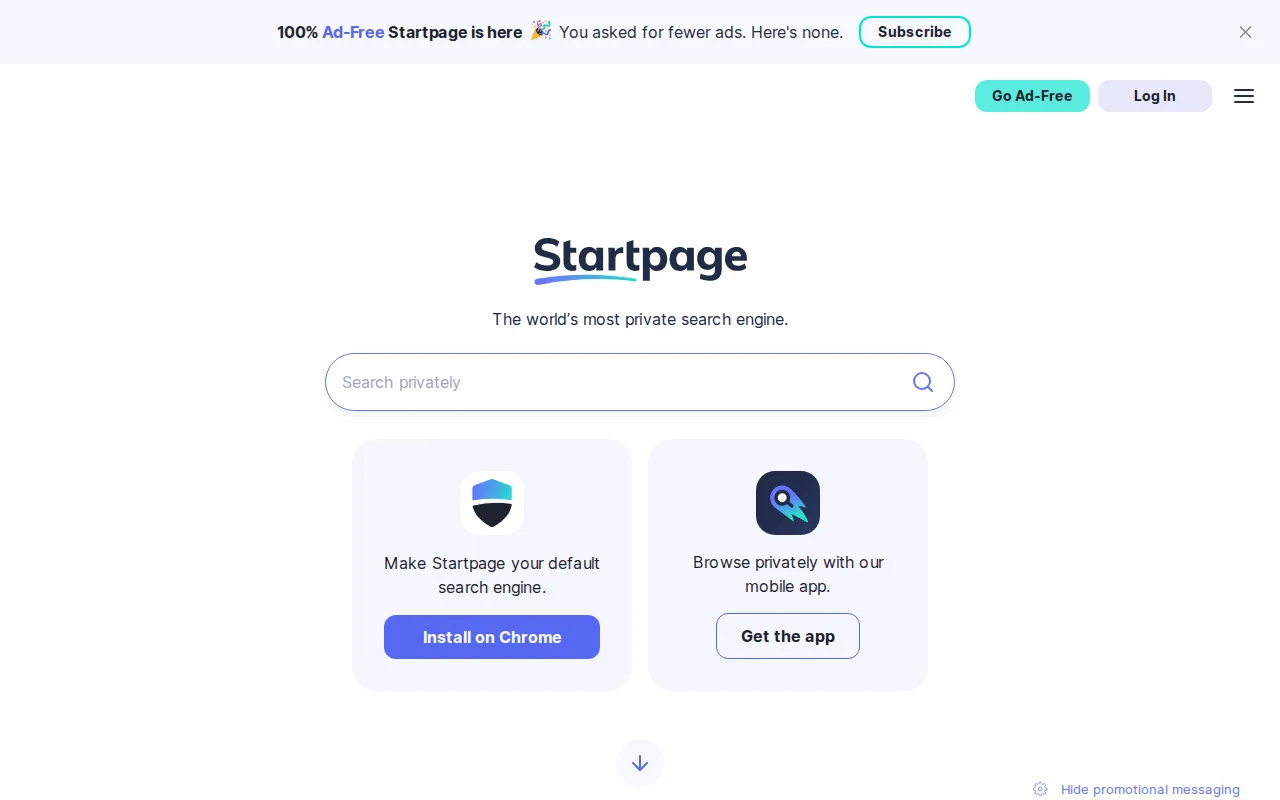
Startpage is the best Kagi alternative for users who want Google-quality search results without Google's personalized ad tracking, and without paying anything, unlike Kagi's $5/month-minimum subscription. Startpage delivers Google's own search results while stripping trackers and not storing IP addresses or search history, funded entirely by contextual, non-behavioral advertising rather than a subscription. It's available in 82 languages and includes an Anonymous View proxy for opening results without revealing a user's IP to the destination site, a specific privacy feature Kagi's listing doesn't describe. Kagi is still the better choice for users who want a fully independent, ad-free product with a bundled AI assistant: Startpage is not open source, so its no-logging claims can't be independently verified in code the way an open product's could, and it has been majority-owned by adtech company System1 since 2019, raising privacy-community concerns about how its contextual-advertising business model is implemented, concerns that don't apply to Kagi's direct pay-for-search revenue model.
Compared to Kagi: free Google-quality results without personalized tracking vs Kagi's $5/month-minimum subscription, Anonymous View proxy for hiding IP from destination sites, but majority-owned by adtech company System1 since 2019
Wins:Free to use with no paid tier required, vs Kagi's $5/month Starter minimum · Returns Google-quality search results without Google's personalized ad tracking · Anonymous View proxy lets users open search results without revealing their IP to the destination site
Loses:Not open source, so its no-logging claims cannot be independently verified in code · Majority-owned by adtech company System1 since 2019, raising privacy-community concerns Kagi's direct-pay model doesn't carry · No bundled AI assistant, unlike Kagi which includes Kagi Assistant on every paid tier
Pros
- Free to use with no paid tier required for full functionality.
- Returns Google-quality search results without Google's personalized tracking.
- Anonymous View proxy lets users open search results without revealing their IP to the destination site.
- Available in 82 languages with a long operating history dating back to 1998 as Ixquick.
Cons
- Not open source, so its no-logging claims cannot be independently verified in code.
- Majority ownership by adtech company System1 since 2019 has raised privacy-community concerns about the business model.
- Relies on Google's index, so search quality and any Google-side biases carry through to Startpage results.
- No dedicated business or enterprise tier; it is a consumer-only product.
Pricing: Free — $0 vs Kagi's $5/month Starter or $10/month Professional
5.Bing — best Kagi alternative for users who want Microsoft's Copilot AI assistant integrated directly into search results, or who are already inside the Windows/Edge ecosystem
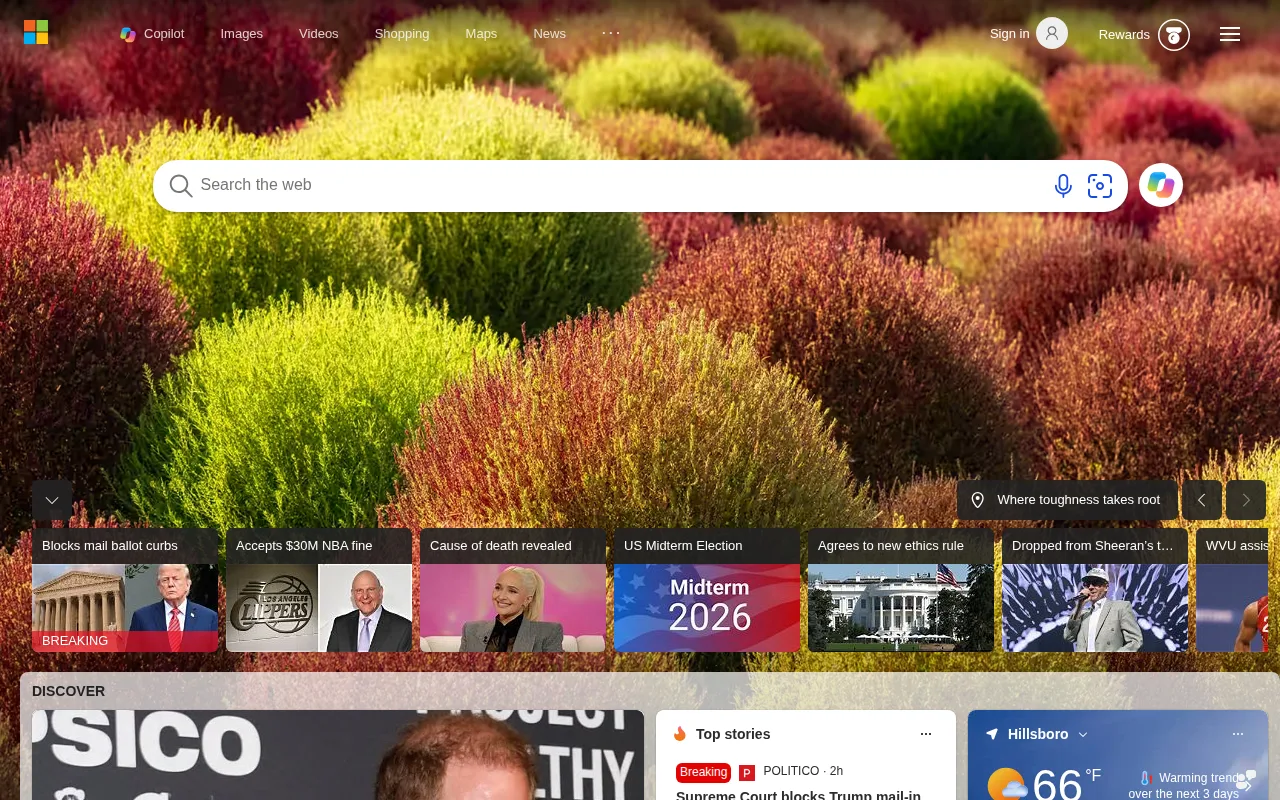
Bing is the best Kagi alternative for users who want Microsoft's Copilot AI assistant built directly into the search results page at no cost, rather than paying Kagi's $5-25/month for its own bundled Kagi Assistant. Bing is a free, ad-supported product with no paid tier at all, and Microsoft Rewards pays users points for searches and Microsoft purchases, redeemable for gift cards and Xbox credit, a loyalty layer Kagi's subscription model doesn't have. Bing is the default search provider across Windows, Edge, and Microsoft 365 Copilot, giving it built-in distribution Kagi's standalone subscription lacks. Kagi is still the better choice for users who want an ad-free, independently ranked search experience: Bing holds a small fraction of Google's global search market share, so many location-specific and long-tail queries return thinner or less locally relevant results than on Google, and Bing's ad-supported results include sponsored placements mixed with organic results, unlike Kagi's fully ad-free result pages.
Compared to Kagi: free built-in Copilot AI assistant vs Kagi's $5-25/month for Kagi Assistant, Microsoft Rewards points on every search, but ad-supported results vs Kagi's fully ad-free pages
Wins:Copilot AI assistant is built into the search results page for free, while Kagi charges $5-25/month for its own bundled Kagi Assistant · Microsoft Rewards pays points for everyday searches, redeemable for gift cards and Xbox credit, a loyalty program Kagi doesn't offer · Default search engine in Windows and Microsoft Edge, giving it built-in distribution Kagi's standalone subscription lacks
Loses:Small global market share compared to Google means thinner results for hyper-local and long-tail queries · Ad-supported results include sponsored placements mixed with organic results, unlike Kagi's fully ad-free result pages · No ranking customization (boosting or blocking specific domains), a feature included on every Kagi paid tier
Pros
- Copilot AI assistant is built into the search results page, not a separate app.
- Microsoft Rewards pays points for everyday searches, redeemable for gift cards and Xbox credit.
- Default search engine in Windows and Microsoft Edge, so no setup is required for Microsoft users.
- Free with no paid tier or account required to search.
Cons
- Small global market share compared to Google means thinner results for hyper-local and long-tail queries.
- Most publishers and SEO practices optimize for Google first, which can affect result freshness and depth on Bing.
- Ad-supported results include sponsored placements mixed with organic results.
Pricing: Free — $0 vs Kagi's $5/month Starter or $10/month Professional
6.Google Search — best Kagi alternative for anyone doing general web search who wants the broadest, most current index along with integrated Maps, Shopping, and AI Overviews, without paying anything
Google Search is the best Kagi alternative for anyone who wants the largest and most frequently updated web index available, entirely free, without Kagi's subscription requirement. Google holds over 90% of global search market share and integrates Maps, Shopping, Flights, and AI-generated Overviews directly into results, at $0 against Kagi's $5/month Starter plan (300 searches/month) or $10/month Professional for unlimited searches. Because Google has no paid consumer tier at all, there's no volume cap to hit the way Kagi's Starter tier caps out at 300 searches/month. Kagi is still the better choice for anyone who specifically wants an ad-free, unpersonalized search experience: Google's results pages carry more ad and AI-Overview real estate above organic links than a decade ago, and search history is tied to a signed-in Google account and used for ad targeting by default, the exact tracking-based model Kagi's no-ads subscription was built to avoid. Google also offers no way to customize ranking by boosting or blocking specific domains, a feature Kagi includes on every paid tier.
Compared to Kagi: free with the largest web index vs Kagi's $5-25/month subscription, integrated Maps/Shopping/AI Overviews built in, but ad-supported results with account-based tracking vs Kagi's ad-free, unpersonalized model
Wins:Free with no paid tier at all, vs Kagi's $5/month Starter minimum · Largest and most frequently updated web index of any search engine, plus integrated Maps, Shopping, Flights, and Knowledge Graph results · No monthly search cap to hit, unlike Kagi's Starter tier which caps out at 300 searches/month
Loses:Results pages carry ads and AI-Overview real estate above organic links, unlike Kagi's ad-free results · Search history is tied to a signed-in Google account and used for ad targeting by default, the tracking model Kagi's subscription is built to avoid · No way to customize ranking by boosting or blocking specific domains, a feature included on every Kagi paid tier
Pros
- Largest and most current web index of any mainstream search engine.
- Deep integration with Maps, Shopping, Flights, and the Knowledge Graph directly in results.
- Free with no paid tier required for full functionality.
- Default search provider across Chrome, Android, and most browsers, so no setup is needed.
Cons
- Results pages carry more ad and AI-Overview real estate above organic links than a decade ago.
- Search history is tied to a signed-in Google account and used for ad targeting by default.
- AI Overviews have been documented producing inaccurate or misleading summaries on some queries.
- No privacy-first mode without manually enabling Incognito or disabling Web & App Activity.
Pricing: Free — $0 vs Kagi's $5/month Starter (300 searches) or $10/month Professional (unlimited)