1 Best Open-Source Alternatives to Heap in 2026
By Noahlast updated pricing verified
Compared: open-source alternatives to Heap
| Alternative | Best for | Standout | Biggest weakness | Learning curve | Price |
|---|---|---|---|---|---|
| Heapreference | product teams that want non-technical staff to build and adjust event funnels retroactively, without waiting on engineering to instrument new tracking code | Autocapture records every interaction from install without requiring events to be pre-defined, so teams can build new funnels against historical data instead of only data collected after an event was manually tagged. | Pricing above the 10,000-session free tier is not published; Growth, Pro, and Premier all require a sales conversation, and reviewers report costs climbing sharply as session volume scales, prompting some teams to switch at renewal. | Low | Free |
| PostHog | product and engineering teams who want analytics, session replay, feature flags, and error tracking in one platform instead of stitching together separate tools | One platform combining product analytics, session replay, feature flags/A-B testing, error tracking, and a data warehouse, each billed on its own usage-based rate that drops at higher volume. | Usage-based pricing across many separate products (events, replays, flags, surveys, data warehouse rows) makes total monthly cost harder to predict than a single flat per-seat price, and some enterprise features live in a separate proprietary ('ee') license rather than the fully open-source core. | Moderate | Free |
 Heap
Heap PostHog
1.PostHog — best Heap alternative for product and engineering teams who want analytics, session replay, feature flags, and error tracking in one platform instead of stitching together separate tools
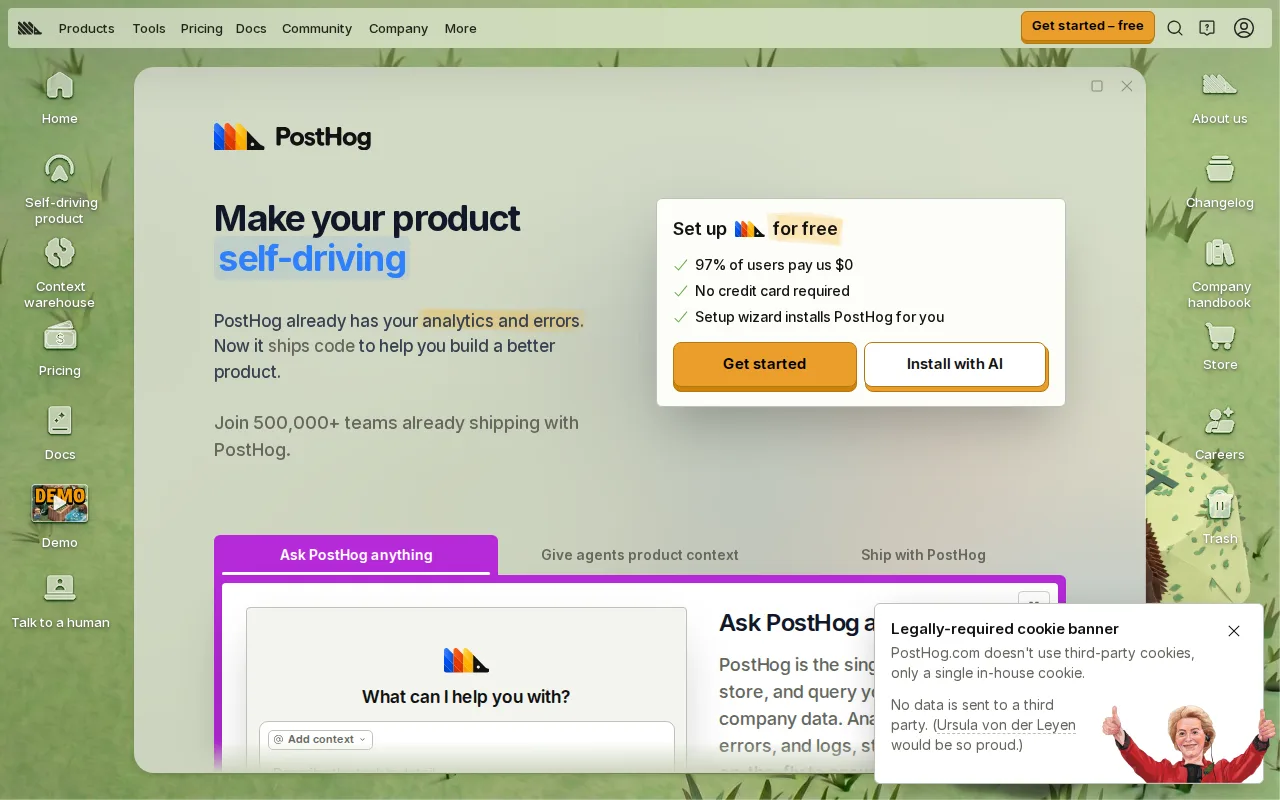
PostHog is the best Heap alternative for engineering-led teams that want product analytics, session replay, feature flags, error tracking, and a data warehouse bundled in one MIT-licensed, open-source platform. PostHog's core is published on GitHub under the MIT license, with a dedicated posthog-foss repository for teams that want strictly open-source code, and its Free plan requires no credit card while covering 1 million analytics events, 5,000 session replays, and 1 million feature flag requests per month, more generous across more product areas than Heap's 10,000-monthly-session free cap. PostHog holds a 5.0/5 rating from 253 Product Hunt reviews, a far larger sample than Heap's 4.5/5 from 42 Capterra reviews, and teams can choose a US or EU cloud region or self-host it entirely. Heap is still the better choice for non-technical teams that want the simplest possible entry point: PostHog's breadth of bundled tools means a wider surface area to learn than Heap's single-purpose, no-code autocapture approach, and PostHog's usage-based pricing spans multiple separately billed products (events, replays, flags, surveys, warehouse rows), making total monthly cost harder to forecast than Heap's simpler free-then-custom-quote structure.
Compared to Heap: MIT-licensed open-source core with self-hosting option, larger review sample (5.0/5 from 253 Product Hunt reviews vs 4.5/5 from 42 Capterra reviews), free tier bundles analytics, replay, feature flags, and error tracking
Wins:MIT-licensed, open-source core published on GitHub, with an official self-hosting option Heap doesn't offer · 5.0/5 rating from 253 Product Hunt reviews, far more review volume than Heap's 4.5/5 from 42 Capterra reviews · Free tier bundles analytics, session replay, feature flags, error tracking, and surveys, more product areas than Heap's free tier covers
Loses:Breadth of bundled tools creates a wider surface area to learn than Heap's single-purpose, no-code autocapture approach · Usage-based pricing spans multiple separately billed products, making total monthly cost harder to forecast than a single free-then-custom-quote structure · Some enterprise features live behind a separate proprietary 'ee' license rather than the fully open-source core
Pros
- Combines analytics, session replay, feature flags, error tracking, and surveys in one platform.
- Generous free tier: 1M analytics events and 5,000 session replays per month with no credit card required.
- MIT-licensed core with source available on GitHub, plus a dedicated posthog-foss repository for strictly open-source use.
- Choice of US or EU cloud region, or self-hosting.
Cons
- Usage-based pricing spans multiple products independently, making total monthly cost harder to forecast than flat per-seat pricing.
- Some enterprise features are gated behind a separate proprietary license (the 'ee' directory), not the fully open-source core.
- Self-hosting PostHog at scale requires more operational overhead than using the managed cloud.
- The breadth of bundled tools (analytics, replay, flags, surveys, data warehouse) means new users face a wider surface area to learn than a single-purpose analytics tool.
Pricing: Free — Free tier (1M events, 5,000 replays, 1M feature flag requests) vs Heap's free tier capped at 10,000 sessions/month; PostHog's paid usage starts at $0.00005/event, Heap's paid tiers are unpublished custom quotes (verified undefined NaN, NaN)