1 Best Open-Source Alternatives to Google Workspace in 2026
By Noahlast updated
All 4 Google Workspace alternatives
Compared: open-source alternatives to Google Workspace
| Alternative | Best for | Standout | Biggest weakness | Learning curve | Price |
|---|---|---|---|---|---|
| Google Workspacereference | businesses, schools, and startups standardizing on browser-based email and real-time collaborative documents instead of desktop Office software | Real-time multi-user editing across Docs, Sheets, and Slides with automatic saving, paired with Gemini AI writing and summarization built into every paid tier at increasing depth. | No official native Linux desktop client and more limited offline-editing depth than Microsoft 365's desktop apps; Meet participant caps and storage are hard-capped per tier, forcing upgrades for larger or heavier-usage teams. | Low | From $7/mo |
| Proton Mail | privacy-conscious individuals, journalists, and small teams who want end-to-end encrypted email with open-source, independently audited clients rather than a mainstream provider that can technically read stored mail | Zero-access encryption paired with open-source, independently audited client apps, so Proton itself cannot decrypt a Mail Plus or Unlimited inbox even under legal compulsion. | The free tier caps storage at just 1 GB and one address, and the higher-value Unlimited and Family tiers bundle VPN, Drive, and Pass features that email-only switchers may not need, pushing the effective per-mailbox cost above single-purpose providers like Fastmail. | Low | Free tier · paid from $3.99/mo |
 Google Workspace
 Proton Mail
1.Proton Mail — best Google Workspace alternative for privacy-conscious individuals, journalists, and small teams who want end-to-end encrypted email with open-source, independently audited clients rather than a mainstream provider that can technically read stored mail
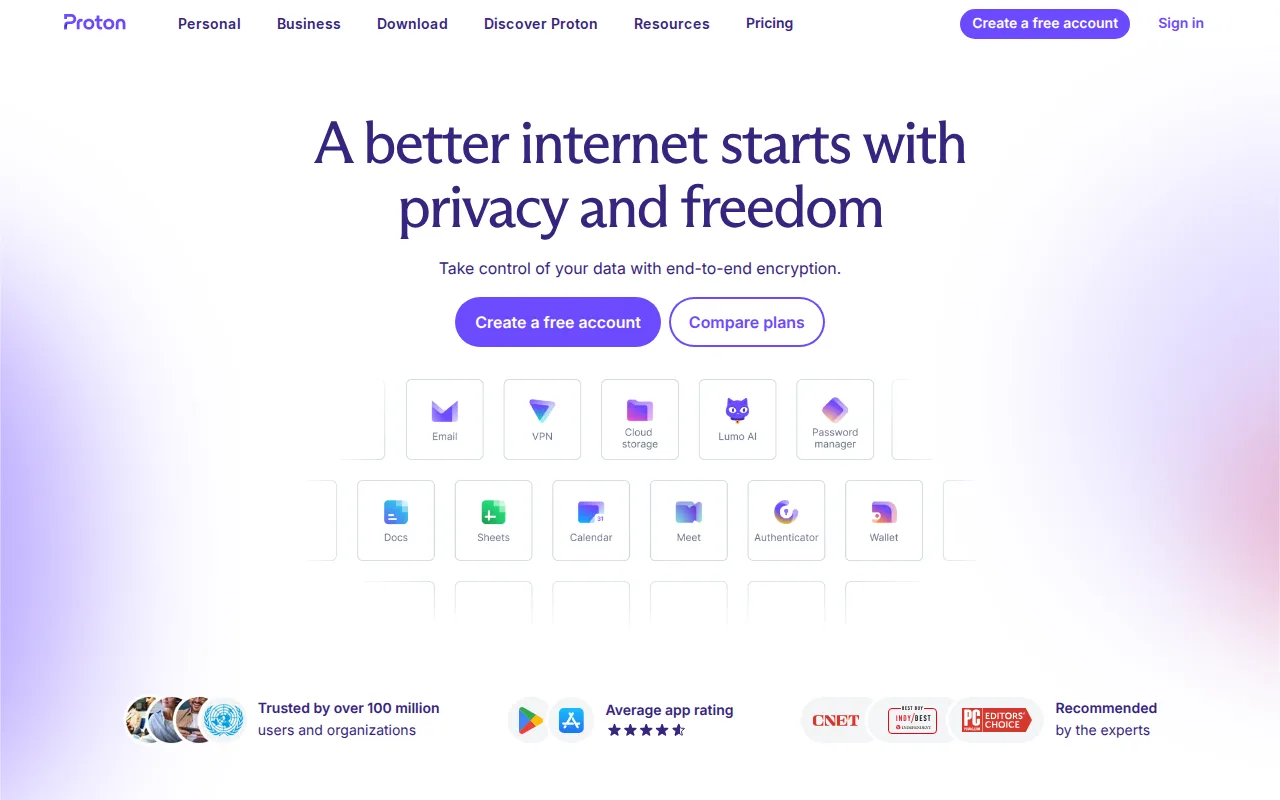
Proton Mail is the best Google Workspace alternative for people whose deciding factor is who can read the inbox. Proton Mail uses zero-access encryption, so Proton itself cannot decrypt message content on any paid plan, its client apps for web, Windows, macOS, Linux, iOS, and Android are open source and independently audited, it operates under Swiss jurisdiction outside US and EU data-sharing agreements, and signup requires no phone number. It is also cheaper than Google Workspace at the entry tier and has a free path Workspace does not: Proton Free gives 1GB (expandable to 1.5GB through onboarding tasks) and one address, and Mail Plus is $3.99/month billed annually (about $47.88/year) with 15GB, 10 hide-my-email aliases, and 1 custom domain, against Workspace Business Starter's $7/user/month. Proton Unlimited at $9.99/month annually pools 500GB across Mail, Drive, and Calendar and adds Proton VPN and Pass, and the Bridge app connects Mail Plus and above to Outlook or Apple Mail over IMAP. Proton lists a Linux client, which Google Workspace does not. Google Workspace is still the better choice for collaborative work. Proton Mail has no Docs, Sheets, Slides, or Meet equivalent and no real-time co-editing at all, Mail Plus's 15GB is half Workspace Business Starter's 30GB pooled per user, custom domain support starts at just 1 domain, and Proton holds 4.5/5 from 122 Capterra reviews against Workspace's 4.7/5 from 17,667.
Compared to Google Workspace: zero-access encryption that keeps Proton itself from reading message content, a free tier plus Mail Plus at $3.99/month billed annually against Workspace Business Starter's $7/user/month, and no Docs, Sheets, Slides, or Meet equivalent at all
Wins:Zero-access encryption means Proton cannot read message content on any paid plan, backed by open-source, independently audited clients and Swiss jurisdiction outside US and EU data-sharing agreements · Proton Free gives 1GB and one address at no cost, where Google Workspace has no free tier at all, and Mail Plus is $3.99/month billed annually against Workspace Business Starter's $7/user/month · Lists a native Linux client alongside web, Windows, macOS, iOS, and Android, covering the gap Workspace leaves with no official Linux desktop app · Proton Unlimited at $9.99/month annually pools 500GB across Mail, Drive, and Calendar and bundles Proton VPN and Pass, and no phone number is required to sign up
Loses:No Docs, Sheets, Slides, or Meet equivalent and no real-time collaborative editing, so it replaces Gmail and Calendar rather than the Workspace suite · Mail Plus includes 15GB against Google Workspace Business Starter's 30GB pooled per user, and the free tier is capped at 1GB and a single address · Custom domain support starts at just 1 domain on Mail Plus, fewer than business-focused competitors offer · Unlimited and Family bundle VPN, Drive, and Pass that email-only switchers may not need, raising the effective per-mailbox cost, and Proton holds 4.5/5 from 122 Capterra reviews against Workspace's 4.7/5 from 17,667
Pros
- Zero-access encryption means Proton cannot read message content on any paid plan.
- Open-source, independently audited client apps across web, desktop, iOS, and Android.
- No phone number required to sign up, and Swiss jurisdiction outside US/EU data-sharing agreements.
- Bridge app connects Proton Mail to standard IMAP clients like Outlook or Apple Mail on Mail Plus and up.
Cons
- Free tier is limited to 1 GB storage and a single email address.
- Higher tiers bundle VPN, Drive, and Pass, which raises the effective price for users who only want email.
- Custom domain support starts at just 1 domain on Mail Plus, fewer than some business-focused competitors.
Pricing: Free tier · paid from $3.99/mo — Free for 1GB and one address, then Mail Plus at $3.99/month billed annually ($4.99 monthly) for 15GB and 1 custom domain, vs Google Workspace Business Starter's $7/user/month annually for 30GB pooled per user