3 Best Open-Source Alternatives to GNU Emacs in 2026
By Noahlast updated pricing verified
Compared: open-source alternatives to GNU Emacs
| Alternative | Best for | Standout | Biggest weakness | Learning curve | Price |
|---|---|---|---|---|---|
| GNU Emacsreference | developers and power users who want a fully reprogrammable editor built on a real Lisp interpreter, not just a configurable one | Nearly every part of the editor is implemented in Emacs Lisp and can be inspected, redefined, or extended at runtime, so users script new features (Org mode, Magit, mail clients) rather than being limited to settings a vendor exposes. | Default keybindings and terminology predate modern UI conventions, giving Emacs a steep initial learning curve, and its Lisp-based extension model means many packages have inconsistent quality and configuration burdens rest on the user, unlike editors with a curated built-in extension marketplace. | Steep | Free |
| Neovim | developers who already use Vim's modal editing and want built-in LSP, Tree-sitter, and Lua scripting without relying on third-party Vim plugins to add them | A built-in LSP client and native Tree-sitter integration ship in the core editor, so modern code intelligence and accurate syntax parsing don't require assembling and maintaining a plugin stack. | The learning curve is steep for anyone not already comfortable with Vim's modal, keyboard-driven editing model, and a productive setup still typically requires configuring a plugin ecosystem (completion, file trees, fuzzy finders) since the out-of-the-box experience is minimal by design. | Steep | Free |
| Helix | developers who want Vim-style modal, keyboard-driven editing with LSP and Tree-sitter support working immediately, without assembling a plugin configuration first | Language Server Protocol and Tree-sitter integration, multiple selections, and a fuzzy finder all work out of the box with sane defaults, unlike Vim or Neovim where equivalent functionality typically requires installing and configuring third-party plugins. | No built-in plugin system yet, the feature has been publicly discussed and planned by the project but is not shipped, so users who want to extend Helix beyond its built-in feature set have far fewer options than Neovim's mature Lua plugin ecosystem. | Moderate | Free |
| Vim | developers and system administrators who want fast, keyboard-only text editing over SSH or in a terminal, without a mouse or a graphical IDE | Modal editing combined with an almost entirely scriptable configuration (Vimscript plus a large plugin ecosystem), letting experienced users compose complex text edits as short keyboard commands. | Steep learning curve from its modal editing model: new users have to unlearn conventional point-and-click text editing, and a genuinely productive Vim setup usually requires assembling a personal plugin and configuration file rather than working well out of the box. | Steep | Free |
 GNU Emacs
 Neovim
 Helix
Helix1.Neovim — best GNU Emacs alternative for developers who already use Vim's modal editing and want built-in LSP, Tree-sitter, and Lua scripting without relying on third-party Vim plugins to add them
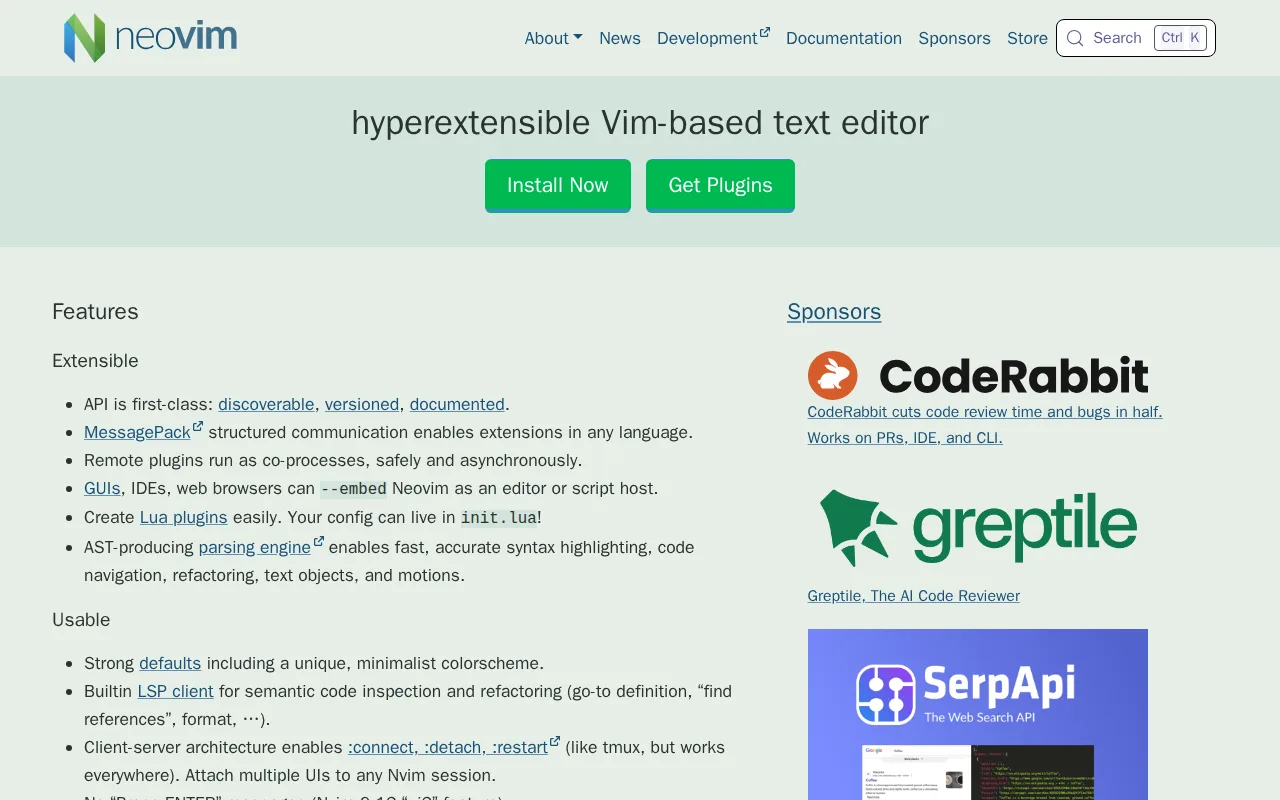
Neovim is the best GNU Emacs alternative for developers who prefer Vim's modal editing model over Emacs' key-chord-and-Lisp approach, while still wanting built-in modern tooling instead of assembling a plugin stack. Neovim ships a built-in Language Server Protocol client and native Tree-sitter syntax parsing directly in the core editor, comparable in spirit to Emacs' own built-in tools like Org mode and Magit, but centered on Vim's motion-based commands rather than Emacs Lisp. Both editors are completely free with no paid tier: Neovim is Apache 2.0 licensed for code written since 2014, close to GNU Emacs' GPLv3 licensing, and Neovim holds a 5/5 rating from 7 Product Hunt reviews, a small but positive signal GNU Emacs' own listing has none of. GNU Emacs is still the better choice for anyone who wants an editor built around a full, general-purpose Lisp interpreter that can redefine any function at runtime: Neovim's configuration is written in Lua or Vimscript for extending the editor, not a foundational language the editor itself is built on, and Neovim has no official GUI beyond the terminal, while Emacs has run in continuous development since 1976 with a correspondingly larger self-documenting help system.
Compared to GNU Emacs: built-in LSP client and native Tree-sitter parsing ship in the core editor, Vim-compatible modal editing rather than Lisp-and-chord commands, 5/5 rating from 7 Product Hunt reviews vs GNU Emacs' zero ratings
Wins:Built-in LSP client and native Tree-sitter integration ship in the core editor without needing extra packages · Vim-compatible modal editing and keybindings, familiar to the large existing base of Vim users · 5/5 rating from 7 Product Hunt reviews, a small but positive signal GNU Emacs' listing doesn't have
Loses:Configuration is written in Lua or Vimscript for extending the editor, not a foundational general-purpose Lisp the editor itself is built on, unlike Emacs Lisp · No official GUI beyond the terminal, while Emacs has native graphical builds · Minimal out-of-the-box experience; a productive setup still typically requires assembling a plugin ecosystem, similar to Emacs' own configuration burden
Pros
- Built-in LSP client provides code completion, diagnostics, and go-to-definition without third-party plugins.
- Native Tree-sitter support gives more accurate syntax highlighting and code navigation than regex-based highlighting.
- Lua scripting and configuration alongside traditional Vimscript, with a large modern plugin ecosystem built around it.
- Completely free with no paid tier, and compatible with most existing Vim 8.x plugins.
Cons
- Steep learning curve for anyone not already familiar with Vim's modal editing and keybindings.
- Minimal out-of-the-box experience; a productive setup usually requires assembling and maintaining a plugin configuration.
- No official GUI beyond the terminal; graphical front-ends are separate community projects with varying maturity.
- Configuration in Lua (or Vimscript) has a real learning investment compared to GUI-based settings in editors like VS Code.
Pricing: Free (verified undefined NaN, NaN)
2.Helix — best GNU Emacs alternative for developers who want Vim-style modal, keyboard-driven editing with LSP and Tree-sitter support working immediately, without assembling a plugin configuration first

Helix is the best GNU Emacs alternative for developers who want Language Server Protocol and Tree-sitter support working immediately after installation, without assembling a personal configuration file the way a productive Emacs setup typically requires. Helix ships LSP, Tree-sitter syntax parsing, a fuzzy file finder, and multiple simultaneous selections as first-class, built-in features with sane defaults, a more batteries-included starting point than Emacs' self-documenting but largely blank-slate default configuration. Both editors are completely free with no paid tier: Helix is licensed under the Mozilla Public License 2.0, and its pricing was verified on the live project page as free with no vendor, matching GNU Emacs' own GPLv3 licensing. GNU Emacs is still the better choice for anyone who wants near-unlimited extensibility through a full Lisp interpreter: Helix has no plugin system yet, a feature the project has publicly planned but not shipped, so users who want to extend Helix beyond its built-in feature set have far fewer options than Emacs' decades-deep Emacs Lisp package ecosystem, and Helix is terminal-only with no official GUI, while Emacs ships native graphical builds.
Compared to GNU Emacs: LSP and Tree-sitter work out of the box with no configuration file needed, multiple selections are a first-class editing primitive, no plugin system yet vs Emacs' decades-deep package ecosystem
Wins:LSP, Tree-sitter syntax parsing, and a fuzzy finder work out of the box with sane defaults, no configuration file assembly required · Multiple selections and cursors are a first-class editing primitive, not a bolted-on feature · Single Rust binary with no external runtime dependencies; starts instantly and uses minimal memory
Loses:No plugin system yet — the feature is publicly planned but not shipped — so extensibility is far more limited than Emacs' decades-deep Emacs Lisp package ecosystem · Terminal-only with no official GUI application, while Emacs ships native graphical builds · Smaller community and third-party theme/config-sharing ecosystem than the much older, continuously developed-since-1976 Emacs project
Pros
- LSP, Tree-sitter syntax parsing, and a fuzzy finder work out of the box with no plugin installation required.
- Multiple selections and cursors are a first-class editing primitive, not a bolted-on feature.
- Single Rust binary with no external runtime dependencies; starts instantly and uses minimal memory.
- Works identically over SSH and inside tmux as it does on a local machine, useful for remote development.
Cons
- No plugin system yet, extensibility is limited to what ships built in, unlike Neovim's large third-party plugin ecosystem.
- Selection-first editing model differs from Vim's motion-first model, so muscle memory doesn't transfer directly for Vim users.
- Smaller community and third-party theme/config-sharing ecosystem than the much older Vim and Neovim projects.
- Terminal-only; no official GUI application for users who prefer a graphical editor window.
Pricing: Free (verified undefined NaN, NaN)
3.Vim — best GNU Emacs alternative for developers and system administrators who want fast, keyboard-only text editing over SSH or in a terminal, without a mouse or a graphical IDE
Vim is the best GNU Emacs alternative for developers and system administrators who want fast, keyboard-only editing over SSH without the memory and startup overhead of Emacs' Lisp interpreter and built-in applications. Vim ships as "vi" by default on most Unix systems and macOS, giving it broader out-of-the-box availability than GNU Emacs, which typically requires a separate install, and both editors are completely free: Vim is charityware, directing donations toward Kuwasha, a Ugandan children's charity, while GNU Emacs is GPLv3 licensed with no cost at all. Vim's pricing was verified on the live project page as free with no paid tier, matching GNU Emacs' own verified free status. GNU Emacs is still the better choice for anyone who wants an editor built around a real, general-purpose Lisp interpreter rather than Vimscript: Emacs Lisp implements the editor's own core features so users can inspect and redefine them at runtime, while Vim's customization is more limited to configuration and plugins, and Emacs' built-in Org mode, Magit, and mail client give it a broader out-of-the-box application ecosystem than Vim's more editing-focused feature set.
Compared to GNU Emacs: pre-installed as vi/vim by default on most Unix systems and macOS, both completely free with pricing verified, more limited built-in application ecosystem than Emacs' Org mode and Magit
Wins:Pre-installed as vi/vim by default on most Unix-like systems and macOS, broader out-of-the-box availability than GNU Emacs, which typically requires a separate install · Extremely lightweight and starts instantly, with lower startup and memory overhead than a fully-loaded Emacs configuration · Pricing was verified on the live project page as free with no paid tier, matching GNU Emacs' own verified free status
Loses:Customization is built on Vimscript and community plugins rather than a full general-purpose Lisp interpreter the editor itself is built on · No built-in application ecosystem comparable to Emacs' Org mode (planning), Magit (Git), or built-in mail client · Little useful functionality out of the box; a productive setup requires learning Vimscript or assembling third-party plugins, a similar configuration burden to Emacs
Pros
- Runs entirely in a terminal with no GUI dependency, ideal for editing over SSH on remote servers.
- Modal editing enables fast, mouse-free text manipulation once the command set is learned.
- Extremely lightweight and starts instantly compared to full IDEs.
- Free, open source, and pre-installed (as vi/vim) on nearly every Unix-like system.
Cons
- Steep learning curve; modal editing is unfamiliar and often frustrating for new users.
- Little useful functionality out of the box — a productive setup requires learning Vimscript or assembling third-party plugins.
- No official web or mobile version, and no built-in project-wide refactoring or debugging tools that IDEs provide.
- Community plugin quality and maintenance vary widely, unlike a vendor-curated extension marketplace.
Pricing: Free (verified undefined NaN, NaN)