3 Best Free Alternatives to FLUX in 2026
By Noahlast updated pricing verified
Compared: free alternatives to FLUX
| Alternative | Best for | Standout | Biggest weakness | Learning curve | Price |
|---|---|---|---|---|---|
| FLUXreference | developers and teams who want to self-host a commercially-licensed open-weight image model (FLUX.1 [schnell]) or pay per API call for image and video generation without a subscription | FLUX.1 [schnell] is a genuinely free, Apache-2.0-licensed model that can be self-hosted and used commercially with no royalty, unlike most competing frontier image models that are API-only or non-commercial by default. | Most of the commercial licensing tiers (Builder, Platform, Professional, Enterprise) don't list actual USD prices on the pricing page, requiring a purchase flow or sales contact to learn the real cost, and the higher-quality [dev] models are non-commercial unless that separate paid license is bought. | Moderate | Free |
| Adobe Firefly | designers and marketing teams already in the Adobe ecosystem who need commercially licensed generative AI (image, video, audio) integrated directly into Photoshop and Express | Access to 30+ AI models, including licensed third-party video models like Veo and Kling, through one credit pool and one commercial-use license, rather than subscribing to each model vendor separately. | The generative-credit system makes cost unpredictable across use cases: video generation burns credits far faster than images, so heavy video users can exhaust a Standard or Pro plan's monthly allotment quickly and need to jump to the $199.99/month Premium tier. | Low | Free tier · paid from $9.99/mo |
| Ideogram | designers and marketers who need AI-generated images with accurate, legible text inside them, like posters, logos, and social graphics | Renders legible, correctly spelled text inside generated images, a capability most competing generators like Midjourney and Stable Diffusion still struggle with. | Free-tier generations are public by default and only available with limited weekly credits, and unused monthly subscription credits expire at the end of each billing period rather than rolling over (only purchased top-up credits carry over). | Low | Free tier · paid from $15/mo |
| Stable Diffusion | developers and enterprises wanting a self-hostable, fine-tunable image generation model that's free under the Community License for small-scale or non-commercial use, rather than a closed API-only image generator | Open model weights that can be downloaded, self-hosted, and fine-tuned at no cost under the Community License for eligible users, with a hosted Platform API and Brand Studio available for teams that want managed infrastructure instead. | The free Community License only applies below a $1M annual revenue threshold, above which organizations need a separately negotiated Enterprise License, and per-image Platform API costs vary by model version and resolution in ways that aren't transparently listed on the marketing site. | Steep | Free |
 FLUX
FLUX Adobe Firefly
 Ideogram
 Stable Diffusion
1.Adobe Firefly — best FLUX alternative for designers and marketing teams already in the Adobe ecosystem who need commercially licensed generative AI (image, video, audio) integrated directly into Photoshop and Express
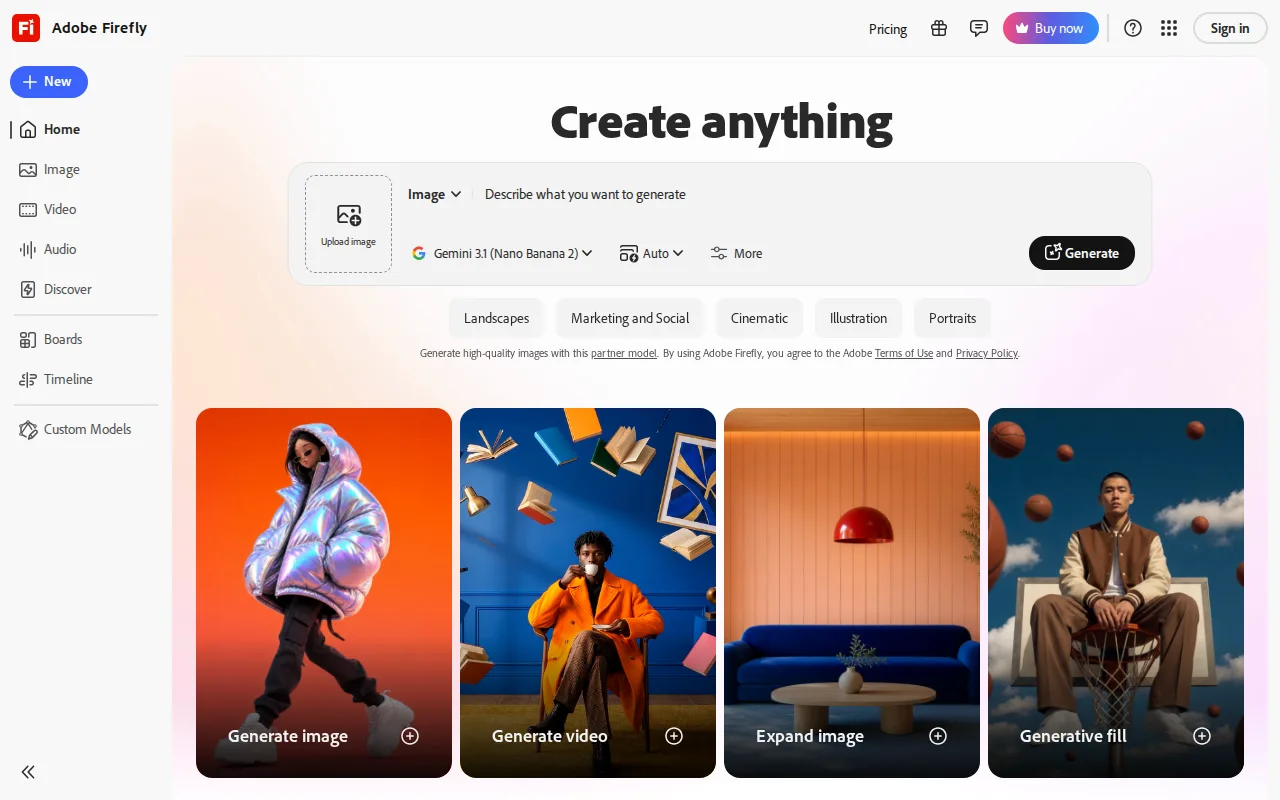
Adobe Firefly is the best FLUX alternative for designers and marketing teams who need generative image, video, and audio access built directly into Photoshop and Adobe Express, rather than FLUX's standalone API or self-hosted model. Firefly's pricing was verified on the live vendor site: Standard costs $9.99/month for 2,000 generative credits and Pro costs $19.99/month for 4,000 credits, both with fixed, published dollar amounts, unlike FLUX's Builder, Platform, Professional, and Enterprise commercial-licensing tiers, most of which require a sales contact to learn the real cost. Firefly holds a 4.5/5 rating from 19 Capterra reviews, giving buyers an independent signal FLUX has none of, and access spans web, Windows, macOS, iOS, and Android versus FLUX's web-only listing. FLUX is still the better choice for developers who want to self-host a model with no subscription or credit system at all: FLUX.1 [schnell] is free and Apache-2.0 licensed for unlimited commercial use on a team's own infrastructure, while Firefly's generative-credit system consumes credits unevenly across image, video, and audio, making monthly cost harder to predict, and heavy video users can be pushed to the $199.99/month Premium tier.
Compared to FLUX: published fixed-dollar pricing ($9.99/mo Standard, verified on site) vs FLUX's mostly sales-quoted commercial tiers, 4.5/5 rating from 19 Capterra reviews vs FLUX's zero ratings, native integration with Photoshop and Adobe Express
Wins:Standard tier is $9.99/month for 2,000 credits, a fixed and site-verified price, versus FLUX's mostly sales-quoted commercial tiers · 4.5/5 rating from 19 Capterra reviews, an independent signal FLUX has none of · Available on five platforms (web, Windows, macOS, iOS, Android) versus FLUX's web-only listing, plus native Photoshop and Adobe Express integration
Loses:No self-hosting option; FLUX.1 [schnell] can be run on a team's own infrastructure at no cost with no subscription · Generative-credit system consumes credits unevenly across image, video, and audio, making monthly cost less predictable than FLUX's per-second video API rate · Full value requires an existing or new Adobe subscription relationship, adding friction FLUX's standalone API and open weights don't have
Pros
- Trained on licensed Adobe Stock and public-domain content, with IP indemnification for enterprise use.
- Access to 30+ models, including third-party video models like Veo and Kling, in one interface.
- Deep integration with Photoshop (Generative Fill/Expand) and Adobe Express.
- Free tier available for testing before committing to a paid plan.
Cons
- Generative credits are consumed unevenly across image, video, and audio, making monthly cost hard to predict.
- Premium tier needed for unlimited access to the newest video models, at $199.99/month before discounts.
- Output quality on Firefly's own image model has lagged behind Midjourney and some third-party models in independent comparisons.
- Full value requires an existing or new Adobe subscription relationship, adding friction for non-Adobe users.
Pricing: Free tier · paid from $9.99/mo — $9.99/month Standard (verified) vs FLUX's mostly unpublished commercial licensing tiers (verified undefined NaN, NaN)
2.Ideogram — best FLUX alternative for designers and marketers who need AI-generated images with accurate, legible text inside them, like posters, logos, and social graphics
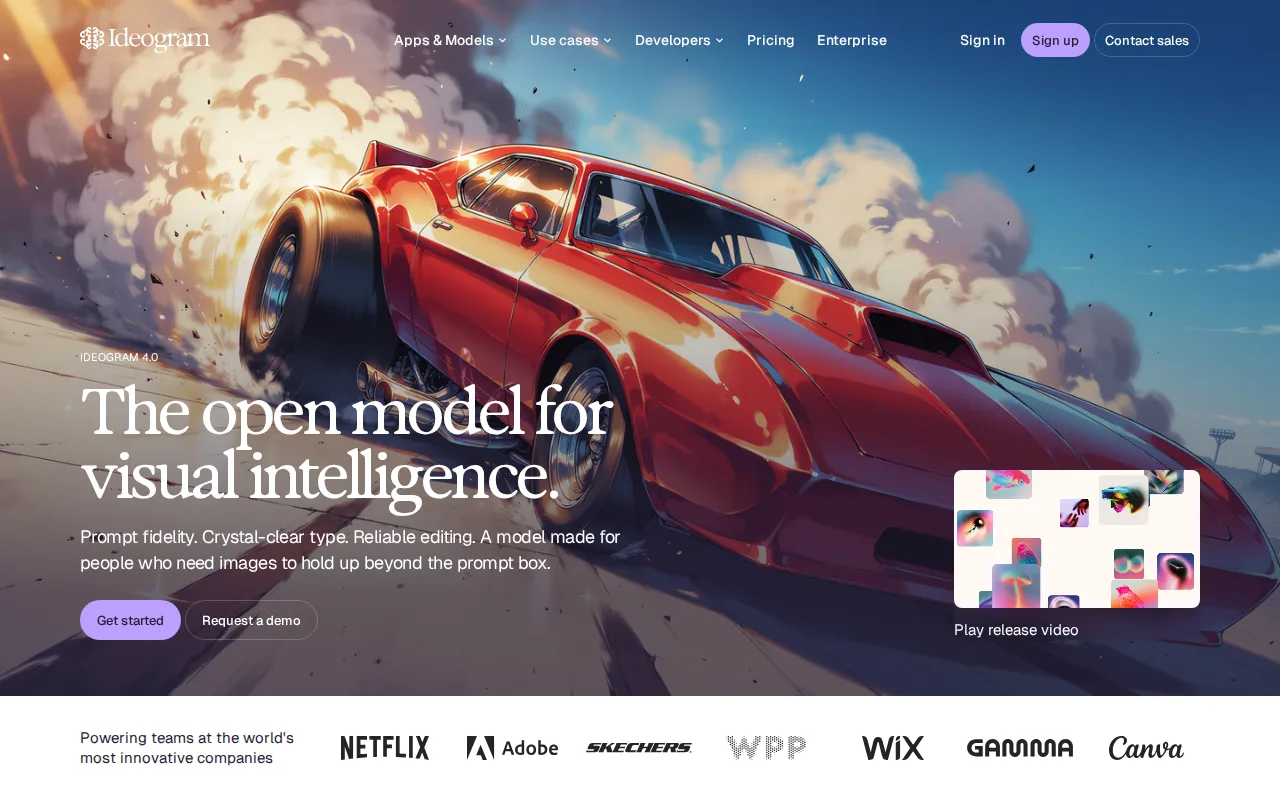
Ideogram is the best FLUX alternative for designers and marketers who need AI-generated images with accurate, legible text, like posters, logos, and social graphics, a capability FLUX's context doesn't document as a strength. Ideogram's pricing was verified on the live vendor site with published dollar amounts: Plus costs $15/month billed annually for 1,000 credits and Pro costs $42/month for 3,500 credits, both fixed prices, compared to FLUX's Builder, Platform, Professional, and Enterprise commercial tiers, most of which require a sales contact to learn the real cost. Ideogram's Free plan offers limited weekly credits at no cost, similar in spirit to FLUX.1 [schnell]'s free open weights, though Ideogram's free generations are public by default rather than self-hostable. FLUX is still the better choice for developers who want to self-host and fine-tune a model on their own infrastructure: FLUX.1 [schnell] is Apache-2.0 licensed for unrestricted commercial self-hosting, while Ideogram is a closed-source, web-and-API-only product with no desktop or mobile client and no option to run the model outside Ideogram's own servers.
Compared to FLUX: published fixed-dollar pricing ($15/mo Plus, verified on site) vs FLUX's mostly sales-quoted commercial tiers, purpose-built for accurate in-image text rendering, Team plan with centralized billing at $20/user/month
Wins:Plus tier is $15/month billed annually for 1,000 credits, a fixed and site-verified price, versus FLUX's mostly sales-quoted commercial tiers · Purpose-built for rendering legible, correctly spelled text inside generated images, useful for logos and posters · Team plan at $20/user/month adds centralized billing for organizations generating at volume, a structure FLUX's context doesn't offer
Loses:No self-hosting or open-weight option; FLUX.1 [schnell] can be run on a team's own infrastructure at no cost · Free-tier generations are public by default and credits are limited to weekly allotments that expire unused each billing cycle · No desktop or mobile app; web and API only, versus FLUX's option to self-host and fine-tune locally
Pros
- Text rendering inside images is meaningfully more reliable than most competing AI image generators.
- Character consistency lets users generate the same subject across multiple images.
- Multiple model versions and rendering-speed settings (Turbo/Balanced/Quality) let users trade credits for quality.
- Team plan adds centralized billing for organizations generating at volume.
Cons
- Free-tier images are public by default; privacy requires a paid plan.
- Monthly subscription credits expire unused at the end of each billing cycle.
- No desktop or mobile app; web and API only.
- Enterprise pricing is not published and requires a sales conversation.
Pricing: Free tier · paid from $15/mo — $15/month Plus (verified) vs FLUX's mostly unpublished commercial licensing tiers (verified undefined NaN, NaN)
3.Stable Diffusion — best FLUX alternative for developers and enterprises wanting a self-hostable, fine-tunable image generation model that's free under the Community License for small-scale or non-commercial use, rather than a closed API-only image generator
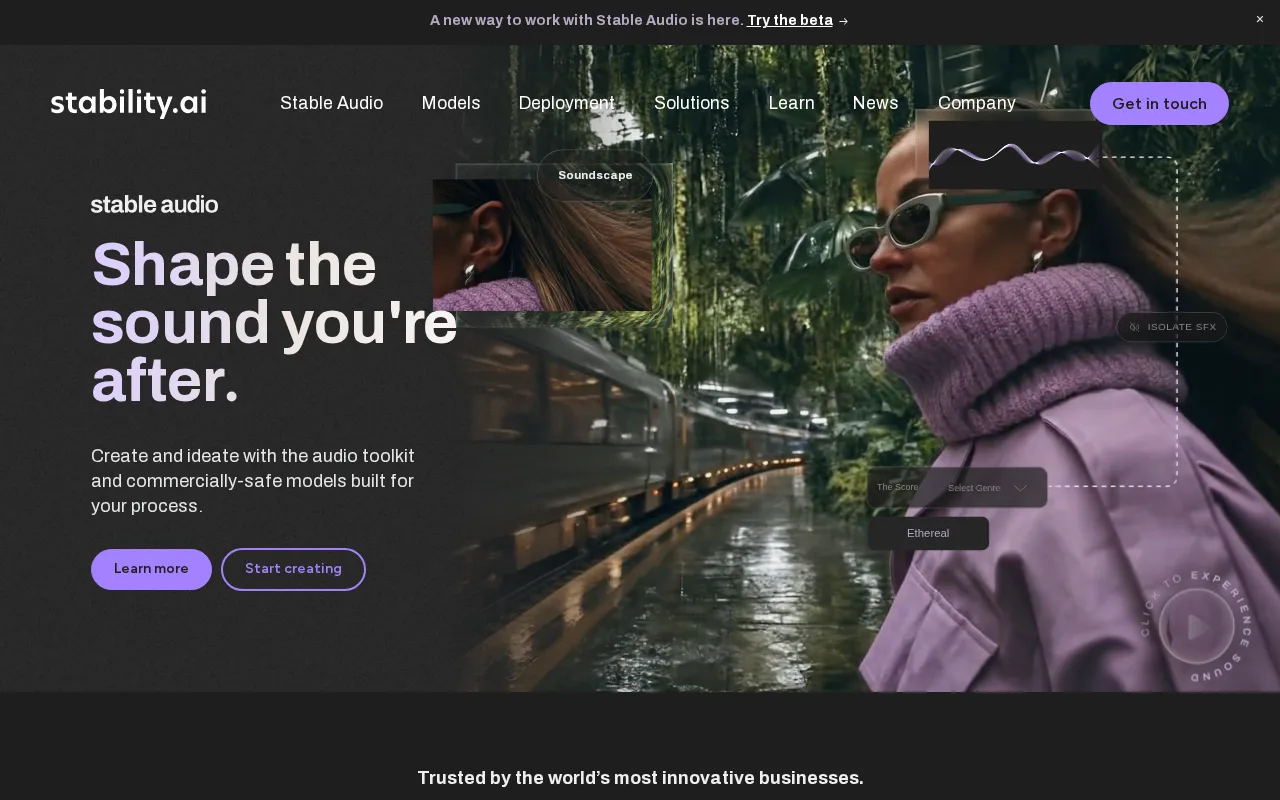
Stable Diffusion is the best FLUX alternative for developers and enterprises who want an open-weight model they can self-host and fine-tune without FLUX's split licensing between a free-but-restricted [schnell] model and a non-commercial [dev] model. Stable Diffusion's Community License is free for individuals, non-commercial use, and organizations under $1M in annual revenue, a broader free-use threshold than FLUX.1 [dev]'s non-commercial-only default, and it runs on four platforms (web, Windows, macOS, Linux) versus FLUX's web-only listing. Stability AI counts Electronic Arts, HubSpot, Mercado Libre, UMG, and Warner Music Group as named enterprise customers, evidence of production-scale adoption that FLUX's context doesn't document. FLUX is still the better choice for teams that specifically want a model licensed for unrestricted commercial use at any organization size with no revenue cap: FLUX.1 [schnell] is Apache-2.0, meaning even large commercial users can self-host it royalty-free, while Stable Diffusion's Community License requires a separately negotiated Enterprise License once an organization crosses $1M in annual revenue.
Compared to FLUX: broader free-use threshold (under $1M revenue vs FLUX.1 [dev]'s non-commercial-only default), available on four platforms vs FLUX's web-only listing, named enterprise customers documented (EA, HubSpot, UMG, Warner Music Group)
Wins:Community License is free for non-commercial use and organizations under $1M in annual revenue, broader than FLUX.1 [dev]'s non-commercial-only default license · Listed on web, Windows, macOS, and Linux, versus FLUX's web-only platform listing · Named production customers (Electronic Arts, HubSpot, Mercado Libre, UMG, Warner Music Group) document enterprise-scale use
Loses:Community License free tier ends at $1M in annual revenue, requiring a separately negotiated Enterprise License, whereas FLUX.1 [schnell] is Apache-2.0 with no revenue cap · Per-image Platform API pricing isn't transparently published, similar to FLUX's own unpublished image-API rates · Steep learning curve for self-hosting and fine-tuning, requiring GPU infrastructure and ML tooling knowledge
Pros
- Open model weights can be downloaded, self-hosted, and fine-tuned rather than accessed only through a closed API.
- Free under the Community License for individuals, non-commercial use, and organizations under $1M in annual revenue.
- Platform API and Brand Studio offer a managed path for teams that don't want to run their own GPU infrastructure.
- Named enterprise customers (Electronic Arts, HubSpot, UMG, Warner Music Group) demonstrate production-scale use.
Cons
- Self-hosting and fine-tuning require GPU infrastructure and ML tooling knowledge, a steep learning curve versus closed API tools.
- Community License free tier ends at $1M in annual revenue, after which pricing requires a sales conversation.
- Per-image Platform API and Brand Studio pricing isn't transparently published on the marketing site.
Pricing: Free